
Melon is a heat-loving crop of the cucumber genus and gourd family, considered to be native to Asia. However, it can be grown outdoors not only in southern regions but also in temperate and cold climates. This requires careful selection of the melon variety, proper planting, and proper care of the seedlings.
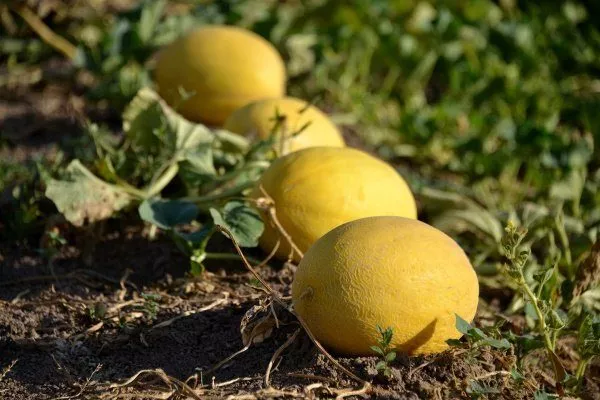
Melon varieties for open ground
Melon varieties should be selected depending on the region in which you plan to sow the seeds.
For the southern regions and the middle zone
| Name | Growing period (days) | Disease resistance | Fruit weight (kg) |
|---|---|---|---|
| Titovka | 55-70 | High | 1.5-2 |
| Early 133 | 60-79 | High | 1.5-2 |
| Pineapple | 70-80 | Average | 1.5-2 |
| Golden | 70-80 | High | 1.5-2 |
| Collective farmer | 79-95 | High | 1.5-2 |
| Blondie F1 | 80-85 | Average | 0.4-0.7 |
Gardeners often prefer the following varieties:
- TitovkaUltra-early maturing, with a growing season of 55-70 days. The fruits have a thin skin, which can be orange-yellow or pure yellow and orange. The flesh is dense and thick, white, and richly fragrant. Can withstand long-distance transportation.
- Early 133An early-ripening variety with a growing season of 60-79 days. It produces oval-round fruits covered in yellow skin. The flesh is thick, firm, and white, somewhat reminiscent of Titovka. The variety is highly resistant to fungal infections and tolerates transportation well.
- PineappleThis is a mid-early variety with a growing season of 70-80 days. The fruits are round-elongated, intensely orange, almost brown. The flesh is light pink, juicy, and quite sweet, with a subtle pineapple aroma.
- GoldenA mid-season variety that yields fruit 70-80 days after planting. The fruits are round and yellow-orange in color. The flesh is white with a strong melon aroma. This variety does not thrive in high humidity conditions, but tolerates diseases and weather fluctuations with low temperatures.
- Collective farmerLike Zolotistaya, this is a mid-season variety. Its growing season lasts from 79 to 95 days. The fruits are spherical, with orange-yellow skin and a fine mesh, and firm, light-yellow flesh. The melon has a delicate aroma and a moderately sweet flavor. It has a long shelf life and is suitable for processing.
All the listed varieties produce fruits weighing from 1.5 to 2 kg.
- Blondie F1A mid-season hybrid with a growing season of 80-85 days. The fruits are round and slightly flattened, with thin skin with a light beige tint and aromatic white flesh. They average 400 g in weight, but can reach 700 g under favorable conditions.
For northern regions
| Name | Growing period (days) | Disease resistance | Fruit weight (kg) |
|---|---|---|---|
| A Sybarite's Dream | 50-55 | High | 0.4 |
| Cinderella | 60 | High | 1.5 |
| Altai | 62-70 | Low | 1.5-2 |
| Wintering | 90+ | High | 2.5 |
In these conditions, it's best to grow varieties that are highly resistant to low temperatures. These include:
- A Sybarite's DreamAn early variety with a growing season of 50-55 days. The fruits are distinguished by their unique elongated shape and green striped skin. Each fruit averages 400 g. The crisp flesh has a whitish hue and a distinctive honey aroma and flavor. This variety is highly productive, produces fruit continuously until frost, and is rarely affected by disease.
- CinderellaAn early-ripening variety with a 60-day growing season. The fruits are round, with yellow skin with a raised, mesh-like pattern and white, juicy flesh with a rich aroma. Each melon averages 1.5 kg in weight. This variety tolerates temperature fluctuations and is highly resistant to various diseases and pests. Disadvantages include a short shelf life and poor transportability due to the extremely thin rind.
- AltaiAn early-ripening variety with a growing season of 62 to 70 days. The fruits ripen into an oval shape with an open yellow color. The flesh is very tender and literally melts into a bowl. It can be used for processing. This variety has excellent shelf life and is resistant to transportation, but is susceptible to various diseases.
- WinteringThis late-ripening variety has a growing season of over 90 days and is more suitable for cultivation in the Urals. The fruits ripen to a weight of up to 2.5 kg, with yellow-green skin and a coarse mesh. The flesh is light green, juicy, and tender. The variety is resistant to anthracnose and powdery mildew, and transports and stores well.
- ✓ Resistance to low temperatures during the growing season.
- ✓ Short growing season (up to 70 days).
- ✓ Ability to bear fruit in short summer conditions.
Many gardeners plant several varieties at once, creating a sort of varietal conveyor belt. This allows them to determine which varieties produce the best yields in specific climates and boast excellent marketability and flavor.
Sowing dates
Seeds should be sown only in well-warmed soil, as seedlings should not emerge before the last frost. Optimal sowing times can be determined by the region where the melon is grown:
- Steppe zone – from the end of April to the beginning of May;
- Forest-steppe zone – the second ten days of May;
- Polesia and Carpathian region – the third ten days of May.
Thus, for cultivation in the Forest-Steppe, it is worth choosing early-ripening and mid-ripening varieties, and in Polesia and the Carpathian region, only ultra-early-ripening ones.
In northern regions, melons are propagated using seedlings or by sowing dry seeds in open ground. The optimal time for sowing will depend on the specific growing method:
- SeedlingSeeds are sown for seedlings in the second half of April. The seedlings are transplanted into open ground 4-5 weeks after sowing. There's no need to rush transplanting, as it must be done once the weather becomes consistently warm.
- Dry sowing in the groundThis is done at the end of May, but only if the bed has been covered with plastic or other non-woven material throughout the spring. The cover is not removed during sowing. Small cross-shaped slits should be made in it for seeding.
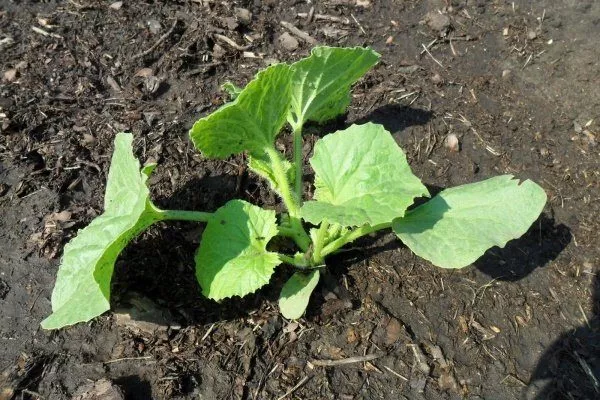
Site selection and preparation
Melons are heat-loving crops, so choose sunny, sunny locations for planting, as sheltered as possible from the wind. Nearby residential or outbuildings, nearby fruit bushes and trees, and side-crops like corn, sunflowers, or legumes planted in two rows around the perimeter of the melon bed can provide protection from drafts.
The best predecessors for melon, from the point of view of crop rotation, are:
- cucumbers;
- onion;
- garlic;
- cabbage;
- corn;
- herbs;
- winter cereals;
- peas;
- beans.
Melon cannot be planted in an area where the following crops were previously grown:
- pumpkin;
- tomatoes;
- carrot.
Melons don't do well near potatoes and cucumbers, but they can thrive near turnips, basil, radishes, and horseradish. However, the location of melon cultivation should be rotated annually, as it's impossible to get a good harvest from the same plot two years in a row.
It is possible to return the melon to its previous growing location without reducing its yield in the 5th year.
Melon produces a good harvest in light, medium-loam soils with neutral pH. It can also be grown in saline soils, but heavy, waterlogged beds are unsuitable.
The selected area with soil favorable for melons should be prepared in the fall, adhering to the following rules:
- In the fall, dig the bed shallowly to the depth of a spade, adding 4-5 kg of humus or manure per square meter as fertilizer. If the soil is clayey, it should also be dried out by adding 1/2 bucket of river sand per square meter. Leave the bed as is until spring.
- When spring arrives, dig the area again and sprinkle it with dry peat or wood ash to speed up snow melting. Then, cover the area with plastic or non-woven material to ensure maximum soil warming.
- When the surface layer of soil warms up to +13°C, perform deep loosening, adding superphosphate (40 g per 1 sq. m) and potassium salt (20 g per 1 sq. m).
Immediately before planting, dig up the area again and add nitrogen fertilizers at a rate of 15-20 g per 1 sq. m.
Preparing seeds for sowing
Melon seeds can be purchased at the store or harvested at home. In either case, to ensure a good harvest, use seeds that are 3-4 years old. Fresh seeds can grow into a strong and vigorous plant but fail to produce fruit. This is because such a plant may be sterile, producing only male flowers without fruit.
The selected seeds can be prepared in one of the following ways:
- Soak for 20 minutes in a weak solution of potassium permanganate. During this process, remove any empty seeds that float to the surface.
- Soak the seeds for 12 hours in a solution of boric acid and zinc sulfate. After soaking, rinse the seeds under cool water and dry.
- Soak the seeds in hot water (up to 35°C) for 2 hours, remove them, and keep them at a temperature of 18–20°C for 24 hours. Then, move the seeds to the bottom compartment of the refrigerator for 16–18 hours, then return them to a warmer place for 6 hours. The prepared seeds should be planted immediately.
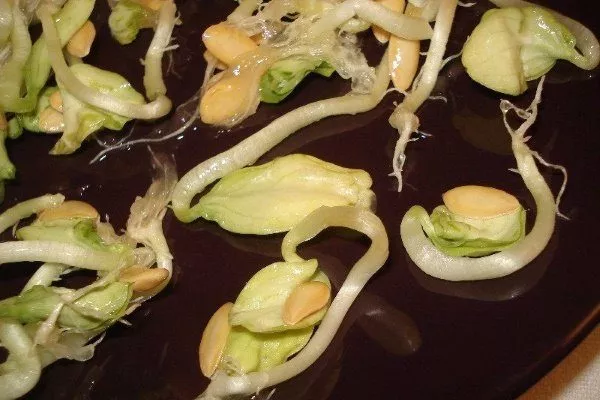
Many experienced gardeners use a third technology for hardening seeds, which is called the temperature method.
Planting methods
Gardeners use two methods for growing melons: seedlings or direct sowing in open ground. Each method has its own rules and characteristics, so it requires separate consideration.
Dry sowing in open ground
Prepared seeds are planted in open ground, observing the following parameters:
- planting pattern – 140x70 cm;
- sowing depth – 4-5 cm;
- the number of seeds for one hole is 3-4 pieces.
You can also add fertilizer to each hole—a handful of humus or 1 teaspoon of nitrophoska. After sowing, cover the soil with soil and press lightly with your foot. The seeds will germinate vigorously at temperatures above 15°C. During the growing season, the temperature should be above 25°C with relatively low humidity.
As a rule, seedlings appear 10-12 days after sowing the seeds.
Through seedlings
This method allows you to speed up the ripening of fruits by 15-20 days.
Sowing seeds
The seeds are sown for seedlings in the last days of April, following these instructions:
- Select containers for growing seedlingsTo get a good melon harvest, it's crucial not to damage the root system when transplanting the seedlings into open ground. To achieve this, sow the seeds in peat pots approximately 10 cm in diameter.
- Prepare the soilGarden soil should be mixed with loose humus. Add 0.5 liters of ash to a bucket of this mixture. For heavy soil, peat should also be added. The prepared substrate should be steamed, then fertilizer should be added: 1 teaspoon of potassium sulfate and 1 tablespoon of superphosphate. Another alternative is a mixture of peat and sand in a 9:1 ratio. For 10 liters of this soil, add a cup of woody zone fertilizer. Some gardeners also prefer to use store-bought garden soil.
- Sow the seedsFill plastic or cardboard pots with the resulting substrate, then plant two seeds in each. The optimal planting depth is 1.5 cm.
Caring for seedlings
After sowing, cover the seedling pots with plastic wrap and keep them at a temperature of 20 to 25°C during the day and 18 to 20°C at night. It's best to grow seedlings in a greenhouse or hotbed, but if these conditions aren't available, the pots can be placed on a windowsill or anywhere that can be illuminated by a fluorescent lamp. The lamp should be positioned 15 cm above the seedlings. Turn it on in cloudy weather and in the evening to provide additional light.
Water the seedlings sparingly, otherwise excess moisture will cause the root collar to rot. Avoid allowing water to come into contact with the stems. To prevent this, shape the soil around them into a cone.
During the plant's development period, two types of fertilizer should be applied:
- When the first true leaf appears on the seedlings. Feed with a solution of mullein (1:10) or bird droppings (1:15) with the addition of 1 tbsp. of superphosphate.
- 2 weeks after the first feedingApply mineral fertilizers, such as Rastvorin or Kemira Universal. Follow the instructions on the packaging.
Once three pairs of true leaves have formed, the tops of the seedlings should be carefully pinched to encourage the growth of lateral shoots. Additionally, when two or three true leaves appear, the seedlings should be thinned out, leaving only the most developed one.
If seedlings are grown on a windowsill, it's also worth hardening them off. This requires gradually acclimating the seedlings to natural weather conditions 10-15 days before planting them in the ground. Initially, regularly ventilate the room, and then temporarily move the seedlings to the balcony or garden, increasing the duration of each exposure. Place the seedlings in light partial shade to protect them from sun damage.
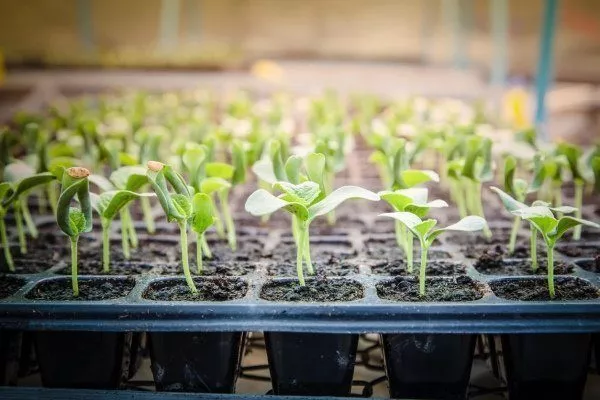
It takes 30-35 days for a fully grown seedling to grow. The seedling is ready for planting when it develops 4-5 true leaves.
Transplantation into the ground
This shouldn't be done during frosts. These can persist until early summer, so transplant the seedlings in early June, following these instructions:
- In a pre-prepared area, create raised beds (10-15 cm). For single-row planting, the width between beds should be 0.3-0.4 m, and for double-row planting, the width should be 0.9 m.
- Moisten the soil in each hole and fertilize with humus or 10-15 g of nitrophoska.
- Water the pots with melon seedlings to easily remove the plant without damaging the root system.
- Move the plant to the center of the hole and fill it with soil up to the root collar, which should remain at ground level. Lightly moisten the soil again.
For 2-3 days, protect the seedlings from sunlight by creating shade to help them establish better. If there are significant temperature fluctuations between day and night, cover the planted plants with plastic film. It's best to use arches about 0.7 m high and wide. If the temperature drops unexpectedly, you can additionally cover the film with old plastic or any other material that will prevent the air from becoming too cold.
In sunny weather, it's a good idea to open the plastic film to allow the plants to ventilate. This is typically done around June 20th. This is when flowering occurs, so pollination requires allowing insects access to the flowers.
Basic rules for caring for seedlings
During the period of fruit formation and development, proper care is essential. Let's take a closer look at what this involves.
Loosening and hilling
Regular loosening ensures oxygen reaches the plant's roots. During the first two cultivations, loosen the soil between rows to a depth of 10-15 cm, and subsequently, no deeper than 8-10 cm. Avoid disturbing the soil near the stems to avoid damaging the root system.
When loosening the soil, carefully remove weeds. In southern regions, after fruit set, a few weeds can be left to create shade and protect the melon from sunburn.
As soon as lateral branches begin to develop, the seedlings should be hilled. Mechanical tillage should be stopped when the foliage closes. At the same time, the growth of the shoots should be regulated, guiding them in the desired direction so that they do not fall into the row spacing.
Watering
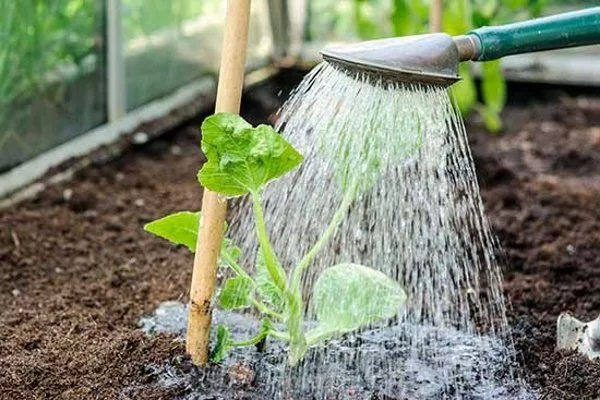
Moisten the soil before planting moderately and once a week. For watering, use warm water heated in the sun to 23°C. To prevent drips from falling on leaves, stems, flowers, and ovaries, dig a ditch around each plant or use drip irrigation.
The soil should never be over-watered, as this will cause the plant's root system to rot and prevent a bountiful harvest.
Once fruit begins to appear, watering should be gradually reduced until no watering is needed at all. This will increase the sugar content of ripe melons. Another trick worth considering is to place a piece of plywood or board under each fruit that has set, otherwise there's a risk of it rotting when it comes into contact with damp soil.
Topping
The first time is done when growing seedlings. After planting the seedlings in open ground, pinching should be repeated as they adapt. This procedure helps limit the development of the vegetative mass of the fruit, which is necessary for a full harvest.
Initially, pinch back the main shoot and leave 2-3 side shoots. If you're growing hybrid varieties, there's no need to pinch back the main shoot, as it contains the female flowers. Side shoots should be pinched back at the level of the second pair of leaves.
Additionally, it's worth removing all excess flowers, leaving only 2 to 6 fruit buds per bush, spaced apart rather than adjacent to each other. Fruitless shoots should also be removed to prevent them from draining the main stem.
Top dressing
Before the leaves close, you can apply 2-3 additional fertilizers:
- Two weeks after planting the plant in the ground, add fertilizer in the form of ammonium nitrate, chicken manure or mullein.
- After 10 days from the first feeding or at the budding stage, feed the plant with a solution of organic fertilizers at a ratio of 1:10.
- Three weeks after the second feeding or during the melon ovary growth phase, feed the plant with a solution of phosphorus-potassium fertilizers at a rate of 50 and 20 g per bucket of warm water.
Once the fruits begin to ripen, there is no need to apply fertilizers anymore.
Pests and diseases
Failure to properly cultivate melons in open ground can result in the plant becoming susceptible to various diseases, the most common of which are:
- FusariumCaused by fungi, it reduces the yield and flavor of melons. It manifests itself as a sudden lightening of the leaves, which take on a gray tint and become covered in spots. Within a few days, the plant rapidly wilts and dies. The plant is infected through the root system, and the risk of an epidemic increases when melons are grown in the same area two years in a row. To save the melon at the budding stage, the plant should be treated with a concentrated solution of potassium chloride, and the affected leaves should be collected and burned. As a preventative measure, adhere to the following measures:
- do not plant the crop in the same bed for 6-7 years;
- Before sowing, soak the seeds for 5 minutes in a 40% formalin solution;
- water the beds evenly, avoiding excessive soil moisture;
- loosen irrigation furrows.
- Powdery mildewThis fungal disease often leads to plant death. Bluish-white spots appear on the leaves, stems, and vines, eventually turning brown. Eventually, the leaves dry out and die, shoot growth slows, and fruit development is halted. To combat powdery mildew, the beds should be treated with sulfur powder at a rate of 4 g per square meter. Repeat the treatment every 10-12 days until 20 days before harvest.
- Anthracnose (scarden)The disease manifests itself as pinkish-brown spots and holes on the leaves, brittle stems, and fruit deformation and rotting. To combat anthracnose, apply 3-4 treatments of the plant with Bordeaux mixture.
- PeronosporosisWhen infected with this disease, yellow-green spots appear on the leaves. To get rid of them, spray the plant with a urea solution (1 g per 1 liter of water).
The plant can also become infected with viral diseases such as cucumber or watermelon mosaic. In these cases, affected seedlings must be destroyed, as they are incurable.
When grown outdoors, melons are also at risk from various insect pests, including aphids, spider mites, wireworms, cutworms, and tobacco thrips. To repel them, young seedlings should be treated with systemic insecticides, and mature plants with contact insecticides. Popular products among gardeners include Fufanon, Confidor Maxi, Actellic, and Fitoverm.
Harvesting and storage
The harvest is collected as the fruits ripen, which will be indicated by the following signs:
- easy separation of fruits from the vine;
- color that matches the variety;
- a dense network of cracks that evenly covers the peel.
Ripe melons should be consumed within 30-40 days. Fruits that are only half-covered with netting are suitable for storage. They should be stored in a cool cellar, barn, garage, or any other area where the temperature is around 4°C and the humidity is up to 70%. Some varieties can be stored for up to 6 months.
Video: An example of growing melons in open ground
In the following video, an experienced gardener shares the secrets of growing melons outdoors:
Growing melons outdoors is not difficult, but it does require following a number of important rules and nuances. Although this crop originates from the south and thrives in warm conditions, it can be grown even in harsh climates simply by choosing a cold-resistant variety. Of course, regardless of the weather, a good harvest requires a competent approach to both preparation and care.