
Blueberries are one of the most delicious and healthy berries, widely used in cooking and medicine. There are several species of blueberries in nature, differing in bush height, berry color, and other characteristics.
Description and distribution area
Blueberries belong to the extensive Ericaceae family and the genus Vaccinium, which includes berry bushes such as blueberries, lingonberries, and cranberries. In a favorable climate, a blueberry bush can grow and bear fruit for 50 years or more.
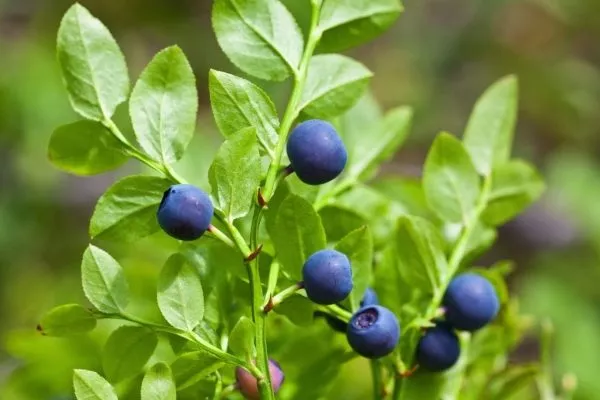
General description of blueberries:
- bush height - from 10 to 50 cm;
- shrub type - spreading-branched;
- leaves are leathery, glossy, bright green;
- leaf size (LxW) - 2.5x1.3 cm;
- rhizome - creeping, with many shoots;
- flowers - white;
- fruits are dark blue or black;
- The pulp is juicy, sweet, elastic, with small seeds (color depends on the type).
- ✓ The soil should be acidic, with a pH of 4.0-5.0, to ensure optimal growth and fruiting.
- ✓ The presence of mycorrhiza in the soil is essential for blueberries, as the plant forms a symbiosis with fungi, which is critical for its nutrition.
The blueberry taste is balanced and refreshing, with a harmonious combination of sweetness and acidity.
Blueberries prefer to grow in coniferous and mixed forests, swampy birch forests, and in the highlands and tundra of Europe, Asia, and North America. The exact origin of blueberries is unknown, but they are believed to originate in Siberian and Far Eastern forests.
Types of blueberries
Blueberries grow all over the world in favorable climates, so it's no surprise that they come in numerous varieties. Below are the blueberry species most common in Russia, Belarus, and Ukraine.
| Name | Bush height (cm) | Fruit color | Pulp color |
|---|---|---|---|
| Common blueberry | 10:40 | Dark blue or black | Purple |
| Caucasian blueberry | up to 300 | Blacks | Not specified |
| Blueberry oval-leaved | up to 150 | Dark blue or black | Red |
Common bilberry or myrtle-leaved bilberry
The common bilberry is a low shrub with edible berries. It is also known as the myrtle-leaved bilberry (Vaccinium myrtillus). The plant received this name for its resemblance to myrtle. The Russian version of the name, "bilberry," comes from the color of the berries, which blacken the mouth and hands.
This berry is widely used in cooking, for winter preserves, freezing, making jelly, etc. It is also actively used in medicine, especially in ophthalmology – blueberries are considered the most beneficial berry for the eyes.
Description of common blueberry:
- bush height - 10-40 cm;
- leaves are ovoid, dense, shiny, light green, with finely serrated edges and pointed tips;
- root - creeping, with numerous layers;
- flowers are single, white, with a greenish tint, 5-toothed, 5-7 cm long;
- fruits are dark blue with a waxy coating or black, spherical, 5-8 mm in diameter;
- The pulp is purple, with many small seeds (up to 40 pieces).
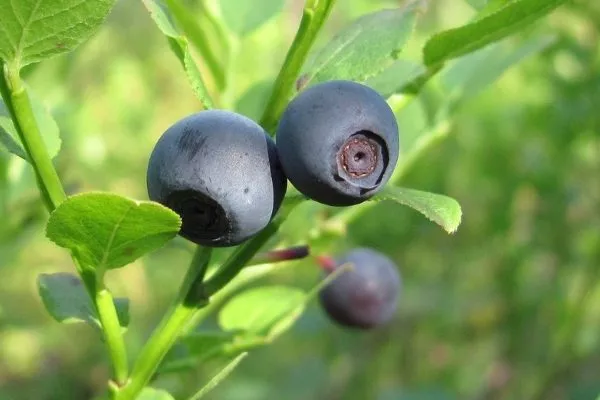
The grooved leaves are designed so that during rain, water is channeled through them to the deep-grooved branches, where it flows directly to the roots. In winter, blueberry leaves fall off.
- ✓ The leaves of the common blueberry have a grooved structure to drain water directly to the roots.
- ✓ The flowers are tilted downwards to protect the pollen from moisture, which is a unique adaptation to growing conditions.
The common blueberry blooms in May. The flowers have a single pistil and 10 stamens. They are tilted downward to protect the pollen from moisture. The main pollinators of blueberries are honeybees and bumblebees.
Blueberries reproduce vegetatively and by seed. In nature, they are found primarily in coniferous forests and marshy areas.
Caucasian blueberry
This species of blueberry is common in the Balkan-Asian region, as well as in the Transcaucasus. It most often grows in mixed forests (fir-spruce and fir-beech) and rhododendron thickets. Less commonly, the Caucasian blueberry (Vaccinium arctostaphylos) is found in pine and birch forests.
Unlike the common blueberry, the Caucasian variety is a large shrub or even a small tree. The plant has rounded branches, and the young shoots are hairy.
Brief description of Caucasian blueberry:
- height of shrub/tree – up to 3 m;
- kidneys - pointed;
- leaves - large, membranous, oval, pointed at the end and tapering towards the base, with short petioles and finely serrated edges;
- flowers are white and red, collected in brushes, with long peduncles;
- The fruits are black spherical berries.
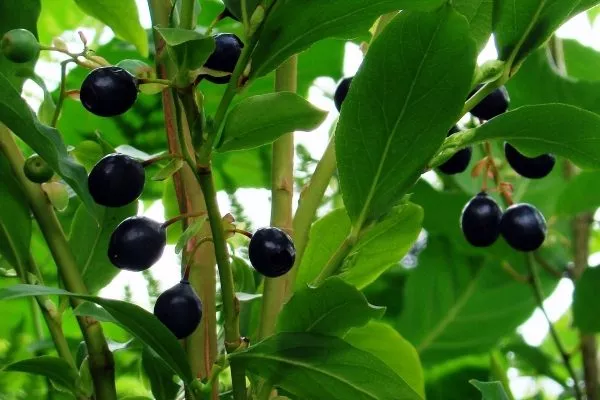
The berry ripens in July and August. It's easy to pick, as the fruits are gathered in clusters of 2-6. The berries are used as a tea substitute, dried, eaten fresh—they taste similar to common blueberries—and used to make jelly and decoctions.
Caucasian blueberries can be grown commercially and for private use. They are recommended for growing in acidic soils. If the soil is insufficiently acidic, they should be watered periodically with acidified water: 1 g of sulfuric acid diluted in 100 liters of water.
This blueberry variety requires a moist microclimate, so it's best to plant the bushes in the shade. In dry weather, it's advisable to mist them with soft, warm water.
Blueberry oval-leaved
The oval-leaved bilberry (Vaccinium ovalifolium) is also known as the Amur blueberry. This species is found in North America, Japan, Sakhalin, and the Russian Far East. The berry prefers moist and swampy areas. It can be found in spruce-fir forests, forest edges, and mountain slopes. This berry is endemic to the Commander Islands.
The species is a fairly large, spreading shrub. It has smooth, sharply ribbed green branches and deciduous leaves. In autumn, the green foliage turns red and crimson.
Brief description of the oval-leaved blueberry:
- bush height - up to 1.5 m;
- leaves are oval, with small teeth, 2-5 cm long, matte, light green;
- flowers are pink, up to 6 mm long;
- fruits are dark blue or black, often with a waxy coating, spherical, up to 1 cm in diameter;
- the pulp is red and sweet.
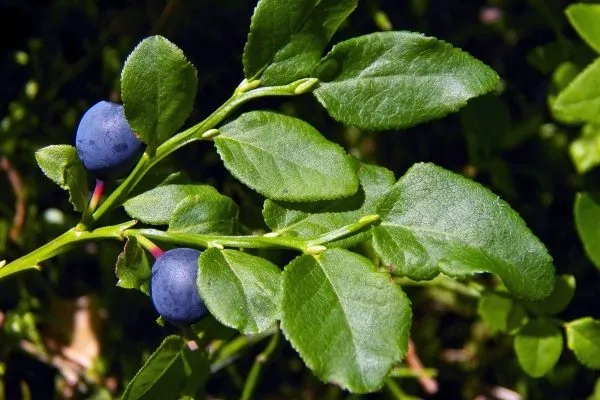
Caucasian blueberries bloom in late May or early June, and the fruits ripen in August or September—the timing depends on the region and the current weather.
Caucasian blueberry is used primarily as a medicinal and ornamental plant. It is widely used in folk medicine as an anti-inflammatory agent.
The oval-leaved blueberry is rarely used in cooking, although its berries are edible. However, for the indigenous peoples of Japan and North America, this plant is a traditional ingredient in many dishes and drinks.
Varieties of blueberries
Blueberries get their name from their black fruit, but there are varieties of this berry with a completely different color. These include, first and foremost, the krasnika, as well as the white blueberry, recently discovered in the Bryansk forests.
| Name | Fruit color | Bush height (cm) | Peculiarities |
|---|---|---|---|
| Red | Bright red | 10-12 | Specific smell |
| White | White | Not specified | Sweet taste |
Red
Vaccinium praestans, or raspberry, is a creeping shrub. This berry is often called "smokeberry" or "bugberry."
The saffron berry blooms in June or July, and the berries ripen in August or September. It prefers to grow in swamps, mixed forests, and moss beds. It is common in the mountain taiga regions of Khabarovsk and Primorsky Krai, and is also found in Kamchatka, Sakhalin, the Kuril Islands, and Japan.
Brief description of the smokehouse:
- bush - small in height, usually buried in moss and rising above it by 10-12 cm;
- leaves - collected in bunches of 3-5 pieces, round, tapering towards the base, 2-6 cm long, hard, with finely serrated edges;
- flowers are pinkish, 5-6 mm long, collected in 2-3 pieces at the base of the leaves;
- The fruits are spherical, bright red, glossy, with 10-15 seeds.
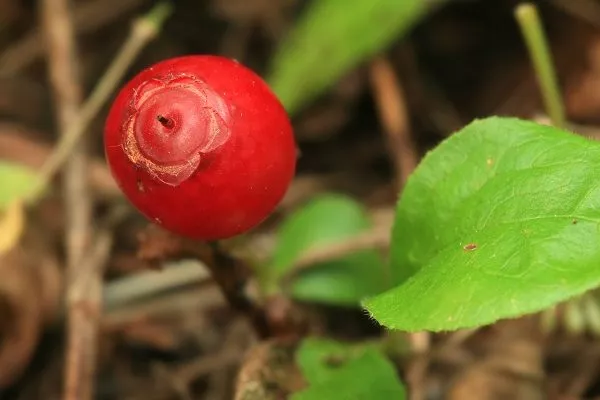
The taste of the krasniki berries is sweet and sour, and the flesh is juicy. A distinctive feature is the unpleasant, specific smell, which is why this berry is called "bug-like."
The berries contain many flavonoids, ascorbic and benzoic acids, and other active substances. They are used to treat colds and digestive disorders. The fruits also have a tonic effect and reduce high blood pressure.
The saffron berry is considered an excellent honey plant and pollen producer. Honey yield per hectare is 10-20 kg. Saffron berries are edible, but they are rarely consumed uncooked due to their unpleasant odor. An interesting feature of the saffron berry is that its juice does not spoil for a long time due to benzoic acid.
White
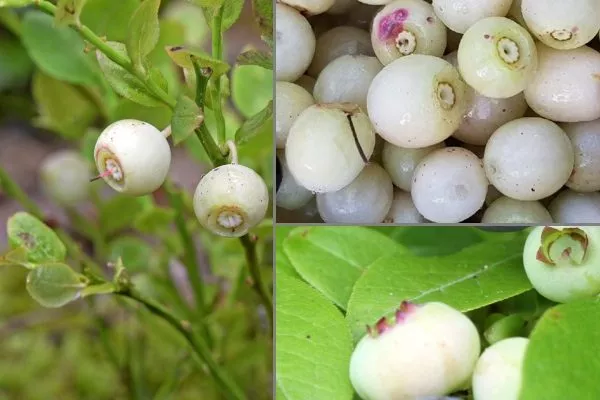
Not long ago, white blueberries were discovered in the protected forests of the Bryansk region. Apparently, this berry has been growing in the reserve for several years, but is very rare. It can be seen alongside ordinary blueberry bushes.
Interestingly, while strikingly different in color from traditional berries, white blueberries taste very similar. Those who have tasted white blueberries claim they are sweeter than black berries. Aside from their color, albino blueberries are indistinguishable from regular blueberries.
Chemical analysis of white blueberries revealed that they contain:
- fructose - 49.3 g/kg;
- glucose - 36.1 g/kg;
- sucrose - 5.1 g/kg.
An interesting feature of white blueberries is their high potassium content. They contain 1,480 mg/kg, while regular black berries contain almost three times less potassium—510 mg/kg. Potassium is known to be a vital micronutrient for the cardiovascular system.
Another difference between white and black blueberries is that they are almost twice as heavy.
Uses of blueberries
Blueberries are of significant economic importance. They are harvested en masse using specialized equipment and then sold or processed. In areas where they grow abundantly, blueberries are a significant source of income for local communities.
Where and how blueberries are used:
- In medicine. Maintains visual acuity and the ability to see in low light. The berry is beneficial for the kidneys, liver, bladder, and gallbladder. It removes waste, toxins, and radiation from the body, normalizes weight, improves mood, and overall health.
- In cooking. Blueberries are used to make jams, preserves, liqueurs, kissels, and pie fillings. They are also preserved for the winter by mashing them with sugar, drying them, and freezing them.
- In beekeeping. Blueberries are considered a potent honey plant and produce abundant nectar. Honey collected from blueberry plantations has a slightly reddish tint.
- In light industry. Blueberries contain a natural dye that is used to dye wool and canvas in red and purple shades.
Blueberries are highly recommended for children, as well as for people who work as drivers, pilots, and those who spend a lot of time at the computer.
Blueberry diversity is not limited to the species discussed above; other, lesser-known varieties also exist. One thing is clear: all blueberry varieties are unique in their properties and are not only a valuable food product but also an effective healing agent.