
The Producer watermelon variety is highly prized by both farmers and consumers. It is grown primarily in southern regions, but its early ripening allows for harvesting in colder climates. This article explains the steps to take during planting, care, and harvesting.
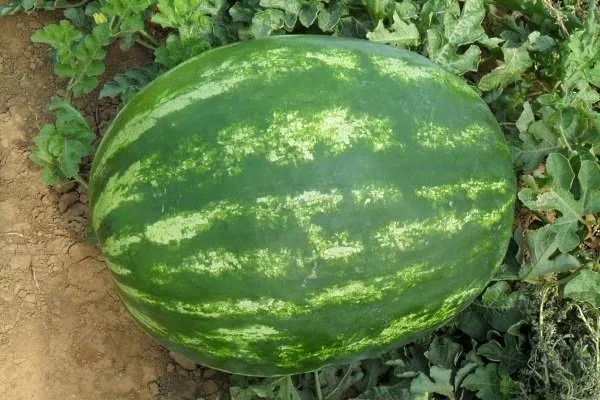
Watermelon variety "Producer"
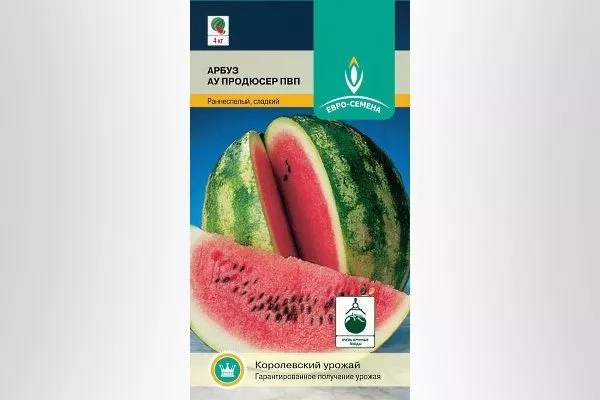
watermelon seeds, variety "Producer"
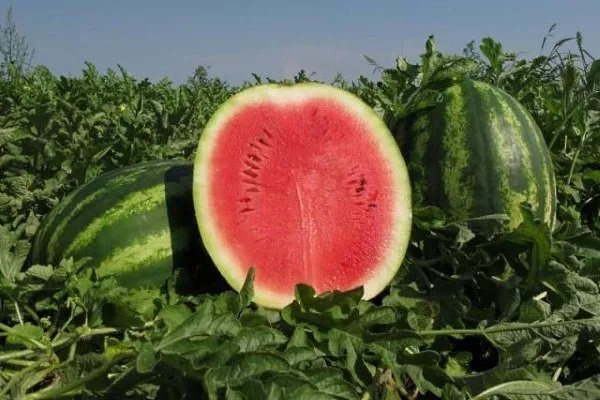
The flesh of a ripe watermelon "Producer" is very sweet and contains a large amount of sugar.
History of selection
The berry's global distribution began in Egypt. The Producer variety was later refined in the United States. It is an improved version of a popular watermelon variety. Crimson Sweet.
As a result of selective breeding work, it became possible to grow it both in industrial conditions and in private farms – the shelf life has increased while maintaining the same taste qualities.
Description and characteristics of the Producer variety
The Producer variety is early maturing and is distinguished by its high yield.
Description:
- Stems. Medium-long. Leaves are grey-green, moderately dissected.
- Berry. Oval in shape, smooth, without dents or roughness, has a characteristic shine.
- Pulp. Red, grainy, crisp, juicy, with a high sugar content (12%), and no veins. The seeds are located near the bark, dark brown, and relatively few in number.
- Crust. Not thick, reaching 1 cm when ripe. Color – almost white with a greenish tint.
Berries are considered a dietary product and have medicinal properties. They are consumed primarily fresh, but are also suitable for canning, making drinks, and desserts.
Table of characteristics of the Producer variety:
| Growing season, days | Fruit weight, kg | Yield, c/ha | Seed germination, % | Transportability | Purpose |
| 65-75 | 8-18 | 105 | 90-99 | high | for fresh consumption |
Regional distribution
Today, the Producer watermelon is grown in southern Russia (the Caucasus, Krasnodar Krai), Belarus, Moldova, Ukraine, Kazakhstan, and Tajikistan. Greenhouse cultivation with irrigation systems is also possible in temperate climates.
What are the benefits of watermelon?
The main advantages of the variety include:
- early ripening;
- large size;
- high taste qualities, aroma;
- good ripening;
- disease resistance;
- high transportability properties;
- high shelf life of the crop.
What are the disadvantages of the Producer?
The disadvantages include:
- demanding of growing conditions (microclimate, irrigation);
- ripening depends on weather conditions;
- may not be fully ripe inside.
Watch a review of the Producer watermelon in the video below:
Preparatory work
Preparatory work before planting will include several stages.
Site selection and preparation
Yield depends largely on the site where the watermelon will be grown. It must meet the following requirements:
- Illumination. Choose an open area without shade.
- Priming. Sandy and sandy loam soil with an acidity of pH = 6.7-7.0 is best suited.
- Groundwater. Set aside a raised area for the garden bed, where the groundwater does not come close to the surface.
- Predecessors. Good predecessors for watermelon are: cabbage, legumes, onions, wheat, alfalfa.
- ✓ The optimal depth of the root zone should be at least 60 cm to ensure sufficient space for the development of the root system.
- ✓ The organic matter content in the soil should be at least 2% to provide nutrients.
It is not recommended to grow watermelon in an area where melons were grown.
Seed preparation
Preparing seeds for planting follows the same pattern and does not depend on the planting method.
The best germination is observed in seeds stored for 3-5 years.
Preparation stages:
- Calibration. Sort the seeds by size.
- Soak. Prepare a salt solution (1 teaspoon of table salt per 1 cup of water) and soak the seeds in it. Let sit for 10 minutes. Discard any that float to the top. Dry any that sink to the bottom.
- Warming up. Warm the collected material for 20-30 minutes using hot water at 50-60°C. This process disinfects the sample.
- Re-soaking. Prepare a 1% potassium permanganate solution. Soak the seeds in it for about 20 minutes. This method helps prevent fungal diseases.
- Germination. Spread the prepared seeds on damp cheesecloth folded in several layers. Once the sprouts appear, they are ready for planting.
Rules for landing
The main criterion for planting is the temperature regime:
- if the soil temperature is below +12 °C, the watermelon will not grow;
- the minimum soil heating temperature should not be lower than +14 °C;
- The optimal temperature conditions are heating up to +20-25 °C.
Growing methods
There are 2 ways to grow Producer watermelon.
Seedlings
In the central and northern regions, it's best to plant seedlings to ensure watermelons have time to ripen during the short summer. Gardeners in the southern regions can also use this method, but watermelons will also grow well in open ground.
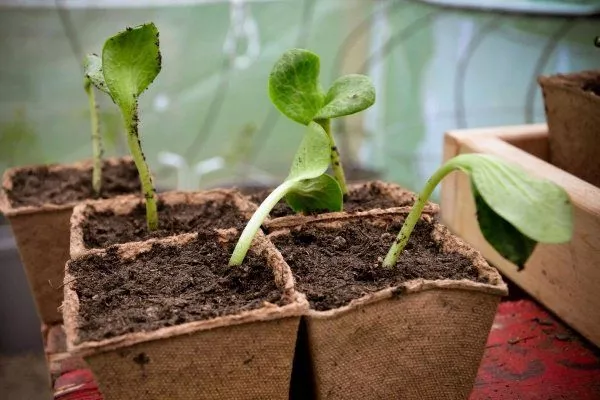
Planting dates
For seedlings, seeds are sown starting in mid-April. This way, by the end of May, the seedlings will be well formed and strong enough for planting in open ground.
Planting technology
Planting is carried out in peat pots.
Subsequence:
- Preparing the soil. You can buy a specialized soil mixture for seedlings or prepare it yourself:
- Option 1: mix turf soil and humus in a ratio of 1:3.
- Option 2: mix peat, sawdust and humus in a ratio of 3:1:0.5.
- Preparing the pots. To grow watermelon, prepare the required number of peat pots, at least 6x6 cm in size. Fill them with potting soil.
Using peat pots prevents damage to the root system when transplanting into the ground.
- Planting depth. In each pot, make holes in the soil to a depth of 4-5 cm.
- Planting seeds. Sow the seeds, previously germinated in cheesecloth, into peat pots. Cover the seeds with soil, but do not compact them.
- Soil moistening. Moisten the soil well, but do not overwater.
Caring for seedlings
Further care includes:
- Creating a mini-greenhouse. Cover the planted plants with polyethylene or glass and place them in a well-heated sunny place.
- First shootsIt will take about a month for the first shoots to appear. Once they appear, remove the covering and place the seedlings in the sun.
- MoisturizingMake sure the root ball stays moist. Don't let it dry out or become overwatered.
- HardeningBegin hardening off the seedlings 10 days before planting. To do this, take them outside every day. On the first day, leave them outside for 1 hour. Gradually increase this time to a full day in subsequent days.
Planting seedlings in the ground
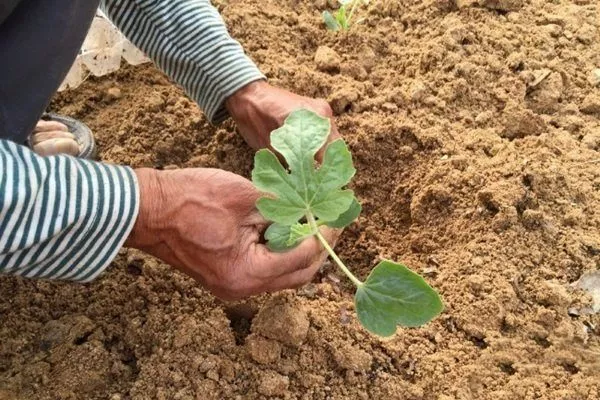
Seedlings can be planted in open ground or a greenhouse after 3-5 true leaves appear.
Step-by-step process:
- Dig holes. Their depth should completely accommodate the peat pot.
- Plant the sprouts. Place the watermelon sprouts and the cup into the holes.
- Cover with soil. Cover the seedlings with soil, compact the soil around them, but without applying excessive force.
- Water the sprouts. Moisten the soil around the stems well.
Seeds in the ground
This method is less labor-intensive than the previous one. Watermelon can be sown in the ground in late May.
Sequence of work:
- Number of seeds. Calculate using the formula: 0.3 g per 1 sq. m of area.
- Cultivation. Loosen the area with a cultivator to a depth of 6-7 cm.
- Breaking up the garden bed. Divide the plot into rows, leaving 1 m between them. Dig holes 3-4 cm deep in each row, spaced 0.5 m apart. You can use a 1.5 x 0.6 m or 1.4 x 1.0 m layout. In a greenhouse, use a 0.7 x 0.7 m layout.
- Sowing seeds. Place 2-3 seeds in each hole.
- Sprinkling with earth. Cover the seeds with soil without compacting.
- Watering. Water the bed using warm water.
If the air temperature drops below +12 °C, the bed should be covered with film.
Watermelons require warm weather (ideally 25-30°C). When grown in temperate climates, gardeners construct plastic covers over the beds to ensure better heating. These covers are removed in late June on a cloudy day or in the evening to prevent the plant from being scorched by direct sunlight.
Some gardeners grow watermelons outdoors using double cover. The process is as follows:
- the seeds are sown in the garden bed;
- cover with a cut small plastic bottle;
- cover the top with another bottle, but of a larger volume (3-5 l), creating a thermos;
- After the warm weather sets in, first remove the lower bottle, and after some time, the upper one.
Care Features
Watermelon Producer is a very capricious plant, so it requires good care.
Irrigation rates
Watering depends on the stage of vegetation.
Watermelon is drought-resistant, so watering should be moderate.
Please follow these guidelines:
- with increased development of the ovary water the bed in the morning and evening;
- during flowering water the plants twice a week;
- in good, hot weather – 1 time in 7-8 days;
- at the stage of fruit formation – limit watering;
- during fruit ripening – watering is stopped completely.
A drip irrigation system is best for watermelons. If the bed is small, you can use under-bush irrigation. To improve water and air flow to the root system, perform shallow loosening of the soil weekly.
Sprinkling watering can encourage the development of diseases.
In regions with colder climates and close groundwater, gardeners make furrows between rows and water along them, so the root system extends outward rather than inward, preventing rotting.
Top dressing
Fertilization should be carried out during the following growth periods:
- 30 days after plantingWhen shoots appear, use superphosphate at a ratio of 1:15 or mullein at a ratio of 1:6.
- After the formation of the ovary. Apply mineral fertilizer weekly after watering or rain. The plant especially needs phosphorus and potassium.
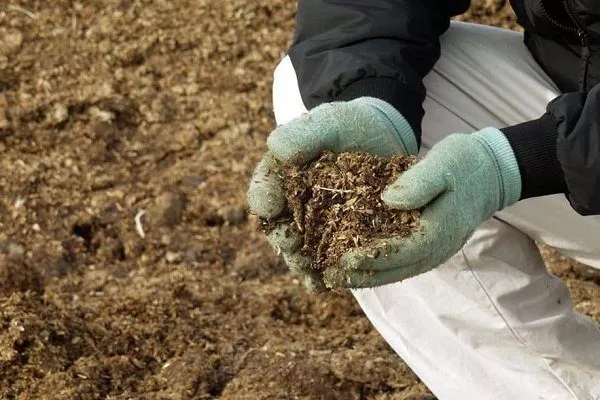
- Before planting, add 100 g of humus and 50 g of wood ash to each hole.
- 30 days after planting, feed the plants with a solution of mullein (1:10) at the rate of 1 liter per plant.
- During ovary formation, apply potassium fertilizer at a rate of 20 g per plant.
Regular fertilizing can be replaced by adding ash or humus to each hole before sowing.
There are also some restrictions on applying fertilizers:
- During fruit ripening, avoid fertilizing plants with nitrogen fertilizers. Watermelons tend to accumulate sodium salts, which impairs their flavor.
- Fresh manure cannot be used as fertilizer.
Bush formation
The formation of bushes depends on the method of growing watermelon:
- In open ground. Form the bush from 3 shoots, pinch their tops.
- In the greenhouse. Watermelons are grown on trellises. Form the bushes from a single stem, which is tied to a support. Trim off any side shoots longer than 50 cm. Leave two side shoots on the main shoot. After the ovaries have formed, pinch off the tops every three leaves.
To ensure uniform ripening, no more than 3 ovaries are left on each shoot.
Fruit ripening
Despite its sun-loving nature, the plant's fruits ripen better if they are placed in a cloth or covered with large leaves, such as burdock, in hot weather.
Avoid allowing the fruits to ripen for too long in the open ground, as they may begin to rot. In a greenhouse, each watermelon is placed in nets and hung from a trellis to ripen.
Pest and disease control
The producer has a high immunity to the development of diseases such as rot and anthracnose.
But they can be affected by the following diseases and pests:
- Melon aphid. The insect nests on the stems of the plant. Black spots appear on them, and over time, the stems curl. To eliminate the pest, completely remove the affected stems and treat them with Fitoverm.
- Putin's tick. You can spot the insect immediately after planting the seedlings—it forms a web under the leaves, and the mite can be found in this web. Over time, the plant dries out. To prevent the pest from reproducing, burn the affected leaves and treat the bed with an insecticide, such as Agravertin.
- Powdery mildew. The disease is caused by a fungus. The leaves become covered with a white-gray coating on which droplets of liquid form, resembling dew. The plant dies. To treat, remove the diseased leaves and treat the plant with Karatan suspension or Topaz.
- Root rot. The disease develops in the soil and attacks the roots, causing brown, wet spots on the stems near the ground that emit an unpleasant odor, along with yellowed leaves. Treat with copper sulfate, Fundazol, or ash.
You can determine the presence of fungus by having the soil analyzed in a laboratory.
There are preventative measures that can help prevent the development of diseases and the proliferation of pests:
- Before sowing, disinfect the soil;
- disinfect the seeds with Fitosporin;
- When watering, do not overwater the stems and leaves;
- adhere to the rules and regulations for feeding;
- Inspect plants regularly for damage.
Reproduction
The Producer watermelon reproduces exclusively by seed. This is due to natural factors: in the wild, ripe fruits roll along the surface until they burst under the influence of external factors. The juice then moistens the soil, thus anchoring the seeds in the soil.
How to determine if a berry is ripe?
In the south, watermelon ripens in mid-July, in cool climates – closer to September.
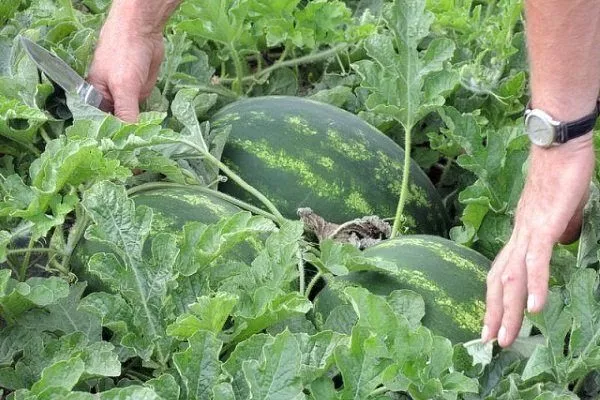
The ripeness of fruits can be determined by the following criteria:
- high contrast of dark green and light green stripes on the skin;
- the texture of the peel changes from matte to glossy;
- On ripe fruits you can often find scratches and pecks, birds do not touch unripe berries;
- the stalk dries up by the time it ripens.
Harvesting and storage
Harvesting begins five days before the fruit is fully ripe. At this time, the flesh is a soft pink, turning red as it ages. Berries harvested earlier will not ripen fully in storage, and later harvests will not keep well.
It's best to harvest by hand. The watermelon is pulled from the stems, leaving 3-5 cm of the stem.
Store watermelons observing:
- Temperature and humidity. The temperature in the storage area should not be higher than +1-4 °C, humidity within 70-80%.
- Storage method. You can resort to one of 4 methods:
- in boxes lined with moss;
- in barrels filled with ash;
- in nets in a suspended state, after wrapping the watermelon in natural fabric;
- by treating each fruit with 5 mm thick wax.
Reviews of the watermelon Producer
The Producer watermelon is an early-ripening variety, making it suitable for growing in short summers. It's a demanding plant, requiring specific climate conditions, soil, and irrigation. However, with timely agricultural management, it will reward you with a bountiful harvest. Producer can be grown both commercially and in private farms.