
Grafting watermelons onto pumpkins has become popular in temperate climates, where warm soil conditions are insufficient for the heat-loving watermelon to fully ripen. Grafting, however, increases the plant's cold tolerance. In this article, we'll discuss the main grafting techniques and subsequent care for grafted watermelons.
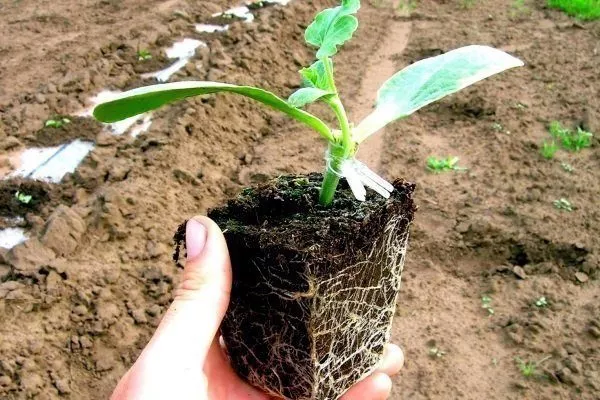
Why graft a watermelon?
The main reason for grafting watermelons is their very delicate root system, which doesn't thrive at temperatures as low as 18°C. Watermelons also need full sun and loose, fertile soil to thrive. Grafting two related crops allows the stronger root to feed. fusedwith it the stem of a less resistant plant.
- ✓ The air temperature in the room for grafting should be stable and be 25-28 °C.
- ✓ Air humidity should be maintained at 85-90% to prevent the grafting material from drying out.
In South Korea, Japan, France, and some other countries, all melons are required to be grafted.
Let's consider the benefits of watermelon grafting:
- Pumpkin roots deliver nutrition to the stem at a soil temperature of +7 °C.
- Grafting allows the watermelon to form good vines withbig the number of ovaries, and allows the berry to ripen successfully.
- The fruits on a grafted watermelon grow larger, and the yield increases almost 2 times.
- During prolonged cloud cover, the grafted watermelon continues to grow fruit, while the ungrafted one begins to ripen.
- Not susceptible to fusarium, anthracnose, or root fungal rot.
- Allows you to plant plants in a permanent location earlier than usual.
- The rate of development and ripening time of watermelons are accelerating.
- It grows and bears fruit even on heavy, infertile soils.
- It has a powerful root system that penetrates into the deep layers of soil.
- No crop rotation required.
- Drought-resistant.
Will pumpkin affect the quality of watermelon?
Pumpkin rootstock has virtually no effect on the taste of watermelon. However, those parameters that depend on nutrient supply are improved. For example, thanks to the rootstock's resistance to adverse conditions, more nutrients reach the scion, resulting in larger, more sugary fruits.
What tool will you need?
For vaccination you will need:
- Cutting tool - a scalpel or a razor.
- Dressing — hemp thread, bandage, bast, aluminum foil or polyethylene strips 30x1.5 cm.
- Grafting clips or a clothespin with smooth clips.
- Wooden peg.
- Marker.
The grafting instrument must be:
- Sharp A dull blade doesn't cut, but crushes the cells, preventing moisture from penetrating the scion tissue. The best option is a new razor blade, one side of which should be wrapped in electrical tape.
- Clean - If dirt and bacteria get into the graft, the plant will rot.
It is necessary to ensure tight contact between the scion and the rootstock so that as many cells as possible come into contact. To do this, the graft is tightly tied and clamped with grafting clips.
Since grafting is a delicate and delicate procedure, it is recommended to sow plants in reserve - only some of the plants may take root.
Methods for grafting watermelon onto pumpkin
Seedlings for grafting are grown in 200 ml cups. Watermelon is sown first, as it takes longer to germinate. Lagenaria is sown 3-5 days later. Grafting is performed after 2-3 true leaves have emerged.
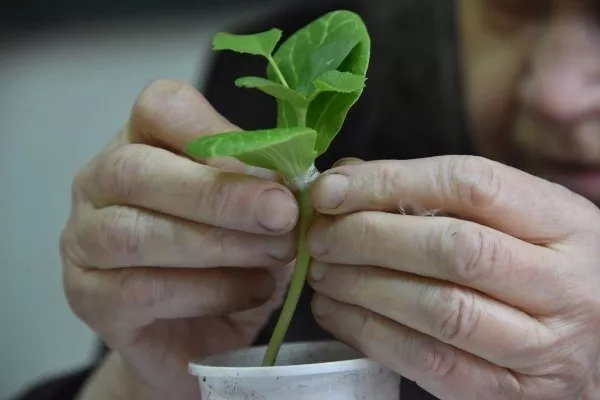
There are several ways to vaccinate:
- With your tongue —the most common.
- In the center (in the cleft).
- Rapprochement.
- Butt joint.
- Injection.
- In the side cut.
- Into the phone.
The first method —the most common, we will also consider methods 2 and 3, the rest, due to the complexity of execution and the low survival rate of the scion, are rarely used.
With your tongue
The simplest and most effective method. In this case, the watermelon continues to live on its own roots for some time. This method has the highest survival rate.
For seedlings, it is advisable to use light, nutritious soil (soil and coconut flakes in a ratio of 1:3), which should be disinfected before planting to avoid fungal diseases.
Vaccination procedure:
- Place the scion and rootstock seedlings next to each other.
- Place the plant stems next to each other and mark the connection point under the cotyledons with a marker.
- Step down 1 cm from the mark and make diagonal cuts at approximately a 30-degree angle. For the pumpkin, cut from top to bottom, reaching the middle of the stem, and for the watermelon, cut from bottom to top. Cut at approximately a 30-degree angle, one opposite the other. The resulting cut should be 6-8 mm long (2/3 of the way down the stem). This creates the "tongues."
- Pinch the tongues together so that the watermelon is slightly higher than the pumpkin.
- Wrap the grafting site tightly with foil and secure with a clothespin.
- Place a stake next to the grafted stems to support them vertically.
- Plant the interconnected plants in a 0.5-0.8 liter container.
- Place in a lighted area.
- After about 7 days, firmly press the watermelon stem under the graft with your fingers so that the watermelon begins to take nutrition from the roots of the rootstock.
- Repeat this procedure every other day and 9-10 days after grafting, completely cut off the watermelon stem, which has withered by this time.
- Remove the leaves from the top of the pumpkin and its growing point.
- Once the grafted area has healed, remove the foil.
- After a month, when the plants have taken root, plant them in prepared soil.
In his video, the gardener shares his experience grafting a watermelon onto a pumpkin using the "tongue" method:
In the center (in the cleft)
This grafting technique originated in China. It requires experience and precision, and the grafted seedling's survival is a lengthy process requiring a favorable microclimate, which is why the graft often fails.
Sequence of execution:
- As soon as the first true leaf emerges from the pumpkin seedling, cut off the growth bud with an oblique cut towards the center, above the cotyledon leaves, so that a deep cut is formed in its place; if the cut is too small, lengthen it slightly to 1-1.5 cm.
- For a watermelon with 2-3 true leaves, cut the top diagonally below the cotyledons so that the stem cut resembles the tip of a screwdriver.
- Insert the cut watermelon sprout deep into the cut on the pumpkin stem, in place of the cut out growth point.
- Carefully and tightly wrap it with foil so that all the cuts of the graft match, then rewind with film.
- Transplant the grafted plant into a 0.5-0.8 liter glass and, to create a greenhouse effect, cover it with a bottomless plastic bottle with a screw cap.
- When the grafting site has healed, remove the foil.
Watch the following video to learn how to graft a watermelon onto a pumpkin using the cleft method:
Rapprochement
It is performed using a lateral incision below the cotyledons.
Sequence of actions:
- Place approximately identical watermelon and lagenaria seedlings with two true leaves as close to each other as possible.
- On both seedlings, 5-7 mm above the cotyledons, cut off a thin (no more than 2 mm) layer of skin.
- Align the stem cuts as accurately as possible.
- Secure by wrapping it tightly with film and pressing with a clip.
- Be sure to label the containers so that you don’t confuse the desired plant with a pumpkin in the future.
- After a week, press down on the watermelon stem under the graft so that the watermelon begins to receive nutrition from the pumpkin roots.
- Repeat this squeezing of the stem several times until the watermelon begins to dry out in the area of squeezing.
- Remove the pumpkin leaves, leaving 2 cotyledon leaves and 2 regular leaves, do not remove the growing center.
- After transplanting into open ground, you can finally cut off the unnecessary stem and sprout of the pumpkin.
You can see the technique of grafting a watermelon onto a pumpkin using the "approximation" method in the video below:
Features of the procedure and useful tips
Not only the grafting technique is important, but also the ability to increase its impact on the grafted watermelon.
To do this:
- Seedlings of different ages are used—to enhance the grafted watermelon's properties, the rootstock should be younger than the scion. This will allow the plant to develop more of the scion's qualities, so watermelon should be sown at least three days before the lagenaria.
- To switch the nutrition, all the leaves of the lagenaria need to be removed; this will stimulate metabolic processes and, therefore, increase the yield.
- The graft is artificially given a short day.
- Repeated vaccinations are performed.
A grafted watermelon requires a large area. Therefore, when transplanting into open ground, each plant requires up to 8 sq. m.
The best rootstock is Lagenaria, which is almost completely compatible with watermelon, but regular pumpkin can also be used.
Preferred varieties include White Honey, Gray Volga, and Mozoleyevskaya. They can even be grafted onto zucchini, but pumpkin, squash, and watermelon will not be fully compatible, and the rootstock tops will have to be left. The best grafts for lagenaria are considered to be the Astrakhan watermelon variety. Chilly, Kherson, Korean, Chernouska and others.
Grafted watermelons take longer to ripen, so to get an earlier harvest, the planted plants need to be covered with film.
Since the pumpkin stem is hollow and creates an environment favorable for root growth, the grafted watermelon often forms its own root system inside the scion.
Caring for a grafted plant
Watermelons require special care after grafting:
- Be sure to cover the grafted plant for the first few days to prevent the watermelon from dying from lack of moisture, as it is not yet fully receiving nutrition from the lagenaria.
- Every 5 days, ventilate the plants by uncovering them for 20-30 minutes, gradually increasing this time. After 2 weeks, when the watermelon has strengthened, remove the cover completely.
- Plant the grafted watermelon in the sunniest spot.
- After grafting, it's important to maintain a temperature of at least 25°C. Place the seedlings in the sunniest window.
- At planting watermelon in open ground, add a bucket of humus and 0.5 kg of ash to the hole, mix, water well and plant the plants, mulch.
- During the growing season, in hot and dry summers, water the watermelons well once a week, but so that the foliage remains dry.
- When the fruit growth stops, stop watering too, so that the berries can accumulate sugar.
- For the first 3 days after grafting, keep the plants in complete darkness to reduce stress.
- Gradually increase lighting starting on day 4 to full daylight by day 7.
- Maintain high humidity, gradually reducing it to normal conditions by the 10th day.
Grafting watermelons onto pumpkin seedlings is a rather complex procedure, and not always successful. But once you master it, you'll be able to reap a bountiful harvest of large, sweet watermelons every season.