
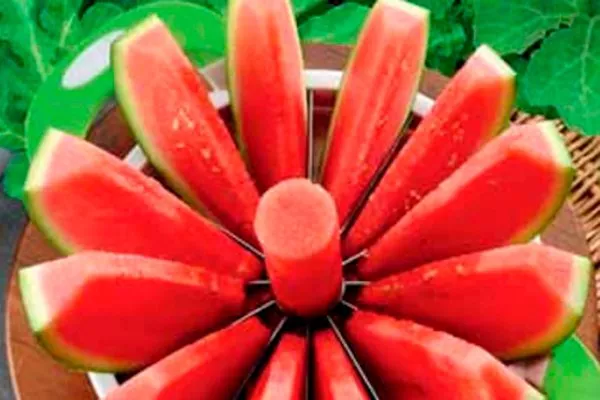
The term "Portion Watermelon" refers to small-sized berries. It's believed that there are several such varieties, but in reality, there's only one, called "Portion Watermelon." This hybrid is characterized by its exceptionally sweet and sugary flesh, its remontant nature, and its early ripening. This variety has excellent cold tolerance, making it easily grown in the harsh conditions of Siberia and the Urals.
Who developed the variety and when?
The Portion Watermelon appeared quite recently – it was registered in the state registry in 2018. Three breeders worked on creating the hybrid – A. Yu. Andreeva, Yu. I. Andreev, and O. P. Kigashpaeva.
Description
The Portion Watermelon is a climbing plant with long stems that reach several meters. The distinctive feature of this variety is the size of its fruit. A single watermelon weighs between 1.5 and 3.5 kg, but most often weighs 2.5 kg. Other characteristic features:
- leaves – slightly wrinkled, medium-dissected and medium-sized, standard green shade;
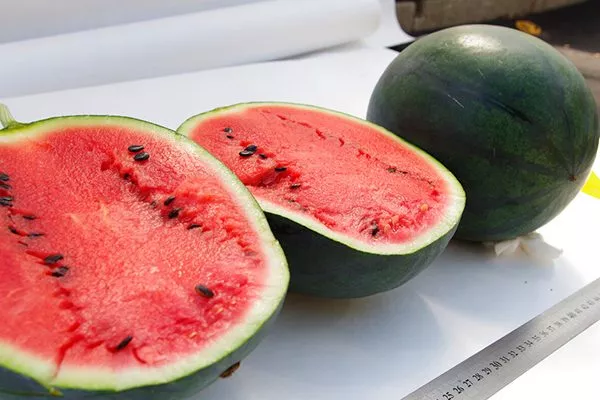
- the peel is medium in thickness or thin, but always strong, has a green background and darker green stripes without clear boundaries;
- berry shape – elliptical;
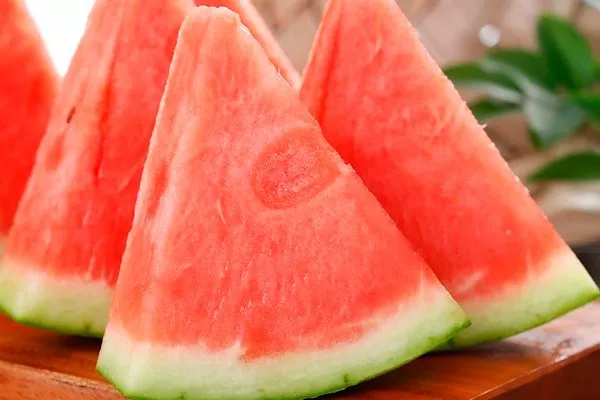
- the pulp is red, dense, with increased juiciness;
- seeds - small, patternless, black in color;
- The number of seeds is above average.
Characteristics
This portioned watermelon can be grown both outdoors and in greenhouses. The variety is relatively new, but gardeners have already appreciated its characteristics:
- Necessary climatic conditions. Watermelon is recommended for growing in southern Russia, as well as in the central and middle zones of Russia, the Lower Volga region, Siberia, the Urals, the Volga-Vyatka region, and elsewhere.
- Taste and Purpose. This hybrid is suitable for fresh consumption, pickling, and canning. The sweet pulp can be used to make any dessert or juice. The watermelon has a very sweet taste, so diabetics should consume it in moderation.
- Ripening and yield. This is an early-ripening variety, with yields ranging from 1 to 2.5 kg per square meter.
Advantages and disadvantages
Despite the fact that the hybrid was developed recently, many people talk about its advantages.
Planting watermelon in open ground
The most convenient and fastest way to sow Portionny watermelon seeds is directly into open ground. This saves time, effort, and expense. The key is to consider all the important aspects and nuances of growing. However, keep in mind that in very harsh climates, you should avoid sowing in open beds, as the short summers prevent the fruits from fully ripening.
- ✓ Check the expiration date of the seeds; the optimal shelf life is no more than 3 years.
- ✓ Pay attention to the manufacturer; give preference to proven agricultural firms.
When to plant watermelon in the garden?
Under average climate conditions, seeds are sown in open soil around May, but sometimes as early as early June. It's important for the air temperature to stabilize at 15 degrees Celsius.
Soil and location for watermelon
Melons are considered southern plants, meaning they thrive in a sunny location. The best exposure is south and southeast. Drafts should be avoided. Crop rotation is also important:
- the best predecessors are beans, onions, cabbage, winter wheat, sainfoin, sweet clover, alfalfa;
- The worst predecessors are eggplants, tomatoes, potatoes, pumpkins, watermelons, melons, squash and zucchini.
It is prohibited to plant melons and pumpkins in one place for 5-7 years.
Pay special attention to the composition and structure of the soil where the Portioned Watermelon will be grown:
- the acidity level should be average – from 6.5 to 7.0 pH;
- The structure is loose, breathable, drained and moderately light, so sandy loam and loamy soils can be considered the optimal option.
Fertile soil will ensure high yields, so it's important to enrich the soil with nutrients beforehand. To do this, when digging the area, add a mixture of the following ingredients per square meter:
- rotted manure, compost or humus – about 5 kg;
- ammonium sulfate – 35 g;
- potassium salt – 20 g;
- Superphosphate – 45 g.
How to plant watermelons in open ground?
After preparing the plot, roughly mark out the soil. Holes within a row should be spaced 150 cm apart, and between rows, 200 cm apart. Next, begin planting the seeds, which don't require germination:
- Dig holes 5 cm deep.
- Pour about 1.5 liters of warm water into them.
- Let the liquid soak in.
- Place 2 seeds per planting hole.
- Cover with soil, but do not compact it. Simply rake the surface.
- Sprinkle a 2-3 cm layer of sand on top.
Growing watermelon in a greenhouse
This method is used in cool and harsh climates. Seeds can be planted directly in greenhouses, but it's advisable to sow them for seedlings first. Here's how:
- Prepare the seeds by soaking them in a solution of potassium permanganate.
- Prepare a substrate from humus, peat, sand and soil.
- Pour the soil mixture into separate containers, moisten and plant the seeds deep.
- Cover with plastic wrap and leave to germinate, removing the cover daily for ventilation and moisture.
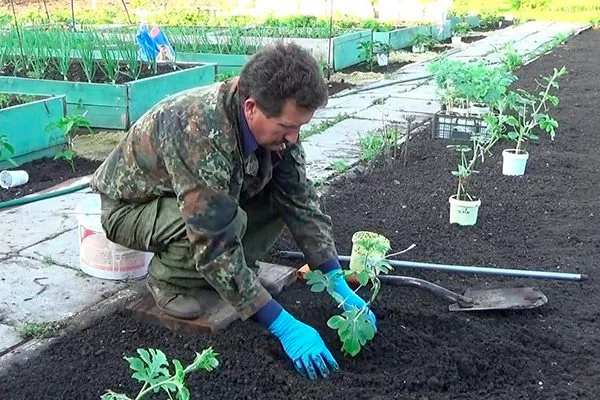
- When the seedlings have about four leaves and the soil in the greenhouse reaches at least 12 degrees Celsius, transplant them. Keep in mind that the greenhouse must be heated or have two layers of plastic covering.
- About 6-8 days before transplanting, form a trench and fill it with humus mixed with straw in equal proportions.
- Place the removed soil on top.
- When replanting, make holes 10-12 cm deep. The distance between them is about 70-80 cm.
- Cut the disposable cups with seedlings and place the seedlings together with the root ball.
- Sprinkle and compact.
- Water it.
- ✓ Maintain the temperature in the greenhouse at least +12°C at night.
- ✓ Provide adequate lighting, using additional artificial lighting if necessary.
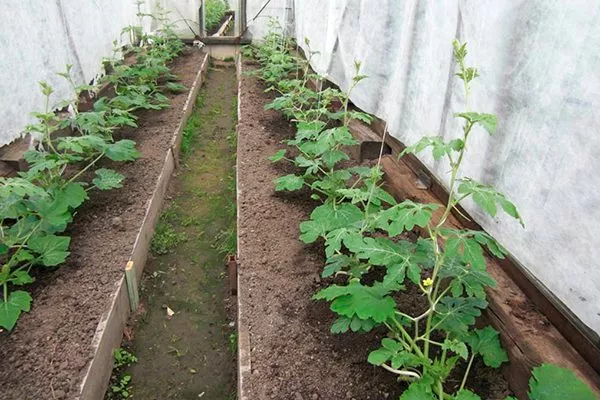
Important recommendations for growing watermelon in a greenhouse:
- Experts recommend artificial pollination because male flowers on the Portionny variety quickly die. To do this, simply introduce bees. Alternatively, collect pollen with a brush and apply it to the female flower. Repeat this procedure 3-4 times.
- To speed up stem development, you can pinch them. Do this on young watermelons.
- Be sure to prune weakened shoots. They draw energy away from the plant and prevent fruit and healthy stems from growing quickly.
- Don't leave all the ovaries, otherwise the fruits will be too small. Five ovaries are enough for each vine.
- When the stems reach 50 cm, fertilize them for the first time. To do this, dig a trench between the rows and add liquid bird droppings or cow manure. Fertilize the plants a second time before flowering, and a third time after fruit set. You can use not only organic fertilizers but also commercially available mineral fertilizers.
Subtleties of agricultural technology
Care is essential when growing this new hybrid. However, the variety doesn't have any special requirements. Keep the following in mind:
- Watering. It's especially necessary during flowering and fruit set. However, as the fruits begin to enlarge, reduce the watering to prevent the sweetness from fading and excessive wateriness from developing (a different concept from juiciness).
Avoid allowing water to come into contact with the leaves and stems, as this will cause rotting. Avoid adding too much liquid. Ideally, allow the water to soak into the soil for half an hour. - Top dressing. Watermelon prefers fertile soil rich in organic fertilizers. To avoid the need for additional fertilizer, apply a mulch of rotted manure, humus, or compost after watering. Avoid peat, as it acidifies the soil, which is not recommended for the Portion Hybrid.
- Prevention of diseases and pests. Juicy, sweet fruits are loved not only by beneficial insects but also by harmful ones, so at the end of flowering, the bushes should be sprayed with insecticides. Sulfur-based fungicides are used against diseases.
Reviews of the Portioned Watermelon variety
The portioned watermelon is an agricultural innovation that has quickly won the hearts of not only consumers but also melon growers. Gardeners praise its ease of cultivation, highlighting its many positive aspects and refusing to mention any shortcomings. This hybrid is the true embodiment of the sugary, striped-skinned berry.