
The Ogonyok watermelon is renowned for its flavor and early ripening, making it a favorite among many gardeners. Let's explore the characteristics of this variety, its advantages and disadvantages, as well as the nuances of growing and harvesting in different parts of Russia.
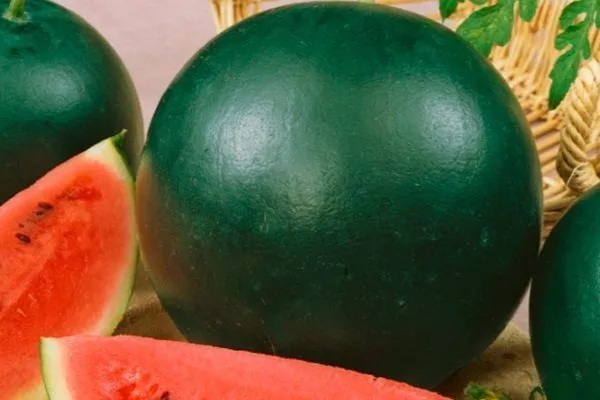
Watermelon variety "Ogonyok"
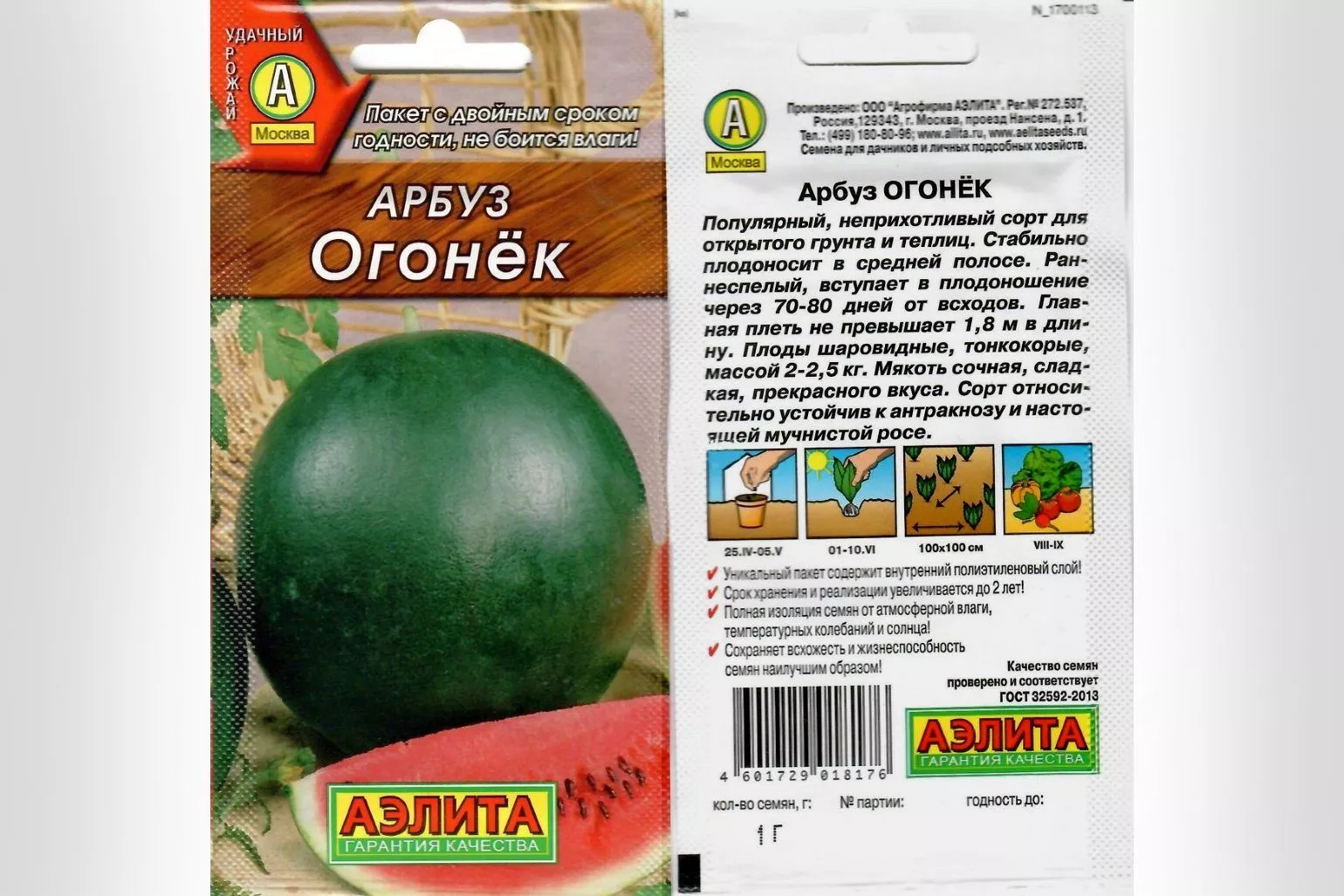
watermelon seeds, variety "Ogonyok"
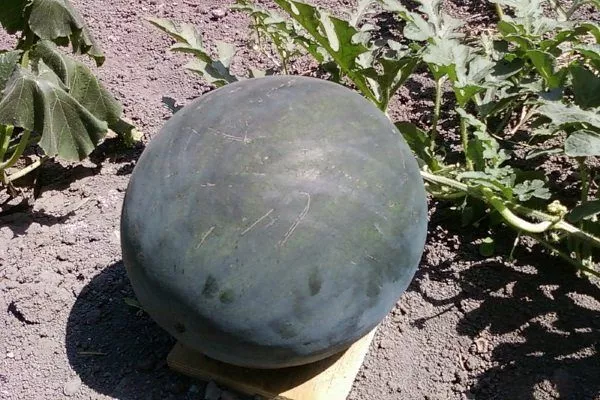
The Ogonyok watermelon has been included in the State Register of Breeding Achievements for 60 years.
Origin of the variety
The Ogonyok watermelon was bred by crossing the Sakharny variety with an Asian hybrid. This was done in the Kharkiv region (Ukraine) by staff at the Institute of Vegetable and Melon Growing. The variety received its name from the orange-red flesh, which resembles a spark.
This watermelon was originally intended for cultivation in warm southern regions. However, Ogonyok has also thrived in the Moscow region and the Urals, and even performed well in Siberia. However, growing the crop outdoors in cold regions with harsh winters is quite difficult, but it is quite feasible in greenhouses.
Characteristics of Ogonyok
The Ogonyok watermelon is distinguished by its early maturity—the fruit ripens in approximately 80-85 days. The watermelon itself resembles a ball: round and smooth. The fruit typically weighs 2 kg (sometimes up to 2.5 kg), and its skin is quite thin and dark green. The flesh is juicy and sweet, but contains a large number of small, dark-brown seeds.
The Ogonyok watermelon can be grown both in open ground and in greenhouses. Like all melons, it thrives in warmth but can tolerate low temperatures for short periods. In central Russia, this watermelon ripens before the first frosts. Its yield is up to 2.6 kg/sq. m.
Growing characteristics in different regions
Since this watermelon grows widely, the climate of each region must be taken into account. For example, in the Moscow region, Ogonyok can ripen both in a greenhouse and in the open ground.
In the Urals, however, you can't be sure the fruit will ripen if the season is rainy and cold. Watermelons will only ripen in hot summers. Therefore, in this region, it's best to grow this melon indoors (in a greenhouse).
In Siberia, grow these watermelons only in a greenhouse. The region's climate won't allow this heat-loving crop to thrive outdoors. In the south, however, growing Ogonyok is no problem.
Advantages and disadvantages of the variety
Analyzing the characteristics of the Ogonyok variety, we can highlight the following advantages:
- early ripening of fruits;
- the ability to adapt to different climatic conditions, including sudden temperature changes;
- resistance to anthracnose and fusarium wilt;
- the ability to withstand the absence of fertilizing and watering for a long time.
As for the disadvantages, they are as follows:
- unsuitable for long-distance transportation, since the variety has a very thin skin;
- short shelf life – only 7-10 days.
Watch a review of the Ogonyok watermelon in the video below:
Growing seedlings
In most cases, Ogonyok watermelons are planted using seedlings. To start seedlings, select healthy seeds without any damage. Seeds that are 2-3 years old germinate best. Fresh seeds will grow into mature and strong plants, but they won't produce many fruits.
- ✓ Seeds should be no older than 3 years for optimal germination.
- ✓ Check seeds for damage or signs of disease before planting.
How to grow seedlings:
- treat the seeds with a 1% solution of potassium permanganate and leave them to disinfect for an hour, then rinse;
- soak the seeds in a damp cloth in a warm place until sprouts appear;
- prepare the soil for planting – mix humus, peat and sand in equal parts;
- take containers for planting seedlings with a volume of at least 0.6 liters and plant the seeds there to a depth of 4 cm;
- keep containers with seedlings at a temperature of about 25-28 degrees during the day and not lower than 14 degrees at night;
- water the plants with warm water, trying to avoid overwatering;
- Feed the sprouts with mineral fertilizers 10 days after germination and do it again after the same amount of time.
Keep the seedlings in a sunny, warm spot. A south-facing window sill is ideal for this purpose. Once the sprouts emerge, it's important to ensure they receive plenty of light, otherwise they will become leggy.
Since watermelons don't like being transplanted, grow the seedlings in individual pots without picking. About 7 days before planting in open ground – harden the seeds at a temperature of 0 degrees (you can use a refrigerator for this purpose).
- ✓ Start hardening at a temperature not lower than 0 degrees, gradually increasing the time spent in the cold.
- ✓ Avoid sudden temperature changes to avoid damaging the plants.
Rules for planting watermelon
To get a good watermelon harvest, you need to follow certain planting guidelines. Let's look at the differences between growing melons outdoors and indoors.
In the greenhouse
The easiest way to grow watermelons is in a greenhouse. This indoor environment provides all the necessary conditions for proper fruit development. If you're planting seeds rather than seedlings, they can be transferred to the greenhouse as early as April.
If transplanting seedlings, the optimal time for planting is considered to be early May. The distance between plants should be 70 cm, and the same distance between rows. In a greenhouse, the melon patch can be reduced in size by tying the plants to a trellis.
In open ground
Plant the seedlings outdoors in late May or early June. The sprouts should be 30 days old by this time. The soil must be well-warmed at all times, otherwise the melon roots will not be able to grow and develop properly. The soil should be light, neutral or slightly alkaline, and free of waterlogging.
The planting site should be level and sunny, with a large area. This is necessary because melons take up quite a bit of space. Avoid planting watermelons where other cucurbits or nightshades have been grown within the last three years.
Growing features:
- the distance between bushes should be 0.8-1 m, and between rows – 1.4-1.5 m;
- add 2 handfuls of humus and a pinch of fertilizer with minerals to the prepared holes;
- then pour in 2 liters of warm water and plant the seedlings, burying them only to the bottom leaves.
Watermelon is a heat-loving crop, so if there's a risk of temperatures dropping below 15 degrees Celsius, cover the seedlings with plastic or any non-woven material. This is especially important if the sprouts haven't undergone the hardening-off stage.
Sowing seeds
How to plant Ogonyok watermelon seeds:
- start planting seeds in open ground in mid-April – early May;
- the ground should already be well warmed up;
- Dig holes for the seeds (the distances are the same as when planting seedlings) and fill them with water;
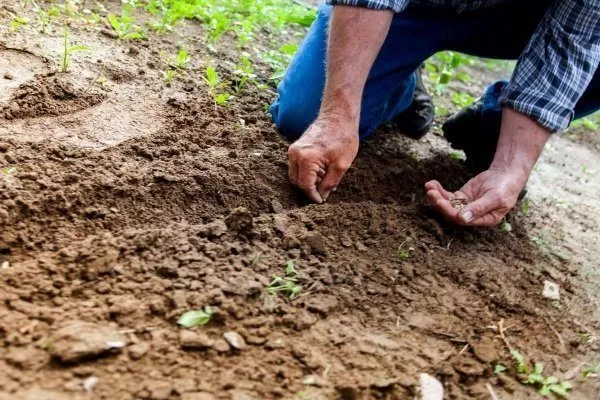
- loosen the soil and place 2-3 grains in the hole at a small distance from each other;
- cover them with earth.
Basics of care
Proper care of your melons will help you harvest a good watermelon crop. You need to water them regularly, remove weeds, loosen the soil, and fertilize them with the necessary fertilizers. You also need to know how to properly shape them.
Watering
Water Ogonyok watermelons only with settled, warm water. They especially need moisture during flowering and fruit set. In greenhouses, water as the soil dries out, and outdoors, depending on precipitation and air temperature. If it rains frequently, watering is not necessary.
Top dressing
You need to feed the Ogonyok watermelon three times:
- 10 days after planting – add 30 g of ammonium sulfate, 45 g of superphosphate and 15 g of potassium salt (dilute this composition in a bucket of warm water);
- during growth and formation of ovaries – 10 g superphosphate, 20 g ammonium sulfate and 35 g potassium salt;
- 10 days after the 2nd feeding- add a similar composition again.
Formation
To ensure a productive harvest in northern regions, the Ogonyok watermelon must be trained properly and the fruit load monitored. Otherwise, the melons will not ripen properly. They are best grown on a net or trellis.
How to properly shape watermelons:
- Since the fruits of the Ogonyok are formed only on the main stem, pinch off all the side ones once a week (they are not needed);
- leave no more than 2-3 fruits on one stem after they have set, otherwise the watermelons will be too small;
- During fruit growth, pinch off the top, as its growth is no longer needed.
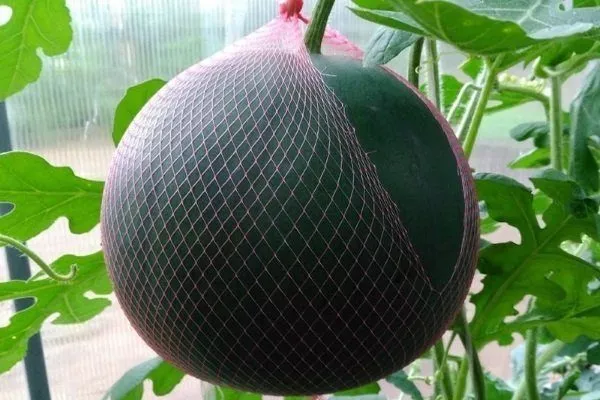
After the watermelons have formed, place them in nets to prevent the vines from breaking. This way, the watermelons are not in contact with the ground and will not rot. If you have plenty of space, leave the long stems to grow along the ground.
Diseases and pests
The Ogonyok watermelon is most often affected by powdery mildew, angular or olive spot, and anthracnose. Cucumber mosaic and root rot may also occur. Control fungal diseases with fungicides such as Bordeaux mixture or Fundazol.
As for pests, aphids, cutworms, and wireworms are dangerous for melons. Control them with insecticides (such as Decis). Timely weed removal, regular soil loosening, and crop rotation also help.
Determination of ripeness
Watermelons of the Ogonyok variety ripen at approximately the same time, and their degree of ripeness can be determined by the following characteristics:
- distinct dark green color of the watermelon with a waxy coating;
- hard rind and dry stalk;
- a light spot on the side when a watermelon ripens on the ground;
- the ability to hear a ringing sound when tapped.
When to harvest?
Harvest times depend on the region where the crop is grown:
- Moscow region – July (by the way, in a greenhouse watermelons ripen 2 weeks earlier).
- Ural - August.
- Siberia – before the first September frosts.
Tips from experienced gardeners
Sometimes, even when following all the rules, watermelons don't grow as expected or yield a smaller harvest. This may be due to ignorance of certain nuances or tricks that experienced gardeners know.
So, some advice from experienced people:
- Grow watermelons from seedlings rather than from seeds – the fruits will be larger in this case;
- Make sure that the fruits do not interfere with each other, that is, plant the melon patch over a large area;
- systematically loosen the soil to allow air to penetrate into the soil - do this again 30-40 minutes after watering;
- Turn the watermelons as they ripen to ensure they ripen evenly and to prevent them from rotting or being attacked by ants and other insects;
- do not leave the harvest in the beds for too long – Ogonyok can very easily become overripe;
- protect the melon patch from birds that might peck the fruits;
- Remove all weeds regularly;
- To speed up pollination of the plant by bees, spray the melon with a honey or sugar solution.
Some gardeners advise mulch the soilunder watermelons. This helps retain moisture and various nutrients and protects the fruit from rotting in damp soil.
Reviews of the Ogonyok watermelon variety
The Ogonyok variety is a favorite among many gardeners for its low-maintenance nature, tolerance to adverse conditions, and pleasant flavor. Follow the recommendations of experienced melon growers and the proper growing practices. A good harvest will surely follow.