
The Moon Watermelon has two unique features: its incredible flesh color and its unusual rind color. This variety is further subdivided into three types, depending on its country of origin. While it's almost impossible to find a hybrid for sale, many people crave these unusual fruits. This is precisely why our gardeners grow this variety.
Why was it called "Moon Watermelon"?
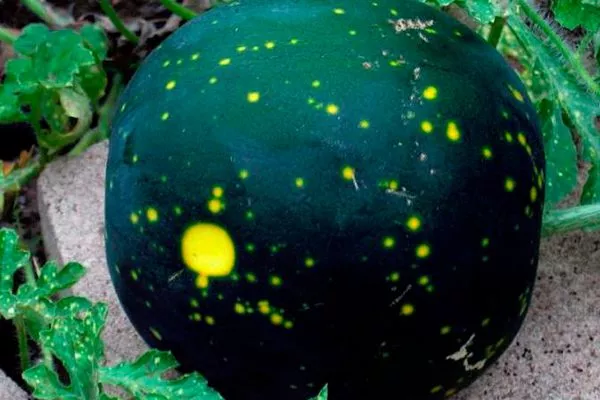
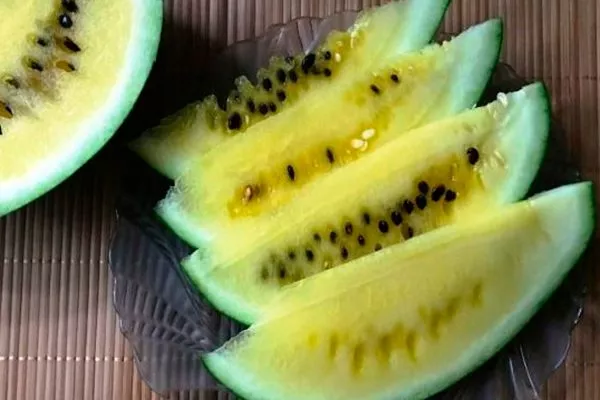
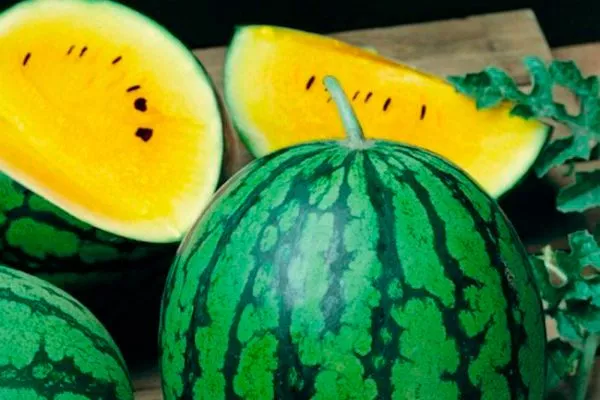
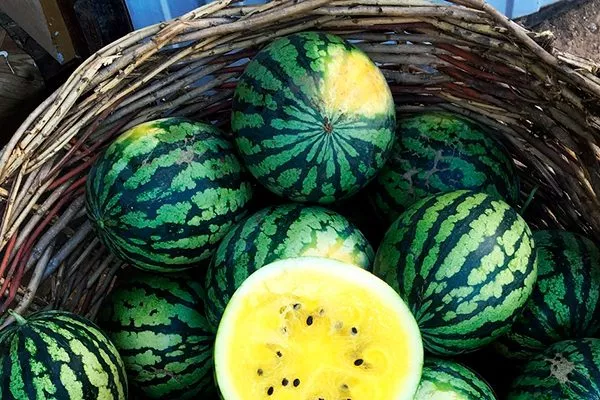
The main reason the watermelon is called the Moon Watermelon is its resemblance to the moon when cut in half, as the hybrid's flesh is completely yellow. But there's another reason: one variety of the Moon Watermelon has a rind that resembles the sky with stars and the moon.
Origin
The moon watermelon was bred in Spain, Thailand, and Russia. The domestic variety, which is widespread in our country, was developed by melon breeder Sergei Dmitrievich Sokolov at the Astrakhan Research Institute for Melon and Vegetable Growing.
For the crossbreeding, the author used a common Astrakhan watermelon and a wild variety, which naturally had yellowish flesh. Research and experiments lasted nearly 10 years, and the breeder ultimately achieved the desired result.
The Russian Lunar watermelon is currently listed among the top 10 global achievements in breeding. The variety was registered in 2007.
Moon Watermelon: Types
| Name | Fruit shape | Peel color | The taste of the pulp |
|---|---|---|---|
| Spanish | Rounded | Dark green with light spots | Sweet with hints of mango and lemon |
| Thai | Oval elongated | Dark green with light spots | Less sweet, 5% sugar content |
| Russian | Elliptical, wide | Light green with dark stripes | Very sweet, 13% sugar content |
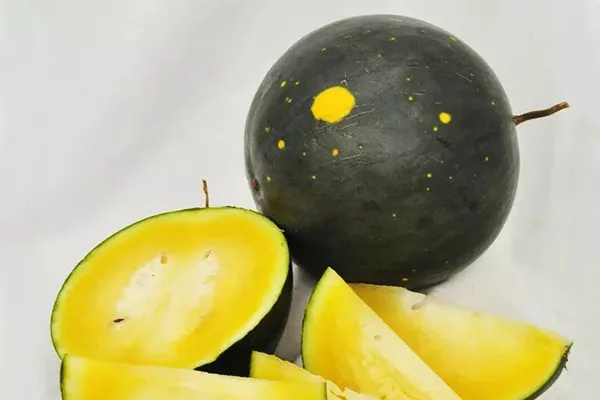
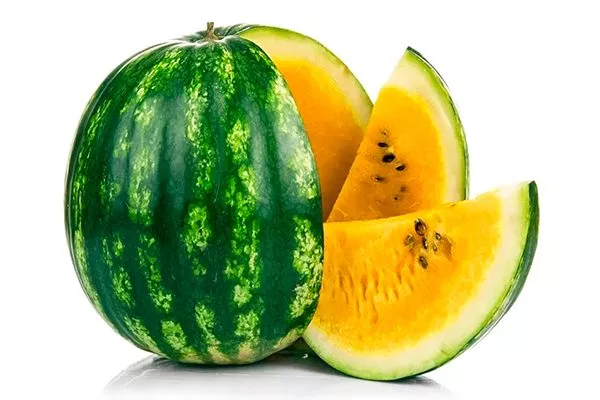
The lunar hybrid is divided into three types: Spanish, Thai, and Russian. The first two have a unique outer skin—a dark green background with light flecks reminiscent of stars and a single large circle, symbolizing the full moon.
The differences between them are:
- The Spaniards bred a yellow, round watermelon.

- The Thais came up with berries of an oval, elongated shape.
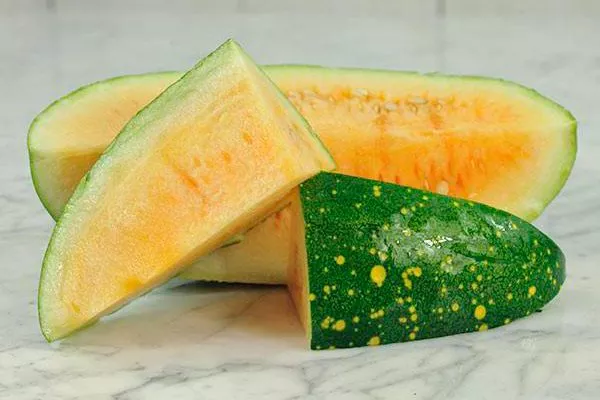
As for the Russian version, our hybrid has a standard skin. Features of the Russian Moon Watermelon:
- the bush is of medium climbing type, because the stems are not very long;
- the leaves have a classic green hue, are medium-sized and have multiple dissections;
- a maximum of 4 fruits are localized on one bush;
- the weight of one berry is from 2 to 3 kg;
- shape – elliptical, wide;
- the skin color is mainly light green, and the stripes are very dark;
- the pattern on the skin is narrow and uneven stripes;
- the skin is thin;
- the surface of the berry is smooth and even;
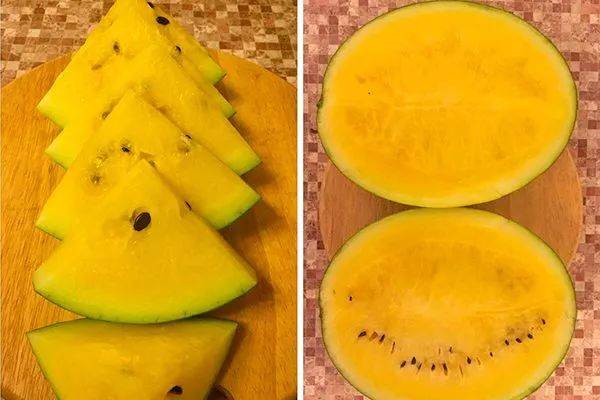
- the color of the pulp is lemon-yellow, richly bright;
- the texture of the pulp is very juicy, sugary and soft;
- The seeds are too small, brown in color, and in large quantities.
Astrakhan Moon watermelons are native to Astrakhan, but efforts are now underway to grow them in other regions of the country. This is because the fruit's skin is very thin and easily damaged during transportation. This forces carriers to pack each berry in individual, cushioned containers, significantly inflating the price of the watermelons.
Description and characteristics of the variety
The moon watermelon from Astrakhan is considered a vitamin-rich fruit – its pulp contains significant amounts of vitamins PP, C, B2, and B1. It also contains numerous minerals, glucose, fructose, and other minerals. Therefore, this variety is recommended for people with swelling, heart problems, and vascular issues.
Characteristic:
- yield – from 1.5 to 2 kg or more can be collected from 1 sq. m;
- growing conditions – in beds, in a greenhouse or under film;
- ripening time is early, ranging from 70 to 90 days after the formation of sprouts, but if the most favorable conditions are provided, the time is reduced to 20 days;
- shelf life – does not exceed one month;
- The fruit size is usually around 3 kg, but if you leave only 3 ovaries on one bush, the result will be surprising - the berries will weigh 5-6 kg.
Taste qualities
Unlike regular red watermelons, the moon hybrid is characterized by a higher sweetness and sugar content. For example, the latter averages 8-10%, while the yellow fruit has 13%. The Thai watermelon, on the other hand, only has 5%.
The pulp has a unique and unusual taste, because in addition to the watermelon flavor, it also contains notes of mango and lemon.
Application
The domestic Moonmelon is traditionally eaten raw in the standard way. However, our home cooks and chefs use the pulp for jams, preserves, juice, desserts, and alcoholic and non-alcoholic cocktails. And the rind makes a delicious candied fruit.
In Thailand, the pulp is used as a thirst quencher in the form of unsweetened juice. It is even used to make spicy sauces served with meat, rice, and fish.
Landing features
This exotic watermelon isn't particularly demanding to grow, but it does require some attention. So, consider the following:
- Seeds are sown for seedlings in late April. If sown in the south and directly into open ground, this timeframe is delayed by a couple of weeks. Therefore, the optimal time is before May 15th. Transplanting of seedlings occurs a month later.
- The optimal distance between bushes is 80-100 cm, and between rows the distance should be greater – about 200-300 cm.
- The site should be as sunny and spacious as possible, but avoid drafts and low-lying areas with stagnant water.
- Particular attention is paid to the structure and composition of the soil. It should not contain large amounts of clay, as the root system extends 100 cm deep. The acidity should be neutral, and the composition should be fertile (both organic and mineral nutrients are needed).
- Proximity is a very important factor, as the Moonmelon easily cross-pollinates. Therefore, planting pumpkins and other melons close to the Moonmelon is prohibited.
- ✓ Make sure that the seeds have a quality certificate and comply with GOST standards.
- ✓ Check the expiration date of the seeds, as old seeds may have low germination rates.
Subtleties of agricultural technology
Caring for the Lunny watermelon variety is easy, as it requires only the most standard care. However, keep the following cultivation guidelines in mind:
- Watering. Although the Lunar hybrid thrives on moisture, it requires moderate watering. Approximately 6-8 liters of settled water should be added to each bush once a week. Once the fruits have fully formed and there are about 10 days left until harvest, watering is stopped completely.
- Top dressing. They are applied before flowering, during budding, and during ovary and fruit formation. Purchased mineral fertilizers, as well as urea, humus, compost, and rotted manure, are used.
- Garter. The Moonmelon's vines aren't very long, but it's best to tie them up, which will save significant space. If you plan to do this, reduce the distance between plantings by 20-30 cm.
- Pruning, pinching. These procedures are essential because excess shoots will rob the plant of all nutrients and moisture. Side shoots and weakened stems must be removed.
- Before flowering, apply a complex mineral fertilizer.
- During budding, add fertilizer with a high phosphorus content.
- When forming ovaries, use potassium fertilizers.
Harvesting and storing watermelons
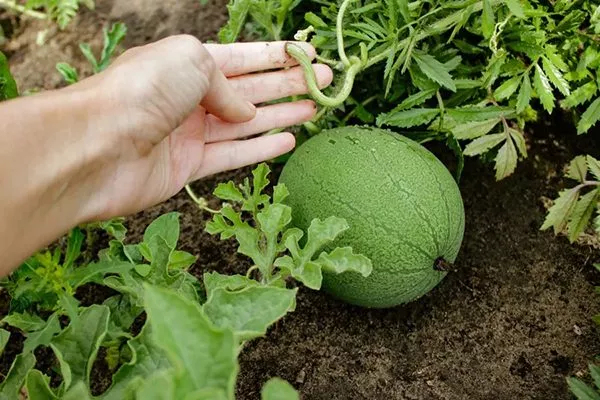
Ripe Moonmelons are harvested starting in mid-July, depending on climate conditions and the current weather. Avoid plucking the berries from the vines when harvesting, especially if there are still unripe specimens on the bushes. It's best to use pruning shears. It's important to leave a small, dry stalk.
These hybrids can be stored for about a month, but only in cool conditions. A cellar or basement, where the temperature ranges from 0 to +3 degrees Celsius, is ideal for this purpose.
Reviews
The Lunar watermelon variety is new to Russia's main regions, but it's already gradually gaining popularity. This is due not only to its unusual lemon-yellow hue but also to its ease of cultivation, even in northern regions. The key is to follow the classic planting and care guidelines, which will result in a good harvest of this unusual fruit.