
Homegrown oats, rich in vitamins, minerals, and nutrients, are a favorite treat for pets, and sprouted oats are beneficial for humans. Growing this grain at home is quite simple.
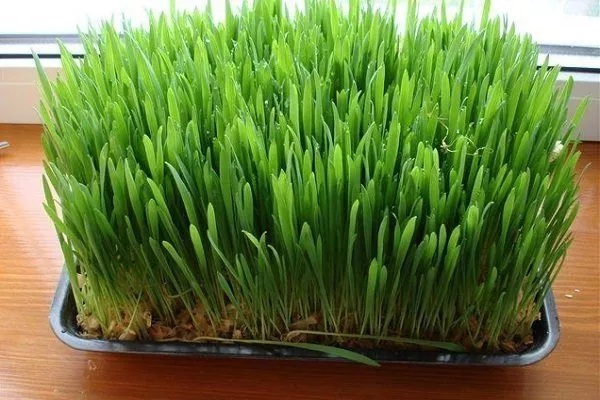
How to Grow Oats at Home on a Windowsill (Pet Grass)
There are three ways to grow oats as a healthy treat for pets.
| Name | Growing method | Time until the first sprouts appear | Watering frequency |
|---|---|---|---|
| In vermiculite | Use of mineral substance | 3 days | 2 times a week |
| In the substrate | Using standard soil for seedlings | 5 days | As needed |
| In gauze | Using gauze and petri dishes | Week | Keeping the gauze moist |
In vermiculite
Vermiculite is a mineral substance often used by gardeners as a growing medium. Its main advantage is its ability to absorb five times its own weight in water. Vermiculite is sold in gardening stores.
The technology for growing oats using this method is simple:
- The grains and vermiculite are soaked for a couple of hours.
- The mineral substrate, saturated with moisture, is poured into the container prepared for germination so that approximately 3 cm remains to the edge.
- Oats are sown.
- The dishes are wrapped in plastic wrap and left on the windowsill.
- After the grains have sprouted, the film is removed.
The first sprouts can be expected within 3 days, and after a couple more days, your pet can begin enjoying the vitamin-rich treat. Water the sprouts twice a week, discarding any excess water.
In the substrate
Growing oats in a substrate is just as simple: just buy standard seedling soil at a gardening store. You can also use fertile soil from your garden.
Sowing algorithm:
- The growing container is filled with a thin layer of soil and watered.
- Oats are sown, placing the grains fairly close to each other.
- Add soil on top until it completely covers the seeds. Don't fill the container to the brim, otherwise the soil will spill out when the sprouts emerge.
- Water the soil again with lukewarm water, but not abundantly.
- Wrap the container in film to create a greenhouse effect and place it in a shaded but warm place.
- After the sprouts have hatched, remove the film and move the container to the windowsill.
After 5 days, your pet can enjoy the healthy grass.
In gauze
This method for growing oats is suitable for those who have plastic Petri dishes at home. You'll need two: one (wider) will serve as a tray, and the other as a growing container. Pierce the bottom of the second one several times with an awl. Place the pierced Petri dish on top of the tray.
To speed up germination, soak oats: pour the grains into any container, cover with damp cheesecloth, wrap in plastic wrap, and leave in a warm place until sprouts emerge. Once sprouted, sow the seeds using the following procedure:
- Fold the gauze in 3 or 4 layers.
- Place in a perforated Petri dish.
- The gauze is moistened and the grains are laid out on it.
- The cup structure is covered with film.
Oats are grown in cheesecloth for a week. Therefore, to ensure your pet always has fresh grass in their diet, sow the oats every 7-8 days. The cheesecloth in the bowl should remain moist. The cut greens are chopped and added to the feed.
Oats grown from seeds treated with agrochemicals should not be fed to animals. Avoid harvesting the grain from the field or buying it from farmers. Untreated oats intended for sprouting are sold in specialty stores and online.
- ✓ The grain must be specially intended for sprouting and not treated with chemicals.
- ✓ Check grain for mold or damage before use.
Sprouted oats contain vitamins and minerals essential for cats and dogs, strengthening bone tissue and restoring coat luster. The herb normalizes digestion, helps with diarrhea and constipation, and helps remove hairballs from the digestive tract. Oatmeal is especially beneficial for pregnant cats.
Sprouting oat grains at home
Oat sprouts are suitable for both animal and human consumption. This healthy ingredient is added to salads, baked goods, diet shakes, and porridge. Sprouts are a rich source of protein and minerals, strengthening the immune system and improving blood composition.
Only the earliest sprouts, no more than 4-5 mm long and not yet sprouting greens, are edible. After three days of growth, oats become unfit for consumption, acquire a bitter taste, are difficult for the human digestive tract to digest, and can cause bloating and food poisoning.
For sprouting for food, buy the same packaged oats used for growing for livestock feed. Unlike grain sown for harvest, they are not treated with chemicals.
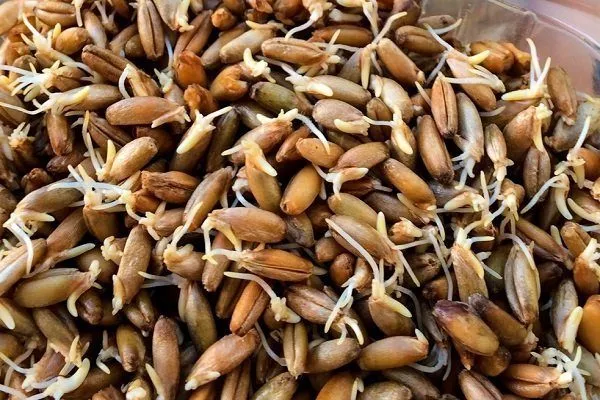
Oat germination algorithm:
- The grain is sorted and washed under the tap.
- Pour into a deep container, fill with water a few centimeters above the surface of the grain mass, and leave to swell for 10 hours.
- The soaked oats are washed again and poured into a wide, flat-bottomed container. The layer should be no thicker than two grains.
- Both under the grain mass and on top of it, they place damp gauze folded in several layers.
- Place the container in a warm place until the sprouts emerge, then move it to the refrigerator. Cooler conditions will slow the sprouts' growth, allowing them to be consumed longer.
It's best to store sprouted oats in a glass container. Air the sprouts daily to prevent them from rotting.
Oat sprouts are contraindicated for those with peptic ulcers or acute gastritis. In these conditions, the fiber-rich product is poorly digested and does not pass through the intestines, which exacerbates inflammation.
Growing oats at home for pet food or as a mineral and vitamin supplement to the human diet is simple and doesn't take much time. Choose the best method for producing succulent greens or sprouted grains, using specialized planting material.