
Ordinary gardeners appreciate corn for its delicious cobs, while farmers appreciate it for its high yield potential and versatility. This southern, heat-loving crop is now successfully grown in various regions of Russia. Let's learn how to plant corn from seeds and seedlings, and how to grow it in a temperate climate.
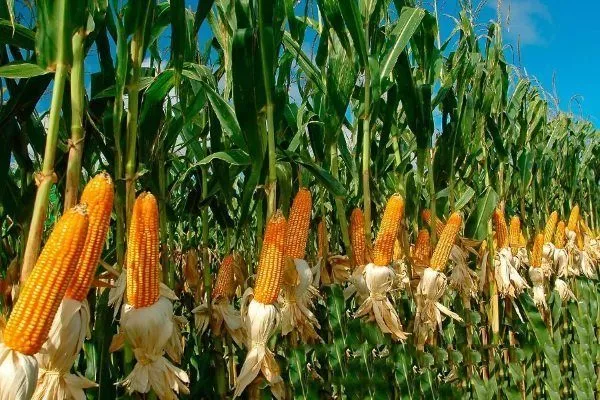
Features of corn as a garden plant
Corn belongs to the grass family (Poaceae). Botanical characteristics of corn:
-
- The plant is monoecious. Pollination is cross-pollination. The inflorescences are dioecious.
- It has a powerful root system, extending up to 1.5 meters deep. The plant forms special roots called buttress roots near the soil surface. These roots give corn its excellent stability. These buttress roots also actively absorb and retain moisture and nutrients.
- The stalk is erect and very strong. Depending on the variety, it grows from 60 to 600 cm. The average height of corn is 3 m.
- A mature plant has leaves 1 m long and 10 cm wide. The leaves are light green. Their surface is smooth, slightly pubescent on the outside. A single stem bears 12 to 23 leaves.
- The corn cob is a compound spike. At the top of the cob is the male inflorescence, which resembles a panicle. In the axils of the leaves are the female inflorescences.
- The fruit is a caryopsis. Depending on the variety, it varies in color and size. The cob weighs from 35 to 500 g.
Corn, unlike all other cereals, does not have a hollow stem.
Corn is one of the most widely cultivated crops in the world. Here are just a few facts that illustrate its importance and the scale of its cultivation:
- Corn is a food product, animal feed, and raw material for the production of industrial goods.
- Its crops occupy 150 million hectares in 160 countries around the world.
- It accounts for 36% of total grain production.
- Russia ranks 14th among the world's largest corn producers, producing 0.9% of the world's corn.
Corn was brought to Europe from the Americas, where it had long been cultivated by Native Americans. After extensive selection, various species and varieties were developed, which, while differing in purpose and characteristics, share common traits.
Corn is very different from its distant ancestor. It has become so domesticated that it has lost the ability to reproduce independently. If an ear of corn ends up on the ground, it won't sprout the following year, but will simply rot over the winter.
Which corn variety should I choose for growing?
Today, there are several types of corn, dozens of cultivars, and numerous hybrids. They differ from each other in their intended use, cob shape, and kernel composition.
Subspecies of common (sowing) corn
| Name | Disease resistance | Soil requirements | Ripening period |
|---|---|---|---|
| Sundance | High | Loose, fertile | 70-95 days |
| Lakomka-121 | High | Loose, fertile | Early |
| Spirit | Average | Loose, fertile | Average |
| Dobrynya | High | Loose, fertile | Early |
| Early Gold-401 | High | Loose, fertile | Early |
| Lingonberry | Average | Loose, fertile | Average |
| Pearl | High | Loose, fertile | Average |
| Polaris | High | Loose, fertile | Late |
| Bashkirovets | Average | Loose, fertile | Average |
| Pioneer | High | Loose, fertile | Average |
| Sugar F1 | High | Loose, fertile | Average |
Corn, or common maize (Zea Mays), is the most common species.
Subspecies of common corn:
- Sugar. The most delicious. It is most often grown for fresh eating. There are many varieties and hybrids. When ripe, the grains accumulate a lot of sugar. The grains have a wrinkled surface and a glassy finish when cut. It is used for canning.
- Waxy. The grains have a matte, smooth surface. The cut surface resembles wax.
- Dentate. The kernel is tooth-shaped. This subspecies forms the basis of corn production in the United States (producing 35% of the world's corn). It is used as livestock feed and as a raw material for flour, grits, and alcohol. It has a small leaf mass but large ears. The varieties differ in ear color.
- Semi-dentate. A hybrid of flint and dent corn. It serves as a raw material for the food industry.
- Flinty or Indian. It has a higher concentration of hard starch and is distinguished by its early maturity and productivity. The most popular flint corn is the "Pioneer" hybrid.
- Starchy. Hybrids with increased starch content. They have abundant green mass. Grown in America. Used for the production of alcohol, molasses, flour, and starch.
- Bursting. They have abundant greenery and several cobs with small kernels. They are used to make popcorn, flour, grits, and cereal.
There are also chaff-cutting and starchy-sweet corn, but they are unsuitable for food use. The former is occasionally grown for feed, while the latter is not even used industrially.
Varieties and hybrids
Common corn is represented not only by varieties, but also by numerous hybrids. The advantages of hybrids over varieties include:
- increased immunity;
- high yield;
- resistance to difficult weather conditions;
- good preservation of the harvest.
Hybrids have one drawback: their seeds are more expensive than those of regular varieties.
Popular varieties and hybrids:
- Sundance. This sweet corn is one of the tastiest varieties. The plant is short, with 2-3 ears. The ears are 20 cm long and 5 cm in diameter. The maturation period is 70-95 days. The kernels are yellow, elongated, and flattened. This variety is good for canning.
- Lakomka-121. This hybrid is popular for its high yield and disease resistance. Height: 1.5 m. Cobs: 20 cm long. The flavor is juicy and sweet. Suitable for freezing and canning.
- Spirit. A high-yielding hybrid. The cobs are very sweet, with golden kernels. The cob length is 20 cm.
- Dobrynya. Early-ripening sweet corn. A large-fruited hybrid. Height: 1.7 m. One plant produces 1-2 ears.
- Early Gold-401. A low-growing, disease-resistant hybrid. It has excellent flavor after freezing and canning.
- Lingonberry. A variety with thick, sweet cobs. Diameter – 6 cm, length – 21 cm. The yellow, sweet kernels retain their flavor after processing.
- Pearl. This variety is distinguished by its increased sweetness and versatility. The beans are delicious after any processing.
- Polaris. A late variety. Height: 2 m. Cobs are massive, golden, 23-24 cm long. Resistant to lodging and many diseases.
- Bashkirovets. A hybrid with very tall stems – up to 3 m. The length of the cobs is 23 cm, the thickness is 5 cm, the weight is 350 g.
- Pioneer. A high-yielding, mid-season grain hybrid. Cultivated in forest-steppe and steppe zones.
- Sugar F1. A widely grown hybrid with a mid-early ripening period. Height: 1.8 m. Cob length: 20 cm. Flavor: delicately sweet.
You can see the listed varieties of corn with their descriptions and photos in this article.
Planting features for different regions
Thanks to selective breeding, corn has become an unpretentious plant, and it is cultivated in almost all regions.
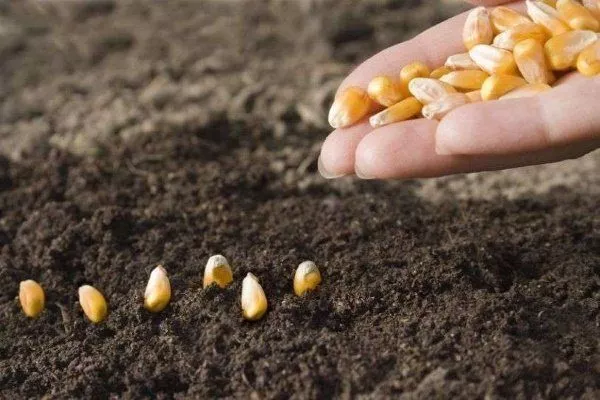
Peculiarities of corn cultivation in the regions:
| Region | How is it grown? |
| Moscow region, Leningrad region and central Russia | Seeds can be planted outdoors. The sowing period is mid-May. By this time, frosts are no longer possible, and the soil is warm and dry. Sow cold-resistant varieties. When planting in early May, cover the seedlings with plastic wrap. |
| Southern regions | Here, corn is grown only in open ground. Sowing begins in late April. |
| Siberia and the Urals | Cultivation here is difficult. The crop is practically never grown outdoors. Seedlings are used. Seedlings are planted in mid-June. |
The rule applies to all regions without exception: corn is planted in soil that has warmed up to at least 10°C.
What is the best time to grow corn?
For corn, soil quality and planting timing are more important than the preceding crops. However, given the same conditions, the highest corn yields are obtained from fields where the following crops were grown:
- melons and gourds;
- legumes;
- potato,
- table, sugar or fodder beets;
- cereals and grain crops.
In arid regions, corn is not planted after beets and sunflowers – these crops especially dry out and deplete the soil.
In ordinary gardens, corn can be grown in the same place for several years.
Millet and sorghum are unacceptable precursors for corn. All three crops share the same diseases and pests.
The best conditions for growing
Corn is demanding of the following conditions:
- Soil. It should be loose, permeable to air and water. Corn grows best in black soil, dark gray loam, and river floodplain soils. It also grows well in sandy and sandy loam soils, provided they are well-fertilized.
Corn does not thrive in saline, heavy clay, or highly acidic soils, as well as in areas with a high water table. Avoid growing the crop in soils contaminated with couch grass, pink bitterweed, and other rhizomatous weeds. - Warm. Seeds germinate at 8-10°C. However, under these conditions, germination is difficult, and many seeds become diseased and rot. Therefore, seeds are sown when the soil warms to 10°C at the seed placement depth.
Seedlings are sensitive to frost, but they can recover from temperatures of -2-4°C. However, autumn frosts of -3°C kill mature plants. A drop in average daily temperature to 10-12°C, especially during the initial growth period, delays the growing season. - Moisture. Corn yield is influenced by soil moisture content and precipitation. The crop is less sensitive to atmospheric dryness than other crops, but responds well to moisture.
- To the world. Corn is a short-day plant, requiring 12-14 hours of daylight. In shade, the leaf surface area is half that of plants with good light.
- ✓ Soil pH should be between 5.5-7.0 for optimal growth.
- ✓ The depth of the arable layer is at least 25 cm for the development of the root system.
How to grow corn from seeds and seedlings?
Corn is grown in two ways:
- By planting seeds in open ground. It is used in regions where warm weather persists for at least four months, and frost is either excluded or at least unlikely. The main requirement is warm soil. The soil is prepared in the fall or a few weeks before planting, adding mineral fertilizers.
- By seedling method. In regions where there's a risk of recurrent frosts and short summers, sowing outdoors is risky and impractical. Growing seedlings is necessary. But corn doesn't transplant well—even the slightest damage to the roots is enough to prevent the plant from taking root.
Selecting a suitable site
Requirements for a site for planting corn:
- Good lighting. No shadows.
- Protection from through winds.
- Slightly acidic and well-fertilized soils.
- Good neighbors include cucumbers, tomatoes, pumpkins, beans, and runner beans. Corn provides good support for beans and cucumbers. Bad neighbors include celery and beets.
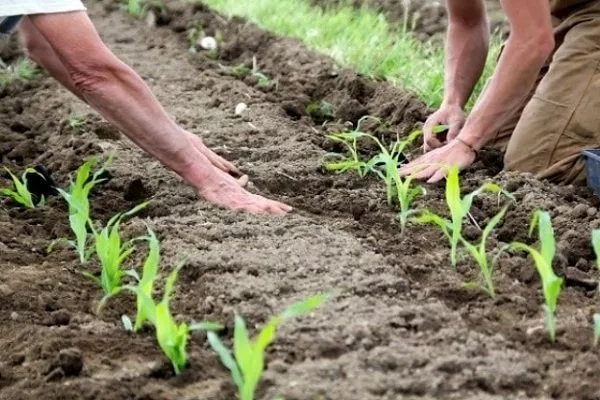
Timing of planting seeds and seedlings
The timing of planting corn depends on:
- Planting method: seedlings or seeds.
- Climate and weather conditions.
- Economic necessity.
- Soil temperature.
Based on these conditions, approximate timeframes are determined:
- For planting seeds. The earliest possible time is late April or early May. By this time, the soil has already warmed up to 10-12°C.
- For planting seedlings. Seeds for seedlings are sown in early May. The seedlings are planted no earlier than mid-June.
How to prepare the soil before planting?
All work is carried out before frost. Specific soil preparation guidelines for corn:
- In the fall, dig the soil to a depth of 30 cm. Organic fertilizer is added during the digging.
- During digging, carefully remove the roots of weeds.
- Fertilizers are applied to corn twice:
- In autumn. For 1 sq. m – humus (5 kg), potassium salt (100 g), double superphosphate (200 g).
- In the spring. Apply 50 g of nitrophoska per square meter. Loosen the soil two weeks before planting.
- In soils with high acidity, lime is added - 2-3 kg per 10 sq. m.
How to plant seeds in open ground?
How to prepare corn seeds for planting:
- Select the largest, undamaged seeds for planting.
- Check the seeds for germination. Place them in a salt solution for 5 minutes. Any seeds that float to the surface are not suitable.
- Rinse and dry the grains after testing in a salt solution.
- Treat the seeds in powder pesticide (3-8 g of TMTD per 1 kg of grains) or in potassium permanganate (5 g per 1 liter of water).
- Disinfect the seeds using hydrothermal treatment. Place the seeds in hot water (up to 50°C) for 20 minutes, then in cold water.
- Five days before sowing, warm the seeds to 35°C and place them in warm water, changing the water twice a day. The seeds will swell and germinate.
The prepared seeds are ready to be planted. Gardeners prefer a square-nested planting pattern. The procedure for planting in open ground is as follows:
- Make markings. The distance between adjacent holes is 50 cm. Or prepare furrows.
- Plant at least four rows to ensure good cross-pollination. Space rows 1 m apart.
- Water the depressions with a small amount of water.
- Place the seeds in the soil. Place 2-3 seeds per hole, and plant them in furrows at intervals of 40-50 cm. Deepen the seeds to a depth of 5-7 cm. Cover them with moistened soil, then with dry soil.
- Water the plantings again and then cover them with film until the seedlings appear.
- In 10-11 days, seedlings will appear.
- When the seedlings appear, pull out the weaker ones, leaving one plant, the strongest one.
An experienced gardener explains how to plant corn seeds outdoors in his video:
Manual seeding is only suitable for small areas. If you want to seed a larger plot, you'll need a special corn seeder.
To produce corn throughout the summer, a conveyor-type planting method is used. Varieties with different ripening times are planted at two-week intervals.
Seedling method
Growing corn from seedlings is a necessary measure. It's used only for small-scale cultivation. To ensure the cobs have time to grow and ripen before the onset of cold weather, the seeds must be sown and the seedlings planted in a timely manner. Early hybrids are most suitable for this purpose.
To speed up germination, soak the seeds in warm water for 12 hours and plant them while they're already swollen. This will cause seedlings to emerge 5-7 days earlier. Wrap the seeds in a damp cloth while they germinate.
The procedure for growing corn seedlings:
- Prepare cups for sowing - paper, plastic, or buy special cassettes.
- Prepare a soil mixture to fill the cups from:
- compost – 2 parts;
- sand – 1 part;
- peat – 1 part;
- ash – 1 part.
- After thoroughly mixing all the ingredients, fill the containers for sowing with them.
- Plant the seeds at a depth of 2-3 cm. Place only one seed at a time.
- Water the trays with warm water and Fundazol (4 g per 10 liters). This product will disinfect the substrate (soil mixture) from harmful microorganisms. Alternatively, use a weak solution of potassium permanganate.
- Keep the seedlings in a well-lit area.
To increase the water-holding capacity of a substrate or potting mix, you can add hydrogel. This reduces the number of waterings by 3-5 times—the crystals, having absorbed the water, will gradually release it into the soil.
Crops need to be looked after:
- Water moderately, several times on a sunny day.
- Feed with water-soluble fertilizers, such as Teraflex.
- 10 days before planting, feed the seedlings with superphosphate.
The planting pattern depends on the agricultural technology of subsequent cultivation:
- If drip irrigation is used, it's best to plant the seedlings in rows. The spacing between corn strips is 120-140 cm, and between rows, 45 cm. The drip tape is positioned in the center of the corn strip. This setup significantly saves both drip tape and water.
Corn is planted in adjacent rows in a staggered pattern to improve light and photosynthesis. The planting depth is approximately 8-10 cm. The distance between adjacent plants in a row is 40 cm. - If watering is to be done at the roots, a square-nest planting pattern is used. The hole pattern is 60 x 25 cm.
The order of planting seedlings:
- Carefully remove the seedlings from the cups, being careful not to damage the fragile plants.
- The holes should be 2-3 cm deeper than the length of the root ball removed from the cup.
- Place the seedling in the hole along with a lump of soil.
- Water moderately and sprinkle the holes with sand.
Below is a video of corn planting using seedlings:
Corn care
Inexperienced gardeners often think of corn as a low-maintenance crop; weeding and watering are the most they give the plant. In reality, this crop requires serious care, otherwise the soil will become depleted and there will be no harvest.
Weeding and hilling
Results of loosening and weeding corn:
- improves soil air permeability;
- increased protection against pests and diseases;
- moisture is retained in the soil better;
- weeds are destroyed.
In addition to loosening the soil, corn requires hilling. Corn stalks are thick and long and can break in the wind. Hilling, which involves pushing soil down toward the roots, increases the stalk's stability.
When growing corn on a large scale, no one weeds corn crops by hand—there's equipment for that. When growing at home, weeding and loosening the soil are done with a regular hoe, a flat-top cultivator, or a hiller.
Watering and fertilizing
Corn thrives on moisture. It can "drink" 2-4 liters of water per day. However, overwatering is unacceptable. If the soil is soggy, it lacks oxygen, causing roots to die, leaves to turn blue, and yields to decline. To prevent this, maintain humidity at 70-80%. The recommended watering rate for each plant is 1-2 liters.
If corn is grown on non-irrigated soils, it needs to be loosened more frequently to ensure that moisture is retained in the soil for as long as possible.
Watering features:
- Watering after planting seedlings is moderate.
- After seven leaves appear, gradually increase the amount and frequency of watering. When inflorescences appear, stop watering. When the threads on the cobs darken, water the plants moderately.
- The best watering method is drip irrigation. Water, along with dissolved nutrients, is delivered directly to the roots, saving water and fertilizer.
Fertilizing the soil in preparation for planting doesn't mean corn won't need additional feeding during the growing season. Unlike other crops, this crop continues to grow foliage throughout the growing season, so it requires feeding from spring to fall. Moreover, it requires different fertilizers at different stages of development.
Corn fertilizing strategy:
- Nitrogen is added in the spring. The plant should receive the bulk of the nitrogen fertilizer before inflorescence formation.
- Potassium is needed during the first half of the growing season. After that, the element is released into the soil.
- Corn requires less phosphorus than nitrogen and potassium, but it is added throughout the season – from soil preparation until the cobs ripen.
Micronutrients are also used for fertilization. Corn requires zinc and manganese, and to a lesser extent, boron, calcium, and copper. Alkaline soils typically lack boron and manganese, while acidic soils lack calcium. To replenish these micronutrient deficiencies, corn crops are sprayed and fed foliarly.
The first time corn is fed is when the third and fourth leaves emerge. A solution of manure or bird droppings is added. The second time, the crop is fed with ammonium nitrate (20 g per square meter), potassium salt (20 g per square meter), and superphosphate (40 g per square meter).
When symptoms indicate a deficiency of specific elements, appropriate fertilizers are applied. For example, if white streaks appear on the leaves, treat the plants with a zinc solution; if fertilization is delayed, treat them with a boron solution.
Pest and disease control
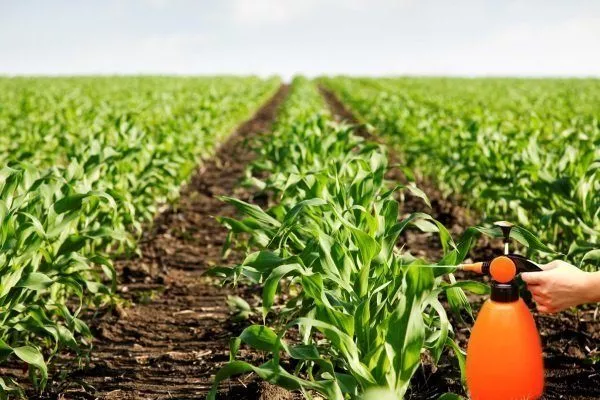
Corn is susceptible to many pests and diseases, and to obtain a decent harvest, it is necessary to treat it with pesticides and agrochemicals in a timely manner.
Schedule of pesticide treatment:
- The first spraying is done at the beginning of the growing season. Alpha-cypermethrin, Thiram, and Tebuconazole are suitable.
- If insects appear, a proven product, BI-58, will do the trick. It's effective against almost all pests.
- Before flowering, spray with Thiram – this will protect the plants from mold and smut, and prevent root and stem rot.
Diseases and pests of corn and measures to control them:
| Diseases/pests | Symptoms | Control measures |
| Fusarium | The cobs have a pink coating. Affected kernels darken and disintegrate. | The disease is not curable, but can be prevented by treating seeds with fungicides and sowing in well-warmed soil. |
| Helminthosporium | Gray and brown spots with a sooty coating in the center appear on leaves and cobs. The spots grow, and the leaves die. The pathogen survives on the seeds. | To prevent this, it is necessary to maintain crop rotation, plant resistant hybrids, treat seeds with fungicides, and remove weeds and corn residues from the area. |
| Stem rot | Spots appear on the stem and internodes. The stem rots and dies. | Likewise |
| Loose smut | Affects inflorescences and cobs. Can destroy up to 40% of the crop. | Likewise |
| Rust | Light yellow spots appear on the underside. The leaves dry out, and the entire plant becomes infected. | Likewise |
| Click beetle (wireworm) | The beetle larvae are yellow worms that eat seeds and sprouts. | For prevention, spray with "Guacho." If infestation occurs, treat with "Barguzin." Add lime or ash during spring tillage. |
| Swedish fly | The fly lays eggs on stems and leaves. The larvae suck out the plant's sap and consume its fibers, causing it to wither and die. | To prevent the problem, disinfect the soil and destroy weeds. If flies appear, treat them with insecticides. |
You can get more information about corn diseases and pests here.
Harvesting and storage
Harvesting begins when the cobs reach milky ripeness. The following signs are used as a guide:
- The outer wrapper has dried out and its color has become lighter.
- The threads on the cob have completely dried out and turned brown.
- If you press on the grain, a milky white drop appears.
- The grains have become smooth, the rows are tightly closed, the color corresponds to ripeness (depending on the variety).
If harvesting is delayed, the corn will overripe and lose flavor. The kernels will become shriveled, tasteless, and difficult to cook.
The procedure for storing cobs:
- Remove the leaves from the cobs without cutting off the husks.
- Remove the corn silk, the thin threads at the top of the cob.
- Braid the cobs and hang them from the ceiling to dry completely. Dry in a dry, well-ventilated area. To check if the cobs are dry, shake them; the kernels will fall out easily.
- To store corn for a long time, shell the kernels. Place them in plastic or glass containers, cloth bags, or cardboard boxes. Store popcorn kernels in the freezer, placed in plastic bags.
Milk-ripe corn, which is used for cooking, is stored at 0°C for no longer than 3 weeks. Storing it at a higher temperature results in a daily loss of 1.5% of its sugars. Milk-ripe corn is best stored frozen or canned—only these conditions preserve its nutritional value.
If your freezer is large, you can freeze corn on the cob:
- Place each cob, cleaned of its stigmas and husk, in boiling water for 2 minutes, then in cold water for 2 minutes.
- Dry the cobs by laying them out on a cloth.
- Wrap each cob in plastic wrap and place in the freezer. They will keep there for up to a year and a half.
Useful tips for beginning farmers
Experienced gardeners give advice to beginners:
- Remove side shoots from corn to prevent the plant from wasting energy on them. This will ensure larger ears.
- To avoid the development of half-empty cobs, do not plant corn in one row; the minimum number of rows is two.
- Do not allow the soil to dry out during flowering, otherwise the stigmas will lose their ability to pollinate.
- When the corn flowers, shake it to help the pollen move from the male flowers to the female flowers more quickly.
Corn is a unique agricultural crop; its versatility and adaptability to a variety of climatic conditions are truly astounding. Growing it outdoors is simple and requires little effort. Growing corn from seedlings is more challenging, but it's entirely possible if you use early varieties and hybrids and strictly adhere to the seedling method.