
Fertilizing peas solves many problems: the soil is enriched with essential nutrients, the crop grows and develops better, and yields a good quality and quantity of harvest. Various fertilizers are used for peas, and they can be applied in several ways.
General rules for fertilizing peas
When feeding peas, you need to follow certain rules:
- Before applying fertilizers in the form of solutions, apply generously water the peas with clean water. This helps avoid burning the root system.
- Foliar feeding is best done in the evening, when the sun is not active. On cool days, spraying can be done early in the morning.
- When sowing, apply fertilizers in water-soluble form.
- Avoid fertilizing the crop for the first two weeks after planting. This time is necessary for the peas to begin growing and acclimate to the new conditions.
- Adjust the frequency of fertilizing to the plant's growth phase. The more active the plant, the more nutrients it needs.
- Strictly adhere to the recommended dosages. Excessive fertilizer application can adversely affect plant health and their chemical composition. Overly concentrated fertilizers can cause root and aerial parts burn.
- Avoid over-fertilizing with nitrogen. This negatively impacts shelf life and leads to nitrate accumulation in the fruit.
- Remember to take personal protective equipment – wear gloves and protective clothing when handling fertilizers, and wash your hands thoroughly after handling.
- ✓ Consider the soil pH before choosing a fertilizer type, as peas prefer neutral or slightly acidic soils.
- ✓ Test the soil for trace elements such as boron, cobalt, manganese, copper, molybdenum, zinc before applying micronutrients.
When creating your own pea fertilizer mixtures, it's important to keep in mind the compatibility of different substances. Some can neutralize or enhance the effects of other elements.
Fertilizing the soil before planting
The pea plot should be prepared in the fall. Fertilizing at this stage has a positive effect on the crop's growth the following year, reducing the need for additional fertilizing.
- ✓ Use of green manure, such as mustard or phacelia, in the fall to improve the soil structure and enrich it with nitrogen.
- ✓ Use of wood ash (0.5 kg per 1 sq. m) to reduce soil acidity and enrich it with potassium and microelements.
When digging beds in the fall, it's effective to use organic matter, with the exception of fresh manure. We recommend applying 6 kg of fertilizer per square meter. One option for autumn organic feeding is rotted grass. Spread it over the selected area, distributing one bucket per 2 square meters.
Potassium-phosphorus fertilizers are also effective. 30 g of potassium salt and twice as much superphosphate are required per square meter.
Applying potassium-phosphorus fertilizers to peas in the fall can increase yields by 30-50% compared to similar fertilizers applied in the spring.
Peas prefer neutral or slightly acidic soils. If the soil is highly acidic, add slaked lime at a rate of 0.3 kg per square meter. Dolomite flour can be used effectively instead, at a rate of 0.4 kg per square meter.
When growing peas in black soil, sod-podzolic soil, or acidic soil, applying phosphorus flour is also effective. 30 g of the product per square meter is sufficient when applied in the fall.
In spring, nitrogen application is recommended, especially during the colder months. If potassium-phosphorus fertilizers were not applied in the fall, a complex fertilizer can be used. Apply a teaspoon of potassium salt, superphosphate, and saltpeter per square meter. After applying these fertilizers, the beds should be dug over.
Fertilizing crops at different stages of their growth
When growing peas, it's recommended to apply fertilizer twice, not counting the fall and spring preparations. The first application is done at the very beginning of flowering, and the second at the beginning of fruiting.
For top dressing, it's recommended to use liquid organic fertilizer, dissolving 1 tablespoon of fertilizer in a bucket of water. This amount is enough to treat a 3 square meter area. Fertilizers are applied via the root system. Along with this type of top dressing, it's effective to use natural stimulants. These are applied foliarly, that is, by spraying.
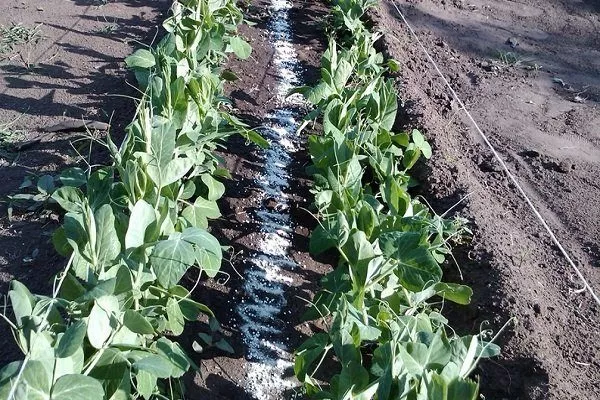
If the pea plot is well-fertilized with organic matter, it's recommended to limit the application to mineral fertilizers during the growing season. These are applied twice. The first time, when the seedlings reach 6-8 cm in height, 25 g of fertilizer per square meter is needed. This can be applied dry, followed by generous watering. The second application is done with the same fertilizers, but as a solution—1 tablespoon per bucket of water is sufficient. The resulting solution is then irrigated between the rows.
Additional fertilizing may also be required, especially in severely depleted soils.
Types of fertilizers and methods of their application
Depending on the chemical composition and origin, there are mineral, organic and bacterial fertilizers and micronutrients.
Organic fertilizers
Such products can be of plant or animal origin. It is recommended to apply organic matter during the fall tillage, and when growing crops, use it only once per season, as needed.
Some experts believe organic fertilizers are not required at all when growing peas. It's sufficient to apply them to the preceding crop.
Mineral fertilizers
This group includes various inorganic compounds. Phosphorus-potassium fertilizers are especially important for peas.
Phosphorus
The crop requires phosphorus until it reaches full maturity. This macronutrient is essential for stimulating root growth, the formation of reproductive organs, and the timely ripening of fruits.
One popular nitrogen fertilizer is urea. When growing peas, it is recommended to use it in the early stages, especially when the seedlings are too weak. Urea is applied when the plants reach 8-10 cm in height. One gram of fertilizer per bucket of water is sufficient.
1.5-2 weeks after the first shoots emerge, it is recommended to apply double superphosphate in granules. 2-3 g of the substance is needed per square meter.
During pea flowering, it is effective to combine phosphorus with nitrogen.
Potassium
Potassium also plays a vital role in crops. Adequate potassium intake improves metabolism and increases plant resistance to drought and disease. A potassium deficiency can lead to leaf tissue death. An excess of this element can cause beans to form and ripen quickly, but this has negative consequences: plants don't reach the desired height, and the fruits remain small.
Potassium fertilizer application rates depend on soil type. If the soil is dark gray, 6 g of potassium fertilizer per square meter is needed.
Potassium nitrate can be an alternative to double superphosphate. For 1 square meter, you need 10-15 g of the substance dissolved in a bucket of water.
Microfertilizers
Mineral fertilizers alone aren't always sufficient for effective pea cultivation. Yields also depend on the proper supply of certain micronutrients. The following elements are particularly important:
- boron;
- cobalt;
- manganese;
- copper;
- molybdenum;
- zinc.
Microfertilizers are often used in the form of complex compositions:
- Micropoppy PeasFertilizing seeds after seed treatment is effective. This increases germination, improves root development, stimulates crop growth, and makes the crop more resilient to adverse conditions, including drought.
- MicroelLiquid fertilizer is used for foliar feeding when 3-4 true leaves appear. It enhances photosynthesis and increases the plant's resistance to disease, drought, and other adverse factors. A second application can be made during the budding stage, combined with fungicide or insecticide treatments. In addition to enhancing photosynthesis, applying fertilizer at this stage increases protein content.
Complex micronutrient fertilizers are highly concentrated, so it is important to strictly adhere to the manufacturer's recommended dosages.
Peas use not only complex fertilizers but also single-component fertilizers. The need for these can be determined by the crop's appearance:
- For copper deficiency Growth slows, turgor decreases, the plant wilts, flowering is delayed, and leaf tips turn white. This deficiency can be replenished with copper sulfate or copper sulphate. This fertilizer is especially effective in sandy or peaty soils.
- Zinc deficiency This is manifested by stunted growth and development, and streaks appearing between the veins on older leaves. Zinc sulfate is used to replenish this element.
- Boron deficiency This is characterized by weak flowering, poor bud formation, and poor shoulder development. Mag-Bor fertilizer can be used. It is suitable for both root and foliar feeding.
Bacterial fertilizers
These formulations are based on microorganisms. They don't contain any beneficial elements, but they improve the crop's nutrition. The following formulations can be used for peas:
- Flavobacterin;
- Agrophile;
- Rhizoagrin;
- Mizorin.
Bacterial fertilizers stimulate root growth and promote biochemical processes. This results in enhanced crop growth and development, increased resistance to disease and other adverse factors.
Fertilizer application methods
Fertilizers are applied either through root or foliar application. In the former case, the desired elements are scattered on the soil and watered generously, or a solution is prepared for irrigation; in the latter case, spraying is used. Foliar application requires weak solutions.
Root feeding is recommended 1.5-2 weeks after the first shoots emerge. Foliar feeding can be done up to four times during the growing season, with intervals of 2-3 weeks between applications.
You can learn about how to feed peas in the following video:
There are many fertilizers for peas, each with specific benefits. Proper preparation of the planting site is the most effective, as this will significantly increase yields. Regardless of the fertilizer used and the method of application, it's important to remember moderation—an excess of nutrients is as dangerous as a deficiency.
Thank you so much for the information. I've only planted peas twice, but somehow they just didn't work out. I'll definitely follow your recommendations this year. By the way, I've made note of my mistakes, and there were many.