
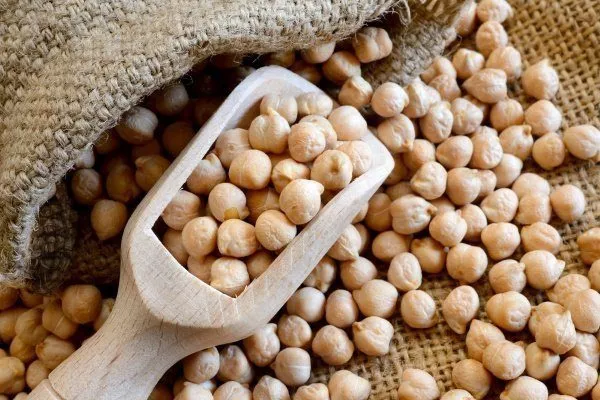
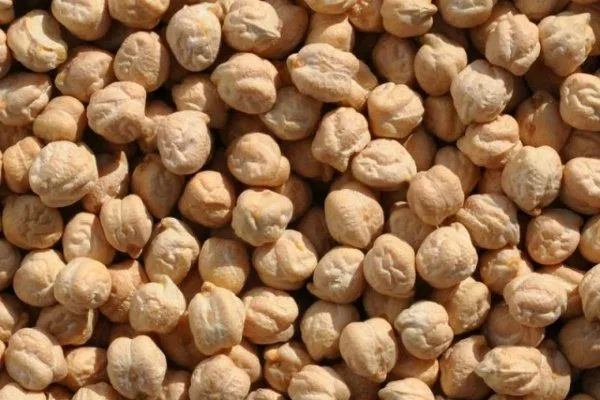
Chickpeas are a widely grown, high-quality legume. Their cultivation has become popular due to their high drought and disease resistance, and the high demand for their seeds. Learn more about the different varieties and how they differ from each other later in the article.
Groups
There are 3 groups of chickpeas, which differ in external characteristics:
- Southern European The bushes are lush, composed of numerous branches and reaching a height of 70 cm. Most of the branches are at the top of the plant. The flowers are small.
- Central European – the bushes are smaller in size (their height is no more than 45 cm), but wide, also consist of many branches and are densely covered with flowers.
- Anatolian – the height of the bushes reaches only 25 cm. The top of the plant is branched, the flowers are white.
- ✓ Optimum soil pH for chickpeas: 6.0-7.5.
- ✓ Required depth of the arable layer: not less than 25 cm.
Varieties
In our country, there are only 4 varieties of chickpeas.
| Name | Bush height, cm | Weight of 1000 seeds, g | Growing season, days | Protein content, % | Yield, kg per 10 sq. m |
|---|---|---|---|---|---|
| Krasnokutsky 195 | 30-40 | 250 | 90-115 | 30 | 2.6 - 3.5 |
| Anniversary | Up to 45 | 250-300 | 90-100 | 25-27 | 1.5-3.0 |
| Budjak | 60-65 | 420 | 80-90 | 27 | 1.8-2.0 |
| State farm | Up to 30 | 260-290 | 100-105 | 22-24 | 1.8-3.8 |
Krasnokutsky 195
The bush is branched and upright. It blooms white and has a short peduncle. The lowest pods are 15-20 cm from the ground. It contains more protein than all other varieties. The pods are yellow-pink and wrinkled. Each pod contains 1-2 seeds. It is resistant to diseases, drought, and pod cracking.
Main characteristics:
| Bush height, cm | Weight of 1000 seeds, g | Growing season, days | Protein content, % | Yield, kg per 10 sq. m |
| 30-40 | 250 | 90-115 | 30 | 2.6 - 3.5 |
Planting of the variety begins in late April - early May according to the following scheme:
- for row sowing - the distance between rows is 30-40 cm;
- for tape - 50 cm;
- for lowercase - distance 20 cm.
It is important to maintain the correct planting depth:
- if the soil is well moistened, the seeds are placed at a depth of 7-8 cm;
- if it’s bad, then by 9-10 cm.
Anniversary
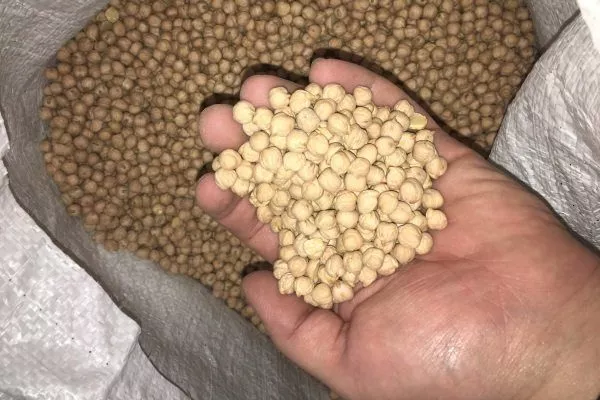
The bush is low and upright, with white flowers and a short peduncle. The pods are yellow-pink, wrinkled, and contain 1-2 seeds per pod.
The plant is relatively disease-resistant. It tolerates drought well, and the beans are resistant to cracking.
Main characteristics:
| Bush height, cm | Weight of 1000 seeds, g | Growing season, days | Protein content, % | Yield, kg per 10 sq. m |
| Up to 45 | 250-300 | 90-100 | 25-27 | 1.5-3.0 |
When planting, follow this pattern:
- 35-45 cm distance between rows;
- 50 cm between strips (for strip sowing).
Sowing is carried out in early May, the depth depends on the climatic conditions of the area:
- with frequent rains – 6-7 cm;
- in arid regions – 8-9 cm.
Budjak
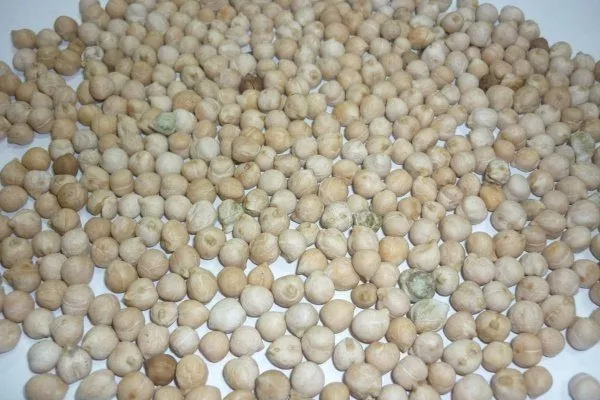
The bush is tall and branched, with oblong, wide leaves, large white flowers, and a small peduncle. The lower pods are located 20 cm from the ground. The pods are beige and oblong. Each pod contains 1-2 seeds.
The plant tolerates drought well and is resistant to diseases such as ascochyta leaf spot and fusarium wilt. It has the shortest growing season of any chickpea variety.
Main characteristics:
| Bush height, cm | Weight of 1000 seeds, g | Growing season, days | Protein content, % | Yield, kg per 10 sq. m |
| 60-65 | 420 | 80-90 | 27 | 1.8-2.0 |
Planting takes place at the end of April.
Sowing pattern and depth:
- row sowing – 35-45 cm between rows;
- tape sowing – 50 cm between tapes;
- in arid areas the sowing depth should be 8-9 cm;
- in well-moistened soil, the sowing depth is 6-7 cm.
State farm
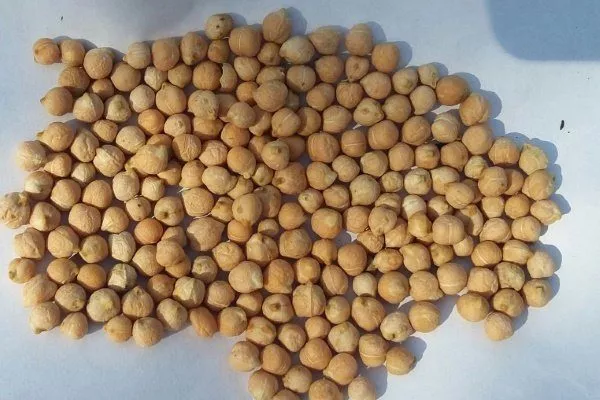
The bush is dense and low, with small, white, solitary flowers and a short peduncle. The pods are brown and angular, tapering toward the beak. Each pod contains 1-2 seeds.
The plant has good resistance to drought, bean cracking and diseases such as ascochyta leaf spot.
This variety contains the lowest percentage of protein. Yield is unstable.
Main characteristics:
| Bush height, cm | Weight of 1000 seeds, g | Growing season, days | Protein content, % | Yield, kg per 10 sq. m |
| Up to 30 | 260-290 | 100-105 | 22-24 | 1.8-3.8 |
Sowing into the ground is done in April-May.
Features of planting and growing:
- sowing pattern: 30-40 cm between rows, 50 cm between strips, 20 cm between lines;
- Planting depth: 6-8 cm with good soil moisture, 9-10 cm with poor soil moisture.
Difficulties in growing
The key to growing all varieties of chickpeas is to thoroughly clear the area of weeds and their rhizomes. Otherwise, not only the appearance of the chickpeas but also their flavor will suffer.
The problem is that none of the herbicides used for other legumes are suitable for chickpeas. All of them lead to complete crop destruction. Furthermore, chickpeas are even susceptible to the residual effects of some herbicides (for example, those containing the active ingredient metsulfuron-methyl) used on previous crops.
- ✓ Yellowing of the lower leaves may indicate a nitrogen deficiency.
- ✓ Delayed growth and development can be caused by a lack of phosphorus.
To prevent the chickpea crop from being damaged by weeds, the following methods are used:
- They select fields where weeds have been removed during the growing stage of previous plants, using long-acting herbicides that do not harm chickpeas.
- If perennial weeds are present, they are removed in the fall, immediately after the previous crop has been harvested, using methods such as cultivation, disking, and treating the field with glyphosate.
- Harrowing is the most effective method; in dry areas, it eliminates the need for herbicides entirely. The first harrowing is done before the first shoots emerge—four to five days after sowing. The next harrowing is done when the shoots reach about 6 cm in height, and then again a week later.
Sometimes, after rains, in the second half of the growing season, weeds reappear among the chickpeas. In this case, they are removed by treating them with desiccants.
- ✓ Watering is especially important during the flowering and bean formation period.
- ✓ Avoid over-watering the soil to prevent the development of fungal diseases.
Chickpeas, a legume crop, grow well in warm, arid regions without any special growing conditions. The only difficulty is weed control, but this can be easily overcome by improving farming practices. Knowing the proper planting and care guidelines for your chosen chickpea variety can help you easily achieve a bountiful harvest.