
Staking peas shouldn't be ignored, even when it's not necessary for a particular variety. This measure provides numerous advantages during cultivation, positively impacting the yield, flavor, and quality.
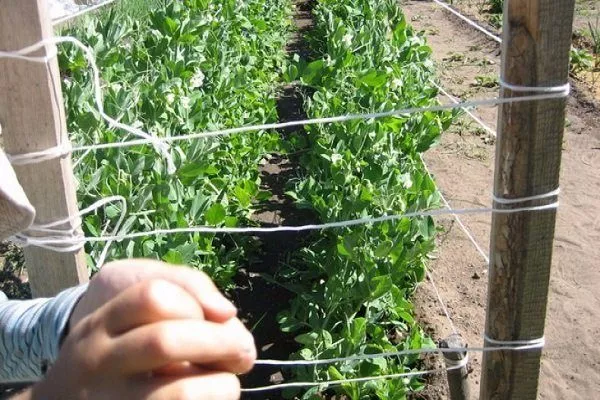
The need for gartering peas
The primary need for pea support is due to the crop's height, which can reach 2 meters or more. This translates to considerable weight, which increases as the peas grow and ripen. This can lead to lodging, leading to problems.
The following tasks are solved by using the garter:
- peas look neat, plantings can perform a decorative function;
- saves space in the garden bed – when arranged vertically, the stems require less space;
- air circulates better between plants, light and heat penetrate even to the lower branches, so the stems develop fully;
- sunlight falls evenly on the pods, the peas ripen on time, becoming larger and sweeter;
- interaction of the above-ground parts of the plant with soil and moisture, which leads to rotting and disease, especially in rainy weather, is excluded;
- the risk of being affected by the pea weevil (bruchus), after which the germination of the seed material disappears and the harvest becomes unfit for consumption, is reduced;
- harvesting is simplified and the risk of missing pods is reduced, as their overripening causes the entire plant to dry out.
Timing of garter
The need for staking should be based not on specific dates, but on the height of the plants and their developmental characteristics. Lodging begins when the seedlings reach 30-40 cm. Staking should be done earlier, when the shoots reach 15-20 cm. The presence of tendrils, which the plant will use to cling to the support, is essential.
It's important to think ahead about how exactly the peas will be supported. If you're using a complex structure, it should be set up before planting.
Material for garter
When choosing a material for staking peas, it's important to consider its rigidity. Steel wire and twine are not suitable for this purpose. If the material is too rigid, the tied sections may break in wind or rain.
You can choose one of the following options:
- soft fabric - it needs to be cut into narrow strips, the material should be durable enough to withstand the season;
- thick threads;
- cord made of plastic or polyethylene;
- hemp;
- plastic garters with snap;
- Special clips - these devices resemble clothespins and can be purchased at the store.
Methods of garter
Peas can be tied up in a variety of ways. When choosing the best option, consider the planting area, the height of the specific variety, and the desired decorative effect.
Tying to stakes
One of the simplest and most common options. You can use picket fencing, thick branches, bamboo, or other similar materials. Wood is best, as metal will get too hot in the sun and cause burns.
- ✓ The height of the support should exceed the maximum height of the plant by 15-20 cm to ensure stability.
- ✓ The distance between supports in a row should not exceed 50 cm to prevent sagging of plants.
The number of stakes should correspond to the number of plants in the bed. They should be installed vertically, 10-15 cm away from the seedlings. This can be done during planting. The length of the stakes should be calculated for the height of the specific plant variety, with an extra 15-20 cm required.
If the peas aren't tall, they'll twine around the support, and that's enough. For taller plants, you'll need to stretch a rope between the stakes as they grow. Do this every 20 cm.
For information on tying up peas using stakes and rope, watch the following video:
Support from other cultures
This option is usually used for large plantings. Sunflowers and grain crops can serve as natural support for peas. They should be planted between the rows of the pea bed, taking into account the growing season.
If you use corn as a natural support, you'll need to pay extra attention to fertilizing. This crop draws out a lot of nutrients, so it's best to avoid this type of planting.
Fence support
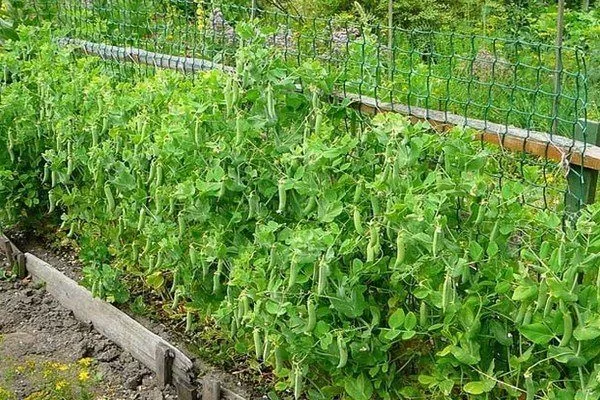
This option is completely free, reliable, and time-saving. It's best to plant peas near a fence, as long as it's not made of metal. The plants will naturally cling to the support as they grow.
Most pea varieties require full sun. Avoid using a fence for support if the area is shaded.
Trellis
This type of pea support is very popular. You can make the trellis from scrap materials or purchase it from a store—it's available in collapsible or folding versions.
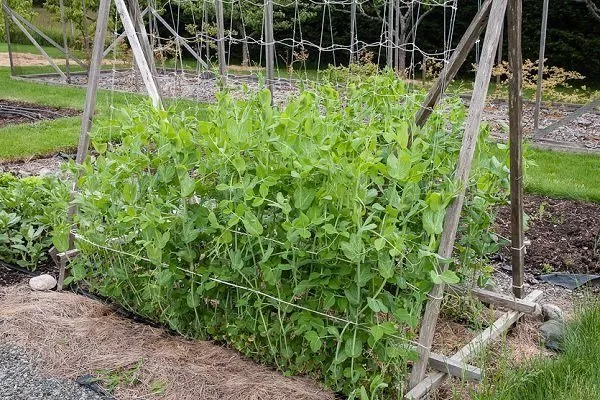
To make it yourself you will need:
- Take four sturdy beams, each 2 meters high, eight thin slats, and some rope. The finished structure will resemble a double-sided stepladder.
- For the frame, use strong beams; they must be connected in pairs at an angle to each other – you should get two triangles without a base.
- Use thin beams to create crossbars spaced 30 cm apart, resembling the steps of a staircase. The first step should be 15-20 cm high.
- Stretch a rope or other material perpendicular to the crossbars to tie up the peas.
Trellis should be installed before planting peas. Their advantage is that they are portable, so they can be used for years to come.
hut
This support can be used for decorative purposes – the green shelter looks impressive. It's easy to build:
- Make four supports from stakes or pickets. The optimal height is 2 m. You can place these supports at the corners of a single bed or connect two beds.
- Tilt the supports toward each other in pairs and connect them. You should end up with two triangles at the beginning and end of the bed.
- Connect the tops of the triangles with a picket or pole. This will form the frame of the hut.
- Connect the supports along the long sides of the bed at the bottom. If the bed has a wooden frame, this measure is not necessary.
- Stretch ropes or other material connecting the top pole to the bed frame. The number of ropes depends on the number of plants being planted—each requires its own support. Pickets or long, thin poles can be used instead of ropes.
For a hut-shaped support for peas, watch the following video:
Wigwam
This is not only a reliable support but also a way to decorate your property. This solution is effective for especially tall varieties. You'll need four poles for the teepee, with the optimal height being 2 meters. If desired, you can add a central pole for a more secure support.
The poles are installed at a distance of 0.7 m, forming a circle with the central pole at the center. The tops of the side poles should be tilted toward the center and secured together. The optimal angle is 60 degrees.
It's recommended to create a teepee before planting the peas. They are planted next to the side poles. As they grow, the peas will climb up them, creating a beautiful decorative look.
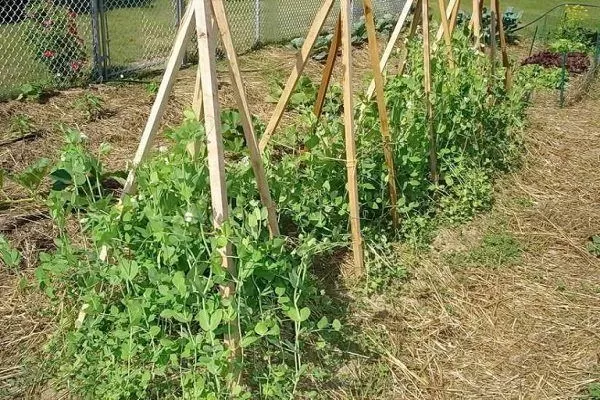
Trellis mesh
You can buy this device at the store; it's usually designed for cucumbers. You can use pickets or stakes to secure the netting. The height of the stakes should be appropriate for the specific variety.
The stakes should be installed along the entire length of the bed, centered in its center. The netting should be stretched and secured. Binding wire is a good choice for this. The resulting structure resembles a tennis net.
Peas should be planted on both sides of the net in a staggered pattern. When the first tendrils appear, they should be hooked into the lower mesh of the structure. The plants will then secure themselves to the net.
You can set up this structure near a fence. Attach one side of the mesh to the fence, and the other to a beam on the ground. It should be angled 60 degrees relative to the fence. This option provides excellent lighting.
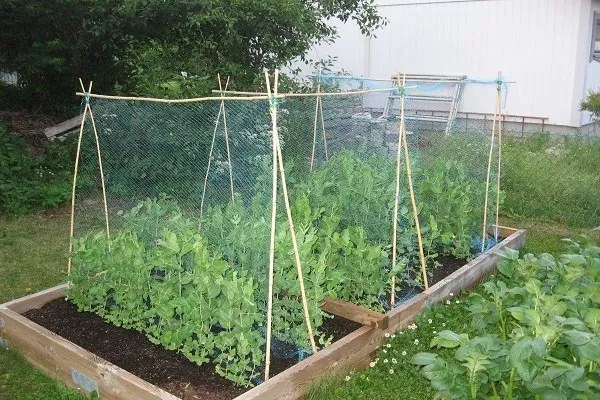
Galvanized mesh
This option is attractive for its durability, thanks to the material's strength and corrosion resistance. It's ideal for use in shaded areas—some varieties can be grown in such conditions.
The mesh diameter should be at least 10 cm. It is better to use reinforcement supports to secure the mesh.
Bicycle wheel support
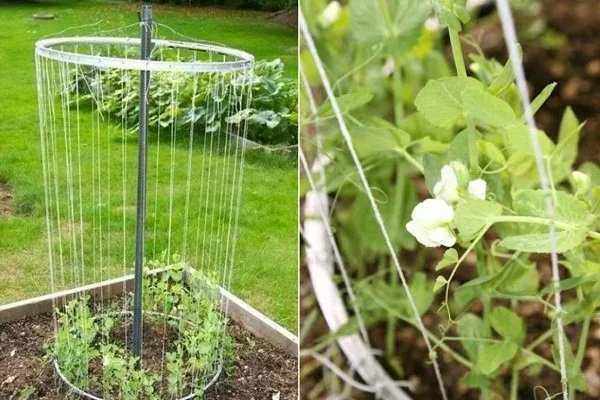
You don't have to use whole wheels; just a rim from each wheel will do. You'll need two rims per support—one placed on the bed, the other 1.5-2 meters above it. It's best to use rebar for securing them. String or thread should be stretched vertically between the bottom and top rims to tie the peas to.
This structure should be built before planting. Peas are planted around the bottom rim. The structure is portable and can be used for many years.
Instead of bicycle wheels, you can use barrel hoops or make circles from rebar.
Common mistakes
There is nothing difficult about tying up peas, but gardeners often make mistakes:
- Installing supports after planting peasIn this case, there is a high risk of damaging the plant. This applies to both the above-ground parts and the root system.
- Use of metal structures. May cause plant burns.
- Application of rigid materials. Leads to stem breaks.
- Insufficient support lengthIt is essential to take into account the height of a particular crop variety, and with some allowance.
- Insufficient strength of supportsThe structures used must be strong and stable, especially large structures like shelters, trellises, and stretched nets. If such a structure collapses, it could destroy the entire garden bed.
The article listed pea support options of varying difficulty. Every gardener can choose the most suitable method based on their personal needs and preferences. The main goal of staking peas is not decorativeness, but rather providing the crop with the best growing conditions.