
Peas are an easy-to-grow plant, but their cultivation can be plagued by diseases and pests. This can result in poor yields and reduced crop quality. It's important to detect signs of damage early and take appropriate action.
Pea diseases: symptoms, treatment and prevention
Almost all pea diseases are fungal. Often, affected plants cannot be saved, but it is possible to stop the problem and prevent it from spreading to other crops.
Ascochytosis
Ascochytosis is classified as pale, dark, and confluent. All three types are caused by the same pathogen: ascomycete fungi of the genus Ascochyta.
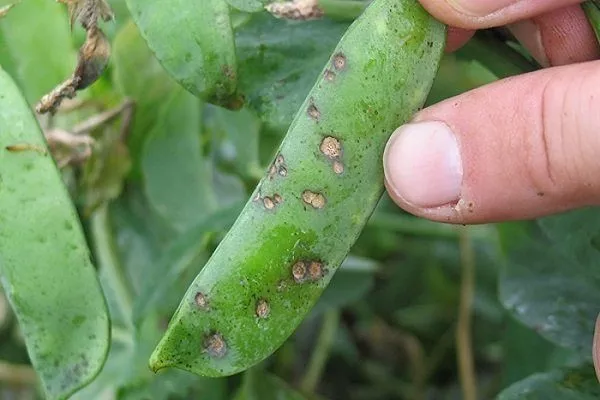
For pale ascochytosis The following signs are characteristic:
- light chestnut spots on beans, with a dark brown border;
- the same spots can affect leaves and stems;
- round spots up to 0.9 cm in diameter on leaves and beans, on petioles and stems they are elongated;
- instead of spots, the formation of multiple pycnidia (fruiting bodies of fungi) is possible;
- The peas become wrinkled and light yellow, faint spots appear on them.
Dark ascochytosis Affects leaves, stems, and beans. Dark brown, irregularly shaped spots up to 0.7 cm in size appear. The surface of large spots is covered with pycnidia. When seedlings are affected, the root collar turns black and begins to rot.
For coalescent ascochytosis Characterized by round, light-colored spots with a contrasting dark border, they often merge and affect leaves and stems.
When affected by ascochytosis, some of the seedlings die, the development of the crop is delayed, and the ripening period increases.
The pathogen overwinters on infected plant debris. Mycelium in seeds can survive for over five years. Disease development is facilitated by high humidity and air temperatures of 20-25 degrees Celsius. Pycnospores are released in abundance and are spread by wind and raindrops.
- ✓ The concentration of Bordeaux mixture should be 1% to effectively combat ascochytosis.
- ✓ The interval between fungicide treatments should be 5-7 days to prevent resistance.
If ascochyta blight is present, treat the area with a fungicide. Bordeaux mixture is effective. If the plants are severely affected, remove them and burn them.
Preventive measures are as follows:
- treat seeds before planting;
- burn plant residues;
- observe crop rotation rules;
- Use fungicides during the growing season for prevention.
Bacteriosis
This disease is also known as bacterial spot. It is caused by Pseudornonas bacteria. They enter through wounds and stomata and can travel through the vascular system to the beans, infecting the seeds.
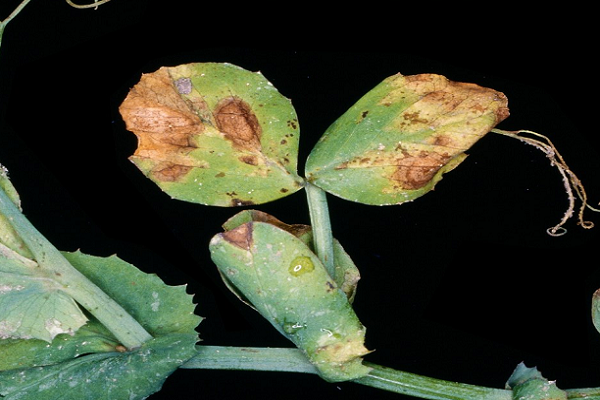
The signs of the disease are as follows:
- large brown spots, round or irregular shape, oily border;
- spots may merge;
- If the seeds are affected, sunken spots appear on them.
The pathogen survives in plant debris and infected seeds. High humidity and cool weather favor disease development. The bacteria can survive for up to 5 years. They are spread by wind, raindrops, and soil dust.
Pea bacteriosis should be controlled with bactericidal or iodine-containing products. These are used for spraying. Gamair and Fitolavin are effective; copper sulfate and Bordeaux mixture can also be used.
Prevention of bacterial rot consists of:
- burning of plant residues;
- deep digging of the soil in the fall;
- seed treatment;
- the use of drugs used to combat the disease.
Root rot (fusarium)
The disease is caused by imperfect fungi, most often of the genus Fusarium Link, and less commonly by Rhizoctonia solani Kuehn or Thielaviopsis basicola Ferr. They inhabit soil and plant debris. They are spread by seeds, which contain the mycelium within their coats.
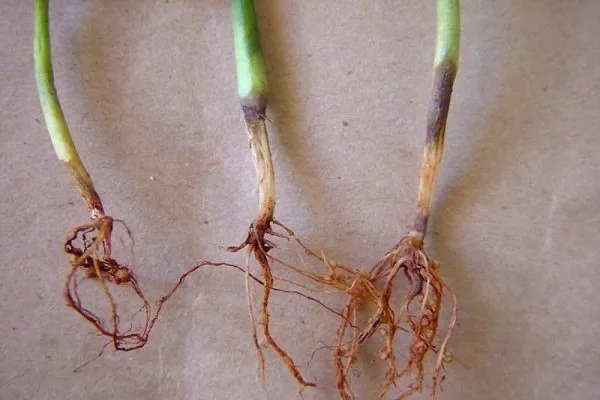
Root rot is expressed by the following symptoms:
- yellowing, curling, drying and falling of leaves;
- stunted plant growth, death of severely weakened specimens;
- at high humidity – the appearance on the affected parts of the crop of a white or pinkish coating with pinkish or orange pads;
- the appearance of many thin lateral roots on the main root above the affected area;
- Tracheomycotic wilt is possible - drooping of leaves and stem tips, their rapid drying out, red-brown coloration of root vessels, leaf petioles and peduncles.
- ✓ The appearance of many thin lateral roots on the main root above the affected area.
- ✓ Red-brown coloration of root vessels, leaf petioles and peduncles with tracheomycotic wilt.
High temperatures and low relative humidity are favorable conditions for the development of root rot. Affected plants produce shriveled seeds or fail to produce fruit at all.
To combat and prevent the disease, fungicides and biological preparations are used: Fundazol, Trichodermin, Trichophyte, Fitolavin, and Bordeaux mixture. Folk remedies are also effective:
- A solution of iodine in four parts water. Use to treat the stem and upper parts of the roots.
- A mixture of equal parts crushed chalk and sifted wood ash. Use to dust affected plants.
- A solution of potassium permanganate. The color should be pale pink. Water the soil around the affected plants, applying it to the roots.
- A paste of 0.5 liters of water, 3 tablespoons of chalk, and 1 teaspoon of copper sulfate. Apply to the top of the stem, root collar, and upper parts of the roots.
- A solution of 10 liters of water, 1 liter of milk, 20 g of laundry soap (grate first), and 30 drops of iodine. Treat the affected plants, repeating the treatment twice at 10-day intervals.
Prevention of root rot is:
- disinfection of soil before planting crops;
- burning of plant residues;
- moderate fertilization;
- preventing over-watering of the soil and moisture stagnation.
Downy mildew
This disease is also known as downy mildew. It is caused by the fungus Peronosporales. Plants are usually affected at the beginning of flowering.
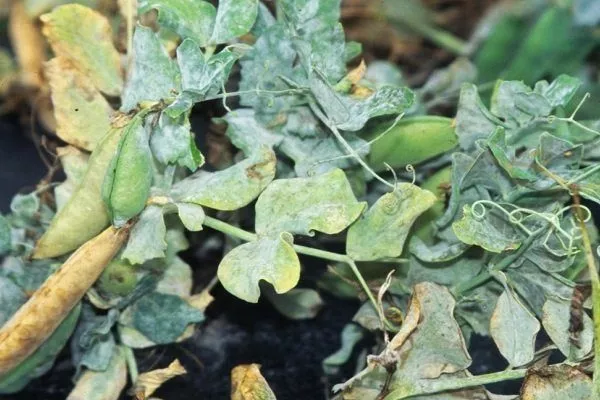
The disease affects all above-ground parts of the crop and is manifested by the following symptoms:
- round spots of whitish or yellowish color on the upper side of leaves;
- a web-like, greyish-purple coating on the underside of leaves that forms when humidity is high;
- diffuse chlorotic spots on stems and pods.
This type of damage is called local, but a diffuse type is also distinguished, when all above-ground organs are uniformly covered with a gray-purple coating.
Plants affected by downy mildew lag in growth, the grain produced is shriveled, and the yield suffers noticeably.
High humidity and low temperatures facilitate the development of downy mildew. The pathogen survives in plant debris and overwinters there. The mycelium may be present in the seed coat.
Fungicides help combat the disease. They are also used during the growing season for prevention. Bordeaux mixture, Fitosporin, Gamair, and Alirin are effective. Alternatively, you can also try folk remedies:
- Dissolve 60-70 g of sulfur in a bucket of water. Spray the affected plants with this solution.
- Prepare a solution of 9 liters of water, 1 liter of skim milk, and 10 drops of iodine (5%). Spray the crop.
- Pour 0.3 kg of mature onion peels into 10 liters of water, bring to a boil, and let steep for 2 days. Use the strained solution for spraying.
- Prepare a weak solution of potassium permanganate. Use for spraying.
To prevent downy mildew you need to:
- observe crop rotation rules;
- burn plant residues;
- carry out crop sowing at an early stage;
- Treat seeds with fungicide before sowing.
Mosaic
The disease is viral, caused by the Pisum Virus. Dry weather and lack of moisture favor its development.
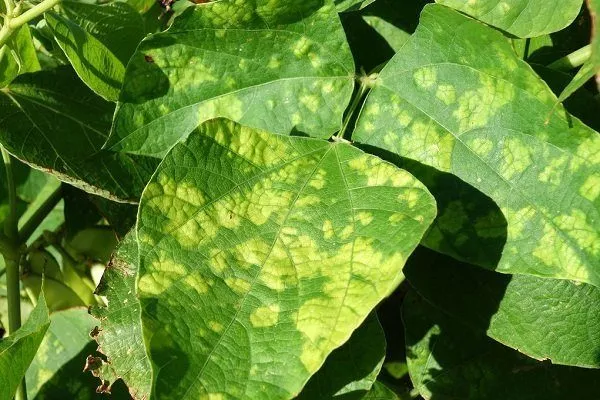
The symptoms are as follows:
- light green spots on the leaves that gradually become transparent;
- mottling of leaves, they become wrinkled and curly;
- if the infection is early, the crop does not bear fruit;
- with late infection, yield decreases;
The main source of infection during sowing is contaminated seeds. During the growing season, the virus is spread by aphids.
If a mosaic is present, remove the affected plants, including some of the soil. Treat the remaining plantings with malathion (75 g of malathion per 10 liters of water).
Prevention of mosaic is:
- aphid control;
- early sowing of crops;
- using healthy seeds.
Powdery mildew
The causative agent is a marsupial fungus of the genus Erysiphales. The disease spreads rapidly, being carried by insects, wind, and raindrops. Temperatures above 20°C, humidity levels of 70-90%, and late sowing are favorable for its development.
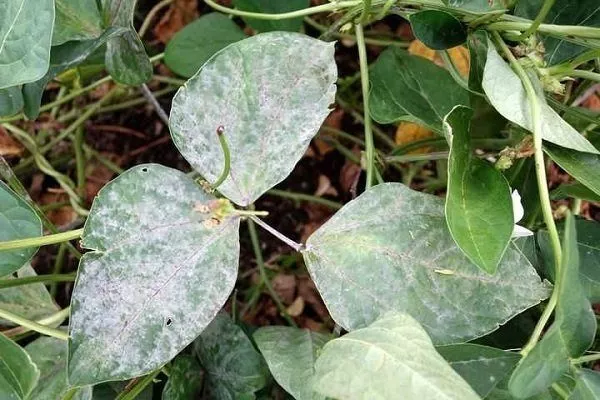
The signs of the disease are as follows:
- a white or powdery coating that affects the upper side of leaves, stems, flowers, bracts, and beans;
- gradually cleistothecia form, the plaque acquires a dirty gray color;
- Severely affected parts of plants become rough and die.
Fungicides such as Fundazol, Fundazim, Topaz, Quadris, Tilt, and Gamair help combat the disease. Traditional methods are also effective:
- A solution of 1 liter of water, 4 g of washing soda, and the same amount of soap (first diluted with water). Apply at least twice a week.
- Brew 1/2 cup of ash in a liter of boiling water, let steep for 2 days, and strain. Add 4 g of soap diluted in water. Apply to the plants, repeat after a week.
- Separate the whey from sour milk or kefir, add 10 parts cold water, and stir until smooth. Use the mixture for spraying.
Prevention of the disease is:
- early sowing of crops;
- burning of plant residues;
- getting rid of affected plants;
- application of phosphorus-potassium fertilizers.
Rust
The causative agent is a basidiomycete fungus of the genus Uromyces. The disease attacks beans, stems, and leaves. Peas are infected in the spring, and the rust often spreads to them from milkweed. Excess nitrogen in the soil promotes the disease.
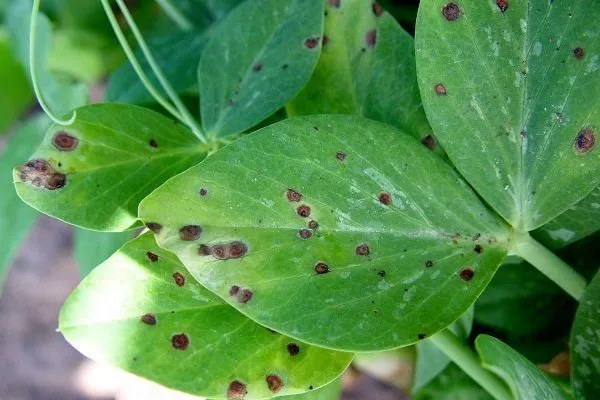
Orange-brown powdery pads, which are the summer spores of the pathogen, appear on affected parts of the plant. They are easily dispersed by the wind. By late summer, the pads turn brown, darkening to almost black.
In an affected crop, photosynthesis and other important processes are disrupted. Yields are significantly affected, with losses potentially exceeding 30%.
Rust should be controlled with fungicides, spraying at intervals of 5-7 days. Amistar Extra, Rex, and Zineb are effective. Bordeaux mixture or a sulfur suspension can also be used; the concentration of any of these should be 1%.
Rust prevention is:
- weed control, especially milkweed;
- burning of plant residues;
- moderate use of nitrogen fertilizers.
Gray mold
The disease is caused by the polyphagous imperfect fungus Botrytis cinerea Per. Sclerotia of the pathogen persist in soil, plant debris, and seeds. In the latter case, germination of the seed is impaired. Gray mold significantly reduces yields. Low temperatures, precipitation, and high relative humidity contribute to the development of the disease.
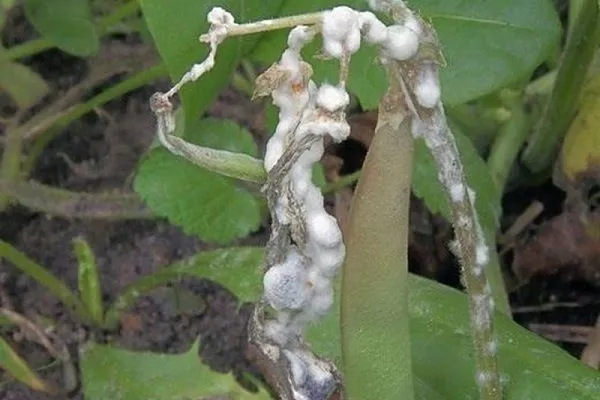
The disease can be identified by the following signs:
- damage to all above-ground parts of plants;
- brown coloration of flowers, formation of spores on petals;
- the affected flowers fall off – this is how the infection spreads to the rest of the plant;
- water-soaked, dirty green spots on the underside of leaves, gradually increasing in size;
- Over time, the spots on the leaves begin to rot, a grey coating appears, and the leaves fall off.
Gray mold develops when beans fill out and begin to ripen. This doesn't prevent seed formation, but in wet weather, pathogen spores appear on the seeds, causing them to rot and fall off. Beans can also be affected at the technical maturity stage, with the infection penetrating the seeds, causing them to lose their seed-growing quality. If fully ripened beans are affected, the seeds are only affected during prolonged rainfall; they lose their luster, become rotten, and develop brown, diffuse spots.
To combat this, you'll need fungicides like Title Duo, Scarlet, Fitosporin-M, and Bordeaux mixture. Gray mold can also be controlled using traditional methods. A mixture of one cup of wood ash, the same amount of chalk, and one teaspoon of copper sulfate will work. Dissolve all of this in 10 liters of water; this amount will cover 2-3 square meters of area.
Prevention of gray mold consists of:
- burning of plant residues;
- soil disinfection;
- treatment of seeds and crops with fungicides.
Pea Pests: Symptoms, Treatment, and Prevention
Various pests can eat some parts of the plant, spread viruses, bacteria and fungi.
Bean moth
The pest is also known as the acacia moth. It is a moth that causes damage to plants during its caterpillar stage. After overwintering in cocoons in the soil, they pupate in the spring. The larvae are usually pale green, sometimes reddish or black.
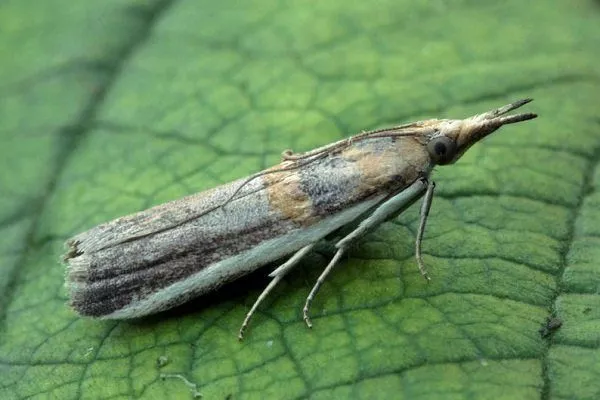
The caterpillars chew through the pods and devour the peas. The pest is very voracious. After finishing one bean, it moves on to another, leaving a web of excrement along its path. If the bean moth infects the bean yield can be halved, and the seeds become unsuitable for planting.
- ✓ Insecticide treatment during the budding phase of peas to prevent egg laying.
- ✓ Use of pheromone traps to monitor and reduce pest populations.
To combat the pest, spray with chlorophos and phosphamide. Universal insecticides such as Borey, Sharpei, Break, and Sirocco can also be used.
Prevention is as follows:
- deep digging of the soil in autumn;
- early sowing of peas;
- distance from acacias;
- timely removal of weeds.
Pea moth
This common pea pest is also known as the bruchus. It is a brown caterpillar 0.7-0.9 cm long. It prefers dry weather, calm weather, and darkness.
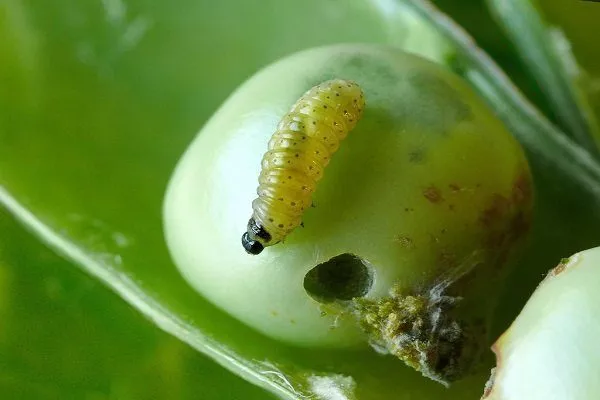
Bruchus lays its eggs on leaves and flowers in the spring. The young caterpillars feed on peas. Infestation can be identified by the following signs:
- a hole in the pod - the caterpillar gnaws through it to get inside;
- black cobweb on peas.
Pea moths can cause losses of up to half a crop. Damaged plants also become more vulnerable to other pests.
You can fight bruchus using the following methods:
- preparations containing chlorophos or metaphos (Vofatox, Metacid);
- pesticides: Paragraph, Operkot, Alkot;
- garlic infusion - chop 30 g, pour 10 liters of water, leave for a day, strain.
Prevention is as follows:
- use of early ripening varieties;
- planting in early spring;
- burning of plant residues;
- processing of planting material before sowing.
Grain
This pest also belongs to the genus Bruchus. The beetle measures 0.1-2 cm. It has a black oval body and a cross-shaped pattern on its abdomen. The larvae pupate in grains, and in the fall, the beetles emerge to overwinter in plant debris and under tree bark.
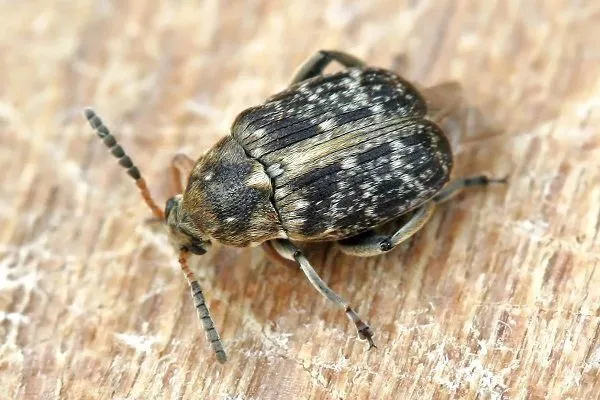
The pest's activity begins with the fruiting of peas. The beetle prefers sunny, humid weather. It's difficult to detect, as the only sign is a brown spot on the pod.
There are many preparations for combating pea weevil: Caesar, Tsunami, Fagot, Zeppelin, Accord.
For prevention you need to:
- sow peas early;
- treat the crop with insecticides at the beginning of flowering;
- in autumn, dig the soil deeply;
- destroy plant debris;
- observe crop rotation.
Umbrella psyllid
These are small yellow bugs with transparent wings. They penetrate leaf tissue and suck out the plant's sap. The above-ground portion of the plant becomes deformed, and growth is stunted.
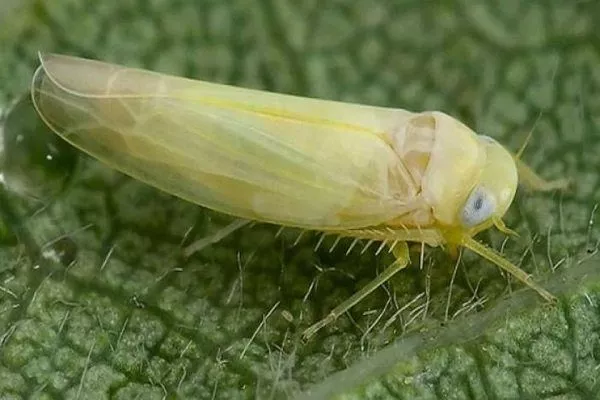
Treating the plant with ash or celandine will help get rid of the pest. Insecticides can also be used.
Prevention is as follows:
- burning of plant residues;
- compliance with crop rotation.
To avoid damage by the parasol psyllid, do not plant peas after carrots or next to them.
Tuber weevil
This beetle is 0.5 cm long, has no eyes or legs, a chitinous head, and dark mandibles. It emerges in early spring and feeds on leaves. Adults eat the tops of pea plants, while larvae in the soil consume the lower portions. The crop dies, and there is no harvest. Some plants survive, but yields can be reduced by 70%.
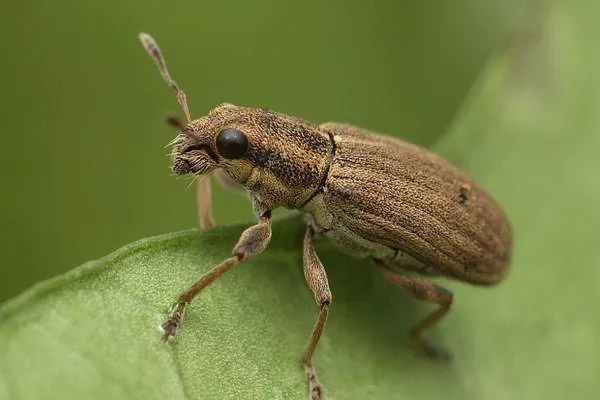
Beetles continue feeding even at night, so they can cause significant damage in just 24 hours. Fastak is an effective pest control product.
Prevention is as follows:
- early sowing of peas;
- burning of plant residues;
- compliance with crop rotation rules.
Chickpea leaf miner
A small but very dangerous pea fly. The insect is only 0.2 cm long, has a brown body, and a bright yellow head. The fly has a proboscis, which it uses to pierce the stems to feed on plant juices. As a result, yields can drop by 70%.
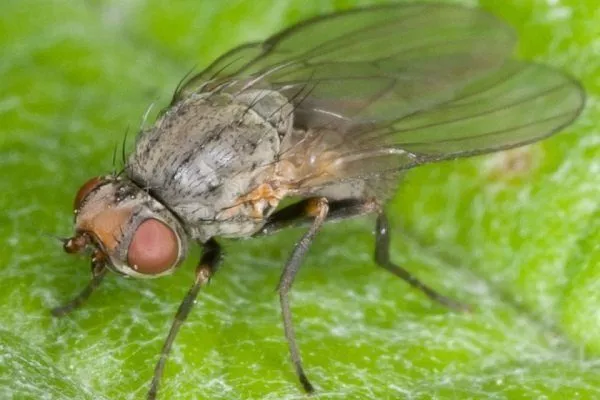
The same proboscis is used for laying eggs. The hatched larvae tunnel throughout the plant. These tunnels vary in length and shape and are called mines. The leaves of affected plants become lifeless, quickly turn yellow, and die.
The pest spreads rapidly, with up to five generations occurring during a single growing season. Insecticides are used to control it, including Verimek, which is also effective.
Prevention is as follows:
- deep autumn digging of the plot;
- timely removal of weeds;
- compliance with crop rotation rules.
Aphid
This pest attacks not only peas but also other agricultural crops, so it's especially important to get rid of it promptly. Aphids carry all kinds of viruses and feed on plant juices. The pest also covers the plants with excrement, which creates a favorable environment for the development of pathogenic fungi.
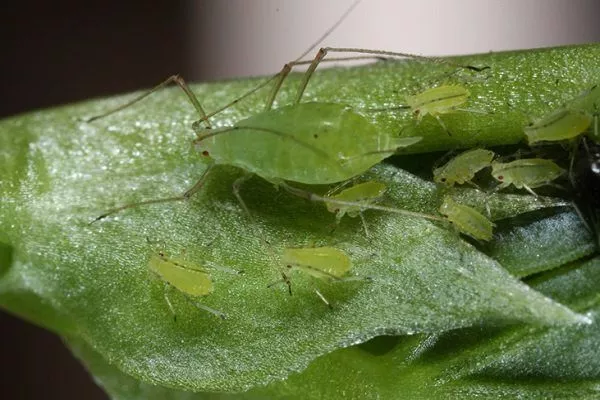
Aphids are 0.5-0.8 cm long and green or red in color. They typically live in colonies on flowers and leaves and overwinter on plants. Aphids typically appear in late August.
When aphids infest your crops, losses can exceed 70%. Pest control should be achieved with insecticides (Fitoverm, Iskra, Fastak). Alternatively, try folk remedies: a solution of wood ash and laundry soap works well – 4 g of each per 10 liters of water.
Prevention is as follows:
- burning of plant residues;
- regular spraying of crops with plain water;
- compliance with crop rotation.
Early sowing of the crop is important, which allows for harvesting before the widespread spread of the pest.
Peas often suffer from diseases and pests if growing conditions aren't followed. It's better to take preventative measures than to treat the problem later with pesticides that aren't always safe.
Good afternoon! Does the Colorado potato beetle eat peas? I've never seen one.
Hello! You're right, they don't eat it. Potatoes and peas are often planted together. Some gardeners aren't sure why this is necessary, but they know it's better this way. Others have heard somewhere that peas protect potatoes from the Colorado potato beetle (how exactly isn't clear...there's no substantiated evidence), but they still recommend this type of planting together. In this case, Colorado potato beetles can indeed be seen on the peas (they crawl from the potatoes to neighboring plants). That's why you often see information that the Colorado potato beetle is a pest of peas. In any case, Colorado potato beetles need to be controlled, regardless of where they infest.
I'll try to explain why it's recommended to plant peas next to potatoes. Firstly, peas are an excellent green manure crop, loosening the soil and preventing weeds from growing. Plus, peas provide nitrogen to potatoes, just when the potatoes need it to grow their tops.
I'll go further: I plant a couple of peas and a potato in the same hole. The crops don't interfere with each other. As for the Colorado potato beetle, it doesn't like peas. I've personally never seen one eat them. Yes, they might land on the plant, but they certainly won't eat it.
From personal experience, I know that the more green peas there are near potatoes, the fewer beetles there are. It's like that with us…