
Beans are a heat-loving crop, so they are planted only after stable warmth has set in. In regions with short summers and prolonged springs, legumes, like nightshade crops, are grown from seedlings. This allows for a quicker harvest by at least a couple of weeks.
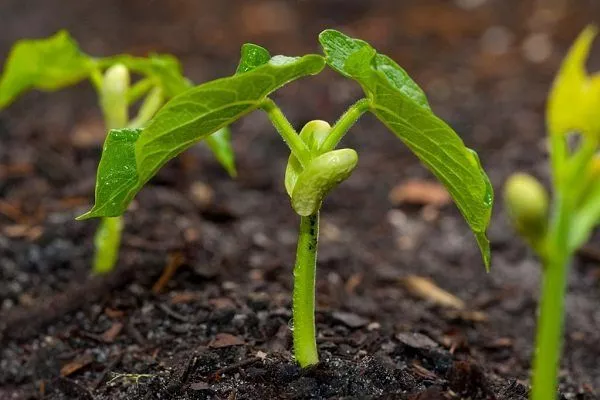
Planting bean seedlings
In the south, beans are grown by direct sowing in the ground, while in cooler regions, the seedling method is popular. Seedlings are grown indoors, in greenhouses, or other warm spaces.
- ✓ Optimum temperature for bean seed germination: +23..+24 °C.
- ✓ Required soil moisture for seedlings: 60-70%.
Preparing soil and containers
| Name | Ripening period | Disease resistance | Soil requirements |
|---|---|---|---|
| Early variety of beans | 50 days | High | Average |
| Mid-season bean variety | 70 days | Average | Low |
| Late-ripening variety of beans | 100 days | Low | High |
- ✓ Drought resistance: critical for regions with hot summers.
- ✓ Length of growing season: choose depending on the climatic conditions of your region.
Bean seedlings don't transplant well, so experienced gardeners avoid growing them in containers. If you sow the crop in individual pots, you won't need to transplant the seedlings—once they reach the desired size, they can be transplanted directly into the ground.
Along with plastic cups, peat pots are used for growing bean seedlings. They are more expensive, but the peat containers are placed in the holes along with the plants. This keeps the seedlings' roots intact, and the peat serves as additional fertilizer.
Features of preparing containers and soil for bean seedlings:
- It is recommended to use new cups for growing seedlings. If the containers are old, scald them with boiling water or disinfect them with a solution of potassium permanganate.
- Seedlings are grown in a universal substrate, which is disinfected before use. The simplest method is to water the substrate with potassium permanganate and then let it dry.
- Instead of purchased substrate, you can use soil mixtures prepared according to one of the following recipes:
- peat, humus and sawdust are mixed in a proportion of 2:2:1;
- turf soil and compost in equal parts;
- garden and turf soil in a ratio of 3:2.
In mixtures without sawdust, it is recommended to add river sand (about 10%) and a little wood ash.
Sowing dates
Seedlings grow for approximately 3-4 weeks from sowing to planting. The sowing time is determined based on the regional climate. Beans are planted in the ground when the weather is consistently warm.
Suitable conditions for planting beans:
- the air temperature settled at +20…+25 °C;
- the soil is warmed up to +12…+15 °C;
- the possibility of frost is excluded.
Recommended sowing dates for seedlings by region:
- Ural – at the beginning of May;
- Siberia – in the second ten days of May;
- Central Russia – at the end of April or the beginning of May;
- North-West region – in the first ten days of May;
- Southern regions - in the second half of March (in the south, beans are practically not grown using the seedling method).
Preparing seeds before planting
Store-bought seeds are usually already prepared for planting, so unlike home-collected seeds, they don't require additional disinfection, and hardening and soaking won't harm them.
The procedure for preparing seeds for sowing:
- Calibrate. Inspect the beans. Discard any small, wrinkled, damaged, or out-of-color seeds. Place the selected seeds in a 5% salt solution.
Discard any plants that float to the top. They are not suitable for planting. Rinse the remaining salt and proceed to the next preparatory step. - Disinfect. Place the seeds in a 1-2% potassium permanganate solution for 20 minutes. Rinse with running water and dry.
- Soak. Soak the seeds in a damp cheesecloth for 12-15 hours. Don't soak for longer than necessary, as the beans may turn sour. Use melted snow or rainwater for soaking. Make sure the cheesecloth doesn't dry out, but don't allow water to stagnate.
- Temper. This procedure is relevant for regions where temperatures can drop after planting seedlings in the ground. To harden the seeds, soak them in the refrigerator for 5-6 hours. The optimal temperature is +4…+5°C.
Seedling planting technology
Once the containers are filled with soil and the seeds have been treated and germinated, it's time to sow. In addition to the containers, you'll need prepared water—warm and settled.
The procedure for sowing beans for seedlings:
- Water the containers with soil. Wait until the water is absorbed.
- Plant one bean in each cup. Plant them 3-4 cm deep. If you're unsure about germination, plant two. If both beans sprout, choose the stronger of the two plants.
- Cover the buried seeds with soil and compact it slightly.
- Cover the cups with plastic wrap to create a favorable microclimate. Place the containers with the seeds in a warm place (23°C to 24°C) until the seedlings emerge.
- Remove the film daily for 10-15 minutes to ventilate the crops and prevent condensation.
- After 4-5 days, when the seedlings emerge, remove the film and move the plants closer to the light. However, the temperature is reduced to 16–20°C. Avoid allowing the temperature to drop below freezing, otherwise the seedlings will stop developing and may die.
- Caring for seedlings involves maintaining normal lighting, loosening the soil, and watering.
- A week before planting, begin hardening off the seedlings by taking them outdoors daily. Once the seedlings have 3-4 true leaves and the weather is favorable, begin preparing to transplant them into the ground.
To learn how to plant bean seedlings without soil, watch the following video:
Transplanting seedlings into open ground
Beans aren't picky about soil, as long as it's not clayey, as this can cause stagnant water and root rot. It's recommended to prepare the soil in the fall by digging it over and adding organic fertilizer.
When growing beans, follow crop rotation. It is recommended to plant them after nightshades (tomatoes, potatoes, peppers, eggplants), cucumbers, or cabbage. Beans should be planted no sooner than 3-4 years after legumes.
Good neighbors for beans include carrots, beets, cabbage, cucumbers and tomatoes.
First, the soil is dug deep—a spade's depth (about 30 cm). Then, organic and mineral fertilizers are added. Per 1 square meter:
- compost and humus – 3 kg;
- wood ash – 1 glass;
- superphosphate – 1 tbsp. l.;
- nitrophoska – 1 tbsp. l.
Fertilizers scattered over the area are mixed with the soil, digging it to a depth of 10 cm.
The procedure for transplanting seedlings:
- Prepare the beds. Rake them level and dig holes at intervals of 15-20 cm. Leave 40-50 cm between rows. When choosing the spacing, consider the characteristics of the variety – the more spreading and taller the plants, the wider the gaps.
- Water the seedlings before transplanting. This will make it easy to remove the plants from the cups.
- Carefully remove the seedlings from the cups. Try to extract them together with the soil lump.
- Carefully transfer the seedlings into the holes. Plant the seedlings 1-2 cm deeper than they were in the cups. Cover the roots with soil and press it down gently. If the seedlings are growing in peat pots, plant them in the containers.
- Water the planted seedlings and mulch the soil. If there is still a risk of cold weather, cover the plantings with film at night.
If climbing bean varieties are planted, then during planting, supports are installed - single stakes or trellises.
Features and planting patterns for bush and climbing beans
The planting pattern and method depend on the bean variety. Bush varieties are planted slightly more densely than climbing varieties.
Planting pattern for bush/climbing beans:
- The intervals between plants are 20-25/25-30 cm.
- Distances between rows: 40/45-50 cm.
Beans are grown in rows or pits. The planting method is chosen based on the variety's characteristics and personal preference.
Planting methods:
- In rows. The simplest and most popular option. Plants are arranged in a single row, leaving wide spaces between rows. This method is used if space is at a premium.
- With ribbons. This option is also called multi-row. Beans are planted in 2-3 rows (lines). The distance between them is smaller than between rows—approximately 25 cm. This allows for more efficient use of space.
- Nests. This option is especially convenient for climbing varieties. A stake is placed in the center, and several plants—5-6—are planted around it to climb up it.
Caring for seedlings in open ground
Beans are an undemanding vegetable plant, but without proper care they won't yield a good harvest. To ensure each plant produces the maximum number of densely packed pods, it's essential to water and loosen the bean beds regularly, and even fertilize them when necessary.
Watering
The development and yield of bean plants largely depend on irrigation. However, moderation is essential when watering, as overwatering can cause plant rot.
Features of watering beans:
- Watering is especially important during the harvest period. The size of the pods and beans depends on it. If the weather is hot and the plants don't get enough water, the flowers and ovaries will fall off.
- After watering, the soil must be loosened to prevent crusting. Weeds are removed simultaneously with loosening.
- Beans are watered approximately once a week. The frequency of watering depends on weather conditions – if it rains, the crop is watered less frequently.
- The watering rate after transplanting is 10-12 liters per 1 square meter. During the period of pod formation, the rate is increased to 16-18 liters.
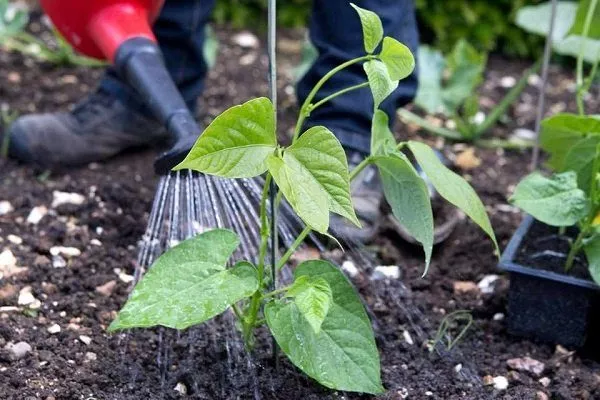
- Water beans in the morning or evening, using settled or rainwater. When watering, avoid getting water on the plant leaves. It is recommended to water between the rows.
Thinning
If beans are planted as seedlings, there's no need to thin them out. However, if a gardener decides to be on the safe side and plants the seedlings more densely than recommended, they'll have to be removed after a while.
However, this solution is rarely used. Considering the labor invested in seedlings, planting them with the intention of thinning them later is not cost-effective. Thinning is typically used when planting bean seeds outdoors.
Top dressing
The crop is undemanding of soil conditions and usually thrives on the fertilizer applied during site preparation. If the soil is poorly fertile and not loose enough, and the plants are not growing well, supplemental feeding is used.
Features of bean feeding:
- Fertilizers are applied 2-3 times during the growing season.
- Beans themselves are capable of accumulating soil nitrogen, so nitrogen fertilizers are not applied to them.
- Potassium and phosphorus fertilizers are applied to beans planted in the ground. For example, superphosphate and potassium sulfate can be added at a rate of 20 and 30 grams, respectively.
It is not recommended to feed beans with organic matter, as its introduction often leads to crop contamination.
Support
Bush beans don't need staking; hilling is enough to give them stability. However, climbing varieties require support. Without staking, the plants will sprawl, become diseased, and rot.
Support options:
- Individual stakes. The recommended height is 2-2.5 m. They are buried 50 cm deep. It is advisable to use wooden supports, as they facilitate climbing. The distance between adjacent stakes is 1 m.
- Inclined stakes. The supports are made from slats that are installed at an angle on both sides of the beds and are fastened together at the top to form an inverted “V”.
- Hut. A stake is placed in the center, and stakes are driven in at an angle around the circle, 70 cm from the center. Their tops are tied to the central support.
- Trellis. Two supports are driven into the edges of the bed, and wire, or better yet, large-mesh mesh, is stretched across them. The first tie is made at a height of 20-30 cm.
Protection from diseases and pests
Beans are not prone to disease, but unfavorable weather conditions, such as dampness or cold, as well as poor agricultural practices, can trigger fungal, bacterial, or viral diseases.
The most common bean diseases:
- Viral mosaic. The leaves become covered in a mosaic pattern, wrinkle, and die. The disease is incurable. Affected bushes are uprooted and burned.
- Anthracnose. The leaves have brown, sunken spots that eventually develop into holes. The spots cover the stems and pods.
- Bacteriosis. The spots are scattered throughout the above-ground parts of the plants. The pathogen can survive in the soil for years.
- Powdery mildew. A fungal disease that occurs when humidity is high. A white coating appears on the leaves. The plants turn yellow and dry out.
To combat bean diseases, biofungicides such as Fitosporin, Mikosan, Baktofit, and Trichodermin are used. Preventative spraying with 1% Bordeaux mixture and colloidal sulfur is also recommended.
The most dangerous pests:
- Sprout fly. Insect larvae gnaw at young shoots. Proper crop rotation and seed treatment can help prevent infestations.
- Bean grain. The beans are damaged by beetle larvae, which gnaw out the pulp of the seeds.
- Pea codling mothThe damage is caused by caterpillars that eat the beans from the inside.
- Aphid. These are small insects that suck the sap from plants. Aphids can be controlled not only with insecticides but also with folk remedies—spraying with an infusion of onion peels or tobacco tops is effective.
Pre-sowing soil cultivation helps prevent pests. To prevent infestations, bean crops are treated with Fitoverm, Boverin, Akarin, and other biological preparations.
Gaupsin, Verticillin, Bicol, Trichodermin and other bio-insecticides are used against bean weevil, thrips, spider mites and pea moth.
Harvesting and storage
Beans are harvested for consumption when the pods reach 3-4 mm. At this stage, the seeds have a tender consistency and are used to make stews, soups, and add them to first and second courses. Store the green pods in the refrigerator.
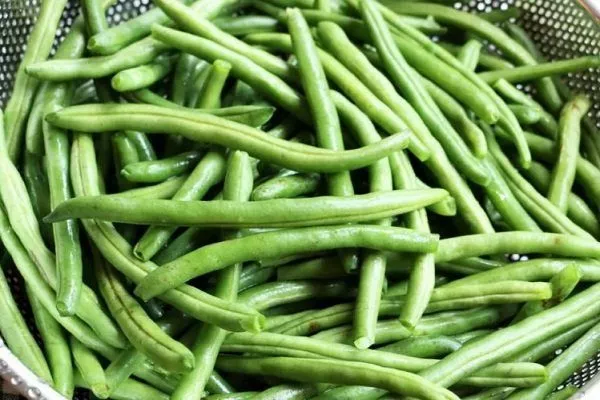
Winter harvesting begins when the pods are fully mature. Specifics of bean harvesting:
- Bush beans are harvested in two or three stages, as the pods ripen evenly. Climbing varieties bear fruit for 1.5 to 2 months, until the frost sets in. The pods are harvested weekly.
- Harvesting times depend on the variety and its early maturity:
- early varieties are ready for harvesting after 50 days of vegetation;
- mid-season – after 70 days;
- late-ripening – after 100 days.
- Harvesting should be done without delay. If the pods are overripe, they will open and the beans will fall to the ground. Part of the harvest will be lost.
- When harvesting bush beans en masse, the plants are laid out to dry, preferably under a canopy. After a couple of days, you can begin shelling.
It is recommended to cut bean bushes at the root, rather than pull them out, so that nodule bacteria, which enrich it with nitrogen, remain in the soil.
Store peeled beans in a dry place, placing them in a suitable container:
- fabric bags;
- paper bags;
- glass jars;
- plastic bottles.
To prevent bean beetles from infesting beans, it's recommended to roast them in the oven at 90°C for no more than 5 minutes.
Growing beans using seedlings requires a little more effort from the gardener than sowing seeds. into open groundHowever, in regions with short summers, this method allows the first pods to be harvested 2-3 weeks earlier than with direct cultivation.