
Birds can be any gardener's worst enemy, quickly destroying crops. But if you know how to scare birds away from your garden, you can avoid this problem. Time-tested methods, as well as modern laser or ultrasonic repellents, can be used for this purpose.
Scarecrow
The oldest and most reliable way to repel birds is to use a scarecrow. A scarecrow, imitating the body of a predator or a human, deters avian pests from approaching crops. The scarecrow is usually stationary, but this is ineffective because the birds soon realize it poses no threat.

It's best to choose a movable object. Experienced gardeners say birds don't like their own kind. Therefore, you can make a scarecrow in the shape of a soaring kite.
Kites in the shape of birds of prey are often installed in large fields.
Using a scarecrow is the best option. This guardian will provide reliable protection for your crops and requires no financial investment. You can make one yourself using any materials you have on hand.
- ✓ Use materials that make noise in the wind, such as tin cans or metal lids.
- ✓ Bright colors of scarecrow clothing are preferred to enhance the visual effect.
To make a scarecrow, you will need:
- cotton wool;
- old clothes;
- pillows;
- sticks;
- scotch;
- hammer;
- nails;
- straw.
The process of creating a scarecrow is very simple, just follow the following sequence of steps:
- Take some wooden sticks and build a frame that imitates the human body.
- Attach an old pillow to the top – it will act as the “face”.
- Place the second pillow over the torso to create a semblance of a human body. Dry straw can be used instead of a pillow.
- Place an old hat on the “head” and secure it securely so that it doesn’t fly off in a gust of wind.
- Put on a blouse with pants or a skirt.
Detailed instructions on how to make a scarecrow yourself are provided in the following video:
Simulated attack
To protect your garden from bird attacks, you can regularly simulate an attack on the feathered pests yourself. Every time a flock arrives, make a loud noise.
Birds' greatest fear comes from their predatory relatives, such as falcons and hawks. Keeping such a pet in your home can be quite challenging. However, you can use the loud sounds these predators make.
Birds dislike loud and harsh sounds. Therefore, a rattle or gas cannon is often used. This will help get rid of birds within a one-kilometer radius.
Protective networks
To protect crops from bird attacks, a simple net made of viscose or plastic fibers is often used. Fishing netting can also be used as an alternative.
To do this, you need to purchase a net of a certain size and then throw it over trees or bushes, covering the berries. Birds won't be able to get past this obstacle.
For small seedlings, a simple string wrapped around the crown works well. Birds can become entangled in such a trap, so it's recommended to inspect the garden periodically.
Shiny objects
Birds dislike shiny objects. You can save your harvest by using various tripwires. For example, strings of old computer disks, metal lids or cans, mirrors, and foil can be strung between trees. Any shiny object you have on hand can be used.
Another option is to make a disco ball-like structure yourself. First, mold a ball out of papier-mâché, then wrap it in a layer of foil, and then attach a few small mirrors on top. The main drawback of this method is that these balls need to be placed on almost every tree.
Damage to a bird's nest
This isn't the most humane method, but it's quite effective. If the feathered pests have already settled in the area and built nests, all the above methods may be ineffective. To save the crop, you'll have to resort to nest destruction.
To avoid this unpleasant experience, you should try to prevent the situation from reaching this point. To do this, you should seal all cracks under the roof. Keep pigeons and sparrows away from your home, and eliminate any niches where they might build nests.
How to scare away birds from your property using thorns?
All birds, before finding a suitable area, first make exploratory forays. To make your garden seem an unattractive food source to these feathered pests, it's a good idea to install thorny spikes on the eaves and fence.
As a result, birds simply won't have enough space to land and look around. Therefore, they'll begin to avoid the area. Plastic spikes are suitable for repelling various types of small birds.
They can be purchased at a gardening store. The kit also includes glue for attaching the spikes anywhere. Metal options are also available, but they are more durable and suitable for larger birds, such as pigeons, crows, and others.
Ultrasonic repeller
Ultrasonic repellents are ideal for protecting small areas. These devices are completely silent to humans, but the ultrasonic vibrations in the air cause a strong sense of fear in birds.
SITITEK Balcony Gard
This model is very popular and helps put pesky birds out of sight for good. The device starts working when the built-in infrared sensor detects movement. This significantly saves battery life and ensures long-lasting operation.
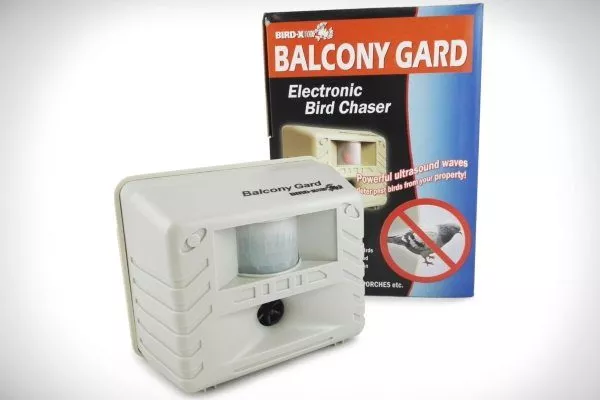
Advantages:
- works within a radius of 80 m;
- powered by batteries and mains;
- The kit includes a charger;
- repels both birds and small rodents;
- it also has an effect on large birds;
- easy installation;
- power saving mode;
- movement work.
There is only one drawback - the relatively high cost.
WT321
A versatile model that's ideal for repelling both birds and rodents. When in use, the device emits ultrasonic waves that induce intense fear in rodents and feathered pests, prompting them to leave the area.
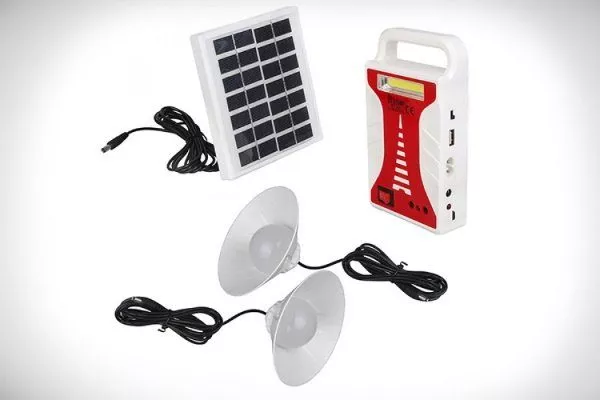
Advantages:
- economical battery consumption;
- safety for people and their pets is guaranteed;
- the model is easy to install and turn on;
- acts on pests;
- there is an infrared sensor;
- The device is inserted directly into the soil and does not require any additional equipment for installation.
Disadvantages: Not very effective against rodents. This device is recommended for bird control.
Laser repeller
This device is effective in bird control. However, laser repellers have several drawbacks. The device operates using a laser beam, which is visible to both pests and humans. This can cause significant discomfort, especially at night.
The laser repeller can operate in various modes:
- Response to a pest. The device has a motion-activated sensor. When a designated guest enters the area, it emits a bright beam.
- Manual control. A person decides independently when exactly to turn on the device.
- Prevention. The device turns on every 10 or 15 minutes, regardless of whether there are pests on the site or not.
Luch-U
This model has proven itself effective in bird control. It comes with a swivel bracket for wall mounting. The front panel features two lenses that generate red and green laser beams of Class 3R quality.
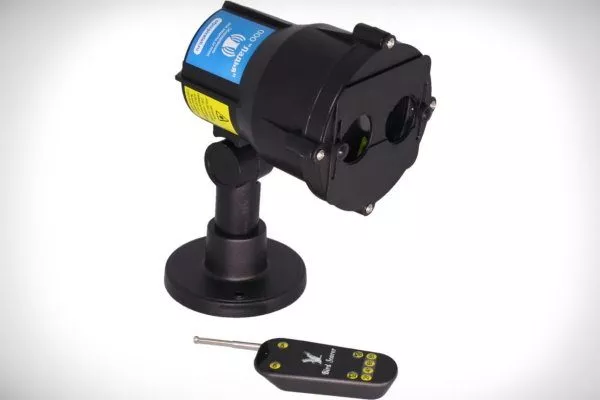
Advantages:
- the housing is moisture-proof, the device can be installed outdoors;
- operating range – 300 m, viewing angle – 60 degrees;
- You can set the working time from 5 to 15 minutes, with a 5-minute break;
- there is an adjustment of the operating time with automatic shutdown;
- affects all species of birds;
- There is a remote control, which makes it easier to use the device;
- easy installation, you can do everything yourself;
- Thanks to the presence of a bracket, the device can be easily rotated in different directions.
Disadvantages: the efficiency of the device is significantly reduced on sunny days, when the beam becomes almost invisible.
Bioacoustic repellency
Bioacoustics operates on a similar principle to the models described above, but is more effective—it targets specific targets. It imitates the roar or howl of a predator feared by local birds.
Tornado OP.01
The model uses a 220V power supply and is connected to the mains using the included adapter. The device can also be powered by a battery, but this must be purchased separately.
There are seven operating modes, each customized to the specific pest being targeted. There's also a universal mode.
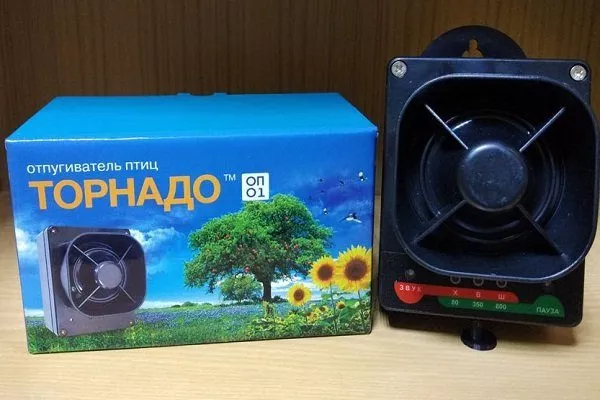
Advantages:
- there is an automatic shutdown mode;
- the device is very compact (14x9x9 cm);
- the device can be hung on a table or under the roof;
- coverage area – 10 thousand square meters.
The disadvantage is that when turned on, it causes significant inconvenience to neighbors, as the device makes quite loud sounds.
Weitech WK-0108
The bird "scare" operates in an area no larger than 400 square meters. The entire device consists of a control unit and a speaker, which amplifies the noise. The device operates in two modes: motion-activated or continuous.
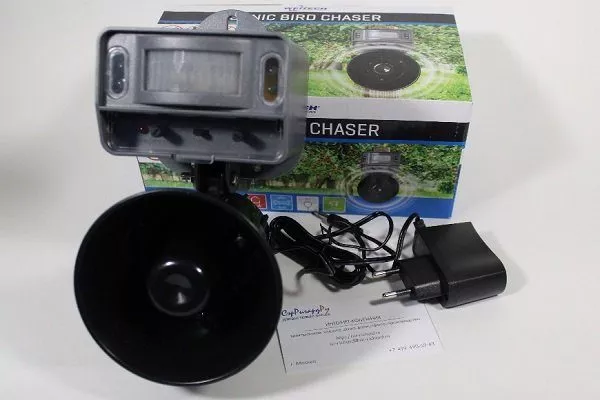
Advantages:
- viewing angle – 130 degrees;
- There is a smooth volume control so you can set the desired level yourself;
- operating range – up to 8 m;
- There is a photo sensor that turns off the device at night;
- the device operates from the mains and battery;
- easy installation;
- high quality recorded voices of birds of prey;
- There are additional visual methods for repelling feathered pests;
- There is a motion sensor.
Flaws:
- the structure is very large;
- high cost.
With the help of chemistry
Most birds are protected by law. Therefore, scientists are developing new agents whose primary purpose is repelling rather than killing. After ingestion, they cause mild discomfort (vomiting, diarrhea) or affect the mucous membranes of birds.
These chemicals are used to treat bird treats. Birds understand that the item is no longer appetizing and will no longer show interest in it in the future.
There are products containing methyl anthranilate. It occurs naturally in small amounts in various flowers, citrus fruits, and even grapes. It affects human health without causing obvious signs of poisoning or intoxication.
Lethal methods
There are several bird species that are not protected at the regional, national, or international level. For example, starlings, sparrows, and common pigeons. They can be hunted or shot in areas where shooting is permitted.
If lethal control methods are used, care must be taken not to destroy protected species, as this could result in serious legal problems.
Rattles and noisemakers
You can make a noisemaker to scare away birds from your garden yourself using:
- a plastic bottle with a cork;
- scotch;
- foil;
- thick wire (length about 1 m);
- felt-tip pen;
- knife;
- pliers;
- glue;
- knitting needle (nail).
The process of making a noisemaker is very simple:
- Clamp a spoke (nail) with pliers and heat it over a fire.
- Use a hot knitting needle to make a hole in the bottom of the bottle and the cork. Make sure the wire fits easily through the hole.
- Using a felt-tip pen, mark the outlines of 4 blades on the sides of the bottle.
- Use a sharp knife to make cuts along the lines (the blades open outward).
- Stick the foil onto the blades.
- Thread a wire through the holes in the bottom and cap of the bottle. The ends of the wire should be longer than the bottle.
- Attach a brake washer to the wire protruding from the bottom at a distance of approximately 1 cm. For this purpose, use a washer, a button, or a bottle cork.
- After pulling the second part of the wire through the cork, wind it onto the neck.
- Attach the lower end of the wire to a stick and place the device on a tree or secure it in the ground.
More detailed instructions are provided in the following video:
Velcro
Today, you can find gels on the market that prevent birds from landing on objects, such as tree branches. There are also products that stain the birds' feet; these come in tubes. These products should be applied in strips using a caulking gun.
Watering hole
Birds will be much less likely to peck at ripe berries and fruit if you provide them with a watering bowl. A small garden pond with rocks and a gently sloping bank is also a good option. A simple basin filled with water will work well as a watering bowl.
Using this method, you must constantly ensure there's fresh water in the water bowl. Therefore, you'll need to top it up regularly.
With so many options available, choosing the right method for bird control can be difficult. The choice should be based on the complexity of the problem and the size of the plot. For example, for a large garden, it's best to install an ultrasonic repeller, while for a smaller garden, a homemade noisemaker made from a plastic bottle will suffice.