
Flatwood trees look very impressive and unusual. They are created using trellises, securing the branches and shaping the crown over several years. This cultivation method is used for a wide variety of trees, including fruit and ornamental ones, and it's also suitable for apple trees. We'll explain how to grow a tree on a trellis and which apple varieties are suitable for this purpose.
Features of growing on a trellis
When grown on trellises, trees become "flat." Their crowns are formed on a supporting structure in a single plane. The tree branches are secured to lattice structures called trellises. The flattened crown begins to be formed in the first year of planting. After a few years, when the tree has acquired the desired configuration, the supports can be removed. However, trees typically remain supported by trellises throughout their life.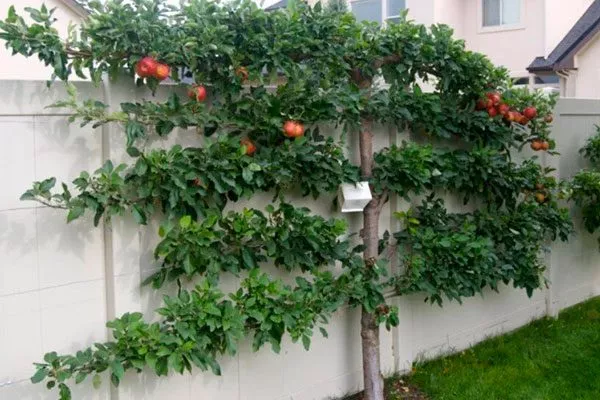
This method was first used by French gardeners as early as the 17th century. Initially, espaliering was used purely for decorative purposes—to line garden paths and arbors. But it quickly became popular with gardeners, as it allowed for space-efficient cultivation while simultaneously enhancing the garden with greenery.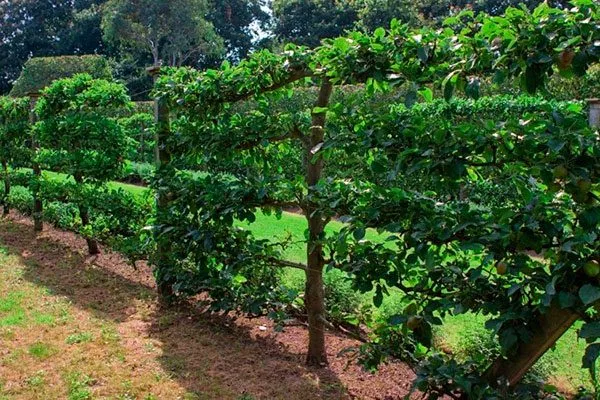
Pros and cons of the technology
At first glance, it might seem that trellis growing serves only one purpose: to create trees that will give the garden a unique look. In fact, the trellis method has many advantages and practical benefits. However, it also has its disadvantages, which it's also useful to be aware of before starting to plant on supports.
Manufacturing and installation of trellises
The trellises used to support trees are not replaced, so they last a long time. They must be durable and aesthetically pleasing. They are usually made of wood or metal. For example, you can attach mesh to the posts—either welded or prefabricated chain-link.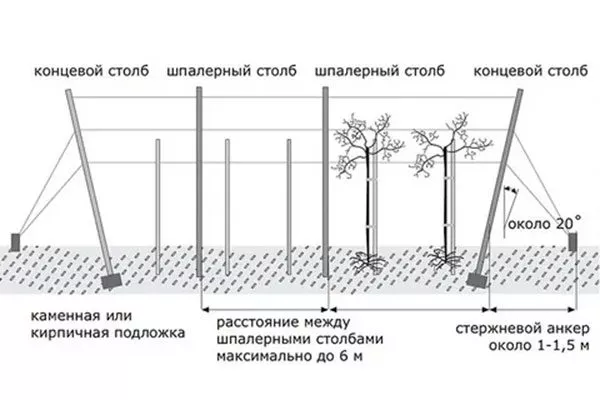
Features of installation of trellis structures:
- A house wall or a fence around the property can be used as support. Classic trellises, made diagonally from thin wooden slats, look especially beautiful. To ensure durability, the wood is treated with drying oil or preservative.
- If there's a building nearby, the apple tree frame should be placed 10-15 cm from the walls, and the planting holes should be 25-30 cm from the trellis. The best location for installing trellises is the west, southwest, or southeast side of the house.
- Trellis structures—whether made of wood or wire—must be reliable and robust. They must be securely attached and able to support the weight of the tree. Trellis structures are difficult to repair, but they must last a long time—at least 20 years or more, depending on the lifespan of the apple tree.

- Willow rods can be used to tie up branches. They weaken over time, so there's no risk of them growing into the bark, unlike metal wire, for example.
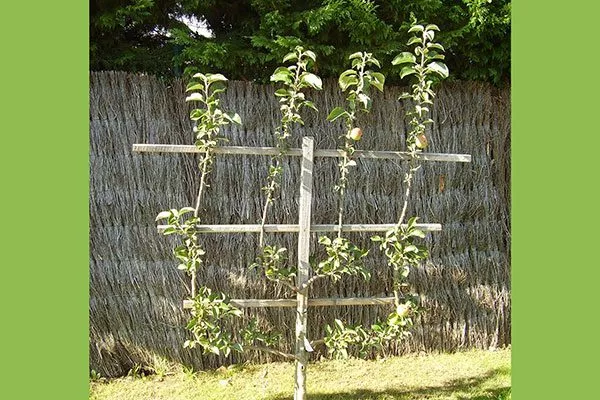
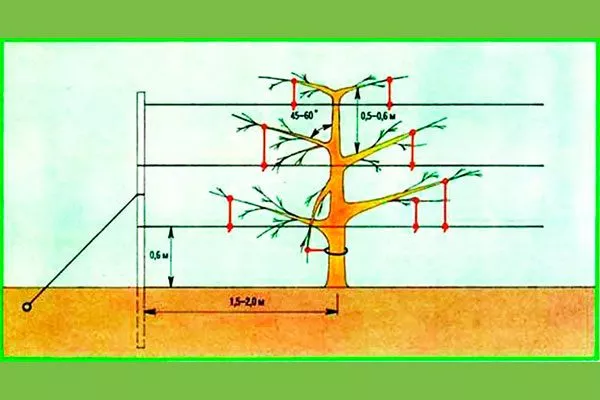
Crown formation options
Apple trees, like most fruit trees, are quite flexible, so their crowns can be shaped into virtually any form. Let's look at the crown shaping options most commonly used by gardeners.
Horizontal cordon
To form a standard horizontal cordon, use one-year-old seedlings. The cordon height is 50 to 70 cm. It is suitable for lining alleys, paths, and property lines.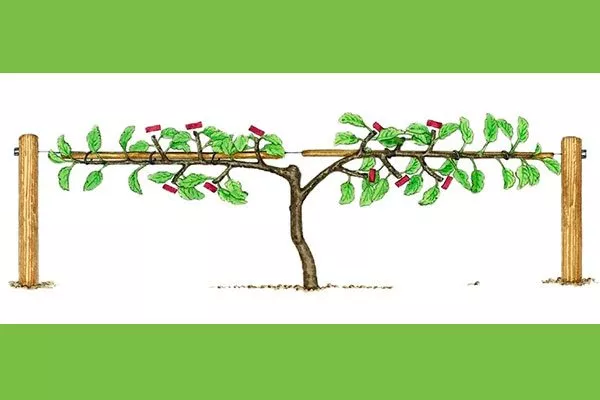
Features of formation:
- At the location of the proposed trellis, posts are installed at intervals of 2-2.5 m. The optimal height is 0.5 m.
- A strong wire is stretched between the posts or wooden slats are installed at a height of 0.4 m.
- The seedling is planted near the first post, bending it at a 90-degree angle toward the second post. The bend in the trunk should be at the same level as the crossbar.
- The top of the seedling is cut off, leaving only two strong branches on the trunk. These are bent to the sides and secured to horizontal supports.
- Horizontal doors can be arranged in 1-3 tiers. New tiers are installed at intervals of 1-2 years.
U-shaped cordon
It begins to be shaped in the same way as the horizontal shoot, but the central shoot is pruned only after it reaches the desired height. The "shoulders" are initially grown horizontally, and when they reach a height of 0.5-0.7 m, they are directed upward. The resulting shape resembles a candlestick.
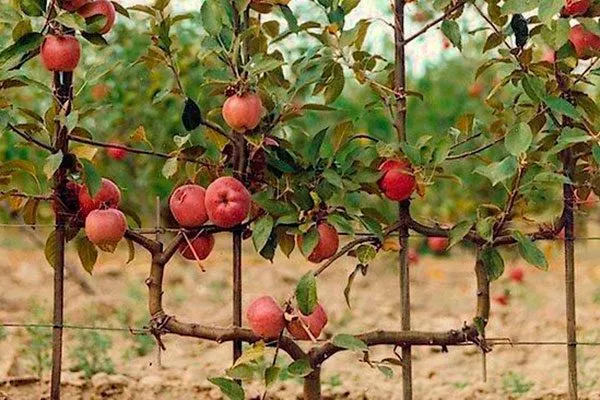
Palmette
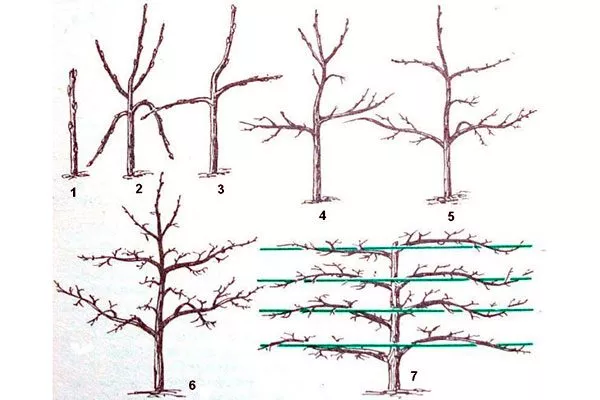
With this method of formation, the branches are bent so that the crown is formed in the shape of a palm leaf, hence the name - palmette.
There are several types of palmettes for apple trees:
- Simple or vertical — the branches are directed in one plane—horizontally or at an angle.
The minimum distance between tiers is about 30 cm.
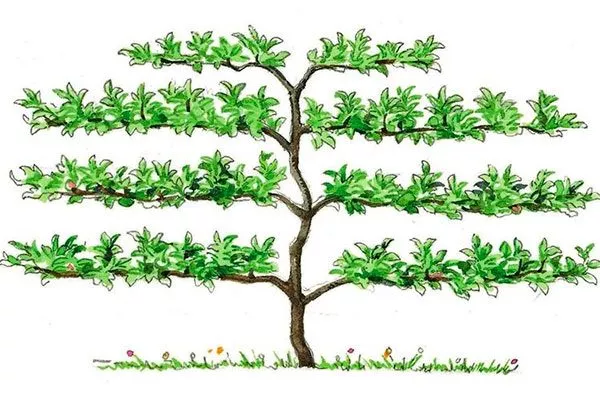
- Fan palmette — the branches are positioned at an angle of 45°.
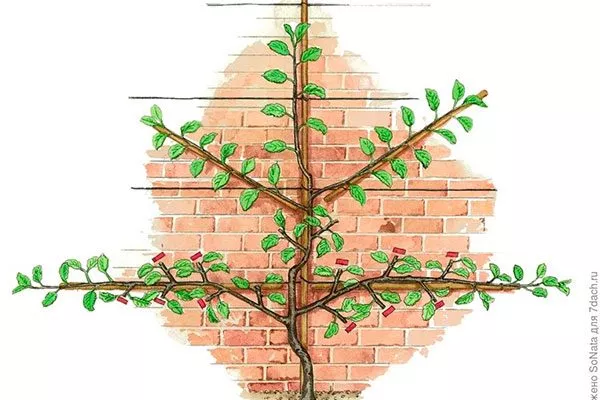
To form palmettes, one-year-old seedlings are used, as they have flexible branches. Trellis or wire frames are installed to secure them. Each year, the shoots are pruned and secured to supports, guiding them into the desired orientation.
Planting patterns
When growing apple trees on trellises, various planting patterns can be used. The choice depends on the apple tree variety, the width of its crown, and the gardener's preferences.
Apple trees on trellises are usually planted according to one of two schemes:
- Average. Depends on the branch width of the mature tree and the regional climate. The maximum dimensions after tree formation are taken into account. A distance of approximately 4 m is maintained between rows, and 2.5 m between adjacent apple trees.
- Individual. This scheme takes into account the soil composition, the apple tree's varietal characteristics, the site characteristics, and other factors. The trellises in a custom planting scheme should be the same height as the mature apple trees. The distance between adjacent trees is determined based on the variety:
- semi-dwarf - 2.5-3 m;
- dwarf - 1.5-2 m;
- columnar - 0.6-1 m.
If the variety is not known exactly, the intervals between trees are calculated taking into account the width of the crown, which corresponds to twice the distance between the upper branches.
Planting step by step
When planting apple trees on trellises, the same rules regarding hole depth and soil composition are followed as for regular trees.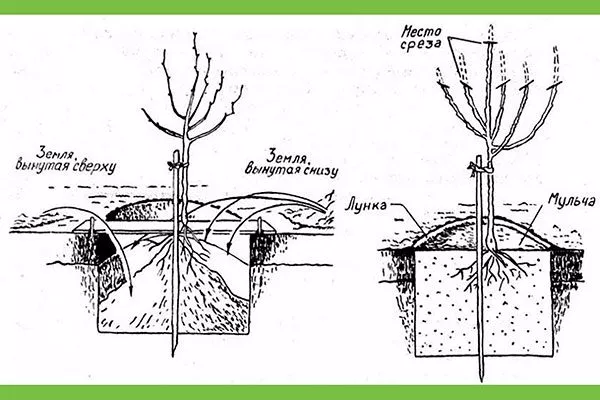
The order of planting apple trees for growing on trellises:
- Dig a planting hole measuring from 60x60x60 cm to 100x100x100 cm.
- Fill the hole with a nutrient mixture prepared from the top fertile layer of soil and organic matter - 8-10 kg of compost or humus.
- Place the seedling in the planting hole at an angle of 45° to the support.
- Secure the trunk with soft twine.
- Cut the central conductor at a height of 0.5-0.6 m.
Trimming
To shape the crown, regularly remove all shoots growing forward or backward during the first two years. Leave branches growing in line with the trellis. The first pruning is recommended in early spring, when temperatures remain above 5°C.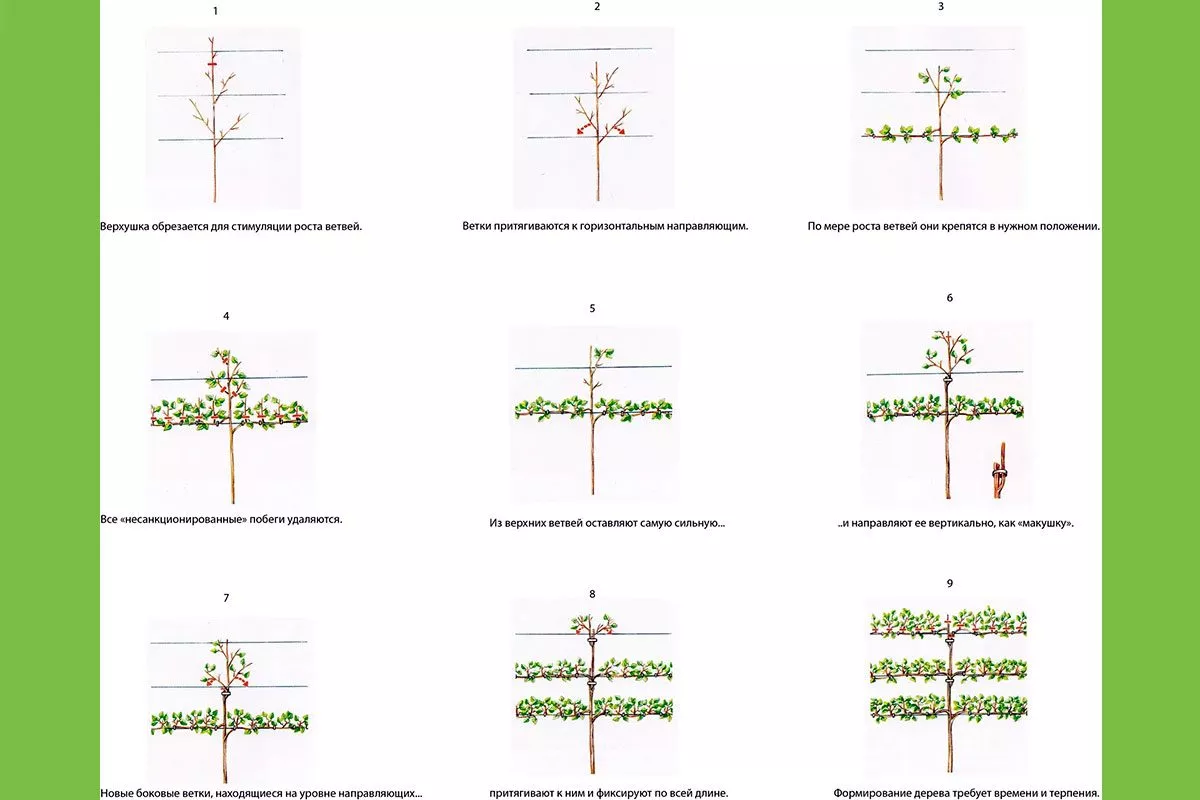
Pruning not only helps maintain the desired crown shape but also serves as a disease preventative and prevents excessive shoot growth. It is recommended to prune apple trees twice a year: in early spring, before the sap begins to flow, and in summer.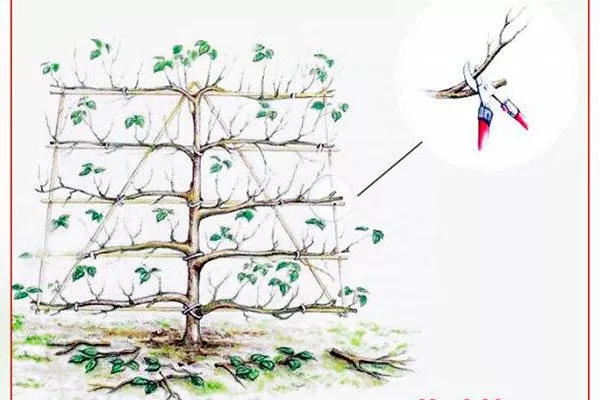
Summer pruning is necessary for apple trees to prevent resources from being wasted on leaf growth. The tree should devote maximum energy to fruit formation. Any diseased or dead branches on the tree are removed completely.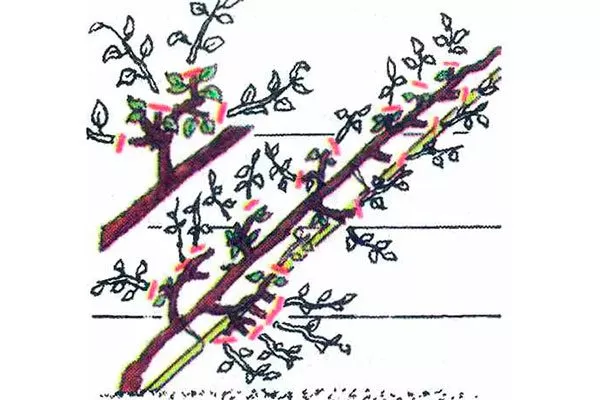
Features of pruning:
- In the spring Thin, weak, and damaged branches are trimmed. The top is shortened to a height of 0.5 m above the side shoots. The cut is made above a strong and healthy ovary.
- In summer, During the fruiting period, remove excess young shoots that thicken the crown and draw moisture and nutrients. These are pruned 1 cm above the growth node.
It's recommended to thin out the fruit on trellis trees. This slightly reduces yield but improves the flavor of the remaining apples.
Caring for trellis trees
Only certain varieties of apple trees, those with a short stature, are grown on trellises. Caring for these trees has a number of specific aspects that gardeners should be aware of.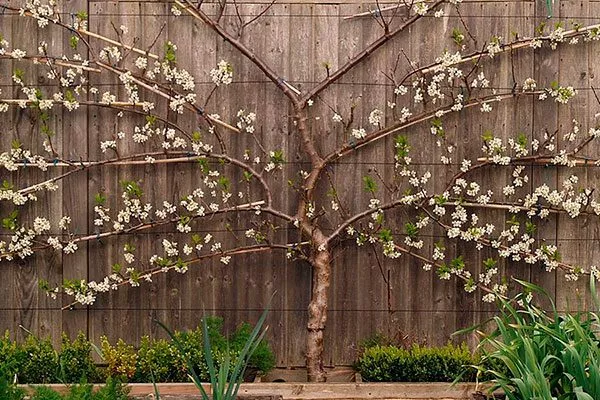
Features of caring for flat apple trees:
- Trees are watered once every 7-12 days. The recommended watering rate is 30-40 liters. This continues for three years after planting. Subsequently, watering is reduced to once or twice a month. Watering is especially important after flowering, during fruit formation, and a week after harvest.
- The next day after watering, loosen and mulch the tree trunk circle; for example, pine bark can be used for this purpose.
- During the first three years, fertilize only in the spring—nitrogen-containing fertilizers with added organic matter. It is recommended to alternate organic and mineral fertilizers. In the first year, add 2 tablespoons of urea or nitrophoska per 10 liters of water; in the second year, add 300 g of dry chicken manure per 10 liters of water.
- From the 4th year, it is recommended to add a solution of wood ash and herbal infusion to the water during each watering.
- In the fall, 90-100 g of superphosphate is added under each tree to increase the trees' chances of successfully surviving the winter.
Criteria for selecting varieties for trellises
Apple trees that meet certain requirements are suitable for trellis cultivation. Not every variety can be used to train plane trees.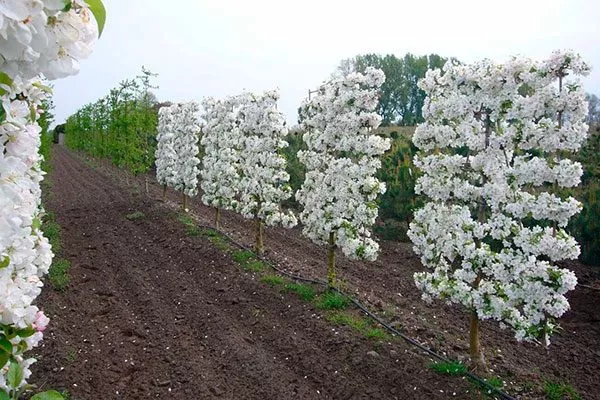
What should be taken into account when choosing apple trees for trellis cultivation:
- Choose varieties with little branching. Anise, Chinese, and Pepin apples are not suitable. These apple trees produce most of their fruit on one-year-old shoots, making it difficult to create neat shapes. Furthermore, heavily branched apple trees do not respond well to pruning—they often become diseased and bear little fruit.
- Early varieties are not suitable for trellises. After fruiting, apple trees shed their leaves too early and lose their decorative appeal—which is one of the main goals of growing apple trees on trellises.
- The best option for trellises is late varieties with brightly colored fruits - they will decorate the area until late autumn.
- It's also important to consider the zoning of varieties. Avoid planting trees that aren't adapted to the local climate—they may not survive the winter, and all your hard work will be wasted.
If you choose seedlings grafted onto low-growing or dwarf rootstocks, the list of varieties suitable for trellis cultivation expands significantly.
What varieties of apple trees are suitable for trellises?
Quite a few apple tree varieties are suitable for growing on trellises. Gardeners can choose a variety that will not only create a flat crown but also produce a good harvest of delicious apples.
Apple tree varieties for trellises:
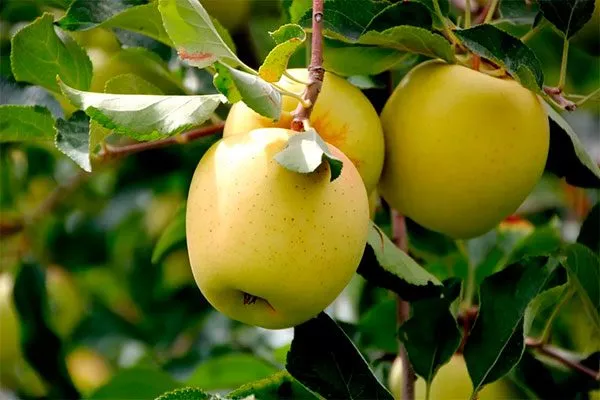
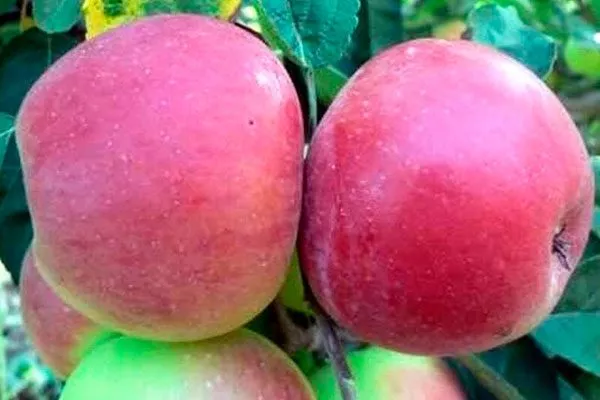
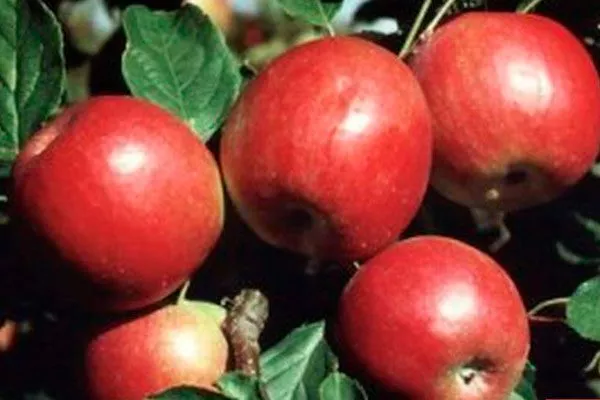
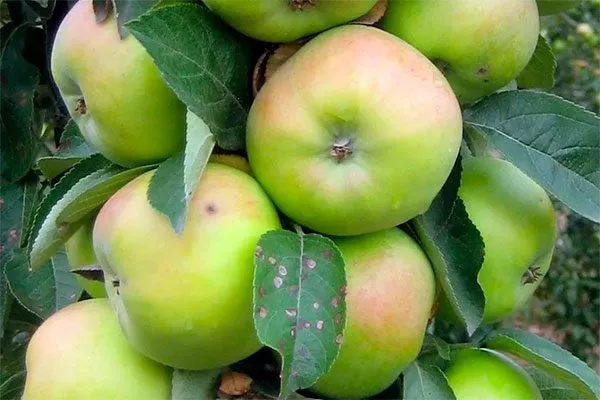
- Golden Delicious. This medium-sized, late-ripening variety, when grown in standard conditions, develops a round, well-foliated, densely branched, and broadly rounded crown. The tree grows up to 3.5 m tall. The fruits are golden-light green, round-conical in shape, weighing 140–170 g. The flavor is sweet and dessert-like.
- Desired. A late-summer variety with a rounded crown. It reaches 3-4 m in height, but can be grown on dwarf rootstocks. The fruits are slightly flattened, initially yellowish-green, turning yellow as they ripen. The flavor is sweet and sour, the flesh is juicy and fine-grained.
- Jonathan. A winter-ripening variety, the tree grows up to 4 m tall. Under normal cultivation, it has a broad, rounded, medium-density crown. The fruits are greenish-yellow with a diffuse blush or dark red stripes. The flavor is sweet and sour, dessert-like. Fruit weight is 100-150 g.
- Welsey. A partially self-fertile autumn variety with trees reaching 4-5 m in height. Trees on clonal rootstocks can be grown on trellises. Under normal cultivation, it has a broadly pyramidal and spreading crown, which later becomes rounded. Fruit weight is 100-150 g. The flavor is sweet and sour, depending on the weather. The fruits are greenish-yellow, acquiring a golden hue as they ripen.
- Aurora. A winter variety with a medium-sized tree. The crown is rounded to oblong when grown normally. The tree height is 3-4 m. The fruits are large, golden-yellow, with a bright red blush. The average weight is 160-170 g. The shape is round-conical. The flesh is white, dense, and juicy, with a sweet and sour taste.
- Winter lemon. A late, self-fertile variety with large, light-yellow fruits. Fruit weight: 230–250 g. Tree height: 2.5 m. Under normal cultivation, the crown is spherical and moderately dense. The flesh is sweet and tart, white, and fine-grained.
- Wagner. An early winter, columnar variety with light green fruit covered with a red or dark red blush. The tree grows to a height of 2-2.5 m. The crown, when grown normally, is broadly pyramidal and sparse. It weighs 150-250 g. It is an early-bearing and productive variety, but bears fruit intermittently.
- President. A columnar autumn variety with large, rounded apples. The tree reaches a height of 2-3 m. Its crown is compact and well-foliated. The flavor is sweet and sour, with a dessert-like quality. Weight: 150-250 g. The fruits are white and yellow, with a delicate, barely noticeable pink blush on the sun-facing sides.
Growing apple trees on trellises is an interesting and cost-effective solution that allows you to make any garden truly unique and unusual. This cultivation method requires some effort from the gardener, but the results are well worth the effort.