
To prolong the life of an old apple tree, gardeners perform special rejuvenating pruning. Reducing the crown's size promotes fruiting. Let's learn how to prune an old apple tree so it bears fruit for several more years.
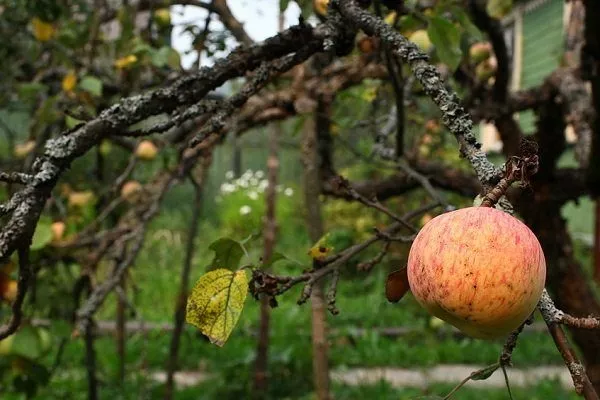
Signs of an old tree
An apple tree can produce a full harvest for at least a quarter of a century, but that's not the limit. If the tree has received the necessary care and pruned properly throughout its life, it can easily bear fruit for another ten years. Without pruning, the tree ages faster, its yield declines rapidly, and the apples become smaller.
- ✓ The presence of a large number of water sprouts, indicating that the tree is attempting to rejuvenate itself.
- ✓ Bark condition: Significant areas of peeling bark indicate the tree is aging.
How to recognize an old apple tree:
- Age. A tree that is 30 years old and has the potential to bear fruit should be pruned according to a rejuvenating scheme.
- Productivity. The quality of the yield has noticeably deteriorated. Fruit production is becoming scarce and smaller than usual.
- Length of annual growth. If it is less than 10 cm, rejuvenating pruning is carried out.
- Dry branches. If the branches of an apple tree dry out, the number of fruit-bearing shoots decreases, and the top dries out without any signs of disease, the tree is definitely aging.
How to rejuvenate an apple tree?
Regular fall and spring pruning won't help prolong the life or fruit-bearing capacity of an aging apple tree. Rejuvenation requires more extensive measures, lasting 3-4 years, and sometimes longer.
Apple trees are rejuvenated in stages. First, the crown is thinned. Branches are cut to ensure even distribution of the load. The healing of the cuts should be accompanied by the growth of new fruiting shoots.
Rules of rejuvenation:
- Avoid cutting multiple branches at once. This will shock the tree, which could lead to its death.
- The first to be removed are branches with damage, growing inwards into the crown and preventing sunlight and air from reaching the fruiting branches.
- When thinning new shoots, leave the strongest ones, those growing upward and away from the trunk. Other shoots are removed throughout the growing season.
- No more than 2 skeletal branches can be cut during one pruning.
- Large branches are pruned only during periods of complete cessation of sap flow – early spring or later in autumnFirst, the branches on the south side are trimmed.
- The cut is made at an acute angle – approximately 45 degrees.
- The branches are cut to the ring, without leaving stumps.
- The cuts are sanded and coated with garden pitch on the day of pruning. Larger cuts are wrapped in plastic film.
When can a tree not be saved?
It's not always possible to save an aging apple tree. The chances are reduced if the tree has been under-nourished throughout its life, improperly pruned, exposed to frost, or suffered from drought. diseases and other unfavorable factors.
Signs that it’s better to cut down an apple tree:
- Infestation with tinder fungus. If this fungus is parasitizing a tree, things are dire—it's impossible to remove. It has penetrated deep into the trunk and will continue to destroy it.
- Peeling of the bark. If the bark at the bottom of the trunk begins to peel off and wood is visible underneath, the tree has exhausted its lifespan.
- Damage. If the trunk has large, through holes and its core is rotting, the tree is not suitable for further fruiting.
- Dry branches. If an apple tree has more dry branches than healthy ones, it is not advisable to rejuvenate it.
Experienced gardeners have managed to revive trees that were almost beyond repair. But this requires considerable effort, and success is not guaranteed.
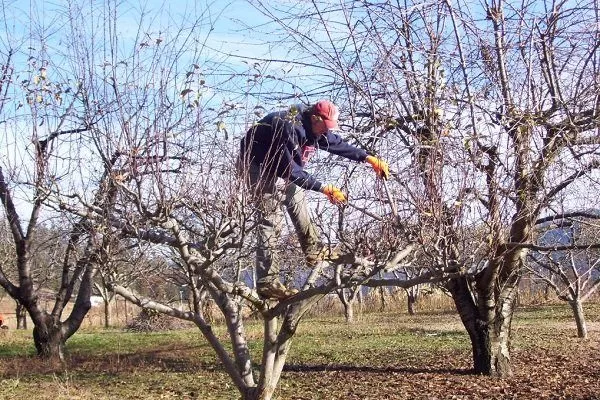
Sometimes an old tree is already doomed, but you want to prolong its life. Then, proceed as follows:
- Cut off large branches that are already badly damaged.
- Try to remove all tinder fungi.
- Treat the wounds – disinfect them and coat them with garden pitch.
- Thin out and lighten the crown.
After such “reanimation” measures, the tree will live for several more years and will even delight you with apples.
If you don't want to lose the variety, take cuttings from an aging apple tree and graft them onto young rootstocks. In a few years, you'll have fully grown apple trees with the varietal characteristics of the parent tree.
Rejuvenating pruning of an old apple tree
There's no one-size-fits-all solution for rejuvenating old trees. Each apple tree requires an individual approach. First, the gardener conducts an inspection and, based on the diagnostic results, chooses a rejuvenation strategy, timing, and pruning schedule.
- Disinfect all instruments with a copper sulfate solution.
- Identify the main skeletal branches that will remain after pruning.
- Prepare garden varnish or oil paint for treating cuts.
Pruning times
Pruning old trees is recommended in spring or fall. Many gardeners believe that summer is also a good time to rejuvenate apple trees, but only after the harvest.
The optimal time for tree rejuvenation is considered to be spring—March or April. The main condition for beginning the process is the elimination of the threat of severe frost (from -15°C). There is no exact pruning date—gardeners take the weather into account.
What signs should you look for when determining the timing of pruning?
- in the spring – the buds have not yet blossomed;
- autumn – the leaves have already fallen.
It's not recommended to prune apple trees after May, as the risk of infection increases significantly. If an old apple tree contracts Cytosporosis, it will most likely die.
Types of rejuvenating pruning
With older apple trees, extra care must be taken when pruning – any mistake can lead to reduced yield, disease, or even death.
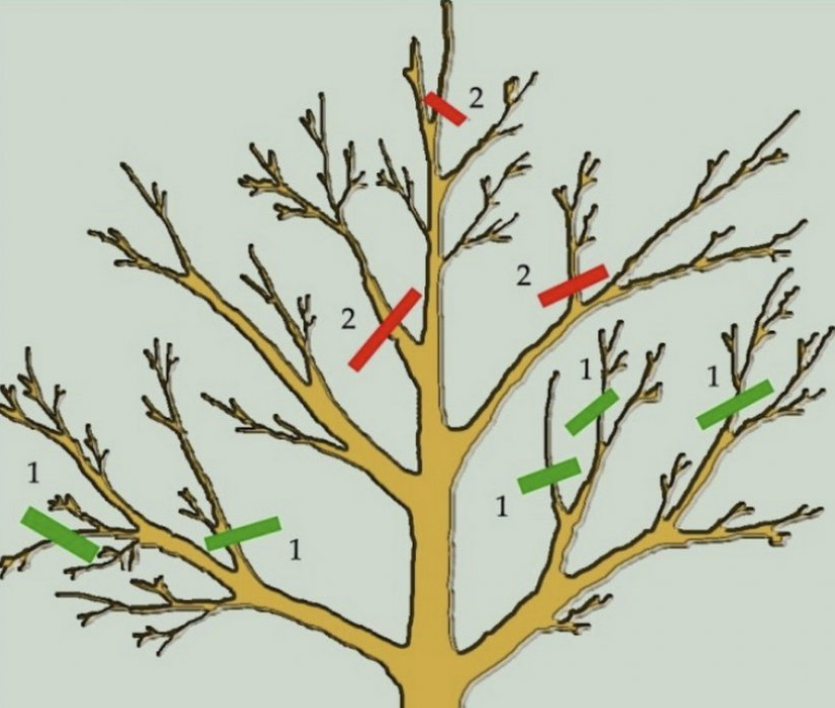
According to the principle of rejuvenation, there are two types of pruning:
- Shortening. This involves reducing the length of branches by 1/3. This procedure is recommended in the spring to prevent the tree from wasting energy on feeding extra shoots. This procedure also prevents the tree from freezing during the winter.
- Thinning. This method involves gradual pruning over a period of three years. This approach gradually reduces the tree's size, preventing stress.
Types of pruning (1 – shortening, 2 – thinning):
Today, gardeners have developed several methods for rejuvenating pruning of fruit trees:
- Shock. This is a relatively new method for extending the life of apple trees. Its goal is to restore the tree's productivity. This is achieved by reducing the crown. It is recommended for use on older, tall trees. Steps:
- Removing dry branches.
- Crown pruning to 3 m. Pruning is carried out in two stages to reduce stress on the tree.
- Pruning lateral skeletal branches up to 2.5 m and thinning out old fruit-bearing branches to relieve the central part of the crown.
- Gentle. The method involves spreading the process out over time to minimize damage to the tree. It's designed to prolong the tree's life cycle and restore its fruiting functions, which can lead to low yields for several years. Features of this gentle method:
- designed for 5 years;
- old branches are removed gradually;
- The shoots are cut so that their length is no more than 2 m.
- Gradual. The process is designed to last 2-3 years. Its key principle is the removal of thick shoots exceeding 10 cm in diameter.
Watch the video about shock trimming below:
What tools will you need?
Pruning is performed with a sharp, disinfected tool. For this rejuvenating procedure, you'll need a set of tools and protective equipment.
Prepare for work:
- several hacksaws with teeth of different sizes;
- garden knife;
- pruning shears;
- stairs;
- gloves;
- safety belt;
- instrument disinfectant.
If you have a large amount of work to do, it makes sense to use a chainsaw.
How to perform the procedure correctly?
Pruning an old apple tree involves removing unnecessary branches and reducing the crown's volume. It is recommended to prune the tree in three stages:
- Shortening the barrel. A typical tree reaches a height of 7-8 m. It's difficult for an old apple tree to support such a large crown. Prune the trunk at 2 m.
Cut the trunk, leaving a small distance from the main branch. Don't leave the stump too large, otherwise, when it dries, it will develop a hole that will collect water, causing the tree to rot. - Cutting out thickening branches. First, remove large branches growing toward the trunk, as they thicken the crown and impede air circulation. The crown should eventually take on a bowl-shaped form. To prevent branches from breaking, prune them in stages:
- Step back 50 cm from the base and saw off the branch from below – by 1/2 of its diameter.
- Step back 20 cm and saw it off again to 1/2 the diameter, but this time from the top. The branch will break off along the saw cut lines.
- Saw off the rest of the branch into a ring.
- Pruning skeletal branches. Cut them so that the length is no more than 2.5 m.
- Pruning small shoots. Remove branches:
- located one above the other;
- which grow at an acute angle to the trunk/skeletal branch;
- crossed with each other.
Crown rejuvenation (a – crown shortening, b – thinning, c – pruning of drooping branches, d – pruning of shoots, d – removal of suckers):
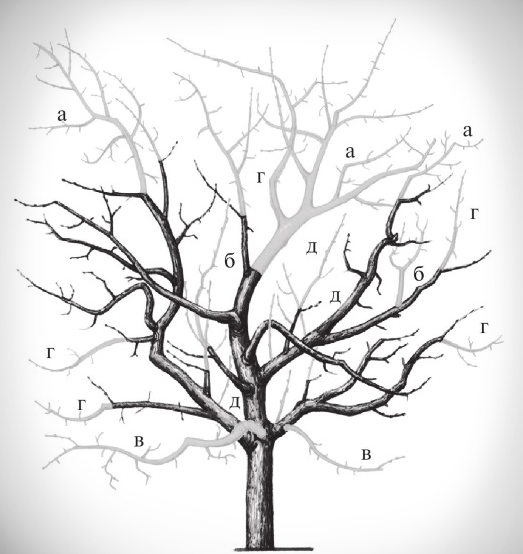
Rejuvenation should be carried out in stages:
- First year. Perform standard sanitary pruning and shorten the tree by a third. Prune large branches on the south side, but no more than three.
- Second year. Repeat the sanitary pruning. Shorten the branches by 1/3 for medium-sized apple trees and by 1/2 for vigorous trees. Aim for a triangular crown. Upper branches should not cover lower branches.
Leave one shoot on each large branch. It's best to leave skeletal branches alone, except for those that are dying, fungus-infected, or dried out. - Third year. Perform preventative pruning and finish shaping the crown. Remove excess branches—approximately 1/3. Keep only the strongest and most viable ones.
After pruning the branches on the southern side of the crown, place supports under the branches on the northern part - they will experience increased stress.
A video about pruning an old apple tree is located below:
Post-rejuvenation care
Rejuvenation is beneficial for the apple tree, but it still experiences considerable stress during the initial stages. The tree requires serious care.
How to care for an apple tree after rejuvenation:
- Wound treatment. Gardeners often use garden pitch, but scientists believe it doesn't help wounds heal; on the contrary, it slows healing. For covering cuts, it's better to use oil paint with natural drying oil. And for cuts less than 2 cm in diameter, seal them with plasticine.
- Top dressing. A pruned tree actively grows green mass, so it needs fertilizer:
- April. The tree needs nitrogen. Apply 1/2 the recommended rate of ammonium nitrate or urea.
- May. Fertilize the apple tree with superphosphate (according to the instructions).
- June. Re-apply superphosphate – half the norm.
- September. Add calcium sulfate (according to the instructions).
Fertilizer is scattered dry, not only around the trunk but across the entire crown. Afterward, the tree is watered at a rate of 20-30 liters per square meter.
How does an apple tree behave after pruning?
After severe pruning, the tree actively produces sucker shoots from dormant buds. These shoots form a new crown. As a result of rejuvenation treatments, the following is observed:
- Activation of dormant buds and active growth of young shoots.
- Redistribution of nutrients and increased yield due to uniform crown formation.
- Improving air circulation in the crown and increasing branch illumination promotes fruit set and full ripening.
- Absence of fungal infections due to timely removal of damaged and dried branches.
Helpful tips
Pruning is one of the most difficult gardening techniques, especially for novice gardeners. Before you begin, carefully study the procedure, as mistakes cannot be corrected.
Gardener's Tips:
- start pruning from large branches;
- Dispose of all cut material to kill pathogens and insects;
- when cutting out the shoots, leave about ten on the tree, but shorten them by 2-3 buds;
- Carefully consider the lifting and fastening system (a stepladder may be needed).
If your apple tree has always received proper care, its life and fruiting can easily be extended for at least several years. Don't rush to trim your "nurse"—just a few sanitary and rejuvenating prunings, and your beloved apple tree will once again delight you with abundant harvests.
I'm so glad I found your article online, because you were the only one I've ever received a comprehensive answer and very detailed instructions for rejuvenation. We were about to cut down the old apple tree completely! We followed your instructions. The result—the apple tree has come back to life!