
Apple trees are grown everywhere and don't require much care. However, sometimes they develop problems, such as branch drying. The causes aren't immediately obvious, but they exist. They can be identified and, in most cases, corrected if you know the proper growing and agricultural practices for apple trees.
Fruit rot - apple moniliosis
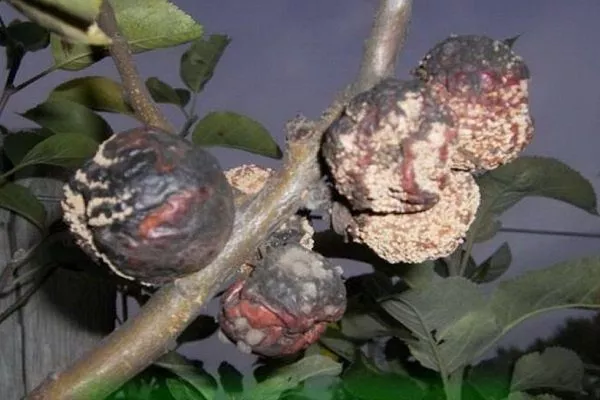
The pathogens primarily attack apple fruit. Branch drying is a side effect, as the unhealthy tree's natural life processes are disrupted.
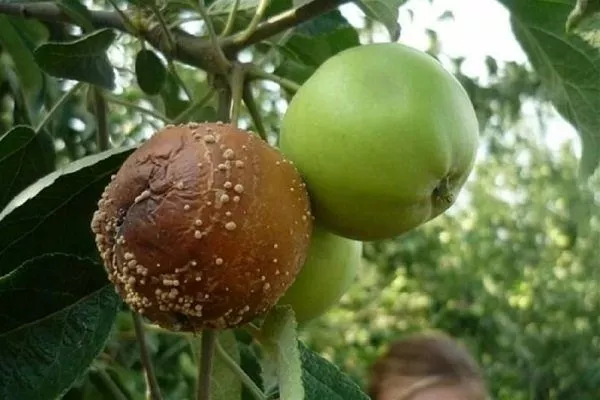
During wet summers, moniliosis spreads rapidly throughout the garden, causing the loss of 80% of the fruit crop. The worst-case scenario is the death of the trees themselves if treatment and prevention measures are not taken.
Insects, raindrops, and wind are carriers of the infection. Infection occurs as follows:
- The first to be affected are fruits with damage from birds, insects, and cracks on the surface.
- The causative agents of moniliosis spend the winter in rotten fruit remaining on the branches after harvest. They pose a threat for two years.
- By the end of winter, the fungus penetrates the fruit stems into the fruit branches and waits there until the last of the cold weather. In spring, it moves to the flowers, then to the fruit ovaries.
- When warm, humid weather sets in, spores spread throughout the garden from one tree to another, causing more and more damage. The disease progresses rapidly: the fruit rots within 3-5 days, and after 8-10 days, the fungus begins sporulating.
- The second wave of the disease arrives in mid-July. Apple trees begin to dry out from the top down the branches.
Treatment for moniliosis is complex, expensive, and time-consuming. It is carried out according to a plan:
- Treat the garden with Fitosporin-M according to the instructions one month before harvesting. An alternative is an iodine solution (10 ml per 10 liters of water).
- Repeat spraying after 3 days.
- Check your plants for signs of scab. Moniliosis spores penetrate the fruit through spots. Pick any damaged apples immediately.
- In early spring, when green leaves first appear, apply a 3% Bordeaux mixture to the branches of the trees. Later, apply a 1% solution when buds begin to form.
- As soon as the apple trees finish blooming, carry out a second treatment with 1% Bordeaux mixture.
- After 2–3 weeks, treat the trees again with Bordeaux mixture (1% solution) or replace it with a copper oxychloride solution (40 g per 10 l of water).
- ✓ The air temperature during treatment should be no lower than +12°C and no higher than +25°C for optimal effectiveness of the preparations.
- ✓ Air humidity should not exceed 70% to avoid reducing the effectiveness of treatment and the risk of developing fungal diseases.
For any treatment, the solution consumption will be 2 liters per 1 tree.
Preventive measures to combat fruit rot:
- Remove damaged fruits - those eaten by wasps, damaged by hail, pecked by birds, etc.
- From the beginning of leaf fall until the end, remove fallen leaves and burn them.
- Collect fallen fruits in summer.
- Cut off dried branches, leaving 10–15 cm of healthy tissue. These should be burned.
- Plant disease-resistant varieties (Uralets, Kandil Sinap, Idared, Slavyanka, Babushkino, etc.).
Other diseases
Some diseases They are less common than fruit rot, but cause just as much damage to apple trees. Among them, the following are particularly notable:
- Common crayfish. It begins its action by affecting skeletal branches, then moves on to second-order branches and the bark.

- Black crayfish. The disease begins at the forks of skeletal branches. It then appears on the leaves as reddish spots (which quickly increase in size). The damage spreads to the bark, which gradually turns black, cracks, and peels off.
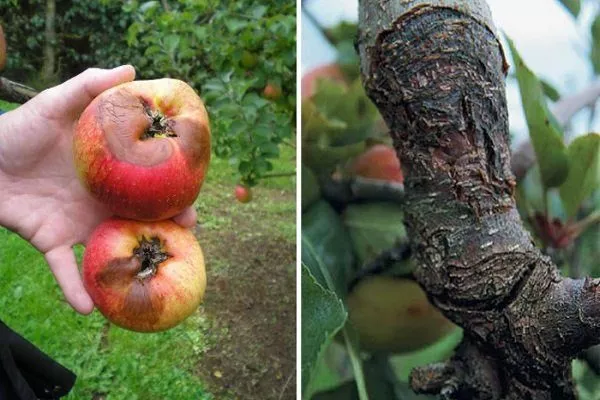
The causes of diseases are:
- unfavorable weather conditions (extreme heat or frost);
- injuries caused to the tree by rough pruning of branches, breaks, lack of treatment of wounds, etc.
Common and black cancers are predominantly found in old apple treesThe diseases are incurable. The only option is to destroy the trees.
High groundwater level
Apple trees need water for growth and development, but excess moisture leads to root rot. This occurs when the groundwater table is high.
When the root system stops functioning, the plant begins to suffer from "starvation." Old branches are the first to react to the lack of nutrition, quickly drying out. The same fate soon befalls the young shoots. Without rescue efforts, the tree will die.
The optimal groundwater level for apple trees is:
- on vigorous rootstocks - 3 m;
- for medium-sized trees - 2.5 m;
- for dwarf forms - 1.5 m.
If it is known that the water level is above the permissible limit, make mounds of fertile soil:
- Pour the soil mixture in layers. Firmly compact the mound to ensure stability when it reaches a thickness of 15–20 cm. The resulting structure should be 1.5–2 m in diameter and 0.5–1 m high.
- Make the mounds in the fall to allow the soil to settle and compact over the winter. Plant the apple trees on them in the spring to prevent the roots from freezing in the ground.
- Tie the trunk of the seedling to a strong stake so that it does not break in the wind.
- Apple trees on hills require frequent and abundant watering, especially if the first 2-3 months after planting are hot and dry.
- For the first two years, apple trees planted on hillsides will lag behind their traditionally planted counterparts in growth. But then their growth will accelerate significantly.
If the groundwater level was unknown at planting, the problem may initially go unnoticed. The trees develop normally, but after 10–15 years, they begin to wither.
Symptoms of roots reaching groundwater:
- the tree stops growing;
- leaves quickly turn yellow or brown;
- frequent infections by fungal diseases;
- When the summer heat sets in, leaves begin to fall en masse.
There's only one way to remedy this situation: radical pruning of the apple tree. When the tree is no more than 2–2.5 m tall, it won't need deep roots to obtain water.
Bad landing site
Planting an apple tree in a low-lying area is not a good option. In such a location, water from melting snow accumulates in the spring, and puddles linger after rains. Stagnant moisture deprives the roots of oxygen. The tree begins to suffer from a lack of oxygen, reacting by drying out its branches.
Meltwater is especially dangerous. In spring, fruit plants begin to grow root hairs. These especially need oxygen to thrive. After a day without air, they die. After another three days, larger roots begin to die.
Symptoms to identify if your apple tree is in an unfavorable location with frequent stagnant water:
- the leaves turn brown and begin to fall off;
- the growth of new shoots stops;
- Over time, the tree dries out completely.
Replanting apple trees to solve the problem is difficult. Only preventative measures are effective: planting trees on elevated sites or on artificial mounds.
Poor soil on the site
Drying branches may indicate unsuitable soil conditions. Apple trees don't like calcium-poor clay, loam, or marshy soils. These soils will need to be amended with lime, chalk, dolomite, peat, and river sand.
Some wild grasses draw essential nutrients from the soil, significantly depleting the apple tree. Branch drying is then caused by a deficiency of certain nutrients in the soil:
- potassium;
- boron;
- zinc;
- manganese;
- magnesium;
- nitrogen.
Special fertilizers will help make the soil more nutritious:
- Superphosphate is a complex mineral preparation;
- Calcium nitrate;
- Super compost Pixa is a product containing beneficial microorganisms;
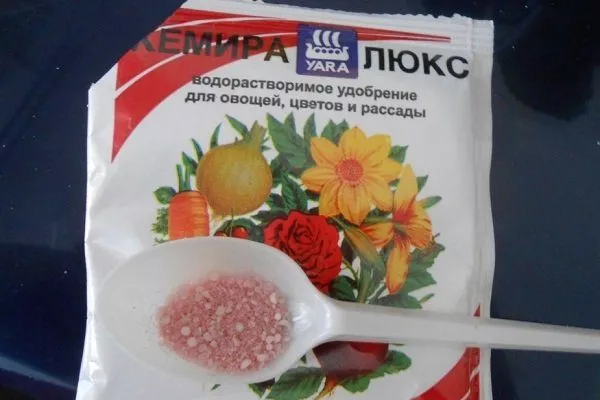
- Kemira-Lux is a substance containing 20% phosphorus, 27% potassium, and 16% nitrogen.
Lack of watering
Many inexperienced gardeners believe that apple trees only need watering during their first year of growth. This is true for northern regions with moist soils and cool summers. However, in southern regions, even mature trees require watering.
Lack of moisture is indicated by:
- uniform drying of branches;
- wilting of leaves.
During the summer, if there's no rain, apple trees only need to be watered twice: 2-3 weeks after flowering and 3 weeks before harvest. In regions with frequent, prolonged droughts, an additional watering is needed in the spring before flowering begins.
The water consumption for each tree is as follows:
- 50–80 liters of water for a 3–5 year old seedling;
- 120–150 l for an apple tree 7–10 years old;
- up to 200 l for older specimens.
Landing errors
Branches dry out when young seedlings don't root in a timely manner. Some gardeners make the mistake of planting trees in the summer. The plant simply doesn't have time to adapt to its new location and develop a sufficient root system and branches before fall.
According to the rules, apple trees are planted in spring or fall. In the first case, the seedling will take root well over the summer; in the second, it will adapt and harden over the winter.
Another mistake when planting seedlings is placing large perennials with extensive root systems too close together. This happens when the plot is small and the owner tries to squeeze as many fruit trees and berry bushes into it as possible.
Incorrect pruning and grafting
There are specific rules for pruning, covering the selection of unwanted branches, the method and timing of the procedure, etc. Violations of the procedure sometimes result in the drying out of previously healthy shoots.
A poorly performed graft will, at best, result in the scion drying out and being rejected, and, at worst, the rootstock dying. A swelling at the graft site is a sign of incompatibility between the scion and the tree. This also indicates the apple tree has been infected with a viral disease due to poor hygiene.
Presence of pests
Pests are often the cause of apple tree branches drying out. The most common insect is the cockchafer larva, which is found in almost all regions.
The larvae reside in the soil around the plant's roots. They damage young seedlings up to five years old. Their roots are shallow and poorly anchored. The disruption of nutrition and oxygen uptake from the soil initially affects the branches (they begin to dry out), and then the tree as a whole.
To get rid of cockchafer larvae, use a solution of ammonia (50 g per 10 liters of water). Apply 10 liters of solution per tree. Water the trees in mid-May. The larvae hate the smell of ammonia, and the solution provides good nitrogen nutrition for apple trees.
Besides insects, rodents also harm the apple tree:
- field mice;
- moles;
- shrews.
They build nests in the soil, disturbing the roots (sometimes gnawing them). Branches are the first to react to the rodents' presence, gradually losing their elasticity and drying out due to a decrease in nutrition.
Reasons for drying out in different months
Branches can dry out at any time of year. Monitoring the tree's condition should begin immediately after the snow melts and continue until the apple tree enters winter dormancy.
After winter, an apple tree may bloom normally, but then begin to rapidly "lose" shoots. Reasons:
- severe wetting in early spring;
- mold infestation;
- water rat damage;
- in steppe regions - winter-spring drying out.
In most cases, the tree is incurable. However, if there are visible wounds or burns on the trunk and branches, the damaged areas must be cleaned down to healthy tissue and sealed with pitch or red lead.
With the onset of summer, the bark on apple trees begins to curl and peel. This is caused by prolonged rains and excess moisture. This doesn't affect the tree's overall health this year. However, with this kind of damage, the tree will have a hard time surviving the winter, and the branches will begin to dry out next season.
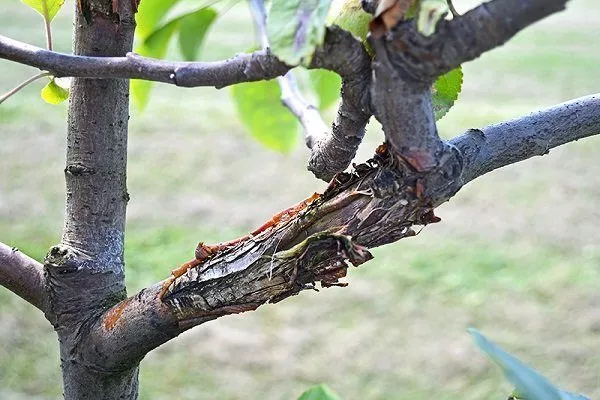
In summer (especially in July) the following can cause problems with branches:
- cytosporosis;
- black and common crayfish;
- fire blight;
- rust in an advanced state;
- sensitivity to soil waterlogging;
- pests;
- diseases of the bark and roots;
- consequences of the frosts experienced.
Reasons for the drying out of tree branches of different ages
The problem arises at any stage of apple tree development and growth—from seedling to mature tree. Specific treatment options exist for each specific case.
In seedlings
The most common cause of seedling drying out is Cytosporosis. This disease also manifests itself as reddish spots with yellow areas on the trunk surface. When detected, use the combination of Insecticide and Fungicide Rescuer.
Young plants often lack minerals, especially nitrogen. Feeding with complex fertilizers can help.
Young apple trees
Branch drying is caused by root parasites, rodents, and fungal infections. This problem can be solved with chemical treatments.
To combat diseases, the following means are used:
- Trifloxystrobin;
- Copper sulfate + calcium hydroxide;
- Difenoconazole + 1/2 flutriafol.
For insect pests, the following preparations are recommended according to the instructions:
- Pyriproxyfen;
- Aversectin C;
- Malathion.
Another reason for young apple trees drying out is poor rooting. At an early age, the problem can easily be resolved by relocating the tree to a new location suitable for growth and development.
Near the old trees
The primary cause of drying out of old apple tree branches is natural aging. Once the plant reaches 10 years of age, it enters the final phase of its life cycle.
Old trees also have a weak immune system. Various diseases "stick" to them. Dry branches can indicate canker, black canker, and root canker. In this case, the tree is beyond repair, and it's best to destroy it to save younger seedlings.
Often, the gardener is to blame for the drying out of apple tree branches. Their carelessness or negligence when planting the tree and subsequently caring for it will inevitably have consequences. If caught in time, the problem can be solved, and the plant will only suffer the loss of a few branches. Otherwise, you can forget about developing an apple orchard.