
The Rudolph apple tree is an interesting Canadian variety widely used in gardens and parks. Its apples are not particularly marketable, but that's not the main advantage of this short, fast-growing apple tree. The Rudolph variety, which can grow as a small tree or a multi-stemmed shrub, is primarily noted for its ornamental qualities.
Description of the Rudolf apple tree
The Rudolf apple tree has a rather unusual appearance. This profusely blooming variety attracts gardeners and landscape designers for its decorative qualities, but its fruit is also noteworthy.
Tree
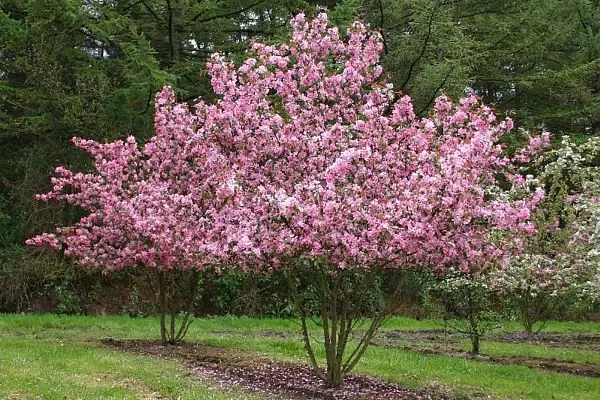
When a tree is young, its crown may be elongated or pyramidal. Over time, it becomes more rounded.
Characteristics of the Rudolf apple tree:
- Tree height — 4-6 m.
- Escapes - depart from the trunk at a slight angle.
- Leaves — dark green, with a metallic sheen, dense, broadly elliptical, 3-5-lobed. In mature trees, the branches droop, taking on a weeping appearance.
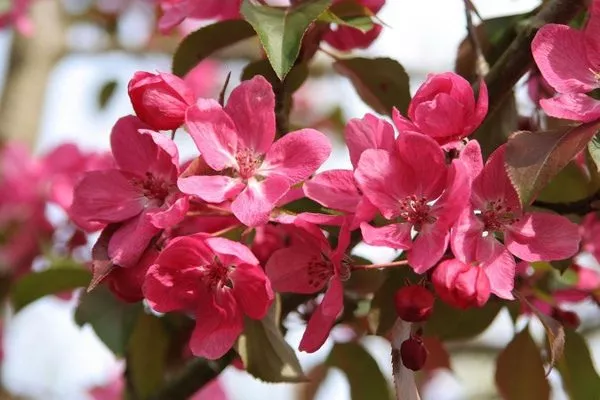
- Flowers — pink, 2-3 cm in diameter. The petals are darker on the reverse side.
The Rudolf apple tree's leaves emerge after flowering. They're initially copper-red, turning green in summer and bright yellow in autumn.
Fruit
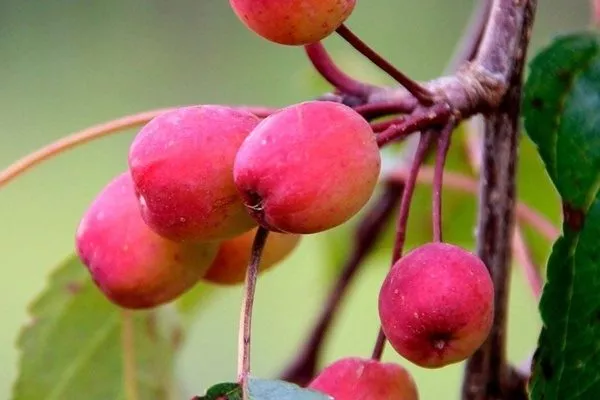
The fruits of the Rudolf apple tree are small, not particularly tasty, but very beautiful.
Fruit characteristics:
- Color - yellow-orange, often with a red blush on the side facing the sunny side.
- Form - spherical.
- Weight — 20-40 g.
- Diameter — 1.5-2.5 cm.
Who and when developed the Rudolf variety?
The Rudolph variety was bred by Canadian breeder Frank Skinner in 1954.
The apple tree gets its name from Santa's reindeer, Rudolph. A synonym for this name is Malus hybride Rudolph.
Characteristics
The Rudolf apple tree is valued not only for its visual appeal, but also for its excellent agronomic characteristics.
Trees that are planted primarily for their beauty are required, first and foremost, to be resilient, immune, and able to decorate a garden, park, or homestead for a long time.
Regionalism
The Rudolf variety can be successfully grown in a wide range of climatic conditions due to its winter hardiness and high adaptability to weather conditions and soils.
This apple tree is grown, in particular, in the central part of Russia, in the Moscow and Leningrad regions, in Crimea and the Volga region, in the North Caucasus, in the Central Black Earth region and the Azov region.
Flowering and ripening
Long flowering is exactly what the Rudolf apple tree is all about. Unlike other varieties, it blooms for about a month, with flowering periods ranging from May to June.
The variety has a late ripening period, the fruits ripen in the first ten days of September.
Productivity
The variety produces an average yield of about 5 kg, which is quite good for an ornamental tree. Overall, yields can vary from year to year.
The Rudolf apple tree begins bearing fruit 2-3 years after planting. The first harvests are quite small—2-3 dozen medium-sized apples.
Taste and application
The Rudolf variety's fruit has a tart flavor, with spicy notes and a fairly strong acidity; the sweetness only comes through in the aftertaste. The flesh is dense and firm, fine-grained. It's firm and crunchy, making it difficult to bite into.
The fruits are not eaten fresh, but they are ideal for processing. Small apples make excellent preserves, such as jam and preserves. The fruits can be dried, making excellent dried fruit. They are also suitable for making all kinds of liqueurs, ciders, and liqueurs.
The tree itself is used for landscaping and urban landscapes. The Rudolf apple tree looks beautiful at forest edges, in group and alley plantings, and is also suitable for mixed compositions, mixed borders, and hedges.
Benefits of fruits
The Rudolf apple tree's fruits, though small, are nutritious. They are rich in vitamins—A, E, B, K, H, and PP—and microelements—iron, zinc, sodium, magnesium, sulfur, phosphorus, potassium, manganese, and iodine. They are also rich in fiber, natural acids, and tannins.
Regular consumption of Rudolf apples strengthens the heart and vision, maintains vascular elasticity, stimulates appetite, regulates gastrointestinal function, rejuvenates brain cells and the entire body, promotes the elimination of toxins and waste, and prevents anemia and vitamin deficiency.
Winter hardiness
The variety is quite winter-hardy. It can withstand temperatures down to -34°C. However, severe frosts pose a high risk of freezing of immature shoots.
Disease resistance
The Rudolf variety is fairly resistant to powdery mildew and scab, which are common on apple trees. However, unfortunately, this apple tree lacks strong natural immunity to diseases and pests.
Pollinator varieties
The Rudolf variety is self-fertile, but its yield increases with the presence of pollinators. Suitable pollinators include 'Chudnoe', 'Kovrovoe', and 'Osennee polosatoe'.
However, pollinating this ornamental apple tree isn't particularly practical. It's more practical to use the Rudolf apple tree itself as a pollinator for fruit varieties that bloom at the same time.
Pros and cons
While flavor isn't the Rudolf ornamental apple tree's crowning glory, it does have many other advantages that are valuable to gardeners and landscape designers. However, along with its advantages, the Rudolf variety also has its drawbacks, which are best learned before planting.
Pros:
Cons:
Landing
Although the Rudolf apple tree is planted primarily for its beauty and isn't expected to produce a large fruit harvest, it, like other varieties, is important to plant it correctly. Improper cultivation practices or poor site selection lead to diseases and other problems. An improperly planted apple tree will wither, bloom poorly, and produce very few fruits.
Selection of seedlings
It's best to purchase seedlings from a specialized nursery or at least from a reputable supplier—this will minimize the risk of purchasing diseased or substandard planting material.
When choosing seedlings, it is important to pay attention to the following points:
- The tree should be healthy, free of damage and growths. The bark should be smooth, free of blemishes and signs of disease, and the leaves should be whole and free of defects.
- Age: 1-2 years. One-year-old seedlings have a crown without branches, while two-year-olds have several lateral branches. It is not recommended to purchase and plant two- or three-year-old seedlings, as they have a very poor survival rate.
- The roots of a healthy seedling are moist and well developed, not rotten or dry.
Selecting a site
The Rudolf apple tree is best planted on eastern and southeastern slopes. Lowlands and marshy areas are not suitable. A site with high soil moisture, but good drainage is essential, can be selected.
What else to pay attention to when choosing a site:
- Lighting. Open or partially shaded areas are suitable. However, in the latter case, the decorative effect may be significantly reduced.
- Priming. Fertile loams are preferred, but soils with sand, chalk, and clay are also suitable. Neutral or slightly acidic pH is ideal.
- Wind protectionThe area chosen for planting should be free of drafts and gusty winds.
- Groundwater. Locations where the groundwater level is above 1.5 m are not suitable. It is also not recommended to plant apple trees on the banks of bodies of water or near wells or springs.
Site preparation
Prepare the apple tree planting site in the fall to achieve the best results—fertilizers will dissolve over the winter, and the dug-up soil will absorb moisture. The Rudolf apple tree thrives in loose, light, and organically rich soil. Heavy or acidic soils are not suitable.
Features of site preparation:
- The soil is dug to the depth of a shovel blade, adding organic fertilizer to improve soil fertility. You can add humus or garden compost—an average of 5 kg per square meter.
- If your soil is poor, you can add mineral fertilizers, such as Kemira or Rastvorin, at a rate of 250 g per square meter. Alternatively, you can prepare your own soil amendment by mixing 25 g of urea or ammonium nitrate with 100 g of superphosphate and 40 g of potassium sulfate.
- If the soil is heavy and clayey, coarse-grained river sand is added at a rate of 10 kg per 1 sq. m.
- For overly acidic soils, add dolomite flour, slaked lime, and wood ash for deoxidation, approximately 250-300 g per 1 sq. m.
You should not add fresh manure or unrotted compost when digging.
Preparing the planting hole
It is recommended to dig holes for planting approximately a week before the start of planting work.
- A hole 60-70 cm deep and wide is dug for planting. The top layer of soil is set aside to create a soil mixture that will later fill the hole.
- If several apple trees are being planted, intervals of 2.5-3 m are maintained between the holes.
- A nutrient substrate can be prepared from rotted compost (3 kg), fertile soil (2 kg), potassium chloride (70 g), and superphosphate (100 g). A soil mixture can also be prepared from equal parts soil, peat, and humus, with the addition of wood ash and superphosphate—300 g and 100 g, respectively, per hole.
- A drainage layer approximately 15 cm thick is placed at the bottom of the hole. Expanded clay, broken brick, and even nutshells can be used as drainage material.
- Fill the hole 2/3 full with the prepared soil mixture to form a mound. Drive a support into the center of the hole.

Planting a seedling
The timing of planting the Rudolf apple tree depends on climate and weather conditions. In spring, the tree is planted from the first ten days of April to the first ten days of June, and in autumn, from the third ten days of September to the second ten days of October. In regions with harsh winters, spring planting is preferred, while in the south, autumn planting is preferred.
Features of planting the Rudolf apple tree seedling:
- The tree's roots (if planting a bare-root seedling) are dipped in a clay slurry. It's made from mullein and clay (1:1). This procedure improves survival, especially if you add Kornevin or another rooting stimulator to the slurry.
- The seedling is placed on top of a mound of earth (soil mixture previously poured into the hole), the roots are carefully straightened out; they should lie flat, without bending to the sides or upwards.
- Fill the empty space with soil, compacting it periodically by hand to ensure there are no air gaps between the roots. After planting, the root collar should be 8-10 cm above the ground surface; after the soil settles, this distance will decrease to 5-7 cm.
- The planted apple tree is tied to the support with soft twine. The stake should cover the sapling's south side, protecting the bark from the scorching sun.
- The apple tree is watered with warm, settled water, and when it is absorbed, the trunk circle is mulched with straw, tree bark, etc.
Care
The Rudolf apple tree requires minimal care. Its yield is small and of questionable quality, so the gardener's task is limited to basic agricultural practices.
Watering and loosening
The Rudolf apple tree requires regular watering. Young trees need watering approximately 2-3 times per month, while mature and older trees only need 3-4 waterings per season.
The watering rate depends on the age of the tree:
- up to 5 years — 50-80 l;
- from 6 to 10 years — 120-150 l;
- more than 10 years — 200 l.
When watering with a hose, it's important not to wash away the top layer of soil to avoid exposing the roots. It's recommended to loosen the area around the tree trunk with a pitchfork to avoid damaging the roots. Loosening is done 3-4 times per season.
Top dressing
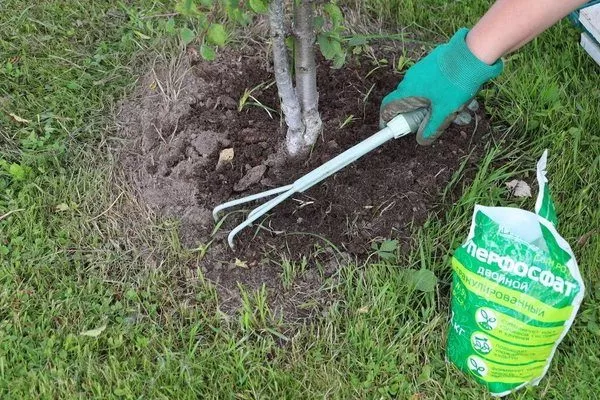
Fertilizing the tree begins one year after planting. It's best to use a complex fertilizer. Apply it in spring and early fall.
Approximate feeding schedule:
- SpringUrea and rotted manure are added, as well as complex mineral fertilizers, such as superphosphate, ammophoska, or nitroammophoska - 15-30 g per apple tree.
- SummerDuring this period, the tree requires potassium and phosphorus.
- AutumnThere's no need to apply fertilizer at this time; it's enough to mulch the tree trunk area for the winter, for example, with rotted manure or compost.
Trimming
To improve the apple tree's ornamental qualities, its crown is shaped annually. The Rudolf apple tree tolerates pruning well and recovers very quickly, so its crown can be shaped into any desired form.
Shelter for the winter
The Rudolf variety is highly winter-hardy and requires no winter shelter. The only thing required is to insulate the root zone. To do this, cover the area around the trunk with a thick layer of compost or rotted manure, about 10 cm thick.
Pest and disease control
Under unfavorable growing conditions and due to care errors, the Rudolf variety can be susceptible to a variety of fungal infections, including powdery mildew, to which it is relatively resistant. The tree is also susceptible to rust, root rot, and, less commonly, bacterial and viral infections.
Spring spraying with copper-containing preparations – before bud break and during flowering – helps prevent fungal diseases.
Among the pests, the most dangerous to the Rudolf variety are codling moths, leaf rollers, apple blossom beetles, spider mites, and aphids. Both specialized chemicals and biological control methods are used to combat these pests.
Harvesting and storage
The harvest is done early in the morning, in dry weather, as the apples, which will be stored for some time, should not be wet.
First, they collect the fallen fruit and store it separately. Then they pick the fruits located on the lower branches, gradually moving up higher and higher. This harvesting order helps prevent or at least minimize apple shedding.
The fruits are harvested with their stems attached. Baskets or crates of harvested apples are left in the orchard overnight to cool, and in the morning they are moved to the cellar. Apples should not be stored near potatoes or vegetables.
Reviews
The Rudolf apple tree isn't about apples; it's more about the beauty and comfort of your garden. But even without a harvest, this flowering tree won't leave you without one; half a bucket of small, tart-sour apples is a pleasant bonus to this ornamental plant.