
The Royalty apple tree is more than just a tree; it's a true gem for any garden. This apple tree resembles the Japanese cherry blossom and is gaining popularity in landscape design, attracting more and more fans. It's important to understand the characteristics of this plant to grow a bountiful harvest without significant financial investment.
History of apple tree breeding and growing regions
Royalty is an apple variety created by Russian breeders to add naturalness and diversity to landscapes. Its ancestor is the Nedzvetsky apple tree.
Despite the lack of official registration in the State Register, Royalty is increasingly becoming a garden staple. The variety is known by various names: it's called "red-leaved" or "purple" due to its unusual dark red foliage with a slight purple or even bluish tint.
The apple tree can grow almost anywhere in Russia thanks to its tolerance of various climatic conditions. Its main cultivation areas include the Northern Caucasus, Crimea, and central Russia.
Characteristic features of the variety
The ornamental qualities of apple trees, which belong to the botanical genus Malus and belong to the Rosaceae family, are distinguished by their ease of cultivation. These plants can grow in ordinary soils, but prefer soils that have a loose structure, sufficient depth and moisture, and are located in sunny areas.
Tree
This tree species can reach heights of 6-7 meters or even more, without the need for pruning. In some cases, specimens can reach 9-10 meters. However, gardeners often limit the height to 3-4 meters, which is reasonable given the intended use.
Varietal characteristics:
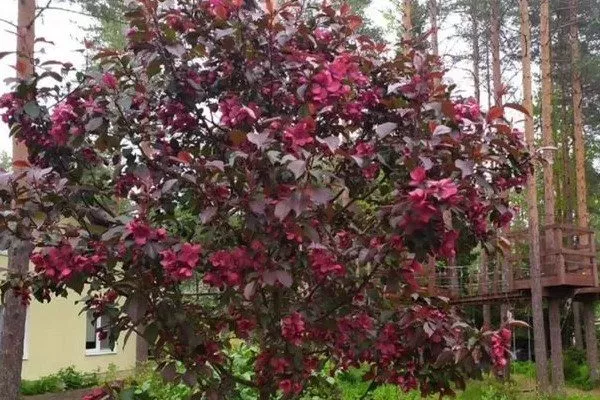
- At the beginning of its development, the tree's crown is compact, sometimes pyramidal or oval-shaped. After two to three years, it begins to expand, becoming wider and more spreading, covering an area of up to 4-5 m. There are also "weeping" forms with long, thin branches drooping downward.
- Royalty's leaves are oblong, elongated, and oval. They are leathery, glossy, and thickened, reaching up to 10 cm in length with a long, pointed, spirally curled tip.
During the growing season they change color, passing through several shades:- At first they are greenish-brown, then acquire a bright purple tone, which can disappear under the influence of the sun in summer;
- During the hottest time of the year they are decorated with various shades of red, and by autumn they become crimson or brownish-red.
- The leaves are firmly attached to the branches and fall late, usually by October or even November, which adds to the trees' ornamental appeal.
- Royalty's branches are thin and light brown in color.
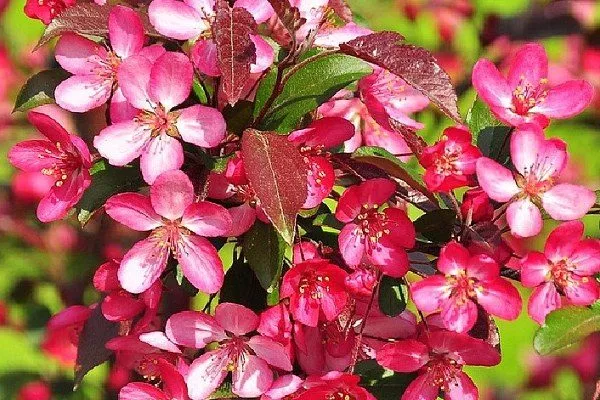
- During flowering, the tree is adorned with large, simple buds up to 4 cm in diameter. The color of these flowers is rich: purple or ruby-red.
Fruit
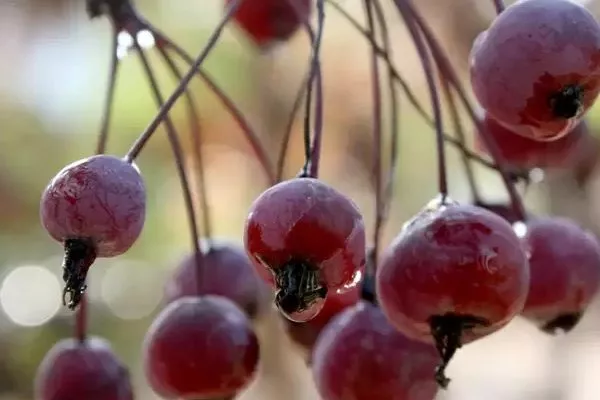
These apples do not attract attention because of their unsightly appearance: they are small, not very tasty and serve as food for birds in winter.
Their features include:
- round or slightly elongated shape;
- rich red or wine-purple color;
- smooth, waxy skin;
- dryish, bitterish pulp of a pink-purple hue;
- small size, with a diameter of 2.5 to 5 cm and a weight of 5-6 g.
Pollination and productivity
Royalty is not cultivated for its fruit. It is grown primarily as an ornamental, as it is intended for other purposes. In high-yield years, a tree can yield up to 10-15 kg of apples, but in reality, gardeners rarely harvest this particular variety.
Royalty is a self-fertile apple tree, meaning that even the absence of other pollinating varieties will not prevent it from bearing fruit. However, those who wish can supplement their garden with other apple varieties:
- Laletino;
- Ranetka Purpurovaya;
- Skalepovka.
Flowering, ripening time and fruiting
Apple trees begin budding in April or May, lasting anywhere from 4 to 13 days, depending on weather conditions. The apples reach full maturity by mid-September, when they are ready for harvest. However, the first harvest from such an apple tree will take at least five to six years.
Growth characteristics:
- In the first two to three years of life, a young tree grows slowly, focusing on developing a powerful root system;
- after this, active development of the above-ground parts begins - 15-40 cm per year, depending on the conditions in which the apple tree grows;
- By the age of ten to twelve years, the tree reaches its maximum growth and at the same time the peak of fruiting.
Frost resistance and disease immunity
The Royalty apple tree has good cold tolerance and can withstand temperatures down to -35 degrees Celsius, making it suitable for growing in a variety of climates. In areas with particularly harsh winters, it is recommended to protect young trees to prevent frost damage to young shoots.
Resistance characteristics:
- The tree does not have genetic immunity to scab, powdery mildew, and other fungal diseases, but its resistance to these problems is rated as average. Even in high-humidity conditions, these apple trees rarely suffer from diseases and recover quickly.
- Pests usually avoid Royalty, but to ensure complete protection of the plant, regular preventative measures are recommended.
Landscape and culinary uses
The small fruits are not suitable for eating raw, but thanks to their rich vitamins and minerals, they are used to make preserves and jams. Chefs value these apples for the unique flavor they impart to dishes, and winemakers harvest them to produce homemade wines and liqueurs.
The Royalty apple tree amazes with its beauty throughout the year:
- in the spring it is decorated with bright leaves and flowers;
- in summer - lush greenery;
- in autumn – red color of foliage;
- in winter – with bright fruits.
This tree can serve not only as an ornamental tree but also as a pollinator in orchards. For larger plots, paradise apple tree seedlings grafted onto tall rootstocks are ideal. For smaller gardens, seedlings grafted onto semi-dwarf or dwarf rootstocks are recommended.
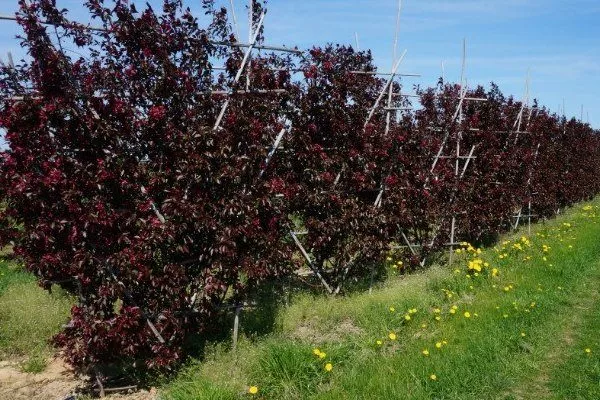
The Royalty apple tree is ideal for narrow garden plots. It is often planted in urban areas due to its tolerance of air pollution. This tree makes a beautiful impression in urban flowerbeds and on long trellises, and looks beautiful in parks, especially in the spring.
To create a vibrant flowerbed, it's recommended to plant this apple tree alongside bulbous plants such as tulips or daffodils. In large and medium-sized garden areas, the paradise apple variety can be turned into a hedge by planting it next to:
- lilac;
- evergreen viburnum;
- climbing or shrub roses.
In spring, when nature comes alive, these apple trees are a delight, adorning the edge of an alley or the shore of a pond. They look especially striking against a backdrop of green fields or conifers.
To highlight the autumn splendor of the paradise apple tree, you can place the following around it:
- multi-colored New Belgian aster;
- Echinacea Fatal Attraction;
- Sedum spectabile Matrona;
- Rudbeckia splendens Goldstrum.
This way you can create a bright flowerbed, in the center of which the Royalty apple tree will reign supreme.
Varieties and subspecies
Royalty is most often grown on rootstock. The main varieties are:
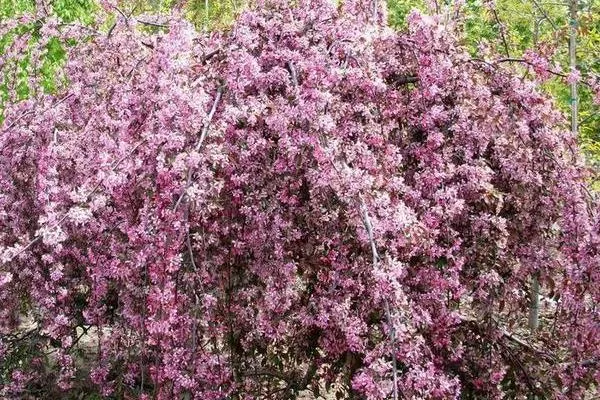
- Royalty pendula (Royalty pendula). A columnar cultivar characterized by downward-hanging branches. Its leaves are typically green with a subtle pinkish tint, and its flowers are abundant, numerous, large, fragrant, and bright pink.
- Nedzvetsky apple tree. Its shoots are dark pink, and its leaves are purple. The flowers have a pink tint. The fruits, though not very large, have a delicious flavor that combines sweetness with a slight tartness.
The Nedzvetsky apple tree is relatively easy to care for and resistant to various diseases, making it an excellent choice for gardeners looking for a good harvest without the hassle.
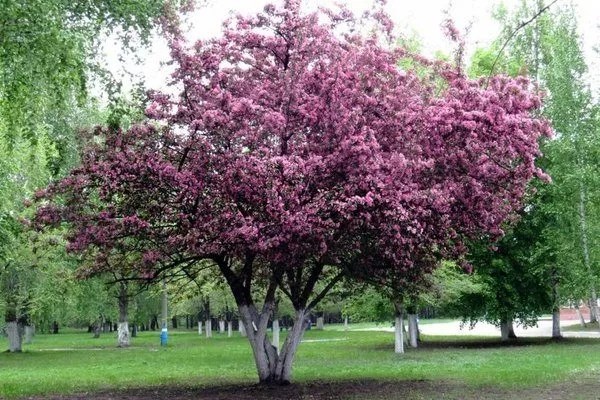
- Royalty Beauty is a weeping woman. This variety boasts long, elastic, flexible, and slender branches that cascade downwards, forming a cascade of foliage and fruit. They display a variety of shades, ranging from bright scarlet to deep purple, beetroot, and even violet.
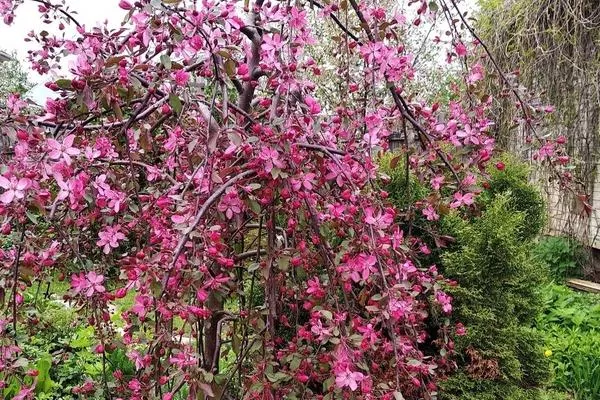
- Purple hybrid (Royalty hybridus purpurea). The hybrid was created by pollinating the blood-red and Nedzvetsky crabapples. It features long, downward-drooping branches, but with a crimson-red hue, including on the bark of the shoots and flowers, significantly enhancing the tree's decorative appeal in landscape design.
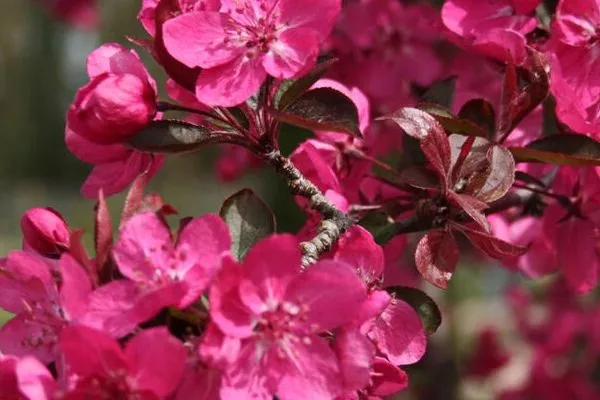
These varieties are distinguished by their increased frost resistance and are suitable for growing in a wide range of climates. Their easy care and undemanding conditions make them suitable for growing even in areas where other fruit trees are unsuitable.
Landing features
When choosing the time to plant, consider the climate conditions of your specific region. In temperate and warm climates, it's best to plant seedlings in late summer or a month before the first frost. In more northern latitudes, early spring is the best time.
Site requirements, site preparation
The Royalty apple tree grows well in ordinary, yet fairly deep, soil. It can be planted in either full sun or partial shade, but a sunny location with ample light provides the best conditions.
- sunlight has a positive effect on flowering, fruiting and autumn leaf coloring;
- When grown in the shade, trees get sick more often, their leaves fall earlier, and they bloom poorly.
Key requirements:
- the area must be protected from strong winds;
- groundwater depth – maximum 2 m;
- land indicators:
- fertile;
- moderately humid;
- deep;
- well drained;
- sandy loam or clayey;
- with pH 5-6.5.
- To ensure that the apple tree fits harmoniously into the landscape, it should be planted alongside shrubs or near buildings.
Plants of this variety adapt to the soil in which they are planted and can even cope with poor soil conditions. However, for best results, it is recommended to plant the seedling in soil with optimal characteristics.
Selection and preparation of seedlings
For successful acclimatization, select plants that are one to two years old. These trees are more easily established in a new location and are less susceptible to fungal diseases.
An excellent seedling is distinguished by several characteristics:
- tree height – minimum 1.5 m;
- root system – should be smooth, without formations or swellings;
- trunk – green in color, without damage on the surface.
Before planting, soak the roots of the seedling in water for 5-6 hours and treat with antibacterial agents or a non-concentrated solution of potassium permanganate.
Technology of planting operations
When planting multiple seedlings, maintain 2.5m spacing between them and 4m between rows, and plant Royalty according to the instructions:
- Dig a deep planting hole. It should be 40 cm deep and 30 to 45 cm in diameter.
- Using a pitchfork, loosen the sides of the hole to allow the soil to become more airy and the seedling's root system to quickly adapt. If the soil is not fertile enough, enrich it with planting mix or compost.
- Before planting, reduce the length of the seedling shoots by about a third, and remove damaged branches completely.
- Place the seedling vertically in the center of the hole, ensuring the root collar is level with the soil. If the seedling was grown in a pot, place it at the same depth it was in the container.
- Fill the hole with soil, optionally adding compost or fertilizer. Compact the soil.
- Create a small depression around the trunk for watering and moisten it.
Watering is crucial early in a tree's life, especially regular and generous amounts. Insufficient watering will cause the roots to develop closer to the surface, which will lead to damage in future droughts.
General care recommendations
To ensure your apple tree develops properly and delights you with its vibrant colors and unusual, tart fruit, it's essential to follow all care recommendations. These are standard, but there are some nuances specific to varietal requirements.
Watering
To keep Royalty apple trees healthy, maintain moderate humidity. Too much water can harm the tree, while too little will negatively impact its appearance and bloom.
Recommendations:
- one young tree should consume no more than 10 liters of water, while an adult tree will require 20-40 liters;
- the poured liquid is first allowed to settle, especially if the water is from the tap;
- To reduce moisture loss, it is important to thoroughly loosen and mulch the soil around the trunk after watering.
Top dressing
To maintain the growth of ornamental trees throughout the growing season, a single fertilization in the spring is sufficient. Complex mineral fertilizers, available at specialized gardening stores, can be used for nutrition. Alternatively, prepare your own mixture, including organic and mineral components.
To fertilize under the crown per 1 sq. m, you need to add the following ingredients:
- manure or humus – 8 kg;
- Superphosphate – 50-70 g;
- potassium chloride – 60 g.
After the procedure, dig the soil to a depth of about half a shovel blade and water it generously with warm water.
Trimming
Pruning ornamental apple trees is individualized for each plant. These trees are easy to shape, allowing them to be turned into hedges, alleys, and even bonsai-like structures. They look magnificent both as part of compositions and as individual specimens.
However, there are requirements that must be followed to improve the tree's immune defenses:
- Sanitary pruning – is a key element of proper Royalty care. Every fall and spring, inspect the crown and remove any dead, diseased, or damaged branches.
- Trunk rejuvenation – You need to prune 2-3 old branches, starting 10-12 years after planting in open ground. This procedure is performed once every 4-6 years.
Preparing for winter
To ensure your Royalty apple tree has a comfortable winter, take a number of safety measures:
- Apply lime suspension to the lower part of the trunk to protect the tree from pests and bark damage during severe frosts;
- Place supports under branches to prevent them from breaking under the weight of snow;
- Cover the tree trunk circle with a layer of peat and pine needles to protect the root system from freezing and retain moisture in the soil;
- wrap the trunks with wire mesh to protect them from rodents;
- In cold regions, cover young seedlings with protective material such as burlap or agrofibre;
- After the snow covers the ground, create a high snow bank around the apple tree.
Diseases and pests
Royalty can fall victim to scab, powdery mildew, and brown spot. To protect the tree from these diseases, regularly treat it with fungicides. Trees are also susceptible to pest attacks, so use insecticides to repel them.
For maximum effect, spray apple trees three times a year:
- in March, before the buds open;
- in May, during budding;
- in the first days of October, before the leaves fall.
If the apples are not intended for culinary use, chemical treatment can be carried out at any time during the growing season.
Common mistakes and their consequences
Young gardeners often encounter common mistakes when caring for the Royalty apple variety, which negatively impact its budding:
- Incorrect bush formation: Excessive pruning can reduce the number of buds.
- Insufficient hydration: especially important in autumn for the formation of ovaries.
- Ignoring fertilizing procedures: Lack of nutrition negatively affects budding.
- Lack of pest control measures: Damaged branches do not produce many flowers.
Pros and cons
The Royalty apple tree, sometimes called the apple of heaven, is one of the highest quality varieties, distinguished by its purple-tinged foliage.
This low tree has a number of advantages:
There are also disadvantages:
Reviews
The Royalty apple tree is a unique ornamental tree that catches the eye with its unusual appearance, reminiscent of Japanese cherry blossoms. It requires little care and can be grown even by novice gardeners. Its lush, crimson-pink blossoms make it an exquisite addition to any garden.