
The Red Catty apple tree has gained popularity among gardening enthusiasts thanks to its attractive, bright-red fruits. These trees are moderately sized and don't require much garden space. The variety is also renowned for its productivity and early fruiting, but to ensure a bountiful harvest, it's important to know and follow the planting and care recommendations for young seedlings.
History of apple tree breeding and regions for cultivation
In 2013, the Red Ketty apple variety began to gain popularity in Russia, achieving widespread popularity thanks to twenty years of breeding efforts. This variety, characterized by its red flesh, was developed without the use of genetic engineering.
Experts disagree about the origins of Red Catty:
- Some believe that it was developed in Canada, North America;
- others claim that his homeland is Switzerland;
- others suggest that it is a club variety of apple tree.
Despite the lack of official recognition in the Russian State Register, nurseries actively offer seedlings of this variety on the Russian and Belarusian markets.
Red Ketty demonstrates high adaptability to various climatic conditions. Thanks to its frost resistance, this variety thrives in central Russia, while its drought tolerance facilitates successful cultivation in the country's more southern regions.
Features and specifications
This variety is extremely popular among gardeners worldwide due to its undeniable advantages and its adaptability to a wide range of climatic conditions. It is characterized by rapid fruit ripening after flowering, making it an early-ripening variety.
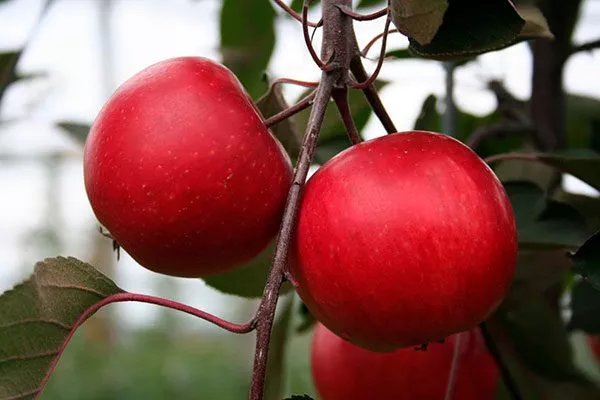
Red Katy apples have an attractive appearance with bright red skin and a medium size.
The appearance of the tree
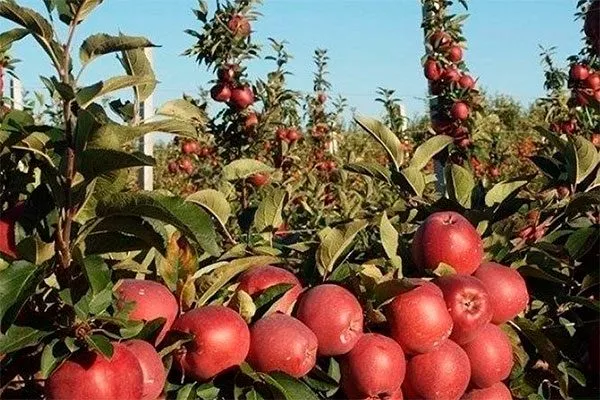
The plant is compact, rarely exceeding 260-300 cm in height. The tree's branches are thin, with reddish-brown bark, and adhere closely to the trunk, forming almost right angles when attached. Small-diameter shoots grow upward, parallel to the trunk, and the lenticels on them are small and sparse.
Other varietal characteristics:
- The leaves of the Red Catty apple tree are oblong and small. The apex is pointed, and the base is rounded. The blade is firm, with serrated edges. Young leaves emerge with a reddish-brown tint, which matures to a rich green over time. The leaf venation is reticulate, characteristic of many apple varieties.
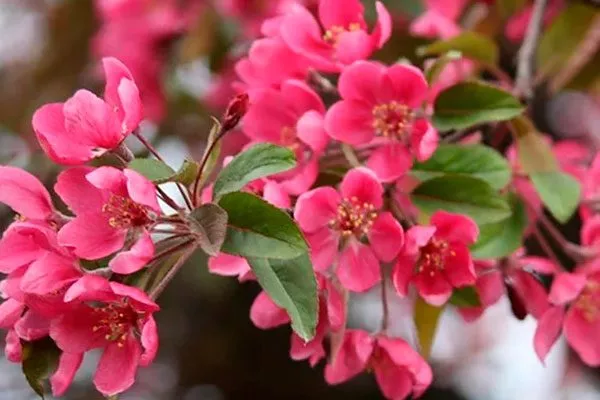
The key distinguishing feature is the characteristic raised, serrated leaf edges. At first glance, the leaf appears somewhat boat-like, with its underside and petiole drooping downward. The stipules are awl-shaped and green. - The Red Catty apple tree is stunningly beautiful during budding. The flowers are large, with three to five typically per cluster. The buds are a rich crimson color.
As the buds open, they take on lighter shades, ranging from deep pink to delicate rose. The petals are oval and loosely arranged around the flower. Remarkably, the stigma is located just below the anthers. The peduncle of this variety is elongated and pubescent.
Description of fruits
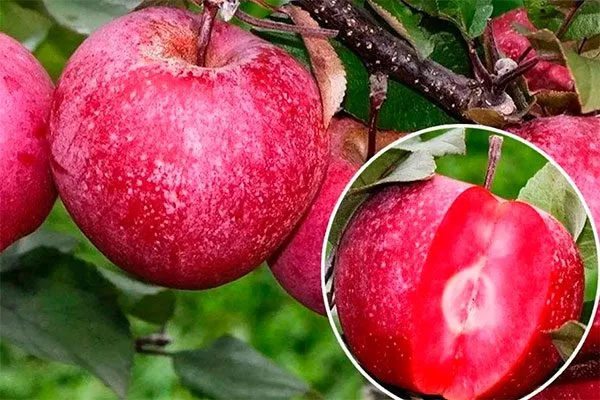
Apples of this variety have a characteristic round shape with a slight flattening along the axis, giving them a balanced and even appearance. They typically weigh 150-200 grams, sometimes more.
Other characteristic features:
- Ribbed structure It only slightly appears in the area of the calyx; it is not noticeable on the rest of the fruit, and there is no lateral seam.
- Skin The apple skin is dry, brightly shiny and glossy, smooth, strong and elastic, although not particularly thick.
- Color - It is a rich red-scarlet shade that can convey pink or crimson tints, but does not have an underlying blush.
- Subcutaneous points light-colored, very numerous, they are small, often covered with irregularities and clearly visible.
- Pulp The apples have a pleasant flavor, peel easily, are crisp and tender, juicy, and fine-grained. They are firm and have a stunning aroma reminiscent of wild berries.
The chemical composition of apples can be estimated from the following data:
- P-active substances (catechins) – 424 mg;
- ascorbic acid (vitamin C) – 21.6 mg;
- total sugars (fructose) – 17.8%;
- pectins (fiber) – 14.5%;
- titratable acids – 1.18%.
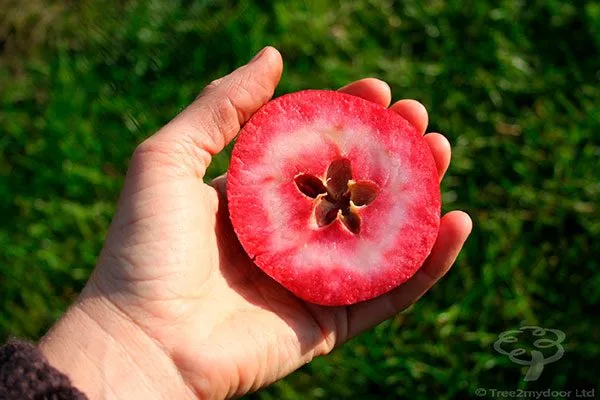
The main distinguishing feature of this variety is its internal color—a reddish-pink that completely covers the flesh, rather than appearing as individual veins. The juice from these apples is also red, and it retains its color even after cooking.
Taste, application, storage
A characteristic feature of these apples is their aroma, reminiscent of the scent of wild forest berries, and the taste of the juice is just like cranberries.
These fruits are rich in antioxidants and beneficial elements, making them perfect for storing in the cellar throughout the winter. They remain fresh and flavorful until spring. They are used to make juices and various preserves.
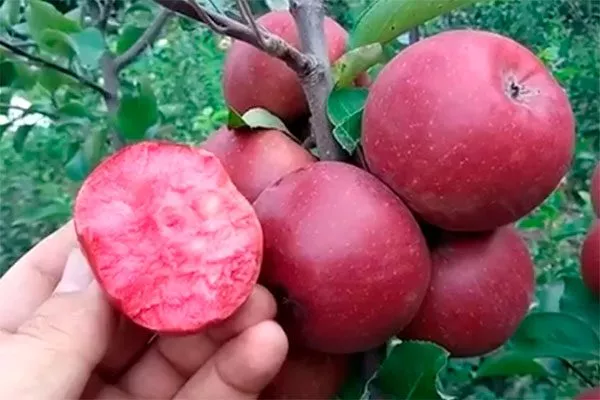
Experts note that the taste of these apples may seem overly sweet with a slight sourness, which fully develops only after some storage, but there is no official tasting assessment yet.
Apple tree pollinators and yield
This variety is self-sterile, so without additional pollination from other varieties, the yield may be minimal. It's important to select a suitable donor tree, which can be located up to 300 meters away.
Pollinators should bloom at the same time as the Red Catty variety. For example, the Vladimirskaya apple tree is an excellent candidate for a pollinator.
This variety has not undergone official testing in our country, so reports of its yield are informal and unconfirmed. According to experienced gardeners, a tree can produce between 100 and 140 kg of apples, although these figures can sometimes be higher. With proper cultivation practices, the yield can increase by a third.
Ripening and fruiting
Red Catty begins to bud in the first year after planting, but preserving the flowers is not advisable. Firstly, the initial buds will not produce fruit, and the young tree also needs time to establish its root system and develop foliage. Therefore, the first fruit can be expected in the third or fourth year.
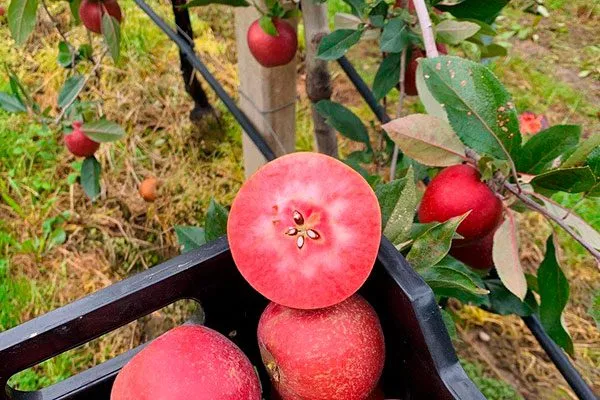
Main characteristics:
- Red Catty, like most winter apple varieties, begins blooming in mid-May, although timing can vary depending on climate and weather.
- The Red Catty tree grows 45-60 cm per year, so maturity occurs quickly.
- Although this variety is classified as winter-ripening, it is recommended to harvest the fruit from the tree in late August or early September. This will prevent the fruit from falling to the ground and ensure the best preservation of unripe apples.
- Technical maturity does not coincide with consumer maturity, which occurs after approximately 3-4 weeks of storage in a cool room, when the sugars are completely caramelized.
- When transporting apples, take special care to avoid mechanical damage, which can lead to rapid deterioration of the fruit.
It's recommended to transport them in boxes layered with sawdust or sand. If the temperature is maintained at no higher than 5-7°C, apples can be stored until February or March.
Resistance to frost, diseases and insects
The variety has demonstrated good tolerance to low temperatures. It can withstand harsh weather conditions, with temperatures dropping to -33 degrees Celsius. These characteristics make Red Catty suitable for planting in the northernmost and coldest regions of Russia, where winters typically see significant snowfall.
It's important to use seedlings adapted to local climate conditions. If the buyer chooses shoots delivered from warmer climates, the apple tree may not demonstrate its winter-hardiness.
The variety is resistant to scab and other diseases common to apple trees. It only becomes susceptible in years when epidemics reach particularly high levels, and even then, not always.
Methods of storing crops
For long-term storage of apples, it's best to use wooden crates with a capacity of 20 to 25 kg. Before placing apples in containers for long-term storage, expose them to sunlight for two to three hours. This will kill most of the microbes with ultraviolet light.
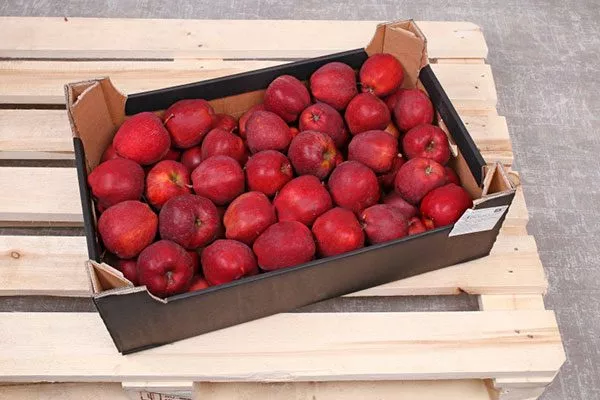
Features and methods of preservation:
- When stacking Red Catty fruits in a crate, be careful to arrange them in layers. Each apple should be positioned with its base facing downward.
- The criterion for correct placement is the position of the stem of the top apple, which should be located between the bases of the lower fruits.
- To extend the shelf life of apples, you can add buckwheat grains or peat chips to the box. Some gardeners prefer to use lemon balm sprigs or moss for this purpose.
- Storing Red Catty apples in plastic bags is also an acceptable method. Carefully pack the apples so that each bag contains approximately 1.5-2 kg.
For the first two to three days after packaging, the bags should be left open to allow the fruit to release excess moisture and improve shelf life. After this, the bags can be tightly tied and stored on a dry shelf in the cellar.
Landing rules
For the successful development of any apple tree, and Red Catty in particular, choosing a wise planting site is key. It should receive ample light, as shaded trees grow more slowly and may not begin bearing fruit until their fifth or sixth year, and in some cases, they may not bloom at all.
Other criteria:
- It's important to ensure good air circulation within the tree's crown to prevent fungal diseases. Therefore, the planting area should be well-ventilated but also protected from strong winds.
- The groundwater table should not exceed 200-220 cm to prevent the tree's roots from reaching it. Otherwise, rotting occurs, leading to the death of the plant.
- Preparing the hole in advance—before the planting season—is ideal for Red Catty. Dig holes 55-60 cm deep and 80-100 cm in diameter to ensure the rhizome fits snugly.
Place soil mixed with fertilizers at the bottom of the hole, cover it with stones or brick fragments to a depth of 10-15 cm, and then fill it with 30-40 liters of water. - The distance between Red Catty seedlings is typically around 220-280 cm, and between rows – up to 300-400 cm. This spacing will facilitate future harvesting and care of mature trees.
- Before planting, the seedlings are carefully inspected, removing all dry and damaged material. The rhizomes are soaked in water overnight before gardening.
- The rootstock should be kept above ground level to prevent roots from growing above. Otherwise, the rootstock will lose its natural properties.
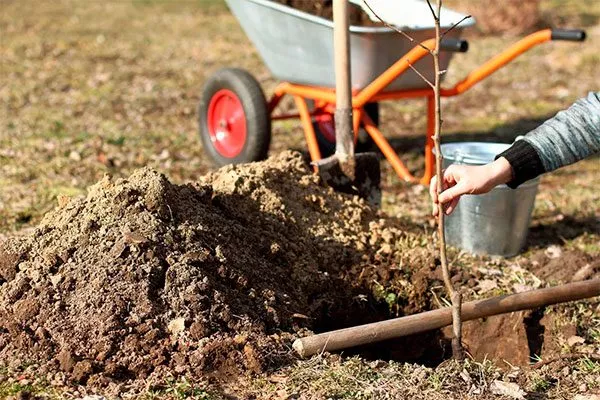
The landing process:
- Form a mound in the center of the dug hole.
- Place the prepared seedling, carefully spreading the root shoots along the walls of the mound.
- Cover with substrate.
- Firm the soil around the roots thoroughly to eliminate air pockets.
- After planting, water the surface and cover with a layer of mulch using the usual method.
A few days or weeks after the grafting, depending on the soil quality, the soil may settle, forming a hole around the trunk. Leaving the trees in this condition is not recommended; it's better to add soil so that the grafting site remains above ground level.
This apple tree variety is no different from others, so it can be planted in both spring and fall. The best time to plant in spring is March 20th, before the trees begin to leaf out, and in fall, after September 20th or even in October, after the leaves have fallen.
Apple tree care
To ensure a good harvest, you should follow certain rules for caring for the Red Catty variety.
Feeding, adjustment
When planting apple trees, consider the need for periodic fertilization, which should be done two to three times a year:
- in the spring – it is necessary to enrich the soil with nitrogen;
- in summer - It is important to add potassium and phosphorus to it;
- in autumn – organic mixtures are desirable.
Do not begin fertilizing the apple tree until its third year of life, as the tree has enough fertilizer in the first two years from the time it was planted.
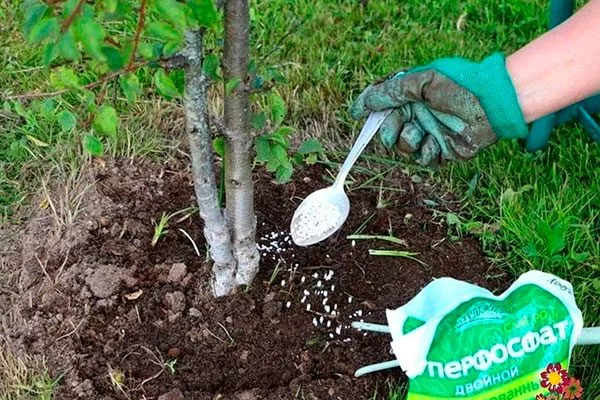
Don't strive for the maximum number of fruits; it's better to regulate their quantity. This will ensure they are sweet, large, and of high quality.
Frost protection
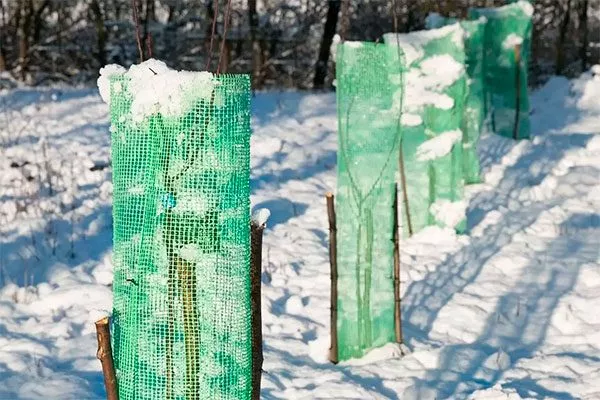
To ensure Red Catty survives the winter safely, it is sufficient to carry out the usual preparation and shelter measures:
- It is important to avoid moisture in time, which should be done in August, before the onset of autumn;
- in conditions of severe frost, you can insulate the root zone by laying a layer of straw, spruce branches or hay over the entire root zone;
- It is better to wrap tree trunks with burlap, tarpaulin or agrofibre, and smaller trees can be covered with a tent;
- To get rid of pests that like to infest cracks and chipped areas of bark, spray the trunks with white lime-based paint - this will not only rid the garden of insects, but also give it a neat appearance;
- To protect apple trees from rodents that feed on the bark and young branches, you can use melted lard, fuel oil, or solid oil applied to the lower part of the trunk.
Loosening the soil, watering: proper agricultural technology
A well-maintained tree trunk protects the tree from diseases and pests, so it's important to renew it twice a year by thoroughly loosening the soil and removing weeds. Don't forget to lightly loosen the soil the day after watering or rain.
This variety is capable of extracting moisture from the soil on its own, but during periods of extreme drought, the tree's trunk can be moistened with 20-25 liters of water twice a day—morning and evening—for a total of approximately 40-50 liters per day. Watering can be scheduled during the following periods:
- flowering;
- formation of ovaries;
- fruit ripening.
Fertilizers can be used along with water, but this should not begin earlier than the third or fourth year after planting.
Pruning: simple crown shaping
The ideal form for this variety is a sparsely tiered or simply sparse one, allowing you to fully enjoy its flowering and harvest. However, thanks to its flexibility, the tree can be given any configuration: from cordons to spindle- or candle-like shapes.
Sanitary pruning is recommended in the fall or spring, if necessary. During this period, remove upward-growing suckers, crossing and parallel branches, as well as dead, broken, and diseased branches.
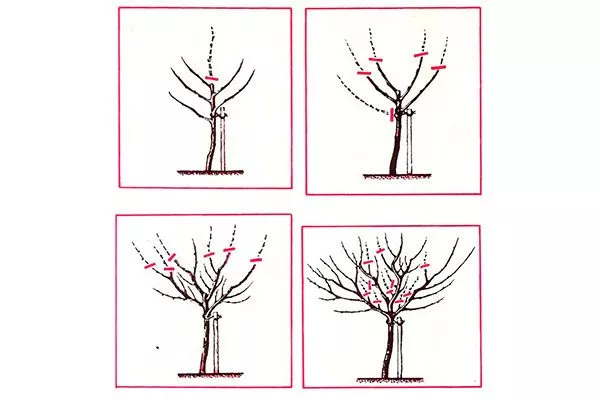
Shaping the crown of a fruit tree isn't particularly difficult. The main thing is to consider a few nuances:
- To ensure the tree looks attractive during the flowering period, it is recommended to use a multi-tiered pruning method;
- Usually the process of crown structuring is carried out in the spring, which is additionally accompanied by sanitary pruning;
- It is important to remove young shoots in a timely manner, since the stems that produce shoots will not bear fruit;
- In order to shape the crown of the Red Catty apple tree, it is necessary to carefully trim its branches every year, but not until the tree is fully mature.
To increase the amount of fruit, plant the apple tree near other fruit trees that bloom at the same time as the Red Catty.
Pest and disease control
The variety is resistant to most common diseases, but the risk of fungal infections increases during humid seasons. To prevent their development, spray the apple trees with Bordeaux mixture in the spring.
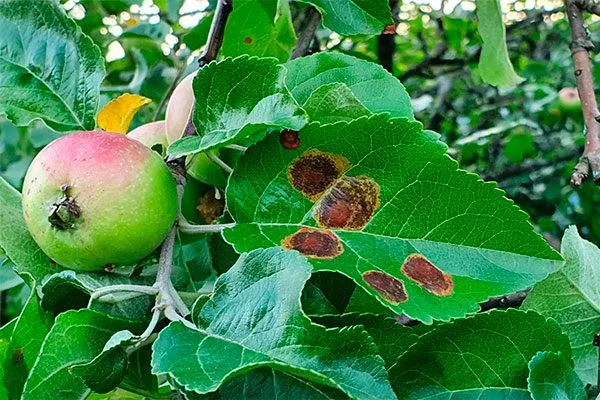
When the first symptoms appear, experts recommend using Fitosporin-M, a biofungicide that effectively suppresses the growth of various phytopathogenic fungi and bacteria, including those that cause powdery mildew, scab, downy mildew, rust, rot, bacteriosis, and septoria.
To prepare the solution, use 10 g of Fitosporin-M per 10 liters of water. Adding 1 ml of the growth stimulator Zircon to the solution prolongs the effect of Fitosporin and enhances its protective properties against pathogens.
Pros and cons
Reviews
The Red Catty apple tree will amaze even experienced gardeners with its appearance and unique flavor. Once grown, you can treat family and friends to red-fleshed fruits rich in vitamins and microelements. The tree perfectly combines decorative blooms with high fruit production, is easy to grow, and requires relatively few planting conditions.