
Red Delicious is an apple that is especially prized by gardeners. It impresses with its excellent taste and attractive appearance. Its high resistance to mechanical damage and long shelf life make it particularly valuable. Red Delicious is variety, which is ideal for commercial cultivation.
How did the variety appear?
Red Delicious originates from America, from Madison County, Iowa, and was discovered in 1880. The variety is the result of a natural mutation of the commercial Delicious variety, which was also developed by American breeders. One expert noticed a branch of red apples on an ordinary green tree. But the most astonishing thing was their incredible flavor.
The name comes from the words "red" and "delicious." Russian scientists recognized its potential and included it in the State Register of Breeding Achievements, granting it permission to be grown in Russia.
Interesting facts:
- At first, Red Delicious was cultivated exclusively in the southern regions of the country, but then it began to be planted in the North Caucasus region.
- Today, commercial plantings of Red Delicious have declined, but demand for apples and seedlings of this variety remains high among the population, so the trees are often found in private gardens.
- During the breeding process with Red Delicious, many interesting sub-varieties were obtained, including those at the Crimean experimental station – Prikubanskoye, Flame of Elbrus, Red Ketty, Winter Beauty.
- Japanese breeders at the Aomori Experimental Station have developed the Orient cultivar, which is distinguished by its excellent apple taste.
- Red Delicious was previously included in the State Register of Breeding Achievements, but then fell into obscurity for a long time. In 2017, Yuzhnye Zemli LLC, located in Crimea, applied for its re-inclusion, and it was approved in 2019.
Officially, the growing areas of the Red Delicious variety are limited to the North Caucasus, but it also grows well on the Crimean Peninsula.
Where can it be grown?
The variety has found its niche in the southern regions of the country, particularly in the North Caucasus, where the favorable temperate continental climate with abundant sunny days and cool nights promotes high yields. These conditions are most similar to the native environment of the Red Delicious apple tree.
Among the regions where the variety demonstrates the best fruit qualities, the following stand out:
- Rostov region.
- Krasnodar Krai.
- Crimea.
- North Ossetia.
- Kabardino-Balkaria.
- Chechen Republic.
- Ingushetia.
This variety was once widely cultivated on southern industrial plantations in Russia, but has recently been replaced by more frost-resistant varieties. Despite this, interest in this apple variety and its seedlings remains undiminished.
Features and specifications
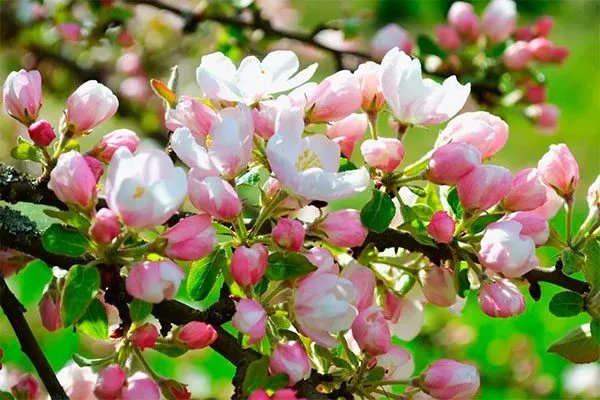
Red Delicious is not only distinguished by its bright red fruit, but also has a number of other unique characteristics: its leaves have a green sheen, its crown is round and wide, and its flowers have a milky pink hue.
The appearance of the tree
A medium-sized tree, the height of which varies from 450 to 550 cm, but sometimes there are specimens reaching 700 cm, while dwarf forms rarely exceed 380-400 cm.
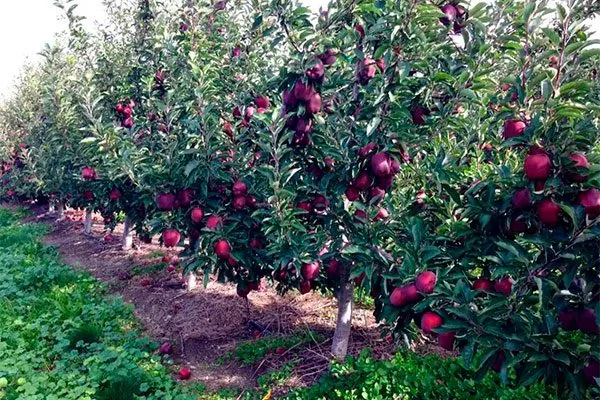
There are other characteristic features:
- Tree shape Red Delicious evolves over time: at an early age (up to 7-8 years) it has a clearly defined oval or inverse-pyramidal appearance, and starting from 9-10 years it becomes more broadly rounded.
- Crown The Red Delicious variety is characterized by numerous small, medium-thick branches that radiate from the trunk at angles ranging from 35 to 65 degrees, and are typically reddish in color. These branches, called rings, produce the fruit, making Red Delicious a ring-fruiting variety.
- Escapes Not particularly vigorous, but not thin either, they are distinguished by their brownish-red coloration in nurseries; in mature trees, they darken to a deep red. The surface of each is noticeably densely pubescent, with no bald spots. The shoots are most often straight, but sometimes curved ones can be found, usually located at the base of the crown.
- Leaves The tree bears numerous leaves. The leaf blade is small and oval. Its base is rounded, and the apex is slightly pointed. The thin leaves are a deep, lustrous green. This color persists until summer, after which it fades to a duller shade.

An uneven, serrated line runs along the edge of each leaf. A reddish hue extends along the underside of the petiole to the center of the leaf, achieved by anthocyanin, a plant glycoside belonging to the flavonoid group. - Bloom The blooming season begins in the last days of spring and ends with the arrival of June. The buds are pinkish-white, while the petals are milky white and oval in shape.
The petals are spaced slightly apart, barely touching at the tips. The pistils and anthers are level. Each inflorescence contains three to four buds, each adorned with five petals.
Description of fruits
Key features of the Red Delicious variety of fruits:
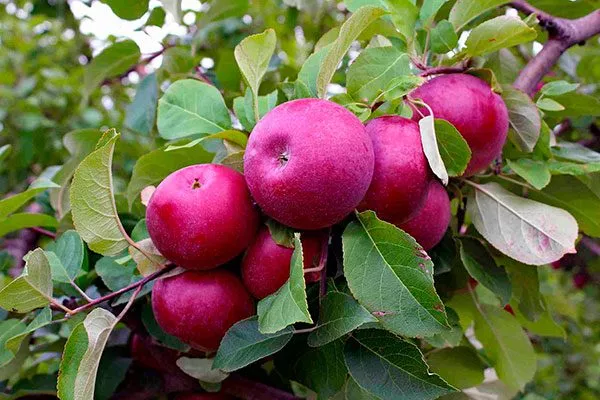
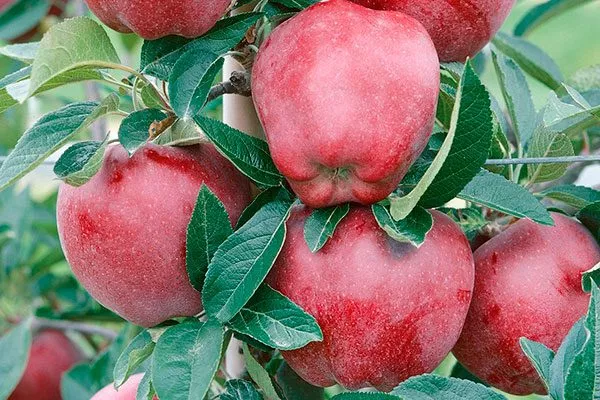
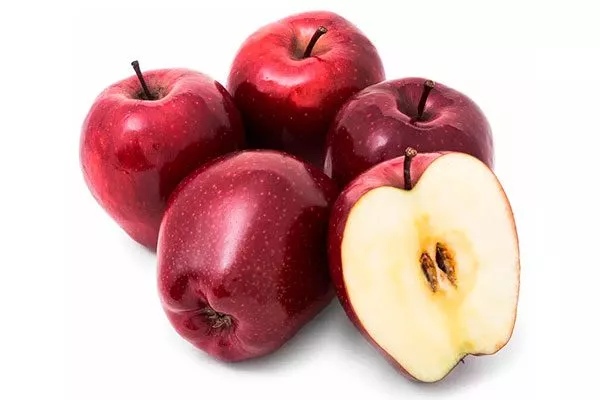
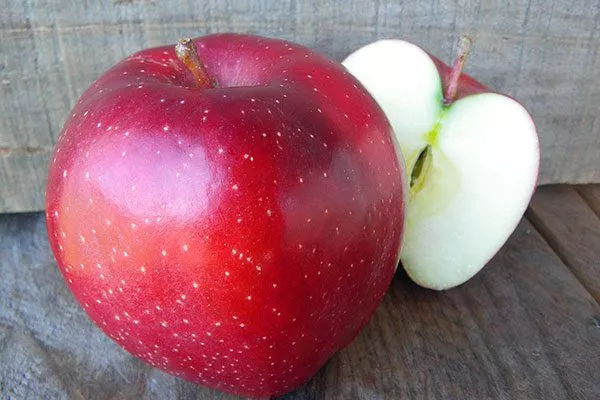
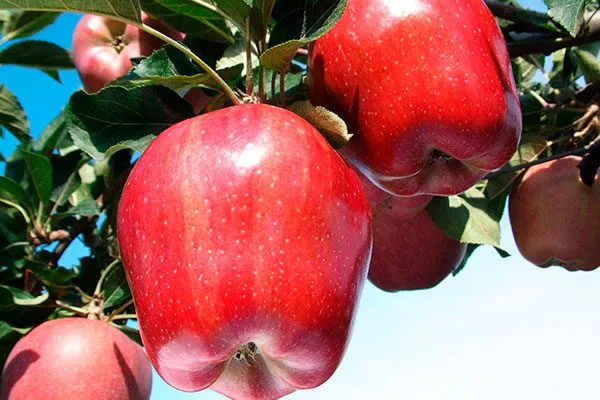
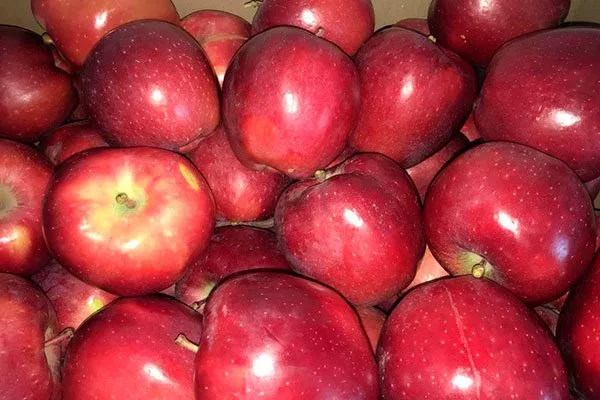
- Appearance. The fruits are bright red, shaped like a rounded cone. The color spreads evenly across the entire apple. In southern areas, the skin takes on a blush-like coloration that extends toward the stem.
- Apple peel. It is sufficiently dense and smooth to the touch, resistant to minor damage and scratches. Large white-gray spots decorate the surface. Gardeners note that the peel can be slightly rough when chewing fresh fruit, so some recommend peeling it off beforehand.
- Weight of fruits. The average weight of one apple ranges from 150 to 250 g, but there are specimens weighing up to 300 g, sometimes even up to 350 g.
- Structure of the pulp. The inside of the apples is light green with a delicate creamy sheen. There's more green near the skin than in the center. The flesh is juicy and crunchy, but over time it loses these qualities, becoming more floury in consistency.
- Shelf life. Apples retain their quality until April.
- Taste and other properties. The taste characteristics of apples are rated by tasters at 4.5-4.6 points, appearance – at 4.7-4.8 points, the taste of dishes prepared from apples – at 4.5-4.6 points out of a maximum possible five.
Interestingly, the fruit's flavor can vary depending on local climate conditions: in warmer, drier climates, apples are sweeter with a hint of acidity, while in cooler regions, the sugar-to-acid ratio shifts toward the latter, giving them a sweet-and-sour flavor.
- Chemical composition and caloric content. Under favorable climatic conditions, apples reach 15.5% dry matter and 11.8% sugars. Apples are rich in vitamin C—100 g contains 6.5 mg—and 130 mg of P-active substances.
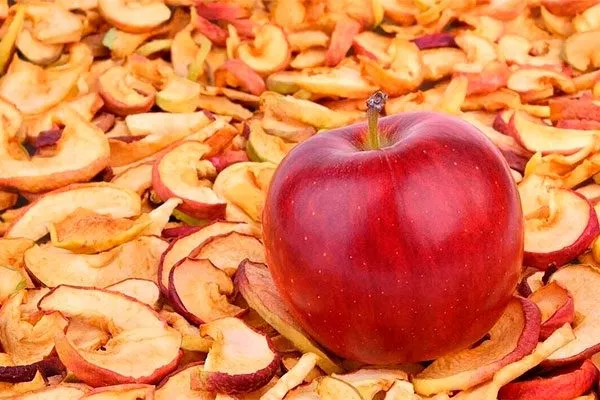
- Use in food. Apples are excellent for eating raw, making a variety of canned and dried products.
Apple tree pollinators and yield
Pollination is a key aspect of successfully growing this apple variety, as it is not self-pollinating—the likelihood of producing a full harvest is less than 20%. To ensure Red Delicious blooms and fruit, it is important to plant it near trees of a different variety, with which they can exchange pollen.
If there are apple trees nearby, for example, at a neighbor's, then the chances of a harvest increase significantly. Among the most suitable varieties are:
- Gloucester;
- Jonathan;
- Idared;
- Delicious spur;
- Wagner Prize.
If Red Delicious budding coincides with Melrose, Prima and Empire flowering, these varieties can also be used as donors.
Peculiarities:
- The distance between pollinators and Red Delicious should not exceed 30 m so that pollen can reach the flowers.
- Bees located nearby facilitate more effective pollination. Some farmers who grow apples for sale rent hives during flowering to ensure fertilization. Other orchardists choose a simpler approach: grafting Red Delicious apples to avoid pollinator problems.
It is recommended to create an orchard with the maximum number of different apple varieties to ensure effective cross-pollination.
The tree begins to bear fruit no earlier than five years after planting, especially if it was planted on a seedling rootstock. This period is considered average. If the apple tree is grown on a dwarf rootstock, the first harvest can be expected as early as four years later.
The frequency of fruiting of an apple tree depends on the conditions in which it grows:
- With proper care and favorable weather conditions, one apple tree can produce 70-150 kg per season;
- the first harvest usually reaches 30 kg and is collected 5-6 years after planting;
- a noticeable increase in indicators can be expected by 10-12 years;
- The documented record yield was 185 kg from a single apple tree that was 14 years old (this achievement was from Stavropol).
Ripening and fruiting
Apple trees begin bearing fruit early: as early as the third or fourth year after planting, even on vegetative rootstocks, they produce their first harvest. On dwarf rootstocks, flowering begins in the first or second year. At this time, it's best to remove flower stalks so the tree can focus all its energy on developing its root system and crown.
Other indicators:
- Red is a later-blooming variety. Its buds open no earlier than the second half of May, most often at the end of that month or even in early summer. The flowers are fragrant. Budding lasts 10-12 days, but in cool and rainy weather conditions, this period may be slightly extended.
- Apple trees grow quickly – they can increase in size by 35-55 cm per year. Productivity also increases with each season, and by the 7th or 8th year, they produce full harvests of high-quality, glossy apples with a pleasant flavor.
- Apples reach full ripeness late—by early to mid-October, depending directly on the climate and current weather conditions. The fruit is not prone to falling, although it's best to pick them early. This way, they'll keep until spring.
- Thanks to their thick skin, apples can be transported even over long distances by simply placing them in boxes filled with sawdust.
Resistance to frost, diseases and insects
It is characterized by excellent cold tolerance, making it suitable for cultivation in the climate of central Russia. However, residents of northern regions, Siberia, and the Urals will need to resort to protective measures, such as covering the trees with burlap or spruce branches.
The Red Delicious apple tree is susceptible to certain diseases: scab, powdery mildew, achene rot, and fruit glassiness. During storage, the fruit can become infected with bitter spot, making them unfit for consumption.
Harvest time and storage conditions
Harvesting begins in late September. Thanks to their strong stems, the fruits remain on the tree longer. If weather conditions are favorable, this period is extended.
The key factor in removing fruit from the tree for long-term storage is dry air – picking apples in humid weather can lead to them being affected by bitter spot.
Apples of this variety can be stored until April if kept in specially prepared rooms. If placed in a regular cellar, the flesh will retain its crisp texture until February, after which it becomes mealy.
Landing rules
The variety doesn't have exceptional winter hardiness, so it's grown only in favorable conditions. The chosen site should be protected from wind and have fertile, but not waterlogged, soil.
Before purchasing a seedling, you need to take the following aspects into account:
- Find out from the seller what kind of rootstock the seedling is grown on: medium-sized or dwarf, which will affect its future size and yield;
- check the height of the young plant, which should be at least 100 cm;
- Count the number of branches - optimally from 3 to 5 pieces.
Red Delicious does not tolerate waterlogged conditions, so groundwater should be at least 180-200 cm below the surface. This rule is waived for dwarf varieties, as these apple trees have a poorly developed root system, allowing them to be planted in soils with a groundwater level of 150 cm.
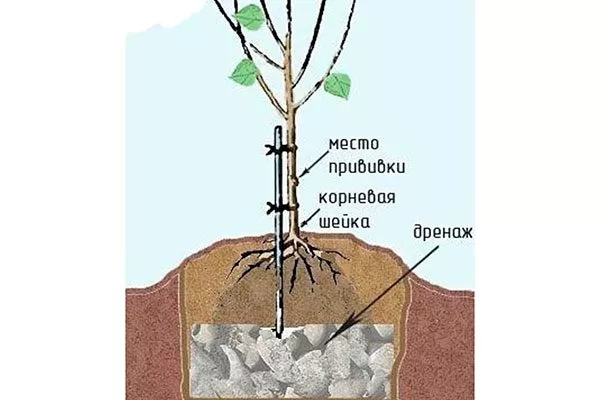
Landing rules:
- Seedlings are planted in the spring, and in the southern regions of the country, autumn planting is also possible.
- When preparing the site, remove weeds, especially couch grass. Add 5 kg of compost or manure and 0.5 kg of wood ash to the planting hole. To improve fertility, add 1 tablespoon of nitroammophoska.
- For the roots, you need a hole about 70-80 cm wide and at least 75-80 cm deep.
- The root system requires drainage, created by a layer of peat, humus, and sand mixed in equal proportions. The thickness should be approximately 10-15 cm.
- After planting, the seedling needs to be watered with a small amount of water - 3 liters is enough.
Further care of the apple tree
Caring for planted seedlings directly impacts their development and future productivity. Therefore, don't ignore agricultural practices and pay particular attention to varietal requirements.
Irrigation regime
During the summer, trees need to be watered at least 5-6 times. Each time, 20-30 liters of water should be applied within a 50-60 cm radius around the trunk. The Red Delicious apple variety is particularly sensitive to watering, so during periods of drought and during the active growth phase, the frequency of irrigation should be increased.
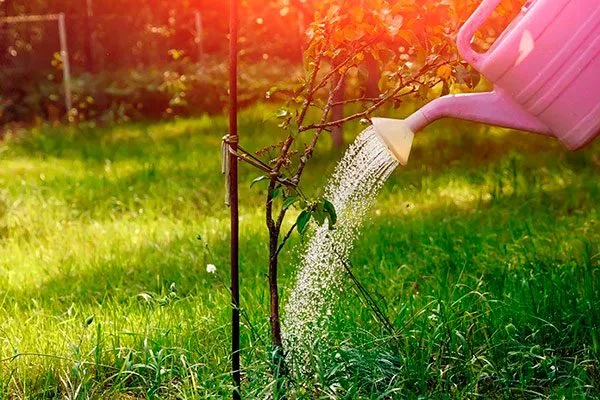
After watering or rain, it's important to loosen the soil around the trunk and fertilize it with freshly mown grass or straw. These materials also act as mulch, protecting the plantings from pests and preventing moisture from evaporating quickly.
The soil around the trunk should be dug twice a year—in spring and fall. This must be done carefully to avoid damaging the roots, which are located just below the surface. The shovel should be inserted no deeper than half the length of the spade.
Tree fertilizing and pruning
To ensure the Red Delicious apple tree grows healthy and produces a bountiful harvest, it needs to be fertilized regularly:
- in the spring – 25-30 g of nitroammophoska is added to the tree trunk circle;
- during flowering – scatter 300-400 g of charcoal around the tree;
- when the fruits begin to ripen, dissolve 25-30 g of potassium salt and superphosphate in a bucket of water (9 l), then water around the roots;
- before the onset of winter – add organic components: 5-6 kg per 1 sq. m around the tree (this can be humus, compost, rotted manure).
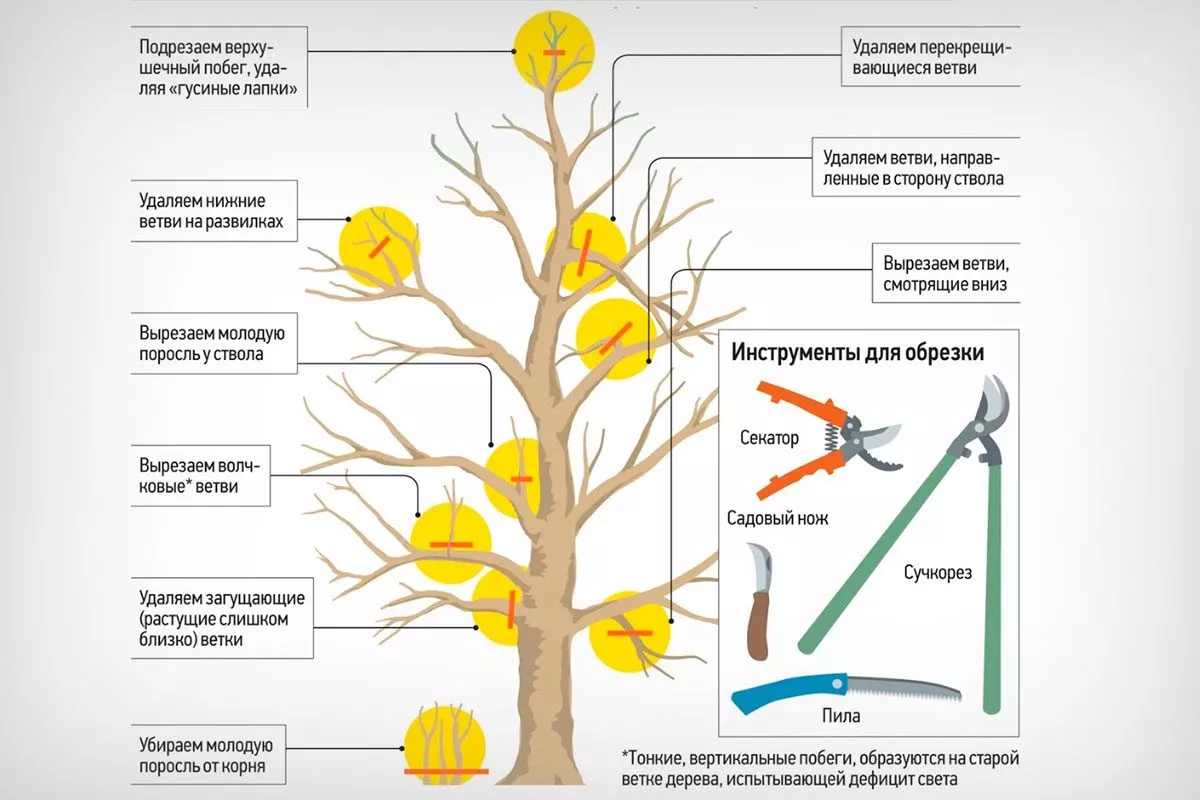
It is important to remember to regularly prune the Red Delicious apple tree:
- at the beginning of development it is necessary to form the crown;
- starting from the fourth year, remove all branches that choke the crown and prevent air circulation;
- Always trim off all dried and diseased branches.
In parallel with tree care, carry out protective treatments of the crown using appropriate fungicides to prevent the occurrence of scab, rot and other diseases that can threaten the health of the apple tree.
Preparing apple trees for winter
Before winter, it is important to perform a moisture-recharging watering to accumulate moisture, apply fertilizers with phosphorus and calcium, and also provide protection for young plants from the cold.
When cultivating the Red Delicious apple variety in cold climate zones, it is advisable to use local winter-hardy rootstocks for grafting.
This variety doesn't have high frost resistance, so it's important to properly prepare it for winter, even if it's not particularly harsh:
- In mid-August, pour 50 liters of water under each tree, and at the end of the month, stop watering completely.
- After the leaves have fallen, remove all vegetation from the ground surface.
- Young trees can be covered with a canopy cover due to its compact size and low height. Mature apple trees require trunk insulation with specialized materials such as agrofibre, roofing felt, or tar paper.
- It is recommended to place spruce branches, straw mats, and similar items around the root system to warm the soil if necessary.
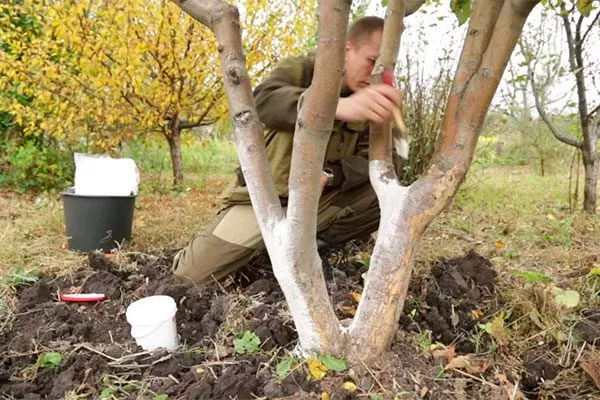
During the winter, young trees can be damaged by rodents such as hares, mice, and hamsters, which are common in southern regions. To repel these animals, folk remedies suggest applying fatty liquids such as lard, grease, or other foul-smelling substances to the trunks.
Pest and disease control
A problem for this variety is the codling moth, which damages the fruit ovaries, negatively impacting yield. The larvae of this pest can be found inside the fruit. They overwinter in fallen leaves and tree bark. To prevent their spread, follow these guidelines:
- Regularly clear the area of fallen leaves and debris.
- Clean the tree of old bark using a special brush.
- In autumn, loosen the soil to destroy the larvae that are preparing for winter.
- Place traps on large branches and trunks of the tree, check them periodically, and burn any captured larvae. If an infestation is detected, spray the tree in the spring with insecticides such as Karbofos or Fufanon.
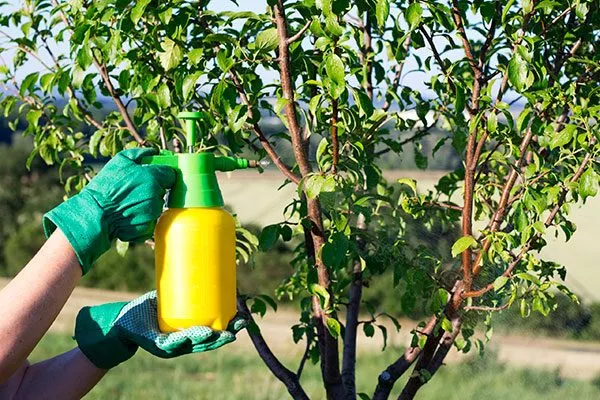
Scab is the main disease of this variety. It damages apples and leaves. Therefore, planting the tree in high-humidity conditions is not recommended.
Antifungal agents are used for prevention, and if there is no infection, natural fungicides such as mustard powder solution can be used. If symptoms appear, chemical treatments such as Gamair or Baktofit are used.
Pros and cons
Red Delicious is an apple variety that boasts many impressive qualities, though it's not perfect. Its strengths include:
At the same time, the variety also has its weaknesses:
It may seem that the variety's many shortcomings make it unworthy of attention, but this impression is deceptive. Over time, Red Delicious will reward the gardener with its fruitfulness and delicious, aromatic apples in gratitude for their care.
Reviews
The Red Delicious apple variety impresses with its flavor, marketability, and juiciness. Growing a fruit-bearing tree requires careful attention, but within five to six years of planting, you'll be able to reap consistently high yields. If you decide to grow this variety in your garden, remember that it requires warmth and produces its best fruit in the south.