
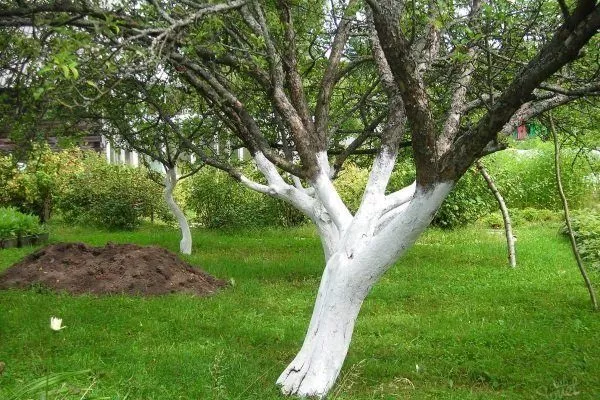
Whitewashing is an important agricultural technique when growing fruit trees. Trees are whitewashed not for aesthetics, but to protect them from a wide range of negative factors. Moreover, good gardeners don't get by with just whitewashing—apple trees must be whitewashed several times throughout the year.
Why is whitewashing necessary?
Bark protects the tree from a wide variety of external influences. However, there are some things it's powerless against. The purpose of whitewashing is to enhance the bark's protective properties and, by preventing its deterioration, protect the tree from these negative factors.
Whitewashing protects the apple tree from:
- sudden temperature changes - because of them, cracks appear on the trunk;
- sunburn - this is especially important when there are no leaves and the tree is unable to protect itself from the scorching sun;
- scorching frosts;
- strong winds;
- rodents and pests, ticks, codling moths, flower beetles, leaf rollers, aphids, and goldtails.
Sun and frost make the bark rough, causing it to crack and peel. While a young tree's bark is smooth, mature trees almost always have cracks in their trunks, allowing infections and pests to penetrate. As a result, the tree weakens and sometimes dies.
Gardeners whitewash the trunks of fruit trees not for decorative purposes – although this factor is present – but for the purpose of protecting them.
Features and timing of the event
Every garden owner knows that spring is the time to whitewash their trees. Only experienced gardeners know that trees are whitewashed three times a year: in the fall, spring, and summer. The specifics and timing of whitewashing are listed in the table.
Table – Timing and purposes of whitewashing apple trees in different seasons
| Season | Month | Target | Note |
| Autumn | October or November | Protect from the February sun—it's especially intense. Exposure to sunlight causes the trunk to heat up to 9°C, which triggers sap flow. The sap freezes, causing the bark to crack. | The main whitewash on which the health and life of the tree depends. |
| Spring | Late February - early March
(if autumn whitewashing was carried out, then later – in March-April) | Protection from insects, fungi, and other infections. | This is the second most important whitewashing, it is carried out as soon as the temperature allows. |
| Summer | June-July | Updating protective functions, protection from high temperatures. | Summer whitewashing is especially important if it was done in the spring with a weak solution. |
Experienced gardeners give advice on when it’s best to whitewash:
- You shouldn't whitewash trees before the rainy season;
- September is too early a month for whitewashing; trees should be whitewashed a couple of weeks before the frost.
At what age do they start whitewashing?
Whitewashing is necessary for both mature apple trees and young saplings. The concentration of lime varies—for young trees, it's half as much as for a full-grown tree. Some trees can be whitewashed as early as three years old, while others can be whitewashed as early as seven or eight years old. You can tell if a tree is ready for full whitewashing by examining its trunk—if characteristic lamellas and cracks appear on the smooth bark, it's ready for whitewashing.
Preparing an apple tree for whitewashing
Before you grab a brush and a bucket of lime, you need to properly prepare the trees for whitewashing. Preparation consists of three stages, the fourth being the actual application of the paint.
Watch a video on how to prepare an apple tree for whitewashing:
Cleaning the barrel
The trunk must be cleared of large branches. High humidity is ideal for clearing. The trunk is cleared of lichens, growths, and loose bark. Clearing is done with a wooden trowel. All debris is collected and burned to prevent the spread of infections and pests hiding in the bark. The best time to clear is after rain.
When cleaning, it is not recommended to use a saw, metal brushes, scrapers or sponges.
Disinfection of wounds
It's carried out in dry weather. The following three days must also be fine, otherwise the desired effect will not be achieved. There are three types of disinfection:
- Capillary treatment. The trunk is sprayed with a mixture of copper sulfate and Bordeaux mixture from a spray bottle.
- Ash-soap treatment. A solution of ash and laundry soap is applied to the trunk with a rag. The solution is prepared in hot water. Laundry soap (50 g) and ash (3 kg) are dissolved in it.
- Spraying.It is carried out with a saturated ash solution.
A copper/iron sulfate solution should not be used annually, as copper and iron can accumulate in the bark and soil. High concentrations of these elements pose a threat to the tree, weakening its immune system and causing it to become diseased and wither.
When disinfecting the trunk, take precautions - work with gloves and a respirator.
Wound dressing
After cleaning, the trunk may have some dents that are filled with putty, paste, or clay slurry. To make the slurry, use clean clay (200 g), manure (100 g), and straw dust. Dilute the ingredients with water to a sour cream consistency. Apply this slurry to all damaged areas of the tree trunk. You can buy ready-made putty at the store, such as "RanNet" paste.
Compositions for processing
For whitewashing, you can use lime solutions, either homemade or purchased ready-made. For painting the trunk, use:
- Mortar – the cheapest and most popular option. The downside is the low level of protection. Manure, clay, or glue are added. Two rains are enough for the whitewash to peel off the trunk.
- Paint (water-based or acrylic)Antifungal agents are usually added to it, creating a protective film around the trunk. The downside is that the paint doesn't "breathe." Only mature trees are whitewashed.
There are many compounds used for whitewashing, their main characteristic is the presence of three main components:
- white coloring matter;
- viscous adhesive component;
- disinfectants.
Let's look at what substances are used for whitewashing apple trees, and what compositions are prepared based on them.
In the following video, a gardener will explain how to paint an apple tree trunk:
Pure lime
Lime is the most popular material for whitewashing trees. It's easy to mix, non-toxic, and inexpensive. Trees are whitewashed with slaked lime, also known as slaked lime. This lime is sold as a paste or powder. Mixing slaked lime requires nothing more than cold water.
Clay
To improve the adhesion of lime to the trunk, clay is added. Whitewashing wood with pure lime alone is impractical; without viscous substances, it quickly washes away in rain. Clay is one of the readily available viscous substances used to prepare lime mixtures.
Clay not only helps adhere the whitewash to the trunk but also has good thermal insulation properties. The clay composition protects trees from overheating and overcooling, as well as from wind. An important advantage of clay is that it does not clog pores and allows the tree to breathe.
Mullein
Mullein, or liquid manure, is a natural organic fertilizer. It's used not only to improve the soil's nutritional value but also to whitewash trees. This ingredient makes the whitewash more adhesive and adheres well to the bark. Furthermore, mullein is a source of micronutrients that nourish the tree.
Dye
Instead of lime it is permissible to use paint:
- Water-based. It protects the tree trunk like lime – from sun and frost. The paint lasts longer than lime mortar, so the number of whitewashings required is reduced.
- Acrylic.The advantage of painting with paint is that you don’t need to prepare a solution; just open the can and start painting.
Paints allow air to pass through but retain water in the bark, preventing it from evaporating. The main drawback of paint is its unnaturalness; although safe, it's still a chemical. The second drawback is its cost: painting trees with paint is more expensive than with lime.
Standard whitewash composition
Standard whitewash is prepared from three ingredients:
- quicklime – 2.5 kg;
- water – 10 l (bucket);
- clay – 1 kg.
The main function of the standard composition is to kill insects and protect the apple tree trunk from harmful influences. The lime content is approximately twice that of clay. Preparation instructions:
- Lime is slaked with water. To prepare lime putty, use 1-1.5 parts water for 1 part lime, and for lime milk, use 3 parts water.
- Add clay to the cooled solution and mix thoroughly – it should have the consistency of sour cream. A thicker solution will create a thicker layer that won't be washed away by the first rain.
- Clay can be replaced with glue – casein or wood.
When working with lime, observe safety precautions and exercise caution – when it interacts with water, the slaking temperature reaches 150°C.
Burn protection
This composition creates a shiny layer on the trunk that effectively reflects sunlight. The composition is prepared from:
- fluff lime – 300 g;
- water – 2 l;
- PVA glue – 2 tbsp.
Protection from rodents, hares, ants and fungi
This versatile composition kills pests and effectively prevents rot. It's made from:
- PVA glue and PVA dispersion (1:1) – 125-250 ml;
- water – 2 l;
- iron/copper sulfate – 2 tbsp.
Thanks to the copper sulfate, the mixture will protect the tree from diseases and fungi. And if you add a few drops of "Knockdown" or a little Creolin to the mixture, it will repel hares, mice, and other rodents. This whitewash destroys fungal spores and any ant eggs hidden under the bark.
The prepared solution is thoroughly mixed and left for half an hour. After mixing again, begin whitewashing.
Store samples
Store-bought whitewash is convenient because it requires no preparation. Just open the lid, grab a brush, and you're ready to paint. Whitewash sold in stores varies in composition. It can be lime-based, acrylic-based, or infused with clay, copper sulfate, silver, and other additives.
The most durable store-bought whitewashes are acrylic. More natural ones are lime-clay ones, which allow the bark to breathe. However, lime-based store-bought whitewashes have serious drawbacks:
- need for reapplication;
- fragility – easily washed away by rain.
Most store-bought whitewash is applied with a brush. But aerosols are much more convenient—the liquid, released under pressure, reaches even the most difficult to reach places without any effort.
Examples of store-bought whitewash:
- GreenSquare (PKF Palisad) – acrylic composition;
- Robin Green (OOO Fasco) – silver biomask;
- Gardener (OOO Fasco) – lime whitewash with copper sulfate;
- Lime whitewash with copper sulfate (PKF August) and others.
After testing garden whitewashes, we concluded that acrylic-based products are the most durable. They create a snow-white, shiny surface and provide excellent sun protection. The paint doesn't crack or wash off after winter—if the tree was whitewashed in the fall, spring whitewashing can be skipped.
Step-by-step instructions for whitewashing an apple tree
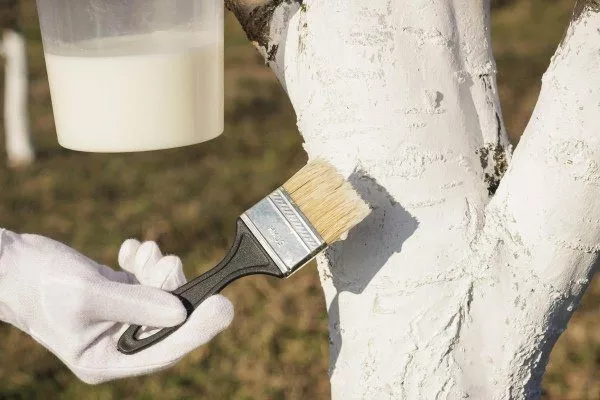
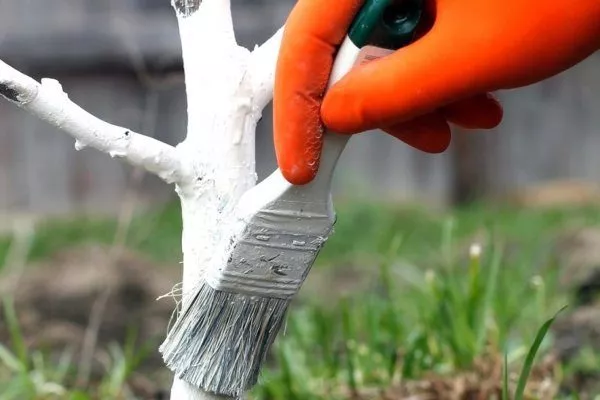
The key to whitewashing is dry weather. For the process to be effective, the lime mortar must dry thoroughly and adhere to the trunk. The brush should be selected based on the trunk's thickness—the older and thicker the apple tree, the wider the brush. Larger trees are easier to paint with a spray gun, as it allows the mortar to fill all the crevices and distribute evenly across the surface.
- ✓ For young trees, use brushes with soft bristles to avoid damaging the delicate bark.
- ✓ For mature trees, brushes with stiff bristles are suitable, which allow you to effectively clean the trunk before whitewashing.
The solution is applied in a 2-3 mm layer. Thicker layers crack and fall off the bark.
The whitewashing procedure is the same at any time of year. Step-by-step instructions:
- Prepare the working solution and let it sit for 2 hours. If you're using ready-made paint, open the container.
- Wear a respirator, gloves, and protective clothing. Avoid contact of the dye with your skin.
- Mix the solution thoroughly – it should have a uniform consistency, without lumps.
- Remove a layer of soil in the tree trunk circle – 4-5 cm.
- Start whitewashing the tree at a distance of 1.5-2 meters from the ground. Paint the trunk from different sides, moving evenly downwards. Continue painting the skeletal branches, 20 cm from where they join the trunk.
- Whitewash the trunk at the bottom, going 4 cm below the soil level.
- When the solution dries, return the removed soil to the tree trunk circle.
Peculiarities of whitewashing old and young apple trees
When whitewashing, the age of the tree is taken into account—it determines the choice of paint and its concentration. What you need to know when planning to whitewash young or old trees:
- Very young seedlings are not whitewashed; they are simply wrapped in burlap for the winter. A full, three-time whitewashing is carried out when the apple tree begins to bear fruit.
- The paint can be applied even to young trees – it does not harm the bark.
- It is not recommended to whitewash young trees with lime, as it can damage the delicate bark. Very young trees can only be whitewashed with a gentle chalk solution, as lime burns the delicate young bark. Use 1 kg of chalk per 10 liters. For older trees, prepare a lime mixture with a reduced lime content—apply 2-2.5 times less lime than for a full-grown tree.
- Literature often recommends avoiding whitewashing young trees to prevent the lime from burning their bark. However, experienced gardeners advise whitewashing even the youngest trees, as sun exposure can cause even more damage. For young trees, chalk is recommended.
Composition of the solution for whitewashing the youngest seedlings:
- chalk – 300 g;
- water – 2 l;
- copper sulfate – 2 tbsp;
- office glue – 200 g;
- karbofos or urea – 20-30 g;
- clay – 200 g.
- Dissolve chalk in water until smooth.
- Add copper sulfate, previously dissolved in a small amount of hot water.
- Add the office glue, mixing thoroughly.
- Add malathion or urea for additional pest control.
- Add clay to improve the adhesion of the mortar to the bark.
Common mistakes
Many gardeners don't delve into the specifics of whitewashing. Once they see how it's done, they repeat the procedure year after year, unaware that they're doing anything wrong. To avoid mistakes and waste time and money, familiarize yourself with the rules of whitewashing beforehand.
Typical mistakes gardeners make when whitewashing apple trees and other garden trees:
- The solution is too thick. Gardeners obviously think that the thicker the mixture, the thicker the layer and the better the protection. In fact, a thick layer negatively impacts the tree's growth and is also prone to cracking. But a liquid mixture isn't suitable either—it simply runs down. It's important to find a balance and create a mixture of the perfect consistency—similar to sour cream.
- Whitewashing on a bad weather day. Don't whitewash trees if the humidity is high. Even if you've already scheduled the whitewashing date, reschedule it. In high humidity, the solution won't dry well and will run off, and if it rains, all your work will be ruined.
- Excess of lime norm. If you apply too much lime, the bark will be scorched. Be especially careful when whitewashing young trees, as the lime concentration for them is lower than for mature apple trees.
- Violation of deadlines. You can't whitewash trees whenever you want. Besides the weather on a given day, you need to consider the timing. Spring whitewashing begins before the buds swell, and fall whitewashing begins before frost sets in. If whitewashing is done late, it will have no benefit other than decorative value.
- Annual use of a solution containing copper sulfate. The tree receives a lot of toxins and develops poorly.
Cleaning and whitewashing the trunk is an important procedure, the correct and timely performance of which determines the tree's growth and development. By performing these simple and affordable agricultural techniques 2-3 times a year, you will protect your garden from weather risks and other problems.