
Fruit trees require fertilization throughout the season. Autumn is especially critical. If the tree's needs are ignored during this time, the following year's harvest will not be a source of pride for the gardener.
Why does an apple tree need autumn feeding?
Additional nutrients strengthen the weakened immunity of young trees and give them strength before the onset of cold weather. Older apple trees regain the energy expended on bloom formation and ripening of the fruit.
If the vitamins and minerals depleted by plants during the spring and summer aren't replenished, trees "starve." Young seedlings produce fewer buds, which negatively impacts the harvest. Weak roots force them to conserve some of their energy and dry out the "excess" shoots.
Older apple trees are unable to develop full bark. This poses the risk of frost burn in winter and sunburn in summer. Furthermore, their immune system weakens, making them vulnerable to diseases and attacks by garden pests.
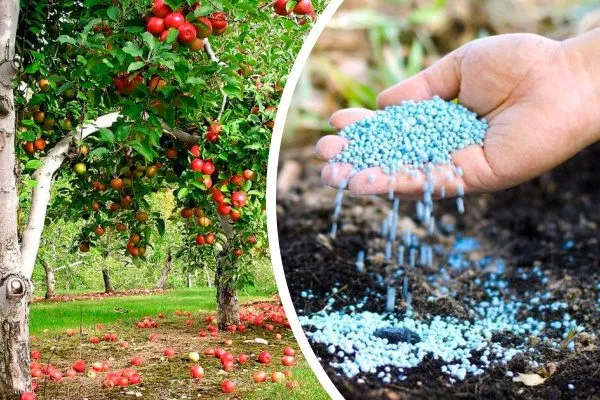
Preparing for fertilization
The best time for fertilizing is from late August to early September. Continued photosynthesis accelerates nutrient absorption in the tree's above-ground parts and roots. As a result, the entire apple tree receives the necessary nutrition and can prepare for the coming cold weather.
Treat the cuts with a copper sulfate solution, then seal with garden pitch. Clear the area around the trunk of weeds.
General rules for applying fertilizers
Begin fertilizing the trees two weeks after harvest. During this time, they develop absorbent roots that will fully absorb all the added nutrients. In some cases, the timing may shift.
In most regions, trees are prepared for winter in early September. In Siberia and the Urals, fall fertilization begins in August. In the southern regions, they wait until October.
Types of fertilizers
Fertilize apple trees using one of the available methods or combine them into a single complex. Use products that dissolve easily in water by spraying or watering. If the substances don't dissolve well, add them during tillage.
Foliar
These are solutions that are sprayed on the above-ground parts of plants. The best time is from September to October, when the trees have harvested their crops and shed their leaves. Start the procedure early in the morning or evening, in dry, windless weather.
Potassium and phosphorus fertilizers strengthen the root system and stimulate shoot maturation. Here's a recipe for a suitable solution:
- 1 tbsp. potassium sulfate;
- 2 tbsp. l. superphosphate;
- 12 liters of warm water.
Mix everything until the powder is completely dissolved and spray the trees. If desired, combine the fertilizer with a preventative treatment against fungal infections and garden diseases. To do this, add Fitosporin to the solution according to the instructions.
Root
It consists of several steps:
- Pre-water the tree.
- Loosen the area around the trunk to a depth of 20 cm.
- Water again and cover with mulch.
- Dig 20cm trenches 60cm from the trunk.
- Add some useful substances to it.
- Dig up the area.
For root feeding, use organic and mineral fertilizers. Apply them around the perimeter of the crown, where root shoots are close to the soil surface. Use solutions during dry weather, and powders during rainy days.
Pitted
The best time to plant apple trees is when they're still bearing fruit. Dig holes 40 cm deep where the main roots are located. Add the necessary fertilizers. Then, bury the holes, water them, and mulch.
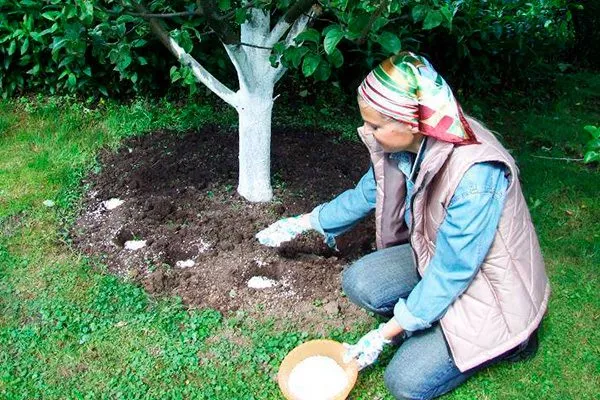
Recipe for long-term feeding (for the next 5-7 years):
- potassium sulfate - 0.5 kg;
- superphosphate - 0.5 kg.
What fertilizers does an apple tree need in the fall?
When choosing fertilizer, consider the age of the trees, the time of year, and the soil characteristics they grow in. If the soil is acidic, choose wood ash, chalk, and lime. If the soil is highly alkaline, use sawdust and peat. The dosages of the necessary fertilizers are listed in the table:
| Age of the tree | Amount of fertilizers | |||
| Organics | Nitrogen | Phosphorus | Potassium | |
| Young (before fruiting) | — | 6 g | — | — |
| Young (beginning of fruiting) | 1 kg | 9 g | 6 g | 9 g |
| Mature (full fruiting) | 1.5 kg | 12 g | 9 g | 12 g |
| Adult (in a year rich in harvest) | 2 kg | 15 g | 12 g | 15 g |
- ✓ For young trees, it is critical to use fertilizers with a low nitrogen concentration to avoid burning the root system.
- ✓ Mature trees require fertilizers with increased potassium and phosphorus content to maintain fruiting and disease resistance.
Mineral complexes
In late autumn, fertilize two-year-old trees that haven't started bearing fruit. Here's the solution recipe:
- 0.06 kg superphosphate;
- 0.06 kg potassium sulfate;
- 10 liters of warm water.
If the leaves are covered with yellow-green spots, this indicates a phosphorus deficiency. The amount should be strictly measured and not exceed 0.03 kg per square meter. When the fruits are shrinking, keep the potassium supplement in the recipe. Otherwise, replace it with "Kalimagnesia."
Good choices include the complex fertilizers "Active," "Ecolist," and "Florovit." Use them strictly according to the instructions. Those who prefer experimentation can choose from other mineral fertilizers:
- ammophos;
- ash powder;
- potassium chloride;
- potassium metaphosphate;
- potassium sulfate.
Organic fertilizers
These include:
- mullein solution (dilute it with water in a ratio of 1:10);
- liquid manure (add it around October 15);
- dry rotted manure (up to 20 kg per 1 adult tree);
- bone meal (completely dissolves within 8 months);
- bird droppings (100 g per 15 l of water, leave the solution for a week);
- vermicompost (500 g per 10 l of liquid);
- green manure (mustard, rapeseed);
- wood sawdust.
In some cases, the area around the apple tree is sprinkled with peat. It can serve as both mulch and regular fertilizer. Peat prevents rapid water evaporation and improves soil quality.
Folk remedies
Wood ash is one example. It consists of the remains of burned plants. The recommended amount is 0.35 to 0.4 kg per tree. If desired, supplement it with minerals. This requires 0.01 kg of superphosphate and 0.02 kg of potassium sulfate (per apple tree).
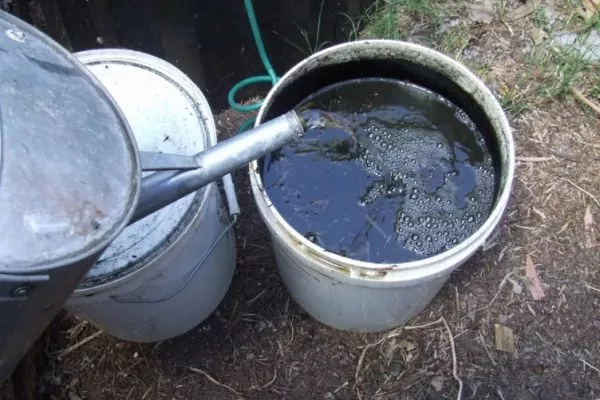
Root fertilization with slurry is the most popular. To apply the fertilizer:
- Fill the barrel 1/3 full with mullein.
- Fill it with water.
- Place the barrel in a dark place for 3 days. Let the fertilizer steep. Stir it periodically.
- Before use, dilute with water in proportions 1:1.
Other folk recipes:
- Clay "chatterbox". Dilute peat and clay (in proportions 1:1) in 10 liters of water.
- Yeast. Mix 500 g of the substance with 3 tablespoons of sugar, then dissolve in 9 liters of water. Let it sit for a week. Then dilute with water (1:20) and water the tree at a rate of 3 liters of solution per apple tree.
- Potassium permanganate solution. Dilute the powder with water (1:10), then water the area around the trunk.
Does fertilizing depend on the age of the tree?
Older apple trees require more nutrition than young seedlings. A well-developed root system draws more vitamins and minerals from the soil. But young trees also require additional feeding. The amount should simply be less than that required by mature trees.
In the first few years after planting, apple trees require virtually no additional fertilizer. Apply only when shoots show signs of nutrient deficiency. When applying additional fertilizer, reduce the required dosage by half. From the tree's fifth year onward, fertilize it strictly according to the prescribed schedule.
Are there any differences in fertilizers depending on the apple tree variety?
They touch columnar apple treesEven when grown, they are smaller than regular crops. They require less fertilizer (65-70% of the usual dose). The roots of columnar crops are located in the surface layers of the soil; the plants require only liquid solutions.
Another characteristic of this variety is that the trees don't always "find" added nutrients. Feed them every two weeks using a balanced fertilizer.
Common mistakes
When fertilizing trees, there are a few things you can do wrong:
- Incorrect choice of fertilizer. The external characteristics of the plant will indicate what substances it lacks:
- nitrogen deficiency makes leaves pale green and slows growth;
- without phosphorus, the leaves turn purple or violet-red;
- potassium deficiency causes the foliage to become lighter and cause it to die off;
- lack of copper leads to chlorosis of leaves, death of shoots and reduction in the number of fruits;
- When the internodes increase, the apical bud and roots begin to die off, feed the plants with boron.
- Error in proportions. Remember the “golden” rule of an experienced gardener: “It’s better to underfeed than overfeed.”
- Failure to comply with the deadlines for applying fertilizers. In autumn, the plant needs phosphorus and potassium, which will prepare it for the onset of winter.
- Ignoring the weather when fertilizing a tree. Apply mineral fertilizers when the soil warms up to 10 degrees Celsius. Biofertilizers will be fully effective when the air temperature exceeds 15 degrees Celsius. Add liquid fertilizers to moist soil.
During periods of drought, stop fertilizing plants altogether, otherwise you may cause harm instead of benefit. - Bad way to fertilize a plant. In autumn, use liquid solutions and organic matter.
- Combination of incompatible drugs. While these are useful tools individually, together they can inhibit each other or become completely useless.
- Increased soil acidity. An acidic environment destroys nutrients and prevents plants from absorbing them.
- Ignoring the type of soil. Sandy soil requires regular fertilization (5 to 7 kg of manure or compost per square meter). Clay soil requires higher doses of organic matter (14 kg of manure or compost per square meter). Add peat moss if desired.
- Uneven fertilization of the area. If you don't pay attention to ensuring that the preparations cover the entire area equally, it may turn out that some plants are "fat" from an excess of substances, while others suffer from a lack of them.
- Failure to comply with storage conditions for fertilizers. Failure to follow the instructions may result in the fertilizer losing its beneficial properties.
Autumn fertilization can help prepare trees for the onset of cold weather. For best results, supplement fertilization with pruning, winter shelter, and whitewashing of tree trunksThen the plants will survive the winter without problems and gain strength before the next flowering and fruiting season.
Thanks for the interesting article! Honestly, I've never even heard of the hole-based fertilizer application method. It's an interesting option, I'll definitely try it.