
If apples are falling prematurely, immediately investigate the cause. This will help slow the process. However, fruit drop isn't always due to disease, improper care, or the like. There are physiological causes, which are completely natural.
Why do apples fall off?
There are many reasons why apples drop. Each has its own distinctive characteristics that can be used to identify the underlying cause. Before identifying the cause, carefully inspect the fruit for damage, unripeness, and juiciness.
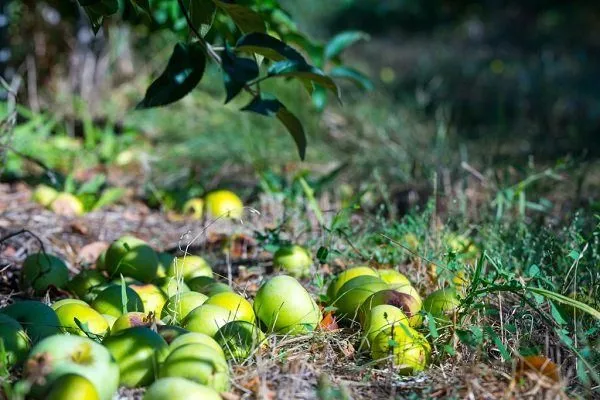
Natural regulation of fruit number
Fruit trees have the ability to self-clean. Breeders claim that only 8-10% of the fruit is harvested by the gardener (the fruit buds open in large numbers).
The culture regulates the number of apples so that all receive sufficient nutrients and the branches can withstand the load. This leads to fruit drop, which is completely normal. This usually occurs in the first month of summer, when the fruit is just forming.
With natural regulation there is no mass mortality.
Technical maturity
Technical maturity is when the seeds inside the fruit are fully ripe, as determined by their color. The seeds should be brown to dark brown, depending on the variety.
Sometimes the seeds have reached full ripeness, but the flesh and skins have not. In this case, it's important to harvest the crop and transfer it to a darkened room for ripening. This process takes 2 to 8 weeks (early ripening varieties require less time, while late ripening varieties require more).
Varietal characteristics
Cultivated apples are a significant factor influencing tree shedding, as some varieties retain their fruit on the branches for a long time, while others shed their fruit long before reaching maturity.
To identify this type of apple, cut open a fallen fruit. If it's juicy and undamaged inside, pick it and let it ripen. Pick the fruit from the lower branches first, gradually working your way up.
Lack of moisture
Infrequent and irregular watering of apple trees contributes to improper moisture distribution throughout the root system and trunk. If watering is infrequent, all the water reaches only the roots, leaving the fruit-bearing branches dry.
Improper care
A lack of moisture is a cause of premature fruit drop, but an excess of water also contributes to this. This occurs because the root system experiences a lack of oxygen, which disrupts metabolic processes and the flow of nutrients to the fruit.
Other reasons indicating improper tree care:
- Soil acidification. Each variety has its own soil acidity level. If the level is too high, nutrients are poorly absorbed, apple growth slows, and fruit shedding occurs.
- Excess of fruits. This can happen if the gardener doesn't prune and shape the tree until it's 5-6 years old. The branches can't support that many apples, and the tree sheds them.
- Lack of oxygen. It occurs not only due to over-watering, but also due to the lack of measures to loosen the area around the trunk.
Nutrient deficiencies
The main signs of nutrient deficiency are yellowing leaves and shriveled apples. During the first half of the growing season, apple trees require nitrogen and phosphorus fertilizers; after the second half of July, only phosphorus and potassium.
If you don't feed the tree, the fruits will fall off prematurely.
Pest activity
One of the reasons why unripe apples fall to the ground is pest infestation. The following insects contribute to this:
- Codling moth. The first enemy that causes fruit drop. It devours the fruit and leaves, completely weakening the tree.
- Sawfly. When it is in the development stage (larva), it crawls into the fruit and eats the seeds, causing the apples to fall.
- Flower beetle. It eats away at flower ovaries, which then form deformed fruits that are unable to stay on the stalks.
- Leaf roller in the caterpillar stage. It eats everything (leaves, fruits, branches). Along with the fruits, the green mass also falls off.
Diseases
Eat a number of diseases, which cause apples to drop. They are divided into two groups: infectious and non-infectious. In the first case, the cause is improper care, in the second, a fungal infection.
Non-dangerous diseases:
- Small-leaved. Occurs due to zinc deficiency. Additionally, it manifests itself as a change in leaf shape (they become claw-like).
- Chlorosis. Indicates a lack of sulfur, magnesium, manganese, and iron, which is accompanied by yellowing of the leaves.
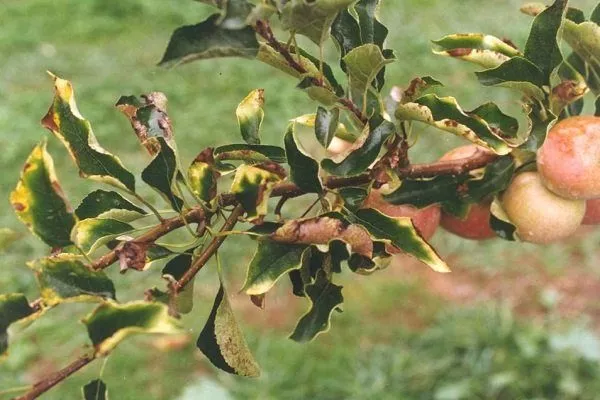
Diseases of fungal origin:
- Scab. Black or grey spots form on leaves and fruits.
- Powdery mildew. First the ovary is dropped, and then the apples.
- Black crayfish. Blackening of ovaries and fruits.
- Apple rust. Rusty areas appear on the leaves.
- Moniliosis. Rotting occurs.
Consequences of recurrent frosts
If recurrent frosts (below 0°C) occur in the spring, fruit growth and development slows. This subsequently leads to apple shedding.
What is the danger of apples falling?
If apples fall prematurely and not for natural reasons, this can lead to the spread of diseases and pests, and if not properly fertilized and watered, it can even lead to death.
Some gardeners doubt whether fallen fruit can be eaten and don't know what to do with it. This depends on the cause and extent of the damage:
- If affected by diseases and pests, dispose of apples (burn to destroy insects and fungi);
- If the apples are whole and undamaged, feel free to eat them.
Fallen, good fruit is left to ripen or used to make jam, preserves, dried fruit, and compotes. You can also make marmalade or cider.
Experienced gardeners use fallen apples to make compost:
- If the fruits are affected by diseases and pests, cut out these areas.
- Cut the fruit into small pieces.
- Place it in a pre-dug hole.
- Add peat, fallen leaves, manure, branches, sawdust.
What to do if apples fall?
If your apples have already started to fall, don't despair, as the process can be stopped. If improper care is the cause, adjust your watering schedule; if a nutrient deficiency is the cause, fertilize immediately, etc.
Normalization of irrigation
To resolve this problem, normalize moisture. This should be done 5 times during the growing season:
- after flowering;
- when dropping ovaries;
- during fruit formation;
- 2 weeks before the expected harvest;
- before the onset of cold weather.
Watering rules and regulations that must be followed:
- To prevent cracking, use contrast irrigation;
- water penetration depth – from 5 to 6 m;
- water the area around the trunk;
- the dose of water per tree is from 80 to 150 liters, depending on its age;
- total annual rate – from 400 to 1000 l;
- water quality – settled, warm.
- ✓ The water penetration depth should be at least 5-6 m for mature trees.
- ✓ Contrast irrigation prevents cracking of soil and bark.
To maintain the necessary moisture level, mulch. Straw, dried weeds, tomato and cucumber leaves, and sawdust are excellent mulches for apple trees.
Top dressing
Every mature apple tree requires an annual fertilization of 25-50 kg of compost or manure. This is a mandatory fertilization. In addition, fertilize as follows:
- In April, apply nitrogen to support the development of all tree elements: mullein or bird droppings infusion at a rate of 1 kg per 10 liters of water. Apply 20-30 liters per tree.
- During May, use a solution of 25 liters of water, 100 g of potassium, 125 g of superphosphate and 70 g of urea twice.
- In June and July, fertilize with the same composition, but once a month.
- In August, make a solution of 30 liters of water, 3 g of sodium powder and 130 g of nitrophoska.
- After harvesting, dissolve 150 g of potassium and phosphorus in 20 liters.
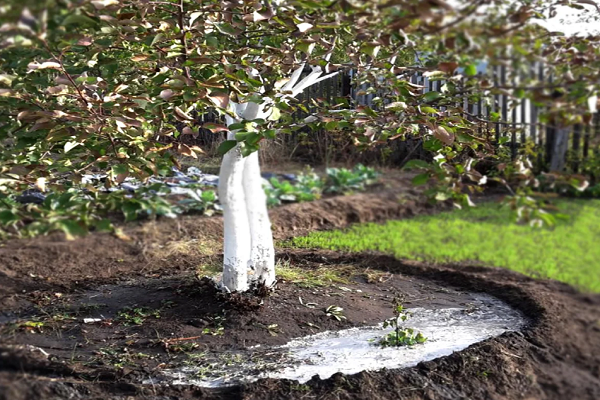
If fertilizers are applied correctly, apple trees receive the necessary complex of nutrients, which prevents early apple drop.
Trimming
Tree shaping is necessary to reduce stress on the branches. What can be done to save the harvest?
- if the seedling is less than 5 years old, thin out the crown, shorten the shoots by 1/3;
- If you have a mature tree, cut off branches to the ring and remove any damaged shoots.
Pest control
Insecticides are used against pests—this is the first and most effective measure, inhibiting their reproduction and reducing fruit drop. Three treatments are required per month, spaced 10 days apart. The following products are recommended:
- Fufanon;
- Aktara;
- Iskra-M;
- Decis;
- Confidor;
- Karbofos, etc.
| Insecticide | Protection period (days) | Number of treatments |
|---|---|---|
| Fufanon | 14-21 | 3 |
| Aktara | 28-35 | 2 |
| Iskra-M | 10-14 | 3 |
In addition, you can destroy pests in the following way:
- Collect all fallen leaves, apples, etc., that may be affected from the tree trunk area and burn them.
- Place special traps on tree trunks. They are sold at gardening stores, or you can make your own from any container with holes and fermented apple juice to attract insects.
- Plant dill and marigolds under the tree immediately. They repel apple pests.
- Use folk remedies - spray with a solution of hot pepper or garlic, dust the branches with tobacco dust.
Treatment of diseases
To protect the tree from diseases, spray it with fungicides. Suitable options include Skor, Horus, and Raek. You can also treat it with weak solutions of Bordeaux mixture and copper sulfate. Spray three times, every 10-12 days.
Prevention of fruit drop
To prevent apples from falling from the tree next year, treat them in the fall, immediately after harvesting. For this purpose, purchase biological products such as Bitoxibacillin, Lepidocide, or Fitoverm. Perform the treatment in the evening. Additionally, remove old bark from the trunk, which is a breeding ground for insects.
What else can be done for prevention purposes:
- Dig up the area around the tree trunk in autumn, spring and summer.
- Spend the spring time whitewashing of tree trunks to a height of at least 1 m.
- Don't leave fallen fruit under the tree - it will rot and spread infections.
- Place the mulch close to the trunk to slow down moisture evaporation.
- Avoid overfertilizing apple trees, especially with nitrogen. It promotes the growth of green mass, preventing nutrients from reaching the fruit.
- Protect from frost – water in the fall with a solution of 10 liters of water and 2 g of boric acid, wrap the trunk.
- To avoid freezing in winter, plant varieties that are appropriate for your region, that is, winter-hardy ones.
If apples are dropping en masse, don't ignore the problem; instead, identify the cause immediately. The sooner you take action, the fewer fruits you'll lose. This is especially true if fruit drop is caused by diseases or pests, as they can quickly spread throughout the orchard.