
The Ola apple tree attracts gardeners with its combination of ornamental beauty and frost resistance. Its compact crown, beautiful fruit, and low-maintenance nature make it a versatile choice for plots of all sizes. It establishes easily, grows quickly, and blooms abundantly. Its apples not only decorate the tree but are also suitable for home processing.
History of origin and regions of growth
The cultivar was developed by Polish breeders back in 1970 through open pollination of the Artur Turner variety with several other apple trees. By the late 1990s, this attractive tree had spread widely not only throughout Poland but also beyond its borders. At the beginning of the 21st century, the variety even reached Russia.
There are several theories about the origin of the name "Ola," but no official data exists. The most plausible theory combines it with the Spanish word "ola," meaning "wave." This may be due to the wave-like nature of the tree's blossoms, which, during the budding period, resemble a lush avalanche of blooms.
Despite its popularity, this variety is not included in the State Register of Breeding Achievements and has no official regionalization. However, it is successfully cultivated in the European part of Russia, as well as in the south, north, and east of the country.
Growing regions:
- Moscow region;
- Leningrad region;
- North Caucasus;
- Central Black Earth Region;
- Crimea;
- Volga region.
Description of the Ola tree
The plant is medium-sized – without formative pruning it reaches 4-5 m. Distinguishing characteristics:
- crown – round, open, as if cut out, of medium density and foliage, with well-developed branching;
- branches – they extend from the trunk almost at a right angle and are covered with smooth bark of various shades: reddish-brown, brown-brown or gray-brown;
- root system – branched, fibrous, of medium depth, but powerful and well adapted to independently search for moisture;
- leaves - small or medium-sized, dense, leathery, with a glossy sheen, and the edges are jagged, crenate, the tips are slightly elongated and shortly pointed, the central vein is rough.
The leaves often curl slightly inward, taking on a boat-like shape. The foliage's color changes throughout the season—at first, they're light brown, then acquire a greenish-crimson hue, and by midsummer, they become a rich dark green with a reddish tint.
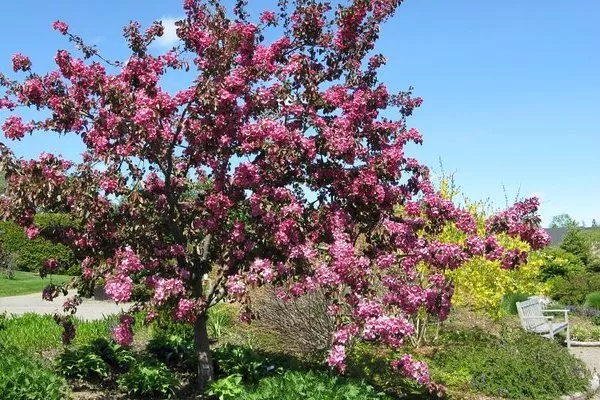
Apples: What do they look like?
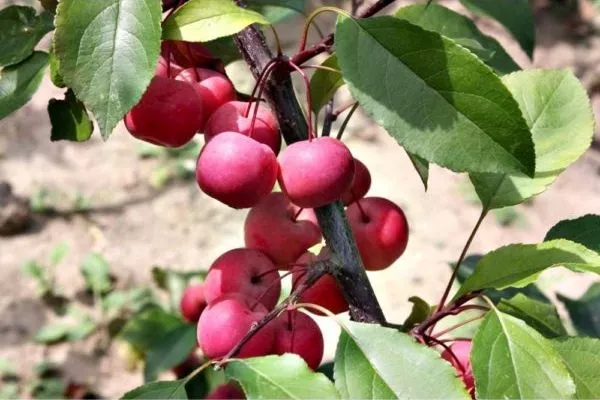
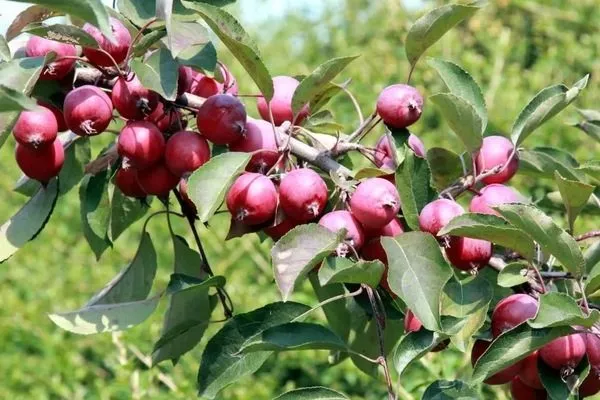
The fruits are very small, with a diameter of only 2-3 cm and a weight of 10 to 25 g. The main characteristics of the fruits:
- configuration – can be round, slightly elongated or turnip-shaped, symmetrical or with a slight tilt to one side;
- surface – smooth, almost without ribbing, even at the calyx;
- peduncles – long and thin, reminiscent of cherries, colored in reddish or burgundy tones;
- skin – dense and even hard, but not rough, it is smooth, shiny and elastic to the touch;
- main background – greenish-yellow or golden, hidden under a dense covering blush, which varies from red-orange to bright red, carmine or burgundy with veins and spots;
- subcutaneous points – small, rare and almost invisible.
Chemical composition of fruits:
- P-active substances (catechins): 108 m;
- Vitamin C (ascorbic acid): 19.1 mg;
- sugars (fructose): 5.2%;
- pectins: 17.4%;
- titratable acids: 1.4%.
The flesh of ripe apples is firm and crisp. After frost, the fruits become soft and greasy, but they don't fall off and remain on the tree until spring.
The flavor is distinctive—distinctly astringent, not to everyone's taste, with sweet and sour notes. This variety has not received an official tasting rating.
Apple tree Ola: general characteristics
This ornamental variety is prized for its low maintenance and striking appearance. It doesn't require complex care, but before growing it, it's important to understand its key characteristics and features:
- Although this variety is grown primarily as an ornamental, gardeners report that a single tree can yield approximately 45-60 kg of small, yet bright and attractive fruits. In particularly favorable years, the yield can be slightly higher.
- Ola is self-fertile and produces fruit even in the absence of other apple trees nearby. Thanks to its long flowering period and high pollen production, it serves as an excellent pollinator for other plants.
- It is characterized by high resistance to various weather conditions: it tolerates drought, heat, and frosts down to -28…-32°C (as long as they last up to 20-25 days). Thanks to this, it grows successfully in most regions of Russia.
- Apple trees have a strong immune system. They are rarely affected by powdery mildew, moniliosis, and other common infections, but in years with epiphytotics and high humidity, they can be affected.
Ripening and fruiting of Ola
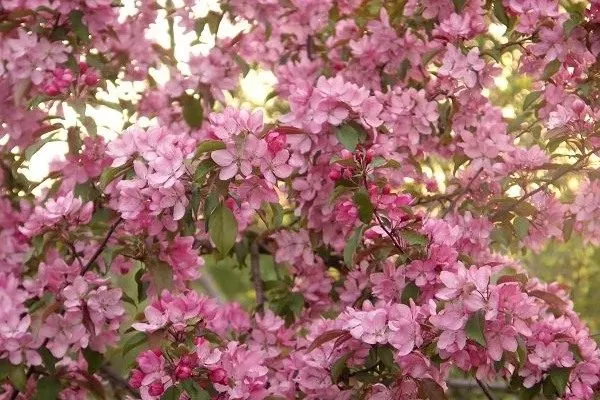
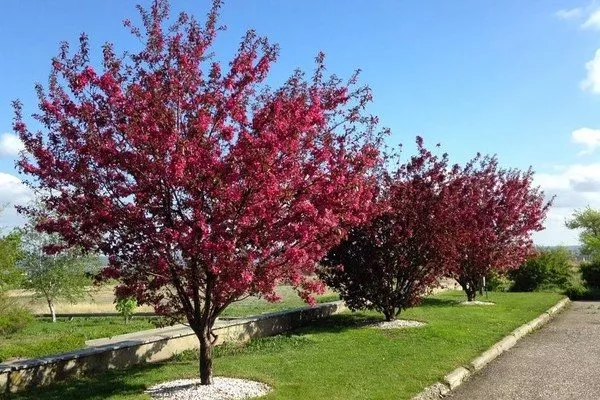
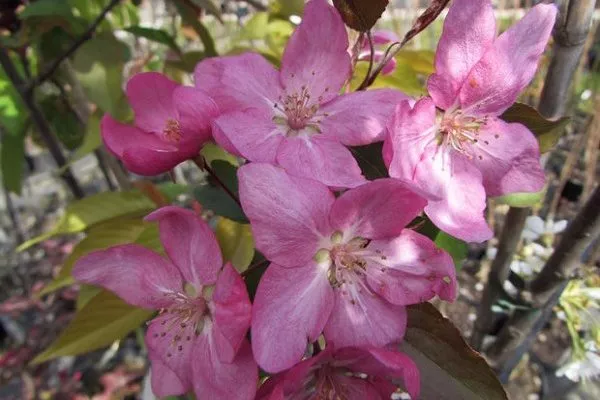
Apple blossoms are long and profuse, resembling a flowering avalanche. Large flowers are gathered in dense clusters that densely cover the branches.
The buds are fragrant and decorative, the petals vary in shade from soft pink with a reddish tint to deep burgundy and beetroot.
The beginning of fruiting
The plant begins to bloom within the first year after being planted outdoors. However, don't expect the first apples for at least 2-4 years. Initially, there may only be a few dozen, but in subsequent seasons, the yield increases significantly.
Apples ripen in September or early October. They can be harvested for processing, as they don't store well—they last no more than a few weeks and don't transport well.
Fruiting and growth
The Ola apple tree is characterized by rapid growth—annual increments can range from 25 to 40 cm, allowing the tree to reach its maximum height quickly. Along with growth, yields also increase rapidly.
The fruits are collected in picturesque clusters, hanging gracefully from the branches, and can remain on the tree until spring. However, before the start of the new season, they must be removed to avoid weakening subsequent flowering.
Rootstocks and subspecies
The crop is grown on various rootstocks to impart specific characteristics unavailable in the standard form. Two subspecies are most well-known, each with its own distinctive features:
- Hybrid Ola. This subspecies is particularly popular in urban landscaping and industrial areas due to its high resistance to environmental pollution. The plant easily tolerates polluted air and unfavorable soils, thrives alongside neighboring plants, and responds easily to formative pruning.
The purple hue, which is present not only in the flowers and foliage, but also in the branches and fruits, gives it a particularly decorative effect.
- Red-leaved Ola. The most popular subspecies in Russia. It produces larger, edible, and quite tasty fruits, used to make preserves, compotes, and jams with a slightly astringent note.
The tree forms a dense, curly crown with arching, powerful branches and abundant foliage. The leaves are colored in rich shades—from burgundy to beetroot and bright red—making the tree especially striking at any time of year.
Landing
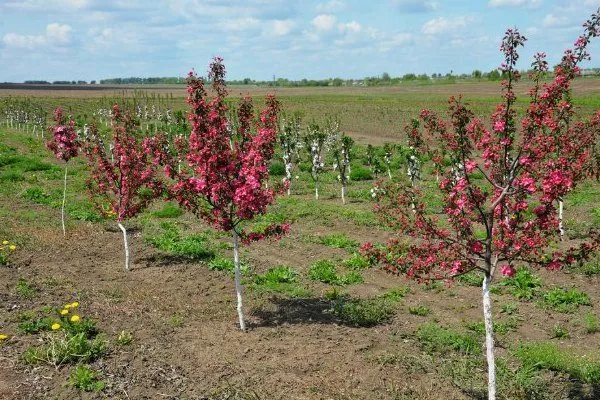
The ornamental apple tree is easy to care for and easily establishes itself in open ground, whether planted in spring or fall. The key is to plant the tree before the sap begins to actively flow.
In spring, it's best to choose a dry, sunny day in late March or early April. In fall, plant seedlings in September or October, at least 3-5 weeks before the expected frost.
Optimal conditions for growth:
- The plant thrives in open, well-lit areas, but can also grow in light shade. Its root system is shallow, so a close water table is acceptable, as long as the water doesn't reach the surface.
- Do not plant the plant near bodies of water, in swampy areas, in floodplain meadows or near wells.
- Fertile soil is essential for healthy growth. In poor, sandy, or clayey soils, add organic and mineral fertilizers in advance. Without this, the tree will develop poorly and may die.
- Before planting, inspect the seedlings: remove damaged and dry roots and branches, and trim the tops by a third if necessary. Soak the roots in warm water for 3-5 hours.
- The distance between seedlings should be at least 4-5 m. However, when landscaping, planting next to shrubs is acceptable – Ola easily coexists with neighboring plants.
- Prepare the holes in advance: depth – 60-70 cm, diameter – 70-80 cm.
Step-by-step algorithm:
- Place fertile soil mixture at the bottom of the hole, then drainage (crushed stone, gravel, brick chips, vermiculite), then fill with water (55-60 l) and leave open for 3-4 weeks.
- On the north side, install a stake that will serve both as a support and as protection from the cold.
- Place the seedling on a drainage mound, gently spread the roots, and cover with soil, avoiding air pockets. When planting, the root collar should be 4-6 cm above the soil level—this is especially important to preserve the rootstock's properties.
- After planting, moisten with 30-45 liters of water, mulch the trunk circle to retain moisture.
Tree care
For successful growth and decorative appeal, the Ola apple tree requires proper agricultural practices. If all guidelines are followed, it will reward you with generous harvests.
Watering
If the spring was wet, water the apple tree immediately after flowering. If the spring was dry or early, begin the process earlier – when the soil is no longer wet.
Next, follow the recommendations:
- The next watering should be done in about three weeks. The third is during the fruit ripening period for early varieties and the formation of ovaries for late varieties. The final watering should be done in early September – it helps strengthen the root system and promotes better winter survival for the tree.
- Late watering is not advisable: the apple tree must have time to prepare for frost by drying out the wood.
- As a tree ages, it requires more moisture. While young seedlings require 40-50 liters, mature trees require twice as much water per square meter of the tree's trunk circle.
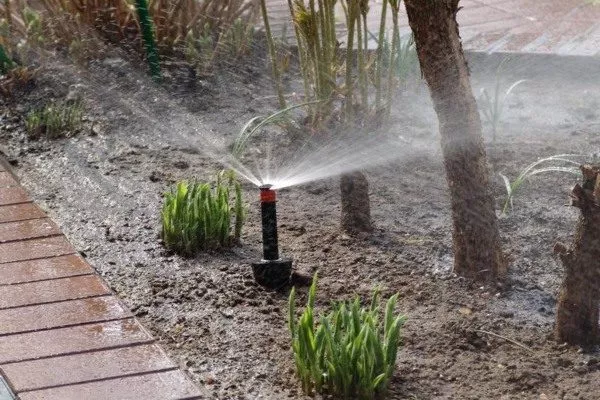
- To ensure even water absorption, form holes around the crown and fill them in several stages.
Fertilizers for apple trees
When planting seedlings in the fall, it is not recommended to add nitrogen fertilizers, as this can stimulate unwanted growth before the onset of cold weather, weakening the tree before winter.
Basic rules:
- In spring, fertilize carefully: use mineral fertilizers—superphosphate (40 g), potassium sulfate (50 g), ammonium nitrate (15 g)—or limit yourself to wood ash (200-300 g). Complex fertilizers are best applied only the following year.
- Use nitrogen with caution: too much can lead to vigorous shoot growth at the expense of root development and fruiting. Add ammonium nitrate, azophoska, and mullein infusion in the spring – in April, after whitewashing the trunks.
- Starting in the second year, feed the apple tree in the spring (April-May) and in the summer while the crown is forming. Alternate nitrogen and mineral fertilizers, do not mix them in the same feeding.
Apple tree diseases and pests
Poor apple tree cultivation practices often lead to weakened tree immunity and the development of diseases. The following diseases can affect the tree:
- Scab. It appears as dry, brownish-brown spots on leaves and fruit. Regular pruning is recommended for prevention.
For treatment, use sprays: urea (500 g per 10 l of water) in early spring and autumn, copper oxychloride (40 g per 10 l) before and after flowering, Bordeaux mixture (300 g of lime and 300 g of copper sulfate per 10 l of water). - Powdery mildew. It affects young shoots and flowers, initially appearing as a white, then brown coating. An effective treatment is 70% colloidal sulfur (80 g per 10 l). Apply in three stages, spaced two weeks apart.
- Fruit rot. Affects only apples, which rot completely. Control involves prompt harvesting and destruction of infected fruit.
- Cytosporosis. It causes bark ulcers, branch dieback, and can lead to tree death. Treatment includes spraying with Hom during bud swelling (40 g per 10 l), then copper sulfate (50 g per 10 l) before flowering, and then Hom again afterward. In the fall, apply a phosphorus-potassium fertilizer and whitewash the trunks.
- Bacterial burn. This is an incurable disease. Infected trees and branches should be destroyed to prevent spread, and be sure to spray the plant against insect vectors.
Dangerous pests include flower beetles, codling moths, scale insects, and sawflies. Use sticky traps and Chlorophos or Malathion before and after flowering to control them. A solution of calcium arsenate (30 g) and lime (40 g) per 10 liters of water helps against codling moth caterpillars. Bury affected fruit deeply in the soil.
Pruning a standard apple tree
To shape the crown during the first 4-5 years, leave a central leader and 3-5 scaffold branches evenly distributed along the trunk. Remove shoots that compete with the leader and any extra shoots growing inward.
Conduct the following activities:
- In spring (before bud break), remove dry, diseased, and damaged branches. Prune thickening and crossing shoots, as well as suckers (thick vertical shoots).
- Prune old skeletal branches into lateral branches. Encourage new shoots to grow as replacements.
- Make the cut above the outer bud. Use sharp pruning shears or a saw. Seal large cuts with garden pitch.
Pruning improves the illumination of the crown, stimulates fruiting and prolongs the life of the tree.
Why do apples fall?
Ola apple tree fruit drop can occur for a variety of reasons. It's important to identify the source of the problem promptly to preserve the harvest. The most common causes are:
- weather conditions;
- early frosts;
- diseases and pests.
Regular tree inspection, preventative pest control, timely watering, and fertilizing will help maintain the health of the tree and avoid crop losses.
What to do if it doesn’t bloom or bear fruit?
If a tree takes a long time to bloom or bear fruit, it's time to reconsider its growing conditions. Often, the problem can be solved with simple agricultural techniques:
- transplant to a sunny place;
- protection from drafts;
- watering regulation;
- elimination of parasites;
- treatment of diseases.
Pros and cons
The Ola variety has a number of advantages and disadvantages that are important to consider before purchasing a seedling. The main advantages include:
The main drawback is the increased hardness of the pulp: the apples have a tough texture, which not all gardeners like.
Reviews
The Ola variety adapts well to various climates, maintaining its decorative appeal and high yields. Despite its firm fruit, the tree is prized for its ease of care, resistance to adverse conditions, and long lifespan in the garden. This apple tree is suitable for both novice and experienced gardeners.