
Pruning is the most important activity in the life of a fruit tree. Apple tree pruning begins at planting and continues throughout the tree's life. Let's find out why most gardeners prune their apple trees in the spring and how to do it correctly depending on the tree's age.
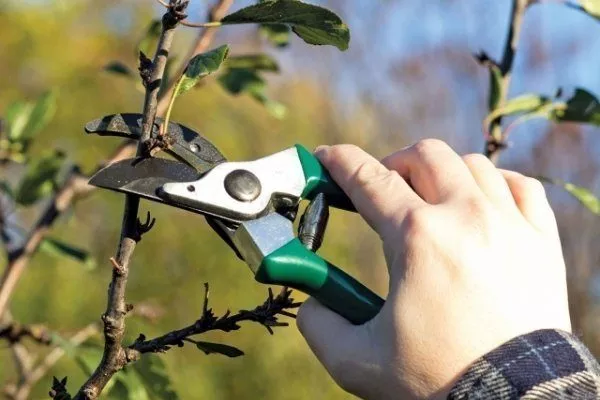
Why do people prune apple trees in spring?
Apple trees can be pruned in any season—spring or fall. Sanitary pruning is typically done in the fall, but crown shaping is recommended only in the spring. In the fall, it's important to prune at a time that allows the wounds to heal. This isn't a problem in the spring—the tree has the entire summer to heal.
Spring pruning tasks:
- Removal of damaged, old, diseased and frozen branches.
- Removing branches that prevent sunlight from reaching the fruit.
- Uniform distribution of the apple tree's forces - directing them to productive branches with fruits.
- Trim branches that are too long – they often break due to the weight of the fruit.
- Removal of young shoots, water sprouts, and competing branches.
- Correcting pruning errors made in the fall.
Lack of proper pruning leads to reduced yields and deterioration in the quality of fruits – they become small and take a long time to ripen.
Spring pruning is especially important for young trees, as rapidly growing branches can shift the tree's center of gravity, causing its trunk to become crooked.
Terms and conditions of pruning
The timing of pruning is determined not by a specific date, but by the climatic conditions in a specific region. When choosing the timing of pruning, it's important to stick to a short window of time suitable for the procedure—between the tree's awakening and bud formation.
- ✓ The air temperature must be consistently above -5°C to avoid frostbite of the cuts.
- ✓ Soil moisture should not exceed 70% of the field capacity to minimize the risk of fungal diseases.
Don't delay pruning—it's important to do it 3-4 weeks before the sap begins to flow. But don't rush either—the wood is very brittle after winter, and pruning too early is harmful.
Gardeners choose the pruning scheme at their own discretion, taking into account:
- age and size of the tree;
- volume of work;
- location of the tree on the site.
During spring pruning of an apple tree, a gardener forms the crown of a certain shape:
- rounded;
- pyramidal;
- flat horizontal;
- flat vertical;
- columnar;
- curly.
Preparation
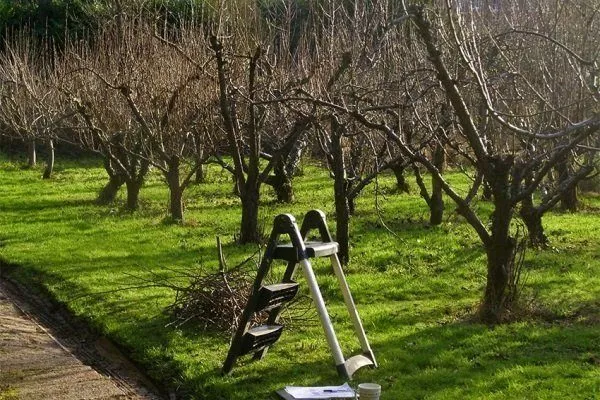
To carry out high-quality pruning, in addition to knowledge or instructions, high-quality tools and cutting processing equipment are required.
Tools
To prune fruit trees, you'll need sharp, clean, disinfected, and corrosion-free tools—rust can cause branches and eventually the entire tree to rot.
Inexperienced gardeners believe that any construction saw will do for pruning. In reality, a whole arsenal of tools is required for the job. For spring pruning, you'll need to use:
- pruning shears;
- with a garden knife;
- loppers with rods of different lengths - to remove hard-to-reach branches;
- garden saws with special bends and tapering at the end of the blade.
The cuts should be perfectly straight. If you're inexperienced, do a practice pruning before attempting to cut the fruit tree.
Take a bottle of rubbing alcohol with you to the garden – clean your tools before work and after each cut branch.
Processing tools
To prevent sap leakage and tree infection, be sure to treat the cut branches with one of the following treatments. You can use:
- garden mastic or garden varnish;
- a solution of copper sulfate and lime in a ratio of 1:10;
- plasticine;
- oil paint.
Some believe that trees don't need pruning, as they supposedly recover better this way. Whether to treat pruning or not is a personal decision for every gardener.
Trimming patterns
There are two options for spring pruning:
- Thinning. This involves completely removing some branches that block sunlight from reaching the fruit. When pruning, a small branch should be left—you can't cut a branch right down to the trunk, but you also shouldn't leave a long branch. With this pruning method, the tree grows well horizontally and vertically, and there are no lateral branches in the crown.
- Shortening. Pruning a portion of a shoot that has grown over the past year. After pruning, the branches thicken and lateral shoots appear. With this pruning method, growth in height and width is slowed, but lateral shoots below the cuts grow faster.
Pruning young and mature apple trees
Apple trees are pruned annually. The first time, the sapling is pruned in the nursery, leaving three to five skeletal branches on the central trunk. The following spring, the apical shoots are shortened, forming lateral branches. Pruning is repeated each spring, but the technique varies depending on the tree's age. Let's look at how to prune young and mature apple trees.
One-year-old seedling
A one-year-old sapling planted in the fall is pruned six months later, in the spring. If the sapling is planted in the spring, pruning is done immediately after planting. Thus, the tree's crown is formed already in the first year after planting. If the tree has a proper structure, it will not require any additional support in the future, thanks to a balanced relationship between the branch arrangement and the number of apples.
Keep in mind that future apple tree harvests depend on how correctly you prune your tree in the first spring. The most popular option is a sparse, multi-tiered crown.
- ✓ Branches must have an angle of at least 45 degrees from the trunk to ensure strength.
- ✓ The distance between skeletal branches in one tier should be at least 15 cm to ensure uniform load distribution.
Step-by-step instructions for pruning a one-year-old seedling:
- Prune the central trunk at a height of 0.8-1.0 m from the ground. By shortening the main trunk, the lateral branches, which will later become skeletal, will stimulate growth.
- Remove all buds and branches (if any) in the trunk area - from the ground surface to the first tier of skeletal branches.
- If the seedling already has branches, mark the ones that will form the first tier. Three to five branches are sufficient – they should point in different directions to create a symmetrical and balanced tree. If there are no branches yet, add five to eight buds for the first tier (use more than needed as a reserve).
- Remove all branches that form an angle of less than 45 degrees with the trunk. If left, they will break off either during a storm or under the weight of fruit.
- Cut the branches that will be skeletal to 30-40 cm, shortening them by 3-5 buds.
When pruning excess branches, be sure to leave those that are at a steep angle. These branches are strong and productive.
When choosing the height of the first tier of skeletal branches, keep in mind that a trunk that is too low will make caring for the tree difficult, while one that is too high will be susceptible to sunburn.
The first spring pruning is an absolute necessity. Even the most careful planting can damage a seedling's root system. By pruning branches, the gardener optimizes the distribution of nutrients throughout the tree.
Two-year-old seedling
When pruning a two-year-old sapling, follow the same rules as for one-year-old trees. Of all the existing branches, retain those that are suitable for forming a strong apple tree structure. Form the crown with 3-5 strong scaffold branches, removing all others. Keep in mind that the leader is located 4-5 buds above all other branches, which is approximately 30 cm.
Instructions for pruning a two-year-old seedling:
- Create a tiered crown by pruning lower and upper branches to different lengths. Lower branches should be approximately 25-30 cm longer than upper tier branches. Pruning shoots that will become scaffold branches stimulates branching.
- Shorten the branches growing between the tiers and bend them at an obtuse angle to encourage fruiting. If you later choose a tiered crown, remove these branches.
- If the top is forked, remove the weaker of the two branches. You can also make a skeletal branch from the extra branch by stretching it to the second or third tier.
Skeletal branches should extend from the central conductor at an angle of 60-90 degrees, no less.
When pruning young apple trees, excess lateral branches are removed gradually. They are left temporarily to help form a stable, broadening trunk.
The video below demonstrates the correct pruning of young trees to shape their crown:
Fruit-bearing tree
When pruning fruit-bearing apple trees, it's recommended to shorten the main branches to slow the tree's growth slightly. If the tree spends energy growing branches, fewer nutrients will be available for the fruit. With a properly formed crown, spring pruning won't require much work.
Features of pruning fruit-bearing apple trees:
- Inspect the crown and remove any branches that are thickening it.
- Trim off all suckers. Vertical shoots only hinder the tree—they drain its energy and prevent sunlight from reaching the fruit.
Rejuvenation of an old tree
Thirty years is not a death sentence for an apple tree. Rejuvenating pruning can extend the productive life of a fruit tree. By removing all unnecessary, old, and rotten branches, you'll rid your orchard of branches that can harbor infections and pests. Rejuvenating pruning makes sense if the old tree's trunk is undamaged and has several strong scaffold branches. Old apple trees are pruned every two years.
Features of rejuvenating pruning:
- Remove shoots that shade fruiting branches.
- Remove branches growing inward.
- Cut the top of the trunk at a height of 3 m so that the crown is open.
- Cut off dried and damaged branches.
- Remove unpromising branches and you will increase the yield of your old apple tree.
- Next year, during spring pruning, remove skeletal branches that interfere with fruiting branches.
During rejuvenation pruning, one-third of all branches and shoots are removed. Most likely, there won't be much of a harvest this year. To initiate renewal processes in the tree, rejuvenation pruning will need to be repeated over the next two years.
Working with trees on a trellis
Apple trees trained on wire trellises are easy to harvest. Here are some guidelines for pruning a tree on a trellis:
- To ensure the tree grows in a single plane, direct the strongest branches in opposite directions. The angle of deviation from the central trunk should be either right or obtuse.
- Shorten the conductor at a distance of 0.5 m from the branches.
- A year later, repeat the pruning pattern: secure the lateral branches horizontally. Prune away weakened branches and the competing shoot at the top. Shorten the basal shoot as in the previous year.
- In summer, lift the young apical shoots of the lateral attached branches upwards with stretchers so that they do not lag behind the central trunk in growth.
- Form the third tier similarly to the previous diagram: secure strong branches and trim vertical and weak ones. If you're forming the fourth tier, trim the leader or bend it at a right angle, creating the final horizontal line.
The effort spent shaping the crown is not wasted – espaliered apple trees look very beautiful. These trees reach a height of 1.8 m on dwarf rootstocks and 2.5 m on vigorous rootstocks.
How to prune espalier apple trees is shown in the following video:
Pruning dwarf trees
Dwarf apple trees require pruning just as much as regular ones. However, it's done more quickly. First, a sanitary pruning is performed, removing all broken and weakened branches. At the same time, the tree's crown is formed. Pruning for dwarf apple trees begins in the first spring.
Step-by-step instructions for pruning a dwarf apple tree:
- In the first spring, prune the main shoot to 0.5 m above the ground. Make the cut above a bud, in the direction opposite to the graft. As a result of this pruning, by fall, the tree should have four shoots, the vertical one serving as the guide.
- In the second spring, cut off the top, stepping back 20 cm from the base. Similarly, cut off the side shoots – at a distance of 20 cm.
- Trim off excess lateral shoots. The cutoff level is the 3rd leaf.
- In the third spring and all subsequent ones, prune the tree in the same way as the second spring.
- Once the dwarf tree reaches your desired height, remove the growing part of the main stem annually. Prune side shoots when they exceed 40-50 cm in length.
- Perform sanitary pruning every year.
- To keep the main branches horizontal, trim off any growth that points toward the ground.
We recommend reading the article about spring grafting of apple trees.
Young tree
Pruning 3-5-year-old seedlings takes minimal time. Although minimal, pruning is crucial for apple trees beginning to bear fruit.
Instructions for pruning young apple trees by year:
- Third Spring:
- Shorten the shoots in the second tier by 10-15 cm.
- Trim the growth of skeletal branches by 10 cm.
- If desired, you can leave a few secondary skeletal branches. Trim them back by 10-15 cm.
- Remove all branches that compete with the main leader and the skeletal branch leaders. Trim off any growth on them as well.
- Fourth spring:
- Shorten the central conductor by 1/3 or 1/4 so that the annual part does not exceed 60 cm in length.
- Remove first-tier branches with sharp angles. The minimum angle is 40-60 degrees.
- Similar to the previous year, continue to form the second tier of skeletal branches.
- Thin out the crown by removing all one-year-old shoots longer than 0.7 m. Shorten all other shoots, turning them into semi-skeletal branches.
- Fifth spring:
- Select a strong branch with a wide angle. It should be 50 cm above the second tier.
- Shorten the selected branch by a third or a quarter of its length. If necessary, increase the angles of the skeletal branches of the first and second tiers.
- Try to leave the third skeletal branch in the first tier, and the first in the second. Then, shape the crown in the same way as the previous year.
Crown formation is complete in the sixth year. In the sixth spring, one more skeletal branch remains to be identified in the second tier. In subsequent springs, thin the crown and remove excess shoots.
An experienced gardener demonstrates how to prune a young apple tree in the spring in the video below:
Caring for an apple tree after pruning
After pruning, the apple tree needs care:
- Treat each cut using one of the above-described products - preferably garden pitch or a copper sulfate solution.
- Regularly remove weeds and loosen the soil around the tree trunk to allow air to reach the roots.
- Mulch the soil around the tree with a 3 cm thick layer of well-rotted manure.
- During the growing season, treat the tree with fungicides and insecticides – preparations against diseases and pests.
Every gardener should know what diseases apple trees can have, therefore This article may be useful to you.
Common mistakes beginners make
Pruning requires a certain amount of knowledge. Even experienced gardeners often make mistakes, and beginners are especially prone to them. Try to avoid these common gardening mistakes:
- Don't leave stumps. Perform circumferential pruning to allow the tree to heal itself.
- Do not trim the apical shoots of a young seedling haphazardly - this will result in the appearance of several shoots at the top, which will weaken the lateral shoots.
- Don't use an instrument that isn't sharpened or disinfected. This error can lead to burrs in the bark, which can impede wound healing.
Advantages and disadvantages
Spring pruning is a mandatory activity with many advantages:
- Forms a beautiful crown.
- Strengthens the trunk and branches.
- Increases light penetration to fruits.
- Frees from damaged branches.
- Prevents the development of diseases.
- Reduces the number of apple pest larvae.
- Allows you to obtain the desired number of fruiting branches.
- Rejuvenates old branches and increases the strength of young branches.
Proper spring pruning will help you grow a small seedling into a beautiful, strong, and productive tree. Remember that pruning is especially important during the first few years of a tree's life, so prepare thoroughly, read the instructions, sharpen your tools, and bring garden pitch.