
When planting an apple tree, gardeners expect a good harvest and, consequently, profit. However, the tree doesn't always bear fruit. Before planting, it's recommended to familiarize yourself with the reasons for the tree's lack of apples. Proper care isn't always the culprit.
Reasons for the complete absence of fruiting
Most fruiting problems can be avoided if all tree care instructions are followed immediately after planting. A healthy apple tree will produce more fruit. However, for a number of reasons, the natural processes of flowering, pollination, and fruiting are often disrupted.
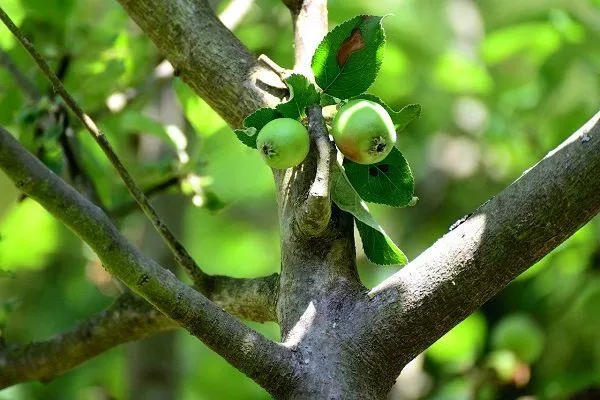
Incorrect landing
The correct technique for planting apple tree seedlings and the chosen time determine the subsequent development, the speed of fruiting, the yield, and the lifespan of the tree.
There are several rules for rooting a fruit tree:
- Optimal time for planting:
- If there is a lot of snow in the region in winter, it is better to choose the autumn period;
- in case of moderate snowfall, but in case of severe frosts, the recommended season is spring.
Critical soil parameters for apple trees- ✓ Soil pH should be between 6.0-7.0 for optimal nutrient absorption.
- ✓ The depth of groundwater should not exceed 2.5 meters to prevent rotting of the root system.
- The soil should be loamy. If the soil is clayey, it is amended with sand, compost, or peat. Clay, humus, or peat are added to sandy soil.
- The growth point of the apple tree (the collar of the root system) should be located above the level of the hole.
- In the year an apple tree is first planted, it needs to be watered regularly. Fertilizing is not necessary.
If mistakes were made when planting a fruit tree, the problem can be solved by raising the tree. Another solution is to dig a hole around the sapling. This will expose the growing point.
Young age
| Name | Fruiting period | Frost resistance | Rootstock type |
|---|---|---|---|
| Winter varieties | 7-8 years old | High | Seminal |
| Summer varieties | 5-6 years | Average | Seminal |
| Columnar trees | 2-3 years | Low | Clonal |
| Varieties on dwarf rootstock | 2 years | Average | Clonal |
Some gardeners believe that all apple trees begin bearing fruit at the same time after planting. This is a misconception. Different varieties produce fruit at different times:
- apples appear on winter fruit trees after 7–8 years;
- summer varieties - after 5-6 years;
- columnar trees bear fruit in 2–3 years;
- varieties on dwarf rootstock - in the 2nd year.
Overnutrition and undernutrition
Often, a complete lack of apples is caused by a deficiency or excess of beneficial micronutrients. It's easy to determine which element is interfering with fruiting by the apple tree's appearance:
- Iron deficiency. Signs: Leaves turn yellow (no matter the tree's age). If the deficiency is severe, flower buds stop forming. Solution:
- bury several rusty objects made of high-quality metal in the tree trunk circle;
- Spray the tree with a weak solution of copper sulfate.
- Nitrogen deficiency. The first signs include shortening and shrinking of shoots, small yellow or orange spots appearing on the leaves, and the rapid growth of small, young leaves. To avoid crop losses, apply nitrogen fertilizer in the spring.
- Excess nitrogen. You can tell if the tree has an excess of this element by its active growth. The branches become soft and thin. The apple tree is starting to get sick various fungal diseases.
Eliminating the problem of oversaturation is virtually impossible. To prevent the accumulation of too much of this element in the soil, apply fertilizers containing molybdenum, copper, and magnesium. - Excess phosphorus. Signs: unhealthy-looking growths appear on the shoots, the leaves become small and dull, and their petioles harden. A single, heavy watering of the plant will help remove excess phosphorus.
- Zinc deficiencySpots between the veins on the leaves will indicate a problem. If the deficiency is severe, the branches will have virtually no leaves or their development will be slow, and the apples will be tasteless.
Feed the tree with a complex fertilizer containing zinc. Apply the first time after all the buds have opened, and the second time after two weeks. - Potassium deficiency. Signs: Leaves lose their green color and eventually turn purple, shriveling. To compensate, apply a potassium salt solution.
- Excess potassiumThe leaves change color to green with a yellowish tint. Their growth slows, and then the leaves dry out and fall off. Fertilizing the tree with ammonium sulfate will help alleviate the problem of excess potassium.
- Calcium deficiency. Brown spots appear on the leaves, and the edges begin to dry out and curl. To adjust the amount of the substance, spray the apple tree with a weak calcium solution.
- ✓ Boron deficiency manifests itself in the corking of fruits and the death of growth points.
- ✓ Magnesium deficiency causes interveinal chlorosis on older leaves.
Flower bud damage
If apple tree buds are damaged, the tree will not bear fruit. There are only two possible causes.
The first is severe frost. Violations occur:
- if the buds enter winter in an unripe state, and severe frosts are observed early (around December);
- if the buds are ripe but winter temperatures drop to levels lower than the tree can tolerate;
- temperatures at the end of winter or beginning of spring are unstable (warm and cold alternate).
To avoid this problem, in Russia it is recommended to plant frost-resistant apple varieties. Alternatively, measures are taken to mitigate the impact of frost, such as using a black fallow system, irrigation, and denser planting of trees.
The second reason is pests. The following insects love to feast on buds, build nests in them, or use them as egg-laying sites:
- bark beetle;
- green midges;
- flower beetle;
- web;
- scale insect;
- Apple moth;
- aphid;
- fruit mites;
- leaf roller.
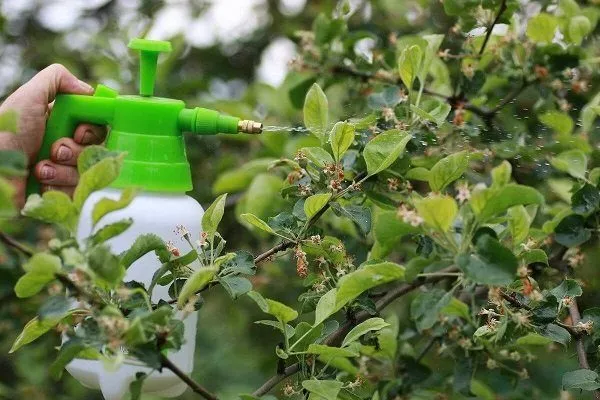
Often, the only possible option for saving a future harvest is spraying with insecticides. The product is selected based on the pest.
No pollination
Pollination is the process of sexual reproduction in seed plants (including fruit trees). It involves the transfer of pollen from the anther to the stigma or ovule. If an apple tree is actively blooming but not developing, the cause is most likely insufficient pollination.
To ensure successful fruit production, plant several varieties with overlapping bloom periods nearby. Space apple trees 3 meters apart. If there are no bees in the area, use pesticides.
Causes of irregular fruiting
Apple trees tend to bear fruit at regular intervals. This doesn't necessarily mean the tree will produce a harvest every year. The reasons for this are described below.
Features of the variety
The fruit tree variety primarily influences the frequency of fruiting. There are several types of apple trees:
- with annual fruiting;
- with a weakly expressed periodicity of harvest (such varieties include Antonovka ordinary, Autumn striped apple, White rosemary, Borovinka);
- fruiting sharply periodically (representatives: Moscow pear, a number of Sinapov).
Trees in the second and third groups suffer the most during winter. This factor further impacts yield and fruitfulness.
The pruning was done incorrectly
A lack of apples sometimes indicates improper tree pruning. This procedure is typically performed in the spring, following the following steps (variety is irrelevant):
- Remove branches that grow strictly vertically.
- Remove diseased shoots.
- Cut large branches at a 45 degree angle.
- Cut small shoots (up to 4 cm in circumference) below the bud.
- Trim the tops of the side branches. This will make harvesting easier in the future.
The essence spring pruning of apple trees consists of shortening and removing excess shoots. These include:
- rods growing "into the middle";
- stems that are a hindrance / obstacle to the growth of main branches;
- weak branches that do not bear fruit;
- dry and damaged branches.
Apples form on horizontally positioned stems. It's important to properly shape the tree's crown. Attach a small weight to the parent branch, heavy enough to keep it parallel to the ground.