
The Medok apple tree is a columnar variety bred in Russia with beautiful yellow-and-white apples generously covering the small tree. This apple tree takes up very little space, yet produces a decent harvest. It's easy to care for, undemanding, hardy, and presents no particular challenges when growing.
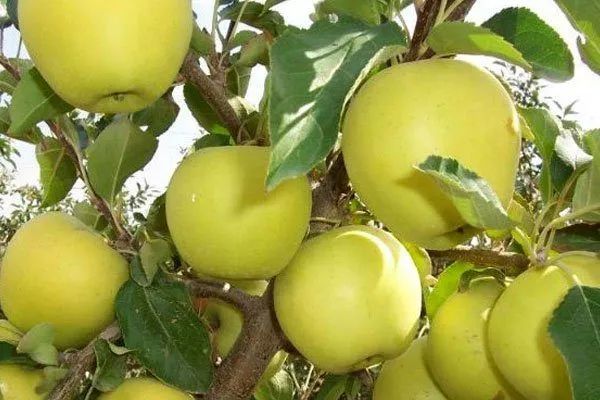
Description of the Medok apple tree
The Medok apple tree is very attractive, like most columnar varieties. Its fruit, while not particularly colorful, is very tasty.
Tree
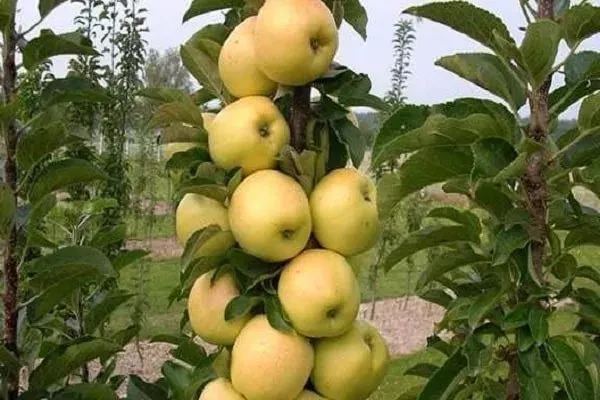
The Medok apple tree is medium-sized to low-growing, reaching a height of no more than 2.5 meters. This columnar apple tree has a compact and neat crown, creating a rather decorative appearance. This variety can be a true highlight in any garden.
The leaves are large, slightly elongated, pointed at the tips, and a standard green color. The Medok apple tree's flowers are white with a greenish center, gathered in clusters. The tree's roots are quite strong and dense, so the young tree tolerates transplanting well in the fall and spring.
Fruit
The Medok apple tree produces large fruits. Their size depends not only on the tree's age but also on its care, such as watering and fertilizing.
Fruit characteristics:
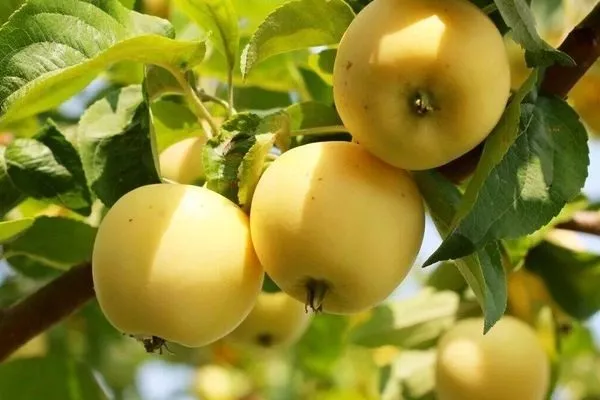
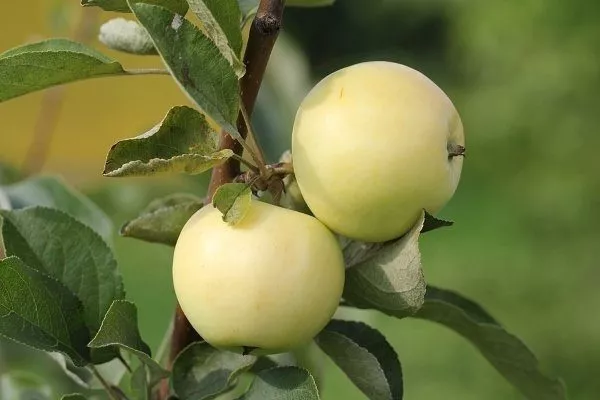
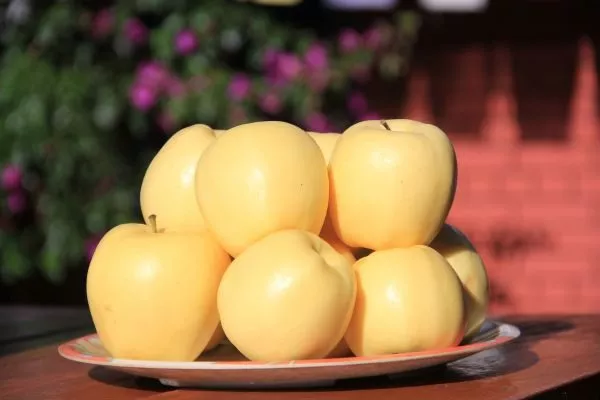
- Color - yellow and white.
- Form - rounded.
- Weight — 100-250 g.
- Pulp: juicy, coarse-grained.
- Skin: dense.
Who and when developed the Medoc variety?
The Medok variety was developed at the Moscow Institute of Horticulture (VTISP) in 1987. The authors of the variety were Professor V. V. Kichin and N. G. Morozova. In 1996, the variety was approved for use, but was not included in the State Register.
Characteristics
The Medok variety has excellent agronomic characteristics, allowing it to be grown in a wide range of conditions. This early-fruiting apple tree takes root well and is capable of bearing fruit within the year of planting.
Features of the variety:
- Regionality. Suitable for cultivation in various regions. The columnar apple tree Medok can be successfully grown in the North Caucasus, the Volga region, the south of the country, the Central Black Earth Region, Western Siberia, the Ural region, and European Russia.
- Productivity. The Medok apple tree is small, so its yield is commensurate. One apple tree produces an average of 5-10 kg of apples. The maximum yield of an adult tree is 15 kg. This is reached in the fifth or sixth year of the tree's life. Experienced gardeners report that with intensive care, the yield can be doubled.
- Taste and application. Medok apples have a dessert-like flavor, with a pleasant sweetness. The flesh is juicy, with a light aroma and a honey-like flavor. The fruit has a versatile use. Medok apples are eaten fresh, used to make jam, compotes, and juices. They are also suitable for baby food, as the pulp contains a small amount of sugar.

- Winter hardiness. Characterized by high frost resistance, this winter-hardy apple tree can withstand temperatures down to -42°C.
- Disease resistance. The variety is highly disease-resistant. In particular, this apple tree rarely suffers from scab or powdery mildew. Even in years of widespread fungal infections, the Medok apple tree can remain unaffected.
- Do you need pollinators?The apple tree is self-fertile and doesn't require pollinators. However, experienced gardeners believe that cultivars that bloom at the same time as the Medok can increase its yield. For example, the Semerenko or Antonovka varieties can be used as pollinators.
Pros and cons
The Medok variety is popular among gardeners, but along with its advantages, it also has a number of disadvantages. Before planting this variety in your garden, it's recommended to familiarize yourself with all its pros and cons in advance.
Pros:
Cons:
Landing
The columnar Medok apple tree takes up little space, so planting is usually hassle-free. However, it's important to consider all the variety's growing conditions and plant it correctly. A successful start determines the tree's entire life, development, and fruiting.
Selection of seedlings
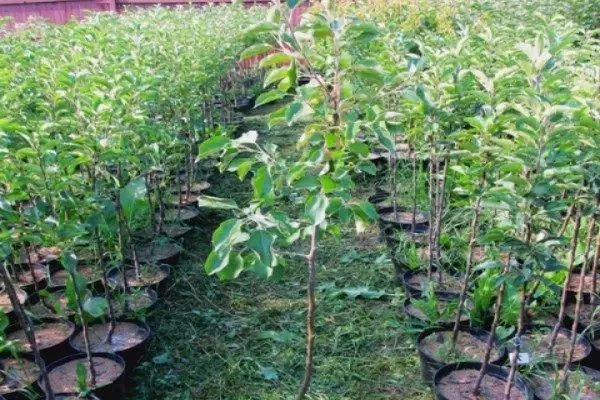
For planting, it is recommended to choose one- or two-year-old seedlings with a closed root system - they take root better than trees with open roots.
What to look for when choosing Medok apple tree seedlings:
- The tree must have a nursery tag. It indicates the tree's age, its morphological characteristics, and other information about the variety.
- The seedling's bark should be free of damage and signs of disease. Leaves are unnecessary; this is considered a negative factor—if they are present, the tree is at high risk of developing diseases.
- The optimal height of a seedling is 70-80 cm.
- The root system is powerful, well developed, the shoots are flexible and do not break when bent.
It's not recommended to buy seedlings from random sellers. Apple trees are best purchased from specialized nurseries.
Selecting a site
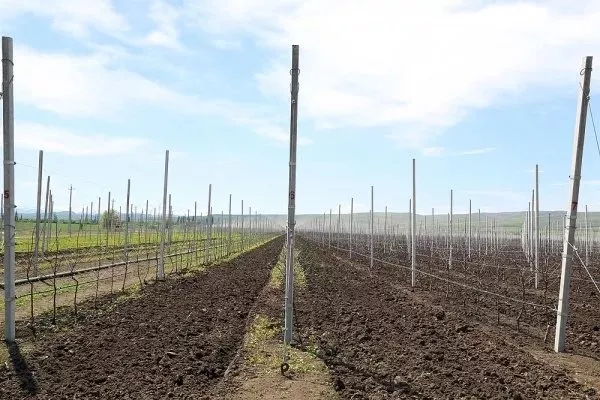
The site for planting the Medok apple tree is selected based on light exposure and protection from the wind. It's also important to consider soil characteristics and groundwater levels.
Site requirements:
- The location should be sunny, without shade. However, in southern regions, growing in partial shade or with midday shade is possible.
- A small tree does not tolerate gusty cold winds well, so it is advisable to have a building, a solid fence, or tall trees on the north side to block the wind.
- The groundwater level should be no more than 1.5-2 meters. Excessively high groundwater levels lead to root rot and tree death.
- Swampy areas and dry sandy soils with close occurrence of lime, crushed stone or dense clay horizons are not suitable for planting.
- The Medok apple tree grows best in loose, fertile soils that are well-drained and aerated. This variety particularly prefers gray forest soils, sod-podzolic soils, and chernozem soils, as well as loams with a neutral or slightly acidic reaction.
Site preparation
Soil preparation in the area allocated for planting the Medok apple tree begins in advance - preferably several months in advance.
Tips for soil preparation:
- Clay soils are infertile, so it's best to prepare them a year before planting the apple tree. Add 50 kg of river sand, 15 kg of sawdust, peat, compost, and humus, as well as 0.5 kg of slaked lime per square meter.
- For sandy soils, add clay - 50 kg per 1 sq. m., as well as 15 kg of humus, 0.5 kg of slaked lime, 40 g of potassium sulfate and 70 g of superphosphate.
- To improve the structure and composition of the soil, it is recommended to sow green manure on the plot.
- Compost and manure are added to peat soils to improve their fertility. Wood sawdust is also recommended.
- Add 15 kg of compost per 1 sq. m to loam soil, as well as 40 g of potassium sulfate and 60 g of superphosphate.
- Black soil does not require fertilization; it is enough to just loosen it a little.
Before planting, the area is cleared of weeds and plant debris.
If the area has high groundwater levels, then to plant an apple tree you need to build an artificial embankment about 0.8 m high and install a drainage system.
Preparing the planting hole
Prepare the apple tree planting hole at least 2-3 weeks before planting. Allow the hole to settle and the fertilizer to dissolve. If planting is scheduled for spring, prepare the planting holes in the fall.
Features of preparing a planting hole for the Medok apple tree:
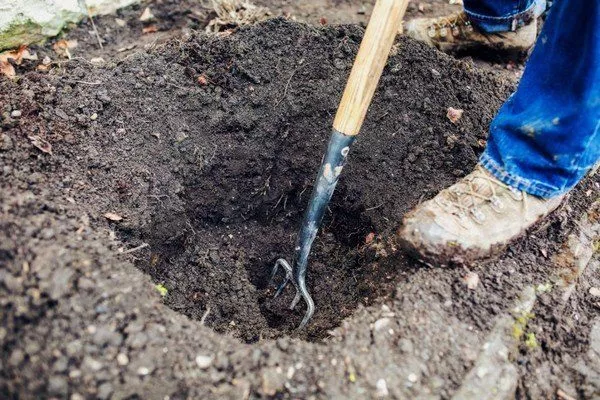
- The planting hole should be large enough to accommodate the young tree's root system. Typically, it's 80-90 cm deep and 90-100 cm wide.
- Crushed stone with sand or broken brick is poured into the bottom of the hole - this will serve as drainage (thickness - 10-15 cm), which will prevent root rot.
- 2/3 of the hole is filled with a nutritious soil mixture, which is prepared from the top fertile layer of soil obtained when digging the hole, humus or compost (30 l), wood ash (250 ml), superphosphate (50 ml).
- A wooden support about 1.5 m high and 2-2.5 cm in diameter is installed in the center of the hole.
Planting dates
Honey apple trees are planted in spring and fall. If the seedling is closed-root (in a container), it can be planted in summer. Bare-root apple trees should not be planted in summer, as their roots will be damaged by overheating.
Planting times depend on the growing region, or rather, on the local climate. Generally, apple trees are planted in the spring from early April to mid-June, and in the fall from late September to mid-October.
Planting a seedling
It is recommended to plant apple trees in calm, windless weather, preferably cloudy, as the scorching sun can cause burns to the young bark.
Features of planting the Medok apple tree:
- Before planting in a permanent location, the roots of seedlings are soaked in water for 24 hours or in a growth stimulator.
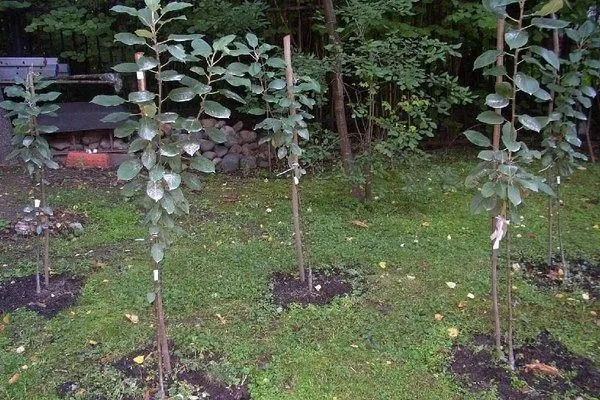
- The soil mixture placed in the hole is raked to form a mound. The seedling is placed on this mound, ensuring the roots lie evenly on the slopes. It's important to gently straighten them out, avoiding any breaks, damage, or bending.
- The seedling is positioned so that after planting, the root collar is 5-7 cm above ground level. The roots are covered with soil, compacting it periodically to prevent voids from forming between the roots.
- The seedling is tied to a previously installed support in a figure eight pattern using soft fabric, ribbon, or twine.
- The planted seedling is watered with settled, warm water. One tree requires 40-50 liters. Once the water has been absorbed, the area around the trunk is sprinkled with a layer of humus, peat, or other suitable organic matter. The layer should be 5 cm thick.
Care
Medok is not a capricious variety, but for better decorativeness and a bountiful harvest, it is advisable to take care of its growth and development.
Watering and loosening
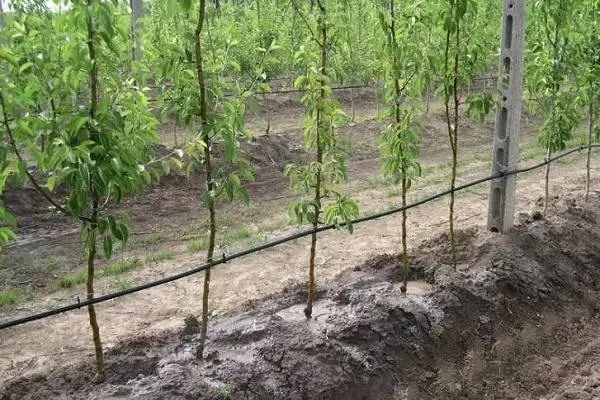
In normal weather, the Medok apple tree is watered once a week. During hot weather, the frequency of watering is doubled. It's important to maintain a balance when watering the tree—avoiding both a moisture deficit and an excess. Overwatering can lead to root rot, while underwatering can cause fruit drop.
Watering features:
- Apple trees should be watered after sunset. When watering the tree with a hose, be careful not to wash away the top layer of soil, so as not to expose the surface roots.
- Apple trees require copious watering during bud break. After that, water once every two weeks. From mid-summer, watering frequency is reduced, and in August, it is stopped altogether.
- After harvesting, in October, moisture-recharging irrigation is carried out.
To ensure oxygen reaches the tree's roots, the area around the trunk is loosened after watering, otherwise a hard soil crust will form. Mulching with sawdust, humus, peat, etc. helps prevent this formation and reduce the frequency of watering and loosening.
Top dressing
To produce a good harvest of Medok apples—large, tasty, and abundant—fertilization is essential. Fertilizer should be applied at least three to four times per season. The composition of the fertilizer depends on the growing season and the time of year. Organic and mineral fertilizers are used alternately for apple tree fertilization.
Approximate feeding regime:
- In the spring, organic matter is added to the apple tree's soil because it's rich in nitrogen. The tree needs nitrogen during this period, as it stimulates the growth of green foliage. For example, compost, rotted manure, or diluted bird droppings can be added.
- A flowering tree is fed with a phosphorus-potassium fertilizer. For example, you can add superphosphate (90 g) and potassium sulfate (70 g).
- At the stage of fruit setting, you can add a urea solution (30 g diluted in 10 liters of water), and after a couple of weeks - superphosphate (50 g) and potassium sulfate (25 g).
- To accelerate fruiting and boost the tree's immunity, spray it with potassium humate (3 g diluted in 10 liters of water). Foliar feeding is carried out in dry, windless weather in the evening, after sunset.
- After harvesting, potassium-phosphorus fertilizer is applied again to strengthen the tree and prepare it for winter.
If the apple tree grows on sandy soil, then during the leaf emergence phase it is recommended to add 20 liters of humus under the tree.
Trimming
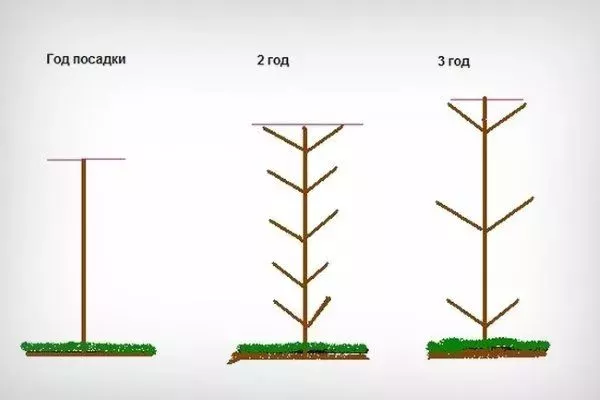
The Medok apple tree is pruned annually. This includes both sanitary and formative pruning. This is done in the spring, before the sap begins to flow.
Features of pruning the Medok apple tree:
- All shoots located less than 0.5 m from the ground are cut off.
- The apical shoots are shortened by a third of their length.
- Remove all dry, frozen and damaged branches, as well as those growing inward into the crown.
- Pruning is carried out with a sharp, disinfected tool.
- The branches are cut to the outer bud so that the shoots do not cross.
- The cuts should be smooth and even, preventing the stumps from splitting. The cut areas are coated with garden pitch to prevent infection from penetrating the tree tissue.
Shelter for the winter
In anticipation of winter, the trunk of a columnar apple tree is wrapped in burlap or special materials such as spunbond, agrofibre, etc. The area around the trunk is mulched with a thick layer of peat or humus to prevent the roots from freezing.
It's best not to use sawdust for insulation, as it can harbor rodents. To prevent rodents, wrap the trunk with spruce branches. In regions with little snowfall in winter, the tree trunks are mounded with soil to a depth of 15-20 cm. The colder the winter, the more extensive the covering should be; young trees can even be covered along with their crowns.
Fighting diseases
The Medok apple tree has good immunity to most diseases, but under unfavorable growing conditions and gross violations of agricultural practices, the risk of damage increases significantly.
The Medoc variety is most often affected by:
- Scab. It typically occurs during damp and cool summers. It is accompanied by the appearance of dark spots on leaves and fruit, leaf drop, and hardening and cracking of apples. To combat scab, apply a 0.02% solution of "Raika" to swollen buds and flower buds, immediately after flowering, and a week later. After harvesting, spray the tree with a 0.2% solution of copper sulfate.
- Powdery mildew. Like scab, it is triggered by high humidity. This fungal disease causes a light gray powdery coating. The leaves darken and fall prematurely, and the ovaries fall off. To prevent this, spray the tree several times per season with "Skor" (2 ml per 10 l) or "Topaz" (3 ml per 10 l).
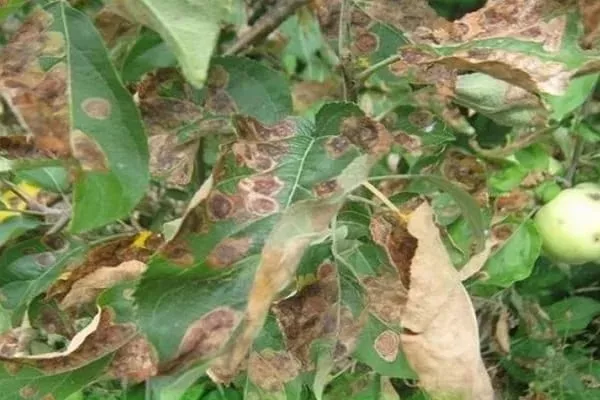
- Brown spot. This disease spreads especially quickly in high humidity. Leaves become spotted, dry out, and fall off. It is recommended to spray trees in early spring, before bud break, with a 0.5% solution of Kumira or a 0.4% solution of the fungicide Zineba.
Pest control
Among insect pests, the most dangerous to the Medok apple tree are aphids, codling moths, and apple blossom weevils. Fungicides, mechanical treatments, and folk remedies are used to control them.
To combat pests you can use:
- Chemicals. In early spring, when the temperature rises above 10°C, the tree is sprayed with Decis. Subsequently, two more treatments are carried out with similar products, such as Batrayder and Profilaktin. The apple tree can also be sprayed with broad-spectrum insecticides such as Skor, Fufanon, Aktara, etc.
- Mechanical means of control. Pests are collected by hand, and various traps are set up, for example, with a sticky surface.
- Traditional methods. You can, for example, spray the tree with a decoction of wormwood (800 g of dry grass per 10 liters of water), a solution of garlic (50 g of cloves per 10 liters of water) or onion peel (200 g per 10 liters of water), etc.
Harvesting and storage
Apples are harvested in late August and early September. They are picked as they ripen, taking care not to leave overripe fruit on the tree. Harvesting takes place in dry weather, so the apples will keep better. The fruit is picked with the stems attached. The fallen fruit is used for food or processing.
Apples stored in storage should not be washed or wiped, to avoid removing the waxy coating that helps them keep longer. Store the fruit in shallow wooden containers. Before storage, sort the apples, setting aside any that show signs of damage or disease.
Reviews
The Medok apple tree is an interesting and promising variety that will surely appeal to fans of columnar trees and yellow apples. This apple tree is compact, hardy, and requires little care, making it suitable for both novice gardeners and any gardener.