
The apple tree has a powerful root system, which not only allows it to obtain water and nutrients from the soil but also to remain firmly upright. Understanding the root structure can help avoid many agricultural mistakes that can lead to frost damage and weakening of the tree.
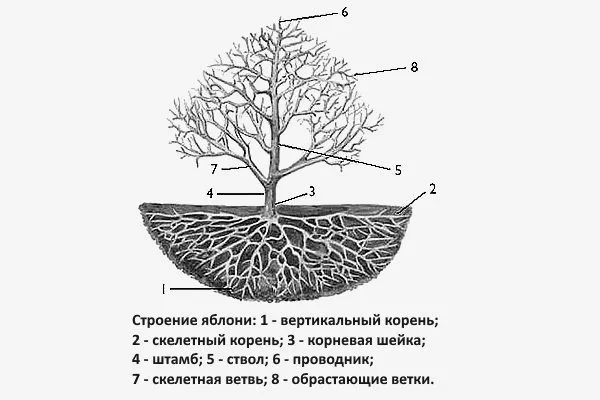
Description and characteristics of the apple tree root system
The apple tree has a fibrous root system—this structure makes it strong and resilient. It has two types of roots: skeletal and adventitious. If the tree is in favorable conditions, its roots grow to incredibly large sizes. The horizontal branching is significantly greater than the crown projection.
Features of apple tree root branching:
- in depth - 3-4 m;
- in width - 5-8 m;
- the active part of an adult tree is 0.2-0.8 m below ground.
Most roots are located at a depth of 0.5-0.6 m. In northern regions, roots are located less deeply. The same tendency is observed in areas with damp and heavy soils.
Experience shows that the rhizome is more sensitive to cold than the above-ground portion of the apple tree. This is why gardeners primarily insulate the tree trunks with a thick layer of mulch—peat, manure, or compost.
Types of roots
Agricultural practitioners use the simplest classification of roots—by type of origin. According to this classification, apple trees have two types of roots: primary and secondary. The latter form through the stem, while primary roots emerge through the seed embryo.
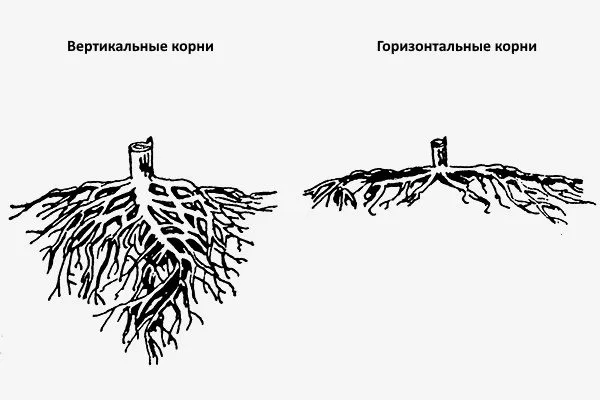
Horizontal and vertical
| Name | Root system type | Root depth, m | Width of root branching, m |
|---|---|---|---|
| Horizontal roots | Fibrous | 0.2-0.8 | 5-8 |
| Vertical roots | Rod | 3-4 | 7-8 |
In addition to the above classification, in practice a simpler and more conventional division of roots into types is often encountered.
Root type by nature and direction of growth:
- Vertical — can grow to a length of 7-8 meters or even more. The length depends on climate conditions, soil type, and apple tree variety. These roots are characterized by pronounced branching and chaotic growth.
- Horizontal They have numerous branches spreading through the topsoil. Numerous roots cover a significant portion of the soil substrate. Compared to vertical plants, they more effectively supply the plant with oxygen and nutrients.
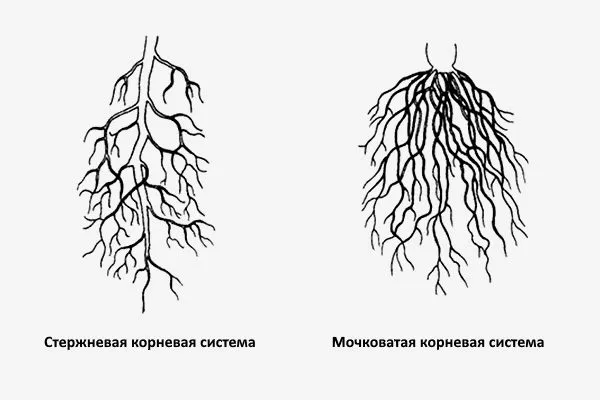
Taproot and fibrous
| Name | Root system type | Root length, m | Root thickness, cm |
|---|---|---|---|
| Skeletal roots | Rod | 0.5-7 | 0.3-12 |
| Fibrous roots | Fibrous | up to 0.5 | thin |
The taproot (skeletal) type is characterized by a well-formed and clearly defined main root, which is strong and thick. Note that the skeletal root type includes a subtype of branched rhizome, distinguished by highly developed lateral branches. In such cases, the main root is shortened.
Fibrous roots are characterized by a large number of equally long adventitious rootlets, which form a small root cluster. Adventitious roots can originate from the underground or aboveground portion of the stem/trunk.
Description of roots:
- Skeletal — grow in length from 0.5 to 6-7 m (in the North Caucasus), their thickness ranges from 0.3 to 12 cm.
- Fibrous - They are quite thin and form on skeletal roots. They release decay products into the environment. They are located up to 50 cm from the surface.
Skeletal roots are also called primary roots, while fibrous roots are called adventitious roots. The former are much thicker, larger, and longer, but apple trees have more adventitious roots. While skeletal roots take two decades to form, fibrous roots grow much faster and actively absorb water and nutrients.
Growth and formation
The apple tree's root system is characterized by uneven growth. Twice a year, intense growth occurs: the first in the spring, when the roots begin to emerge following the tree's growth above ground; the second in the fall, after the leaves have fallen.
There are many factors that influence how quickly roots grow and form, but there are only a few main ones:
- soil temperature and moisture;
- saturating the earth with oxygen;
- soil fertility.
Suitable conditions for root growth are between 7°C and 20°C. At higher or lower temperatures, roots stop developing, which is harmful not only to the crown but also to the rhizome.
Every year, the length and diameter of apple tree roots increases. Transplantation, which inevitably causes trauma, leads to a halt in development.
Features of growth and formation of apple tree roots:
- Skeletal roots They participate in the formation of second-order shoots. From these shoots, third-order roots originate, then fourth, and so on. With each subsequent branching, the roots become thinner and shorter.
- Root lobes They are the outermost, peripheral parts of the roots. The newly formed parts are covered with hairs that intensively absorb water, which the tree needs for growth.
- The apple tree can form skeletal and semi-skeletal roots. up to several meters long and over 10 cm thick. If the root system has a strongly developed vertical root and a weak lateral rhizome, it is called a taproot.
- Columnar apple trees They have a superficial rather than a taproot system, characterized by weak growth relative to the trunk.
- Apple tree seedlingDepending on growing conditions and varietal characteristics, a tree can have up to 40,000 roots, with a total length of up to 230 meters. The total length of a mature tree's roots can be tens of kilometers, and the number of roots can reach several million.
- When forming only roots, others die off one after another—this is one of the constant principles of tree growth and development. New ones soon replace the dead sections.
From the 2nd year of an apple tree’s life, the diameter of its roots is approximately 1.5-2 times larger than the crown.
Features of seedlings and how to choose them?
There are two types of seedlings available on the market: closed-root and open-root. Before purchasing one or the other, learn the differences between them and any differences in planting techniques.
Seedlings with an open root system
These seedlings have their roots exposed—they're taken out of the ground and delivered to market. These seedlings can be planted in spring or fall, immediately or with a delay. If stored properly, they can wait anywhere from two weeks to several months for planting.
When transporting and storing, it's recommended to wrap the roots of such seedlings in a damp cloth. Also, seedlings purchased in the fall can be buried in the garden or basement until spring.
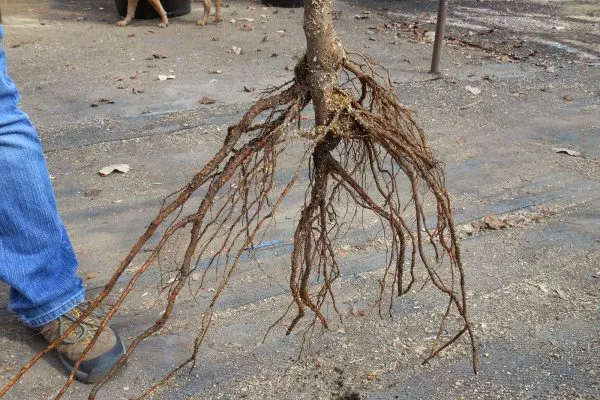
How to choose good bare-root planting material:
- roots - white when cut;
- shoots should grow in all directions;
- absence of diseased, dry, damaged roots, or roots with signs of disease;
- all roots must be flexible and elastic; if they are overdried, the tree is unlikely to take root;
- There should be no swellings on the roots - such formations indicate infection with root cancer.
If a seedling has few or no lateral shoots, it may be older than 1-2 years. Such seedlings are not recommended for planting—the trees will either fail to root or will be weak and diseased.
Bare-root apple tree seedlings should not be out of the ground for more than two weeks, so be sure to check the date they arrived at the store. Better yet, purchase the planting material directly from the nursery.
Seedlings with a closed root system
Apple trees with closed roots are grown in greenhouses rather than in open ground. Here, each seedling has its own container or bag, in which they are sold.
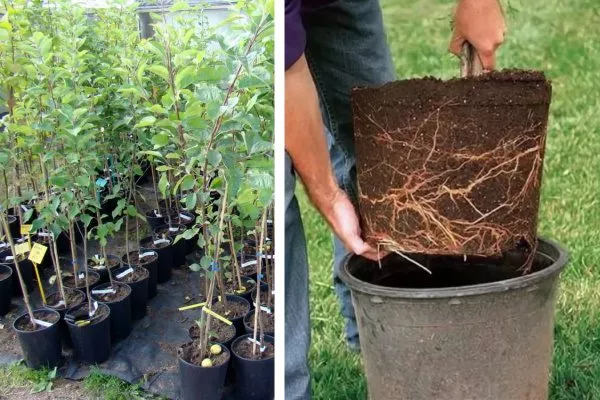
Advantages of seedlings with closed roots:
- Easy to transplant and good survival rate. Planting is done by transferring the plant from its container into the planting hole. To help the soil and roots fall out of the planting container, the substrate is watered generously.
- Extended planting periods. Seedlings sold in containers can be planted throughout the growing season, not just in spring or fall.
- Long-term storage possibility. Unlike their bare-root counterparts, container-grown seedlings are protected from root drying out.
- They take root, bloom and bear fruit faster. All this is due to the low-trauma transplantation and the absence of removal from its natural habitat, which is undoubtedly stressful for the plant.
Gardeners often wonder which seedlings to choose—domestic or foreign. Considering that among our varieties, you can choose varieties specifically for your region, these tend to be preferable. On the other hand, it's important to understand that not all Russian varieties are suitable for your climate.
There are apple trees zoned for the south that shouldn't be planted in the Moscow region or Siberia, and vice versa. However, Polish, Finnish, German, and other varieties offer perfectly suitable options. The main thing is to familiarize yourself with their growing characteristics, such as frost resistance, drought tolerance, and so on.
Once you've decided on a variety, all that's left to do is select high-quality planting material. When choosing open-root seedlings, the buyer's primary focus is on the condition of the roots. When purchasing closed-root apple trees, other characteristics are important.
How to choose a good seedling with closed roots:
- Pay attention to the container - it must have holes for drainage.
- The condition of the visible roots should be impeccable, with no signs of damage or disease.
- It's good if, in addition to the seedling, there are some weeds growing in the container - this is proof that the seedling was grown in this container and not transplanted there at the last moment.
- If a seedling's leaves turn yellow and fall off in the summer, it's weak and has been poorly cared for. It will have trouble establishing itself in a new location, and its growth and development will slow down due to frequent diseases.
- ✓ Roots should be visible through the container's drainage holes, indicating good root system development.
- ✓ No mold or unpleasant odor from the substrate in the container.
How to plant an apple tree with closed roots?
When planting bare-root apple trees, you have to carefully prepare the hole and gently straighten each root of the seedling to prevent it from bending or breaking.
Even so, damage to the smallest roots is inevitable—the seedling needs some time to recover from the stress, adapt to the new location, and gain strength. All this delays establishment and weakens the seedling, which is especially unpleasant as winter approaches.
Planting bare-root seedlings is a different matter—it's gentle and painless. The trees quickly establish themselves and adapt, and in the spring and summer, they begin to grow rapidly.
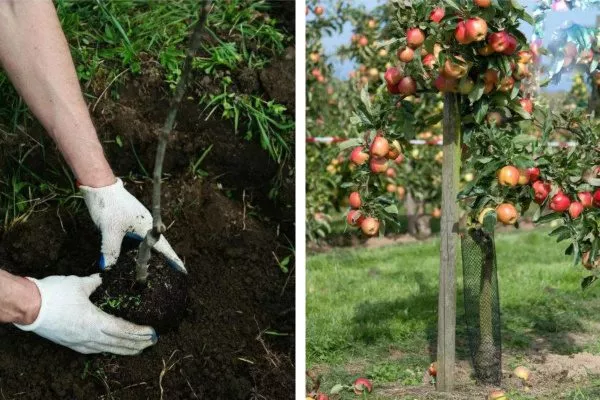
How to plant a closed-root apple tree in open ground:
- Dig a hole up to 60 cm deep and about 1 m in diameter.
- Instead of the bottom layer of soil, add fertile substrate to the hole - prepare it from the top layer of soil, humus and compost, mixed in equal parts, and add 30-50 g of mineral fertilizers (for example, superphosphate).
- In the mixture poured into the hole, make a depression large enough to accommodate the container.
- Water the seedling and the hole you made.
- Carefully remove the apple tree from the container and transfer it, along with all the soil that was in it, to a new location.
- Don't cover the seedling with other soil. Just compact the soil around the sides.
- Carefully insert the support, being careful not to disturb the roots. Tie the tree to it with soft twine or a piece of fabric.
- Water the planted apple tree with warm, settled water. The recommended watering rate is 20 liters. Mulch the soil around the trunk to slow down the release of moisture.
How and when to insulate the roots of apple trees?
In southern regions, there's no need to insulate apple trees; they easily survive the warm and slushy local winters. However, in temperate climates and northern regions, insulation is essential. Here, winter temperatures drop to -30°C or even lower, putting apple trees at risk of freezing.
Insulating young trees is especially important. While root mulch is sufficient for mature apple trees, young trees require top-to-bottom insulation. If an apple tree freezes severely, no amount of fertilizing or care can save it, so it's crucial to properly insulate it for the winter.
Features of insulating apple tree roots:
- Thickness of the insulating layer and degree of insulation. They depend on various factors, including winter temperatures, tree variety, and age. For example, a frost-resistant 5-year-old apple tree requires no shelter, but columnar 3-4-year-old trees require insulation every winter.
- Shelter arrangement deadlines. They depend on the region's climate. It's recommended to begin work when the average daily temperature reaches +10°C. There's no need to rush—insulating too early is harmful to the crop.
Insulating apple trees prematurely prolongs the growing season and accelerates growth. As a result, apple trees, especially young ones, don't have time to adapt to the onset of cold weather. They freeze, even if well-wrapped. Delaying insulation can damage the tree bark.
- ✓ The mulch layer thickness should be at least 10 cm for effective protection against frost.
- ✓ It is preferable to use organic mulch (peat, manure, humus), which will additionally enrich the soil.
Preparations for insulation begin in late September or early November, depending on the region. In temperate climates, the procedure is carried out from late September to mid-October.
Insulation procedure:
- Work begins with cleaning the tree trunk circles. They rake up fallen leaves, treat the bark with a solution of copper sulfate, whiten it, trim it, and remove moss and lichen from the bark, if any.
- The soil is sprinkled with manure, and on top of it - sawdust. The lower part of the trunk, near the roots, is wrapped with an insulating material, such as agrofibre. The trunk itself is also wrapped, if necessary, and soil is raked up to the seedlings.
- Suitable materials for insulating the root zone and trunk. These include paper, spunbond, roofing felt, burlap, fabric, spruce branches, and reeds. The root zone can also be covered with peat or straw.
- If natural material is used as a covering material. It is recommended to treat it with a fungicide - this will protect the tree from infections and rodents.
- In regions with severe frosts. The tree trunks are covered with spruce branches on top of the mulch, and then with snow when it falls.
Knowing the structure of fruit tree root systems and how to insulate them will help you create the most comfortable growing and wintering conditions for your apple tree. This will directly impact the tree's health and productivity.