
Columnar apple trees, thanks to their botanical characteristics, have become serious competitors to conventional varieties. Let's learn how to plant pyramidal trees, how to care for them, and what varieties breeders offer gardeners.
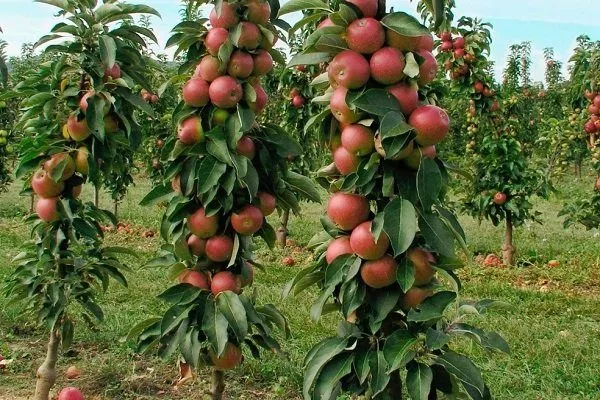
Description of the columnar apple tree
Columnar apple tree clones are those with branches that are positioned at an acute angle to the trunk. They are so closely pressed against the trunk that the tree resembles a pyramidal poplar or a column.
Features of columnar varieties:
- Height. It depends on the rootstock used to grow the seedling. Today, breeders prefer dwarf and semi-dwarf rootstocks for columnar varieties, and occasionally, medium-sized and tall ones. The average height of a columnar apple tree is 2.5 m.
Dwarf varieties are less prone to branching. By the age of 3-4 years, the tree stops growing lateral branches. - Productivity. One tree produces 10-15 kg of apples. An orchard yields an average of 140 tons of fruit per hectare.
- Fruiting periods. The tree reaches its peak productivity at 4-5 years of age.
- Duration of fruiting. The tree, while producing large crops, quickly becomes depleted, and by the age of 15, it reaches a stage where yields begin to decline rapidly. Regular fertilizing and proper care help prolong fruiting.
- Roots. Rootstocks have a fibrous root system that grows at a shallow depth. Because of this, columnar varieties require regular and abundant watering. It's important to prevent standing water around the trunk, as this can cause root rot.
All columnar apple trees are divided into two types: those with a special Co gene, and simple varieties grafted onto a super-dwarf clonal rootstock.
Advantages and disadvantages
Columnar varieties have gained popularity due to their compact size. Despite their low height, the trees produce standard-sized fruits.
Advantages:
- Compactness. Trees take up little space, making them very popular with owners of summer cottages and small gardens. One tree takes up 0.5-1 square meter.
- High yield. Considering the tree's small size, a harvest of 1-1.5 buckets of apples is impressive.
- Ornamental value. Columnar trees are also a garden ornament. They resemble small pyramids, which are especially beautiful during flowering and fruiting.
- Frost resistance. Seedlings with winter-hardy rootstocks thrive and bear fruit in harsh climates.
- Strong immunity. Pyramid apple trees are known for their hardiness and good health.
- Comfort. Thanks to its low stature and compact size, harvesting is extremely easy. You can pick the fruit in just a few minutes, without much effort, and without the risk of falling from a tree or stepladder.
Flaws:
- Price. Due to the high cost of columnar seedlings, many gardeners choose cheaper, non-columnar varieties.
- Lifespan. A typical apple tree, with proper care, can live and bear fruit for 30-50 years. Pyramidal apple trees live much less.
- Large investments. While columnar and standard apple trees yield the same amount of fruit per square meter, columnar apple trees require significantly more planting. Given the high cost of seedlings, planting even a small orchard is expensive.
- Demanding. Careful care is required – regular watering, fertilization, shelter, and crown shaping.
How to plant a columnar apple tree?
Columnar apple trees, like other fruit trees, are planted in spring or fall. When choosing a planting time, gardeners consider local climate conditions. For example, in regions with harsh winters, spring is a safer time to plant.
- ✓ Check the presence of the grafting site – it should be clearly visible and without damage.
- ✓ Assess the condition of the root system – the roots should be alive, without signs of rot or drying out.
- ✓ Make sure that the seedling does not have leaves – their presence may indicate improper storage.
Optimal timing
When to plant seedlings:
- In the spring. Planting takes place before the buds open. In central Russia, suitable conditions arrive in the second half of April. In the Urals and Siberia, it's a couple of weeks later.
- In autumn. In the temperate zone, seedlings are planted in late September or early October. In more northern regions, planting begins a little earlier. The starting point is leaf fall. The first frost should be 25-30 days away.
When planting trees in spring or autumn, you can't rely solely on calendar dates; you need to take meteorological conditions into account.
When planting columnar apple tree seedlings, preference is given to the spring season.
Autumn planting
Columnar apple trees are best planted in rows. The optimal distance between adjacent seedlings is 0.5 m. The width between rows is 1 m.
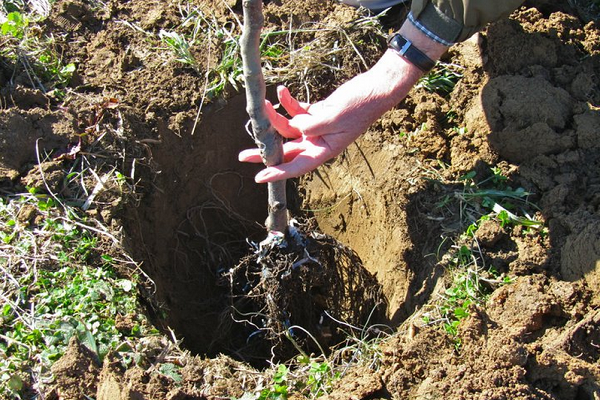
Autumn planting procedure:
- A couple of weeks before planting, dig holes 90 cm deep and 90 cm in diameter. This will prevent soil settlement after the seedling is planted and the root collar from sinking into the ground.
- When digging a hole, store the topsoil separately—it will be used to create the potting mix. Don't let it mix with the infertile soil from deeper down.
- If the soil is heavy and clayey, provide drainage to prevent root rot. To do this, place crushed rock mixed with sand at the bottom of the hole. The drainage layer should be 10-15 cm thick.
- Mix the fertile soil layer obtained from digging the hole with 3-4 buckets of humus or compost. Add 100 grams of potassium fertilizer and superphosphate, and a cup of dolomite flour for acidification.
- Pour half of the resulting soil mixture into the hole. Level it and leave it for two weeks to allow the soil to settle and compact.
- After digging the hole for two weeks, begin planting. First, fill the hole with the remaining soil mixture. Don't level the resulting "hill"—the seedling's roots will rest on top of it.
- Place the apple tree so that the roots are evenly distributed on the earthen mound, and the grafting site is above ground level - it cannot be buried.
- Fill the hole with the poor soil removed during digging. Compact the soil.
- Step back 0.3 m from the trunk and make a 10-15 cm high earthen embankment around the perimeter – this will prevent water from leaking out during watering.
- Water the seedling with 1-2 buckets of settled water.
- Once the water has been absorbed into the soil, sprinkle the tree trunk circle with mulch – sawdust, peat or chopped grass.
If you have any doubts about the sapling's strength, or if there's a risk of strong winds, install a support nearby. Tie the tree with a soft material, such as rope or twine.
Spring planting
The spring planting technique is virtually identical to the fall planting technique. The key difference is the timing of hole preparation. It's done in the fall. Over the winter, the soil will settle and compact, and the fertilizers will dissolve and be absorbed into the soil.
Preparing the hole in the fall allows apple trees planted in the spring to quickly establish themselves, as the planting site is perfectly prepared over the winter to receive the seedling. Apple trees planted in a "fall" hole often bloom that same spring.
Caring for columnar apple trees
Pyramid apple trees are generous with their harvest, but in order for a small tree to produce a bucket of large and juicy apples, it must be cared for from early spring to late autumn.
By seasons
Caring for a columnar apple tree depends on the season, age, and health of the tree. Each season requires a set of mandatory agricultural practices, without which the tree cannot expect to thrive.
Spring events:
- cut off dry, diseased and damaged branches;
- spray the crown and trunk against potential diseases and pests;
- apply nitrogen fertilizers;
- For first-year seedlings, pick off all the buds; for two-year-olds, leave about ten buds;
- Water and loosen the tree trunk circle on time.
If the seedling has a clonal rootstock, its roots are easily damaged during loosening. In this case, it is recommended to sow green manure around the trunk.
The load on the apple tree is gradually increased. At three years of age, twice as many buds are left as the number of fruits to be harvested.
Summer care:
- at the beginning of summer, carry out complex mineral fertilizing;
- thin out the buds again – leave 50% of the ovaries;
- when the fruits reach the size of cherries, remove some more ovaries - there should be two pieces left in each inflorescence;
- Once the apples are the size of a walnut, remove one of the two - one fruit should remain on one link;
- carry out preventive inspections, and if diseases or pests are detected, spray the tree or take other measures;
- In August, apply only potassium fertilizers; nitrogen fertilizers are contraindicated during this period.
A month before harvesting, stop treating apple trees with insecticides and fungicides.
Autumn care and preparation for winter:
- shorten the topmost shoots by two-thirds to prevent freezing;
- After harvesting, apply fertilizer and spray the tree against fungal infections;
- treat the crown, trunk and tree trunk circle to remove pests hiding in the bark and soil;
- if necessary, carry out a second sanitary pruning;
- immediately before the onset of frost, cover the tree trunk with spruce branches;
- When snow falls, cover the base of the tree trunk with it.
Straw should not be used as a covering material, as it will inevitably attract rodents, which can damage the apple tree's bark. If the tree trunks were previously mulched with straw, it should be removed before winter.
Spraying
Various treatments—chemical, biological, and folk—are used to treat columnar apple trees. The emphasis is on prevention—it's important to address the problem early. If codling moth larvae infest the apples, the harvest will be ruined, and no treatments will help.
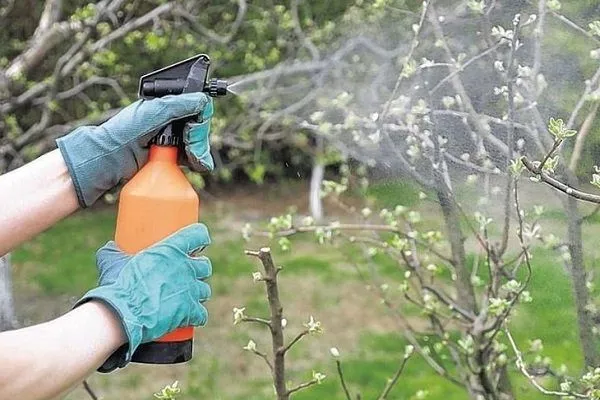
What and when to spray apple trees:
- In spring, before the sap begins to flow, and in autumn, after the leaves have fallen, trees and tree trunks are treated with a 1% Bordeaux mixture or a solution of Nitrafen.
- Before bud break, the tree can be treated with a 7% urea solution. This not only acts as a fungicide and insecticide, but also provides nitrogen.
The tree should be inspected regularly. If signs of disease or pest infestation appear, immediate action is necessary—spray the tree with an appropriate antifungal or antiparasitic agent.
Watering
Columnar apple trees lack a taproot, which allows other trees to extract moisture from deep soil layers. Pyramidal trees with fibrous roots require regular watering, as they are unable to extract water from deep within.
Watering features:
- Water young seedlings every three days—one bucket of water per tree. If it's hot and dry, water every two days.
- Water mature apple trees once a week.
- From mid-June, reduce watering slightly.
- Stop watering completely from the beginning of August.
- You can use drip irrigation. However, it's recommended to water the tree thoroughly once a month, ensuring the soil is thoroughly wet down to the roots.
Once or twice a week, after sunset, water the tree crown with a hose.
Fertilizers
Due to the superficial location of the roots, it is recommended to scatter the fertilizer for pyramidal apple trees in solid form, burying it into the soil by 2-3 cm.
- Apply nitrogen fertilizer in early spring to stimulate growth.
- During the flowering period, add phosphorus-potassium fertilizers to support fruiting.
- After harvesting, apply organic fertilizer to restore the soil.
When and how to feed a tree:
- Fertilize your apple tree for the first time when the leaves are emerging. Apply 50-60 g of nitroammophoska per square meter. If the soil is poor, you can add 2-3 buckets of compost under each tree.
- Apply subsequent fertilizing at intervals of 3-4 weeks. During the second fertilizing, add 80 g of superphosphate and 50 g of potassium sulfate or potassium chloride. You can use urea or slurry instead.
To apply urea, dissolve 2-3 tablespoons in 10 liters of water. Use 2-3 liters of solution per tree. After applying the fertilizer, mulch the soil. - Apply the third fertilizer in two stages. In mid-July, apply urea or ammonium nitrate. At the end of July, apply a phosphorus-potassium mixture or a complex fertilizer.
You can also fertilize the tree with wood ash. Sprinkle a couple of cups of ash under each apple tree. The tree also responds well to herbal infusions, micronutrients, biopreparations, and sodium humate.
After each fertilization, the tree should be watered and mulched. A generous amount of water will prevent the fertilizer from burning the tree's roots, and the mulch will prevent rapid evaporation.
How to trim?
Since columnar trees are not supposed to have lateral branches, they don't require pruning to shape the crown. Regular pruning of lateral shoots is sufficient to maintain the pyramidal shape. This procedure begins when the tree is two years old.
Pruning is performed three times a year - in the springBefore sap flow begins, in summer and fall, and after leaf fall. The main condition of this procedure is to avoid pruning the central basal shoot. Otherwise, the growing point will be affected, and the apple tree will begin to grow lateral branches intensively.
Columnar trees are pruned in the first year after planting. If the seedling is planted in the spring, the first pruning is done in the fall. If the apple tree is planted in the fall, it is pruned in the first spring.
The pruning schedule is chosen based on the season, the tree's age, and the density of the crown. Most of the work occurs during dormant periods, when sap flow is at a standstill. Old trees are pruned in winter to encourage new branches to emerge in the spring.
How to prune an apple tree in spring:
- Trim any frozen branches with sharp pruning shears. If the shoots haven't developed buds, trim them off completely.
- If the top is frozen, cut it off and select a new young shoot to replace the cut central conductor.
How prune an apple tree in autumn:
- Immediately after planting, remove all leaves and trim off side shoots.
- The following year, prune young shoots longer than 30 cm. Leave two or three buds on each. Select the strongest shoot—it will become the central leader.
- In the third year, prune shoots longer than 40 cm. Remove all shoots growing inward. Pinch the central shoot 25 cm from the trunk.
- In the fourth year, thin out all the branches. Leave only the young shoots, the strongest and most properly growing ones.
In summer, pruning is done manually: gardeners pinch out new lateral branches. At the same time, they remove shoots damaged by rot, spotting, rust, or scab.
How to prune an old apple tree in winter:
- Step back 0.5-0.7 m from the ground and select the strongest shoot. The optimal length is 0.7-1 m.
- Step back 5 cm from the chosen branch and cut the central conductor to a ring. This will transfer the apple tree to a young shoot.
- Prune shoots that grow at an oblique angle or inward toward the apple tree. Leave a few strong branches, trimming them back to a couple of buds.
- Cover all cuts with garden pitch.
Propagation of columnar apple trees
Only experienced gardeners can propagate a pyramidal tree. All other apple and compact fruit tree lovers are advised to purchase seedlings from a reputable nursery.
Reproduction methods:
- Seeds. This is the most ineffective method of propagation – it takes a long time and does not guarantee the production of a tree with the parental varietal characteristics.
- By grafting onto rootstock. Experienced gardeners use this option. Local seedlings or dwarf rootstocks, such as Paradise or Malysh Budakovsky, are used as rootstocks.
- Air layering. This method is suitable for inexperienced gardeners. Apple trees can be propagated by two types of layering:
- Horizontal. In the spring, rootstocks are planted and pruned to 2-3 buds. Shoots grow from the cut site. The planting material will grow the following spring.
- Vertical. They are obtained from mother shoots of clonal rootstocks, pruned in the spring. In the summer, shoots grow, which are pruned and planted in the fall.
Pests and diseases
Pest control begins with spring and fall preventative treatments. To prevent tree diseases Spray with fungicides - Horus, Fitolavin, etc. They usually act only on a certain type of fungus.
The most effective antifungal agent is Bordeaux mixture – it destroys several types of fungi.
To prevent and destroy pests, apple trees are sprayed with insecticides - Aktara, Karbofos, Actellic, etc. (strictly according to the instructions).
The main pests of columnar apple trees:
- Apple moth. The caterpillars of this inconspicuous butterfly quickly eat shoots and spoil the fruit. To prevent damage, the tree is sprayed with chlorophos or metaphos after flowering. The treatment is repeated after two weeks.
- Spider mite. It sucks the sap from the leaves. It leaves a fine web on the underside of the leaves—its presence indicates a mite infestation. Before bud break, the tree is sprayed with Nitrafen, and during budding, with Karbofos.
- Aphid. These are small sucking insects that live in colonies on leaves and shoots. Before bud break, treat with a 3% solution of Karbofos, Aktara, or Fitoverm. After bud break, a 2% solution of Karbofos is recommended.
Trees should be sprayed in dry, cloudy weather or in the evening/morning when the sun is out. If there's a strong wind, treatment will have to be postponed, as it will harm both the tree and the person.
The most common diseases of columnar apple trees:
- Scab. This fungal disease affects all parts of the apple tree, including the fruit. It occurs when humidity is high. If light green spots appear on the leaves, the tree is infected with scab. The apple foliage then turns brown and dies, and the scab spreads to the apples.
To combat scab, use a 4% Bordeaux mixture before bud break. If you don't have time, spray the tree during bud formation, but with a 1% solution. Spray the tree again after flowering. - Leaf rust. The foliage becomes covered with rusty spots that spread until they affect all the blades. The disease causes leaf drop and reduced frost resistance. Spray the apple tree with any suitable fungicide, such as "Skor."
- Powdery mildew. The disease affects the entire above-ground portion of the apple tree. The tree grows poorly, and its yield decreases. For treatment, use a 1% Bordeaux mixture or Topaz. Repeatedly spray the apple tree with copper oxychloride.
Popular varieties of columnar apple trees
| Name | Ripening period | Disease resistance | Frost resistance |
|---|---|---|---|
| Nectar | Summer | High | High |
| Ostankino | Summer | High | Average |
| President | Autumn | Average | High |
| Dialogue | Summer | High | High |
| Arbat | Autumn | High | High |
| Triumph | Autumn | Average | Average |
| Gin | Autumn | High | High |
| Malyukha | Autumn | High | High |
| Amber necklace | Autumn | High | High |
| Bolero | Autumn | High | Average |
| Moscow Necklace | Autumn | High | High |
| Yesenia | Late-ripening | High | High |
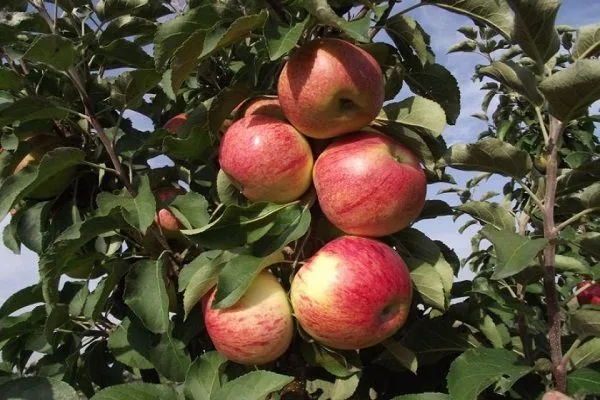
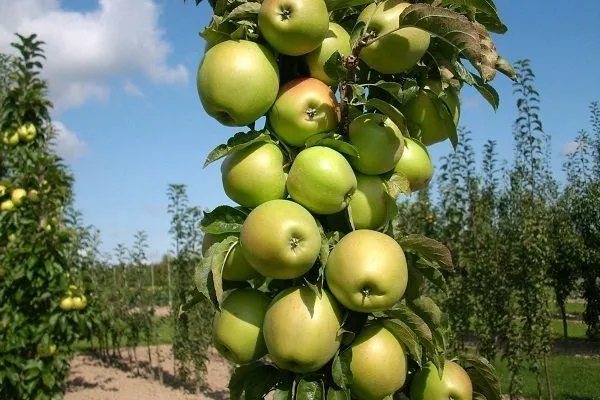
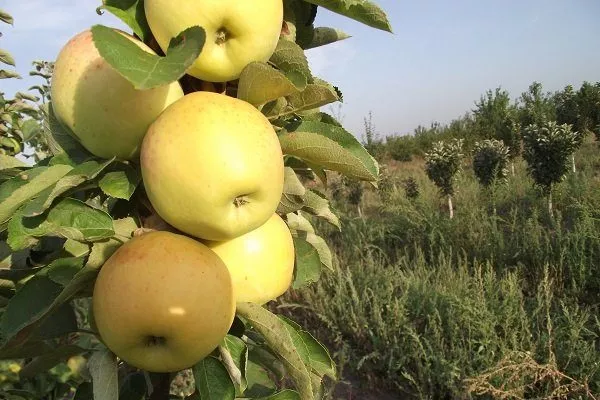
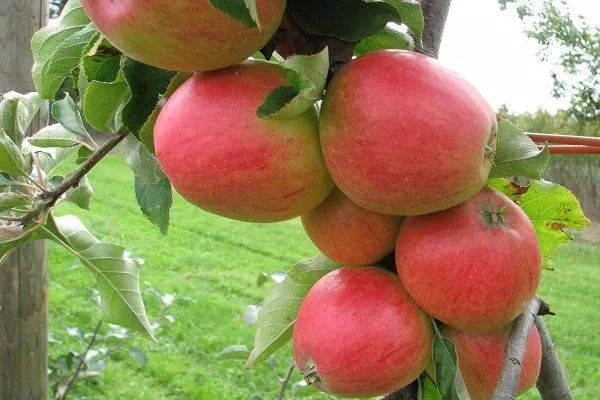
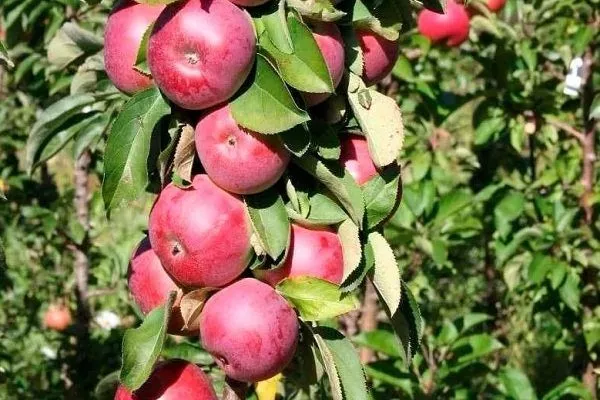
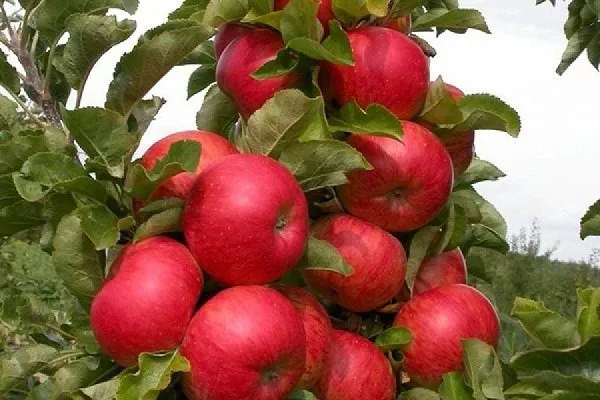
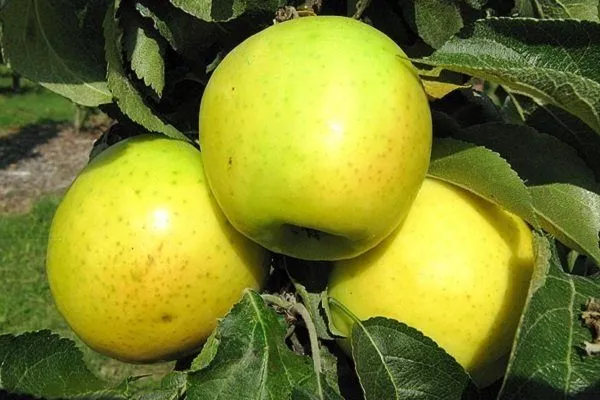
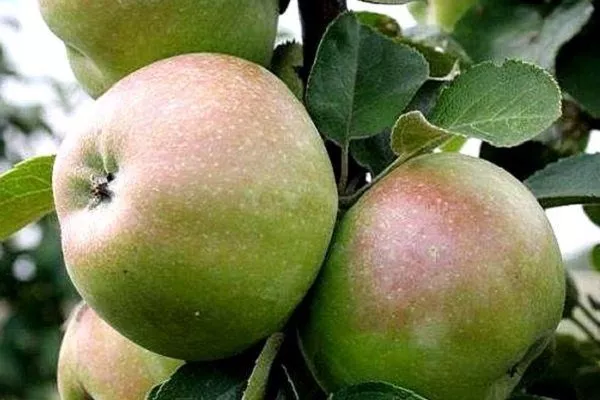
The most popular varieties of columnar apple trees include:
- Nectar. A popular summer variety. Its apples have a honeyed flavor. The flesh is juicy. The skin is yellowish-white. The fruits are delicious fresh, but are also suitable for preserves. They do not have a long shelf life. Each apple weighs 100-250 g.
The tree is semi-dwarf, reaching 2-2.5 m in height. It has extensive roots, tolerates frost well, and has a high immunity.

- Ostankino. This summer variety produces fruit that is slightly tart and sweet. The skin is yellow with a fading red blush. The flesh is white or with a greenish tint. Each apple weighs 100-230 g. It is a medium-sized variety. It has high resistance to scab and tolerates frost well.
- President. This semi-dwarf variety ripens in September. The apples are large, weighing from 150 to 300 g. The flesh is white, fragrant, and tender, and the skin is yellow or pale green. The fruit has a sweet and sour taste. It has moderate drought tolerance.
- Dialogue. A productive, medium-sized variety. Apples ripen in July, weighing 100-150 g. The fruits are light yellow, sweet and sour, with white flesh. The variety tolerates drought well and is resistant to frost, diseases, and pests.
- Arbat. Green-red apples ripen in September-October. Each fruit weighs 100-120 g. The skin has a glossy sheen. The flesh is light creamy with a sweet flavor and a slight tartness. This variety is frost-resistant and highly resistant to frost.
- Triumph. Medium-sized apple trees with small fruits weighing 100-140 g. The skin is greenish with a dark red blush. The shape is round and slightly ribbed. The flavor is dessert-like, with a slight tartness. The flesh is white and crunchy.
- Gin. A productive, self-fertile variety, resistant to frost and summer droughts. The harvest ripens in the fall. The fruits are red and spherical. The skin is red. The flavor is dessert-like, sweet and sour. Weight: up to 200 g. The apples can be stored until January.
- Baby. An autumn dwarf variety with excellent flavor. Conical-truncated shape. Weight: 150-200 g. The skin is firm, yellow, with a glossy finish. The flesh is creamy, sweet, and juicy. This variety is early-bearing, producing fruit in the second year of planting.
- Amber necklace. An early-ripening apple tree with uniform, rounded fruits. Each apple weighs approximately 130 g. The color is greenish-yellow with a pinkish blush. Requires a pollinator. Height is approximately 2 m. Frost-tolerant. Suitable for the Siberian climate.
- Bolero. A self-fertile, productive variety with greenish apples weighing up to 200 g. The skin has a red blush. The flavor is slightly tart. The variety is resistant to scab and other fungal infections.
- Moscow necklace. A self-sterile variety with round, greenish apples. A red blush appears as they ripen. Weight: 130-170 g. The flavor is dessert-like with a hint of tartness.
- Yesenia. A late-ripening, medium-sized hybrid with high immunity. The apples are beautiful, red with a bluish bloom, weighing 170 g. The variety is resistant to scab and low temperatures.
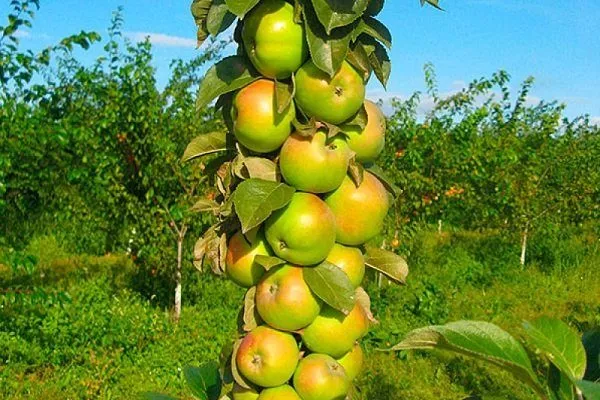
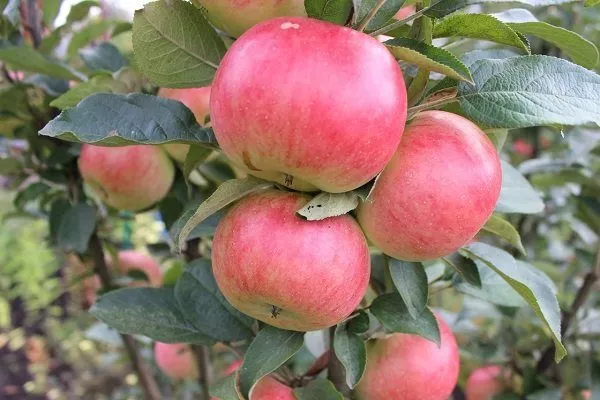
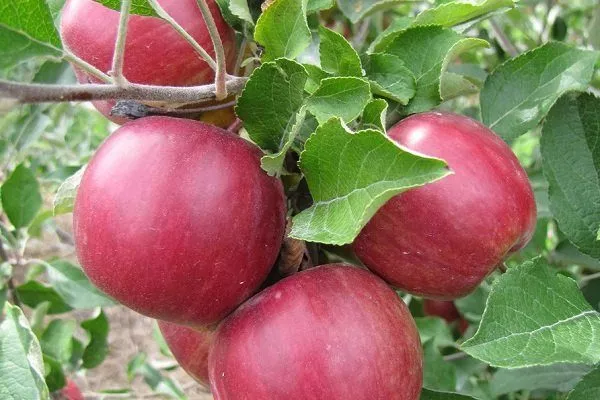
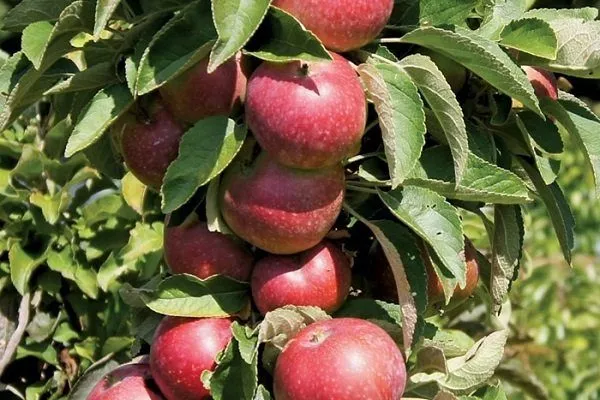
If you're short on space in your garden, plant a few columnar apple trees. But keep in mind that to get a decent harvest, you'll need to care for them regularly. Without watering, fertilizing, pruning, and spraying, you won't see quality apples.