
If apples are rotting on the tree in your orchard, immediate action is necessary. In most cases, this is a sign of a disease that rapidly spreads across all crops. Commonly known as fruit rot, it occurs when infected by various pathogenic microorganisms.
Apple fruit rot: causes
Fruit rot is more common in summer apple varieties, as they are particularly sensitive and delicate. For this reason, they don't store well for long periods.
Diseases that cause fruit rot include moniliosis, scab, chlorosis, and fly rot. The etiology is fungal. Fungi easily tolerate low temperatures and quickly become active after the onset of warm weather. Therefore, it is important to treat trees not only during the growing season but also in the fall.
Besides diseases, fruits spoil due to the following factors:
- impacts of hail particles on apples;
- bird pecking;
- damage by insect pests;
- prolonged rains;
- variety characteristic;
- weakened plant immunity;
- lack of preventive treatments and fertilization.
Fungi are spread by insects, water, wind, and when planting infected seedlings. Sometimes infection occurs through dirty tools. Bacteria are also transmitted by humans via shoes and hands. Dense plantings facilitate rapid dispersal of spores.
Signs of disease
Most often they provoke fruit rot diseasesIn this case, signs that are impossible to miss appear: changes in the structure of the skin and flesh, spots and blackening, and the formation of gray conidia. Each pathological condition has its own characteristic signs.
Scab
This disease is classified as dry rot, so it develops not only due to high humidity. It is caused by the fungus Venturia inaequalis, which attacks the entire tree, from flowers and leaves to fruits and bark.
Fungal spores overwinter in fallen leaves and apples, but during bud swelling and warmer temperatures (18–20°C), they migrate to the shoots. The pathogen's localization is on the underside of the leaf blade. If it rains, it penetrates the skin of the fruit.
After 15-20 days, the conidial stage occurs, characterized by secondary infection. After flowering, the fungus forms pseudothecia, which persist until the following spring.
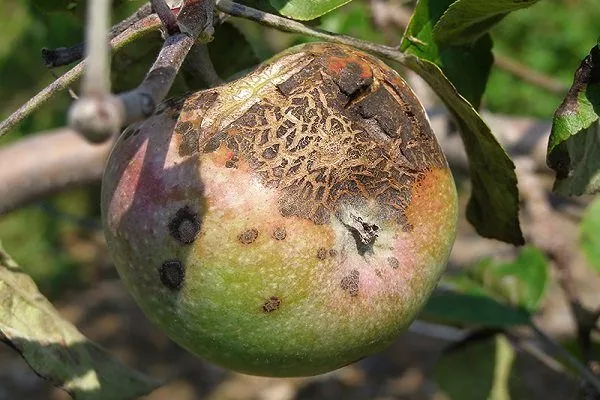
How does scab manifest itself during fruit formation:
- dry leaves, singly located along the crown;
- deformation of green mass and formation on it blackheads, this happens with apples too;
- unripe fruits are mummified and fall off before the harvest time;
- the skin of apples becomes covered with cracks, hardened seals, brownish-brown spots, and gray dots;
- the pulp of the fruit becomes dark and soft.
Moniliosis
The disease is caused by the Monilia fungus (Monilia fructigena and Monilia cinerea), a type of soft fruit rot. It manifests itself in two forms:
- first – in early spring, leaves and branches dry out due to burns (another name is monilial burn);
- second – fruits are affected starting from the period of their formation.
On apples, moniliosis appears gradually:
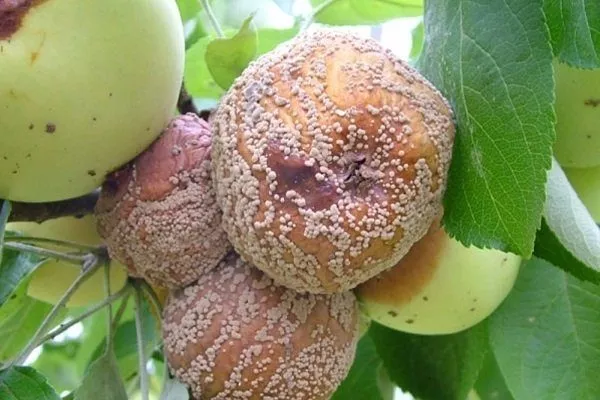
- At first, one small brown spot appears on the skin of the fruit, which quickly spreads over the entire surface;
- after this, grey dots form on it (these are the fungal spores);
- the pulp softens greatly and acquires a dark color;
- the smell of apples becomes sweet and sour;
- the fruits fall to the ground or turn black on the tree.
Chlorosis
The main cause of chlorosis is insufficient production of the pigment chlorophyll, which gives leaves their green color. This occurs due to a lack of minerals such as sulfur, nitrogen, manganese, zinc, iron, and magnesium.
There's also an infectious form, which develops as a result of infection by various viruses, fungi, and bacteria. In the former case, applying fertilizers containing the missing micronutrients is sufficient; in the latter case, treatment with fungicides is required.
The green mass is primarily affected. Signs:
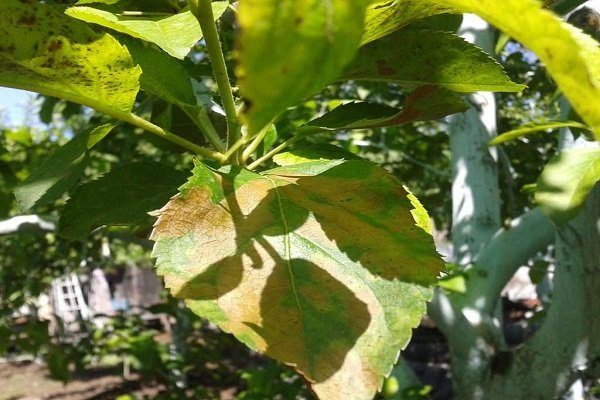
- the leaves turn pale, then yellow;
- dots of different dark shades appear on the surface;
- tissue necrosis – the edges around the perimeter die off;
- the veins remain green.
Clinical signs depend on the form of the disease:
- iron deficiency – leaves in the upper part of the shoots are affected;
- nitrogen deficiency – the lower part of the branches turns pale;
- potassium deficiency – lightening in the center of the shoot;
- deficiency of manganese and potassium – necrotic edges on the leaves and yellowing near the veins;
- Sulfur deficiency - general change in leaf color.
Fly Hedgehog
The cause is a fungus of the same name, the fly lice, which infects the fruit. This pathogen is considered harmless to humans, so affected apples can be eaten (preferably after heat treatment—as jam, compote, or preserves).
How it manifests itself:
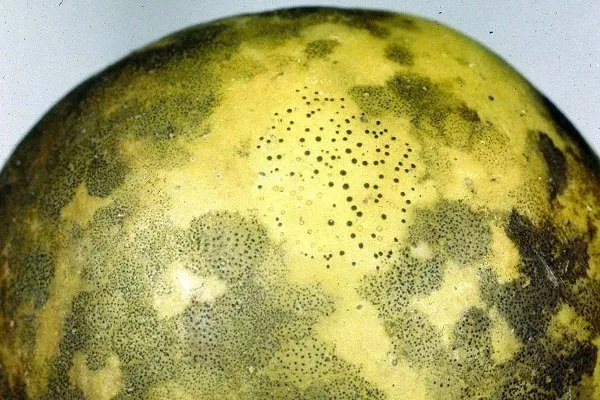
- at the initial stage, the surface of the fruit is covered with small black dots (like fly droppings);
- As the disease progresses, rotting begins.
Methods of combating diseases
The first step is to pick rotten apples and fruit that are just beginning to spoil. Then, measures are taken to further protect the trees and destroy fungi and pathogens. Special preparations and solutions, as well as traditional methods, are used for this purpose.
Store-bought remedies against infectious rot
To combat infectious fruit rot, chemical and biological preparations are used, which are sold in specialized stores.
What to use and how to prepare for spraying:
- colloidal sulfur - 100 g of substance per 10 liters of water;
- Bordeaux mixture 1% - for 10 liters of water take 100 g of copper sulfate, 130 g of freshly slaked lime;
- Tsiram in the form of a suspension - 50 g of dry product per 10 liters of water;
- Zineba - 100 g of substance per 1 liter of water;
- iron sulfate - 300 g of the preparation per 10 liters of water;
- fungicidal agents (Skor, Horus) - 2 ml of the first or 2 g of the second per 10 liters of water;
- other chemical and biological preparations that are diluted with water in accordance with specific instructions for use:
- Oxychom;
- Topsin-M;
- Strobe;
- Abiga Peak;
- Mikosan-V;
- Meters;
- Agricola;
- Phytoflavin;
- Ferovit;
- Vectra;
- Raek;
- Fludioxonil;
- Alirin-B;
- Sporobacterin;
- Rhizoplan.
It is necessary to carry out at least two treatments with a break of 14 days between procedures.
Folk remedies
Many gardeners prefer more natural methods. These products are used for spraying. The following recipes have proven to be the most effective:
- mustard solution – 40 g of dry product per 10 liters of water;
- salt mixture – 50 g of salt per 10 liters of water;
- pepper broth – boil 100 g of fresh red hot pepper and 200 g of onion peel in 1 liter of water for 5 minutes, strain, dilute with water to 10 liters;
- wormwood tincture – 400 g of dry grass per 8-9 liters of water, boil the mixture for 10-12 minutes.
Protective work
To protect your apple trees from further spread of diseases, do the following:
- pick all apples that show signs of fruit rot;
- collect fallen leaves under the tree and burn them;
- if leaves, branches and shoots are affected, remove them and burn them;
- carry out treatment with folk or chemical remedies.
Preventive measures
Novice gardeners often ignore the presence of rot diseases in the early stages of development. They mistakenly assume that foliar wilting is a consequence of recurrent frosts or overwintering. It's important to pay attention to the condition of the flowers, as the fungus most often becomes active during flowering.
To prevent chlorosis, scab, moniliosis, fly rot, and other diseases, follow preventative measures. What to do and when:
- In the spring. Treat the trees immediately after warm weather stabilizes, before blossoms begin to form. Use 3% Bordeaux mixture, copper sulfate, Oxychom, or Abiga-Peak according to the instructions. For one mature tree, 2-2.5 liters of solution is sufficient. For large apple trees, double the dosage.
- 3 days before flowering. Spray with Bordeaux mixture, but at a 1% concentration. If the solution is not available, use Fitolavin according to the instructions.
- 25-30 days before harvest. Spray the apple trees with Fitosporin-M (strictly according to the instructions). If you don't have it, make an iodine solution: 10 ml of the solution per 10 liters of water. After the first treatment, repeat the spraying after 3 days.
- In autumn after the leaves fall. This procedure will destroy various pathogenic microorganisms, preventing trees from becoming infected with fungi in the spring. Solution options:
- copper sulfate - 100 g of substance per 10 liters of water;
- urea - 70 g of mineral per 10 liters of water;
- ammonium nitrate - 1 kg per 10 liters of water.
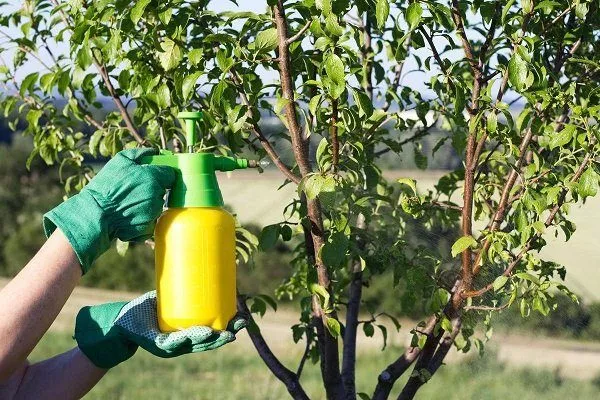
Besides tree treatment, there are other preventative measures that shouldn't be ignored. If you want a bountiful and healthy apple harvest, follow these recommendations:
- In autumn and spring, prune trees, removing old branches, broken and damaged shoots;
- shape the crown to prevent branches from becoming too dense;
- Cover the areas of breaks and cuts with garden resin or regular paint;
- Remove fallen leaves, weeds and other debris from under apple trees more often;
- treat the trunks with lime to a height of 60-90 cm;
- dig up the area around the trunk;
- in the fall, apply phosphorus-potassium mixtures;
- control the humidity level - do not allow over-watering, as this is the main cause of fruit rot;
- do not forget to take care of other types of garden crops, as fungal spores are carried from them by the wind;
- If you plant seedlings, maintain the distance between them as specified for the specific variety - dense trees promote the rapid spread of infection;
- If cracks, holes or other damage appear in any places on the bark, immediately treat them with garden pitch – spores leak through microcracks;
- do not leave fruit on apple trees in the fall;
- Disinfect tools for cutting and digging soil with antiseptics.
Experienced gardeners and specialists recommend that beginners plant apple varieties that are highly resistant to chlorosis, moniliosis, fly rot, and scab. These are most often hybrids, designated by the abbreviation F1. Scientists breed these varieties to achieve superior disease resistance.
- ✓ Antonovka: high resistance to scab, but requires additional protection against moniliosis.
- ✓ White Naliv: resistant to most fungal diseases, but sensitive to over-watering.
- ✓ Saffron Pepin: has complex resistance, but requires regular pruning to prevent thickening.
What are these varieties:
- Antonovka;
- White Filling;
- Pepin Saffron;
- Jubilee apple tree;
- Liberty;
- Welsey;
- Parmen;
- Slav.
What to do with rotten fruits?
Apples affected by fruit rot are strictly prohibited for consumption. It can cause poisoning and infectious diseases in humans. The exception is the fly rot.
Fruit should not be left in the garden plot, as this will promote the further spread of fungal spores. This will eventually infect the entire garden, even the vegetable plot.
Disposal features:
- Rotten fruits are burned, but fresh ones have a wet texture and will burn for a long time;
- Affected apples are taken far beyond the garden and buried to a depth of at least 0.5-0.7 m (this is important because rotten elements left on the surface will destroy trees growing in the wild).
Another way to benefit apples with fruit rot is by turning them into organic fertilizer. It will be rich in vitamins and microelements for plants and soil. As microorganisms multiply in the nutrient medium, the soil becomes enriched with humus, increasing the fertile soil layer and making the soil structure looser and lighter.
Fertilizer production options:
- In the compost pit. Dig a hole, fill it with various organic waste, and add rotten apples. Create a wooden fence around the pile with gaps for proper aeration (ventilation kills putrefactive fungi and promotes the development of aerobic, beneficial fungi).
Loosen the mixture every 3-4 days, and add biological fertilizer to speed up the fermentation process. Composting time is 2 to 3 months. Cut the apples into pieces with a shovel. - Liquid apple fertilizer. Place the crushed apples in a large barrel (halfway full) and fill it to the very top with warm water. This will initiate fermentation. Cover with a lid, leaving 15-20 cm of air space. Place the container in the sun.
15 days are enough for fermentation, after which use the mixture as liquid manure (be sure to dilute it with water 1:1).
Fruit rot creates many problems for gardeners—it attacks all healthy trees, completely destroying the harvest. Therefore, it's important to combat the disease promptly. To prevent this, don't forget about preventative tree treatments and general preventative measures.