
Felt cherry trees planted in a garden can become diseased. The fruit tree is often susceptible to dangerous diseases that can lead to crop loss or even the death of the tree. Therefore, it's important to know preventative and control measures to ensure you get good, tasty berries and avoid further problems.
Scab
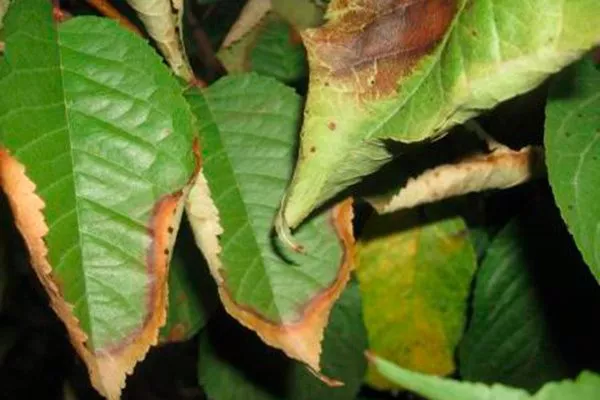
The disease manifests itself as spots on the foliage. These spots have a characteristic brown tint. As the disease progresses, the leaves begin to dry out and curl, eventually leading to their complete destruction.
Cherry scab negatively affects cherry fruits, causing them to fail to develop and then dry out completely. Ripe berries lose their flavor.
For prevention:
- Make sure to carry out formative and sanitary pruning in a timely manner.
- Dispose of fallen leaves by burning.
- Provide care for the tree's trunk area. Dig the soil in spring and fall, and water the tree with a urea solution or 1% Bordeaux mixture in the fall.
- Whitewash the trunk and branches.
- ✓ The concentration of the solution must strictly correspond to 1% to avoid leaf burns.
- ✓ The temperature of the water used to prepare the solution should not exceed 50°C, so as not to reduce the effectiveness of the drug.
How to fight scab:
- Immediately remove affected shoots and pick dried fruits. Burn them.
- Treat the cherry tree with 1% Bordeaux mixture three times: during bud swelling, three weeks after flowering, and after harvesting.
- If the disease appears on ripe berries, use table salt for treatment - 1 kg per 10 liters of water.
Be sure to whitewash the tree and treat the trunk circle using 1% Bordeaux mixture.
Pocket disease
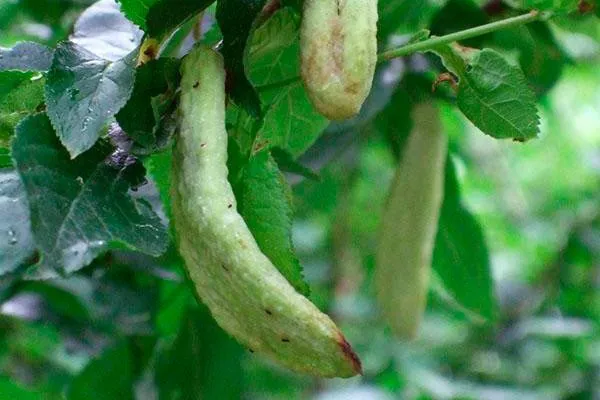
A fungal disease that causes seedless fruits to appear on the tree. These fruit take the form of elongated, soft pockets. These pockets harbor harmful spores and become new sources of infection. Under the influence of the spores, the leaves begin to curl.
Preventive measures:
- Choose the right place for planting - dry and well-lit.
- Perform formative and sanitary pruning.
- When the first signs of disease appear on branches, leaves and ovaries, remove them.
- Burn fallen leaves.
- Loosen the soil around the tree trunk and remove weeds in a timely manner.
Ways to combat pocket disease:
- In March, treat the felt cherry with a 1% copper sulfate solution. You can also use 3% Bordeaux mixture. Perform three treatments, 5 days apart.
- To combat the disease, use fungicides, such as OxyHOM, Skor, Topaz, etc., according to the instructions.
- In the fall, after the growing season, carry out preventative pruning, removing weak, damaged and dry branches.
- ✓ Fungicide treatment should be carried out in dry, windless weather to avoid washing off the product and ensure its maximum absorption.
- ✓ The air temperature during treatment should be between +12°C and +25°C for most fungicides.
After pruning, treat the tree with a solution of copper sulfate or Bordeaux mixture.
Anthracnose (bitter rot)
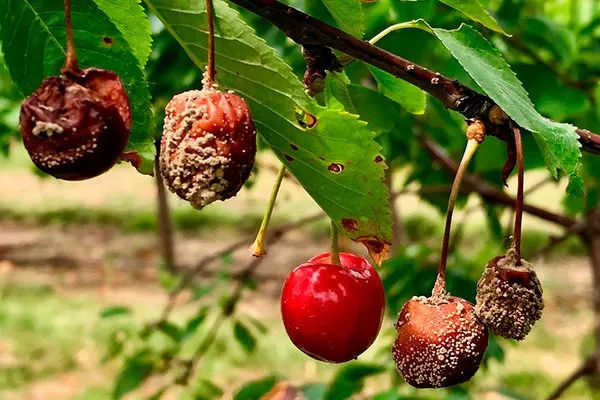
A fungal disease that attacks the fruit. Slightly sunken, round, dark spots appear on the fruit. Pinkish pads then form on the surface—this is the fungus's sporulation. If the fruit is already ripe, it becomes bitter and falls off.
During the fruit set stage, the cherries become hard, shrivel, dry out, and remain hanging on the bush. The disease also spreads to the tree's bark, which turns brown, cracks, and dies. The fungus overwinters in the affected fruit. If the cherries are not removed, the mycelium begins sporulating again in the spring.
Prevention and control measures:
- In early spring, perform sanitary pruning – a thinned crown ensures better ventilation and allows the tree to dry out quickly after rain. Fungal spores are killed more quickly by sunlight.
- After pruning, apply 1% Bordeaux mixture. Apply to dormant buds, and after 7 days, apply lime milk (2 kg of lime per 10 liters of water).
- Add wood ash to the tree trunk circle, and after a while, mulch it with manure.
- Fertilize the tree at least three times during the growing season. Use nitrogen fertilizers (urea, ammonium nitrate, ammonium sulfate, etc.) in early spring, and potassium-phosphorus fertilizers after flowering and in late summer.
After harvesting, spray the tree with a copper sulfate solution (100 g per 10 liters of water). After the leaves fall, collect the fallen leaves and treat the felt cherry and the area around the trunk with a urea solution (500 g per 10 liters of water).
Moniliosis
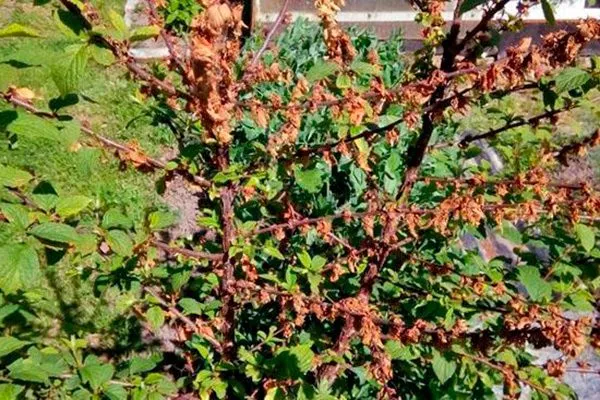
Inspect the plant every two weeks to prevent the spread of the disease, as it can infect neighboring trees. Moniliosis manifests itself as cracks in the bark, from which gum oozes.
After a while, leaves, flowers, and branches begin to dry out. Bald spots appear on the plant, resembling chemical or thermal burns. This disease can kill the fruit plant.
The following steps will help get rid of the disease when only the tops of the shoots are affected:
- Trim them, including healthy tissue up to 15 cm long.
- Spray the tree crown down to the base of the trunk with Abiga-Peak. Repeat treatment four times, 10 days apart.
- 20 days after the last treatment, use Planrizom – it has a protective and growth-stimulating effect and is safe for humans and the environment.
- In the spring of the following year, treat the trees with the same preparation at the budding stage.
If the disease spreads rapidly and affects skeletal branches, follow these recommendations:
- Carry out pruning, capturing healthy tissue.
- Spray the plant with Horus fungicide several times with a 10-day interval.
- In the spring of the following year, treat the fruit tree with one of the following products: Planriz, Fitolavin, or Gamair. Repeat the treatment three times: before flowering, during bud formation, and after fruit set.
Wilt
This is a dangerous fungal disease. The pathogens live in the soil, from where they penetrate the cherry tree roots. Gradually, the mycelium reaches the tips of the shoots, disrupting sap flow. The first signs of the disease are yellow leaves with reduced turgor.
The disease begins at the base of the crown and gradually spreads throughout the plant. The foliage first turns yellow, then takes on a red tint, and eventually falls off. Sometimes, the disease affects the tree unilaterally: one part wilts, while the other remains green.
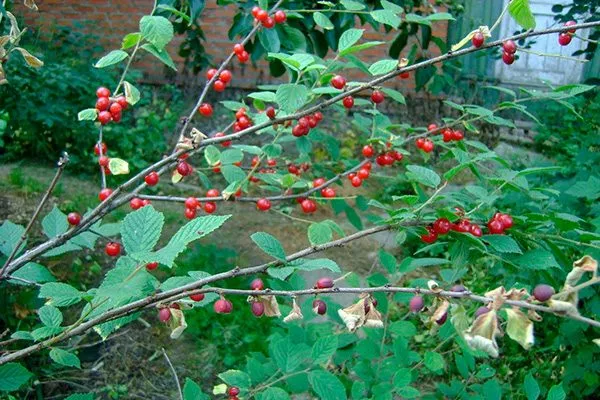
At an early stage, you can try introducing fungicides into the soil:
- Previcur;
- Vitaros;
- Benlat;
- Fundazol;
- Topsin-M.
Once the mycelium has appeared and taken over everything, there's nothing you can do to help the tree. There are no treatments for wilt. Remove the diseased plant and surrounding soil from the area and burn it.
Coccomycosis
The disease is easy to identify: small reddish-brown spots appear on the outer surface of the leaves. The disease typically affects plants from late May to early June. In severe cases of coccomycosis, brown spots appear on berry stalks and young shoots.
By midsummer, the spots expand, and light pink or light gray spore deposits appear on the undersides of the leaves. In mid- to late August, these leaves turn yellow, curl, and eventually fall off. The berries become covered with brown spots, and the flesh becomes watery.
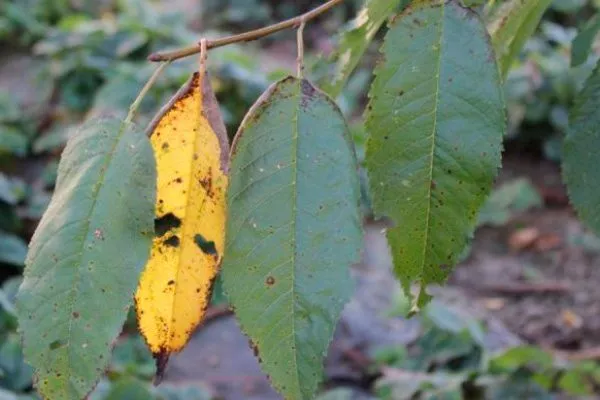
Disease prevention measures:
- Take care of your garden: in the fall, collect fallen leaves and all debris from the area and burn it.
- Perform formative and sanitary pruning.
- In early spring or mid-October, dig up the soil in the area, including the tree trunks.
- Whitewash the trunk and skeletal branches regularly. Whitewash on a dry day. To do this, prepare a solution of 2 kg of slaked lime, 300 g of copper sulfate, and 10 liters of water. Apply the whitewash in a 2-3 mm layer.
Methods of combating coccomycosis:
- In the spring, when the buds are swelling, treat the tree and the area around the trunk with Bordeaux mixture. You can also use Hom (dilute 40 g of powder in 10 liters of warm water).
- During the period of bud formation, spray the plant with Horus (2-3 g per 10 l of water).
- 14-20 days after flowering ends, apply Skor (1 ampoule per 10 liters of water). Remove affected branches before treatment.
- At the end of August, treat the felt cherry with Bordeaux mixture.
Be sure to whitewash the trunk and skeletal branches or treat the fruit tree and the trunk circle with a urea solution.
Clusterosporiasis
A fungal disease often called "shot hole." The fungus lives in diseased plant debris and wood. The mycelium produces spores that are dispersed by rain, wind, and even insects.
Clasterosporium leaf spot affects young leaves, initially appearing covered with small reddish, crimson, or purple spots. After a few days, the leaves become larger in diameter, and holes with a red border appear on the leaves.
In severe cases, the bark of young shoots becomes covered with small, round, red or red-orange spots. Cankers form on the fruit, and the damaged areas develop gum. Flowers fall off, and the buds turn dark.
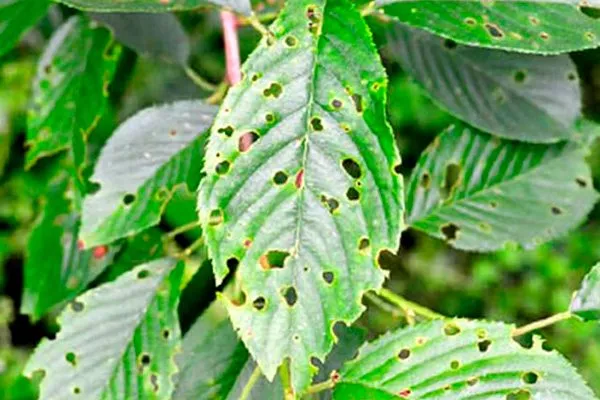
How to combat clasterosporium:
- When pruning in spring, remove all affected parts of the tree.
- Treat the cherry tree three times with a 1% solution of Bordeaux mixture or Abiga-Peak, Indigo: before bud break, immediately after, and 2 weeks after the second treatment.
- Don't just remove all affected shoots from the area, but burn them – they remain a source of infection.
To prevent cherry clasterosporium, water, dig, and mulch the area around the trunk regularly, as well as perform sanitary pruning. Don't forget to fertilize.
Rust
If the summer weather is hot and humid, the leaves of the felt cherry can become infected with rust. Reddish spots appear on the foliage, surrounded by a yellow border resembling rust. The damage is especially noticeable on the outer surface of the leaf.
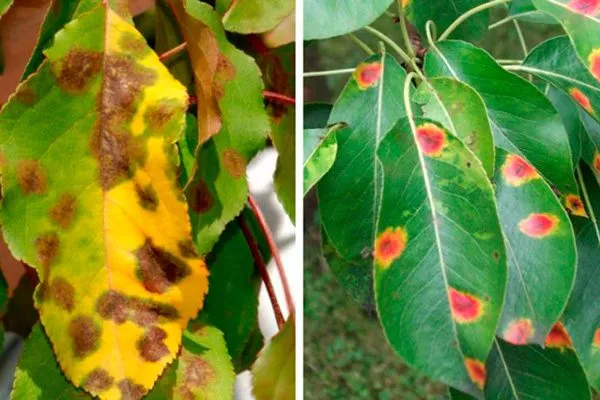
For prevention:
- Use copper-containing products. Gardeners recommend the fungicide Hom (80 g per 10 liters of water).
- Remove diseased leaves and branches from the tree in a timely manner.
- Remove coniferous trees from the area that are in contact with the cherry trees.
How to cure cherry tree rust:
- Remove and burn affected leaves.
- After the tree has blossomed, treat it with one of the following preparations: Skor, Horus, Hom.
- After harvesting the fruit, treat the plant with a 1% solution of Bordeaux mixture.
Coniferous plants should not be placed near the cherry tree, as they are the cause of the spread of rust.
Bacteriosis
If signs of bacteriosis (bacterial cancer) are detected, begin treatment immediately, as the fruit tree, especially at a young age, can die within a few seasons.
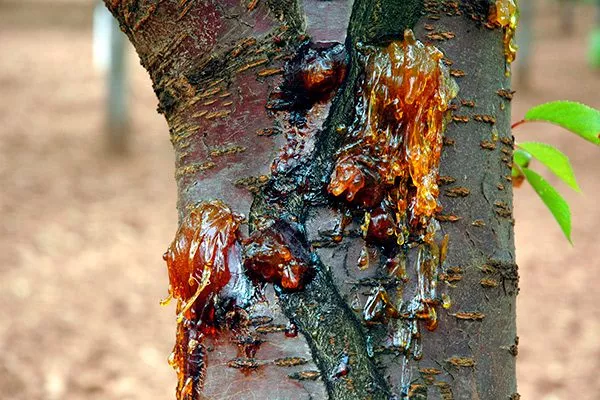
Signs of bacteriosis:
- flowers acquire a brown tint;
- the leaves become covered with yellowing watery spots, which turn brown over time;
- Over time, dead leaf tissue falls out, causing holes to form;
- the shoots are covered with a thick orange liquid;
- cracks, growths and blisters form on the bark;
- Dark spots appear on the fruits, causing them to rot.
For prevention:
- Take care of standard care measures: crown shaping, regular sanitary pruning, cleaning and burning fallen leaves.
- Take care of the tree trunk area: dig it up in spring and autumn, disinfect with a 1% solution of Bordeaux mixture or urea.
- In spring and autumn, whitewash all the trees on the site.
- When pruning felt cherry, use only disinfected tools.
Fighting bacterial cancer:
- Remove affected branches. Cut the diseased area back to healthy tissue, cutting back 4-5 cm. Treat the cut areas with 1% Bordeaux mixture or 5% carbolic acid solution.
It is acceptable to use garden pitch, oil paint, or a mixture of clay and fresh mullein. - After pruning, apply fertilizer. To do this, add 350 g of superphosphate solution, 250 g of potassium nitrate, and 350 g of chicken manure to the trunk circle. To prepare, soak the manure in 10 liters of water for 6 days, and mineral fertilizer in the same amount of water for 2 days. Mix both solutions and fertilize the cherry tree.
- In spring before the buds swell and in autumn during and after leaf fall, treat the tree with 1% Bordeaux mixture or Hom (80 g per 10 l of water).
- 5 days after spraying, whitewash the tree and treat the trunk circle.
If you've neglected the disease and the plant is no longer treatable, uproot it and water the area generously with a potassium permanganate solution (50 g per 10 liters of water). Do not plant anything else in this area for 3-4 years.
Gummosis
The main symptom of gummosis is the secretion of a thick, yellow-brown substance. It oozes from wounds and cracks in the bark. The gum secretion usually causes the plant to weaken. If the secretion appears on a branch, be prepared for its rapid death.
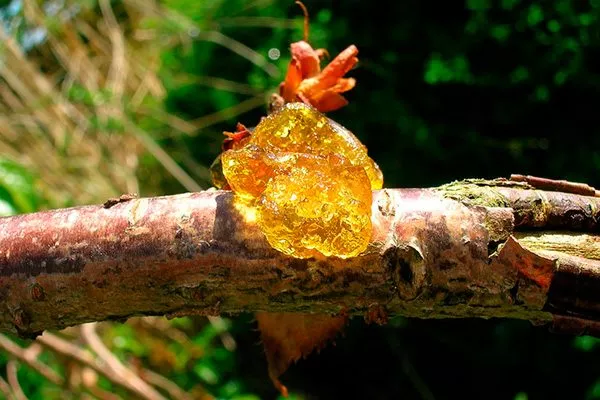
There are several reasons for infection with gummosis:
- untimely or excessive pruning;
- mechanical damage to the trunk or branches;
- frosts and sharp temperature fluctuations in the spring-autumn period;
- excessive yield.
For prevention:
- Make sure that the tree is not exposed to mechanical damage to the bark, for example, during pruning or cleaning.
- Whitewash the plant to protect the trunk and skeletal branches.
- Carry out formative and sanitary pruning in a timely manner.
- In the spring before bud break and in the fall after leaf fall, treat the trunk with a 1% solution of copper sulfate.
Treat cherry trees for gummosis from mid-April to early May, but after the sap flow has stopped. Clean the wounds with a sharp knife until healthy tissue is visible, then rinse with a 1% copper sulfate solution and seal with garden pitch.
Felt cherry is prone to various diseases. With proper care and timely treatment, you can overcome any of them. Follow all recommendations to ensure the fruit tree remains healthy and its yields don't decline.