
Felt cherry, a distant relative of the wild variety, is a perennial highly prized by gardeners. It is grown in various parts of the world. Its main advantage is its excellent tasting qualities. Growing it is simple, but there are some nuances.
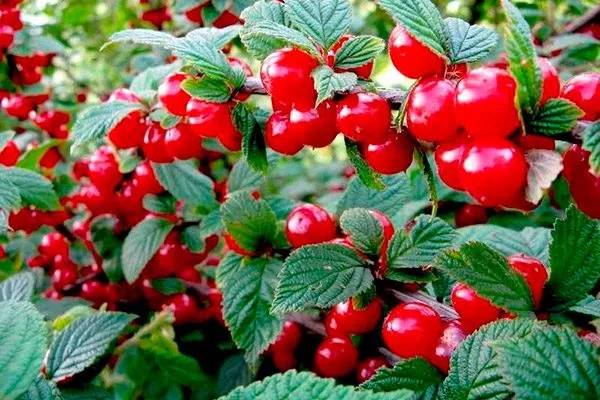
Features of culture
Felt cherry has several synonyms: Chinese, dwarf, mountain, Korean, Manchurian, Shanghai, and Nanjing. These aren't the only distinctive features. A number of others can be identified:
- Early fruiting. The first berries appear on the bush in early summer, while other crops are just beginning to form ovaries.
- The taste is significantly different. The fruits are sweet, with almost no sourness.
- This dwarf shrub can be a beautiful addition to any garden. It makes an attractive hedge.
- The trees have high adaptability. They quickly adapt to cold conditions and are resistant to drought and frost.
- Root shoots do not form.
- The height of the stems is optimal for easy harvesting.
- The branches tend to droop towards the ground due to the large number of fruits that do not fall for a long time.
- Felt cherry is often confused with steppe cherry.
- ✓ The soil must be well drained to avoid waterlogging, which leads to root rot.
- ✓ For planting, choose sunny locations protected from strong winds to ensure optimal conditions for growth and fruiting.
Plant characteristics
Felt cherry is a perennial shrub growing up to 3 m tall. Its crown is oval. The branches are large, skeletal, and covered with brown bark. Flowering occurs in late May. The flowers are initially pink, turning white toward the end of the blooming period.
The plant gets its name from the pubescence on its annual shoots. This pubescence persists on the underside of the leaves, which are small and gray-green in color. The leaf blades are wrinkled in texture, oval, tapering toward the apex, and have serrated edges.
Other features:
- Fruiting begins in the second year of life for grafted specimens and in the 3rd-4th year for species obtained by seed.
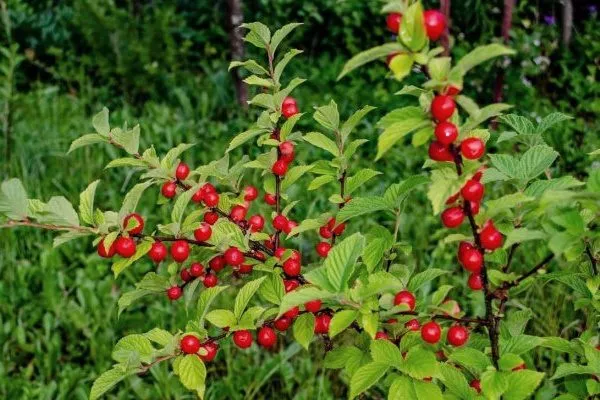
- Cherries have a vibrant aroma. The flesh is juicy. The berries are small, up to 1.5 cm in diameter. They are usually red in color, but there are varieties with pinkish, white, or black hues.
- Yields are high—up to 7 kg per bush. Maximum fruiting occurs in the eighth year of growth. At this point, the perennial yields approximately 20 kg of berries per season.
Growing area
The felt cherry tree's natural habitat is China. Many specimens are found in Tibet, Mongolia, the Korean Peninsula, and parts of India.
The plant was first mentioned in our country by breeder N. N. Tikhonov. He discovered the variety in the southern part of the Far East. I. V. Michurin began to spread the plant. Thanks to his efforts, the perennial began to be grown in the Central Russian region, Ukraine, and throughout the North Caucasus.
Planting is also possible in the northwestern regions and the Leningrad region. However, not every variety is suitable. Recurrent frosts often kill the plantings. Hybrids such as Skazka, Natalie, Vostorg, and Vostochnaya have been developed for the Urals.
- ✓ For regions with cold winters, choose varieties with high frost resistance, such as 'Skazka' or 'Natalie'.
- ✓ Pay attention to the pollination type of the variety to ensure a good harvest.
Types
There are many varieties of felt cherry. They are divided into two categories: self-fertile and self-sterile. It's difficult to distinguish them by appearance. The species is determined by yield.
| Name | Pollination type | Productivity | Frost resistance |
|---|---|---|---|
| Self-fertile | Self-pollination | High | High |
| Self-sterile | Requires pollinators | Average | High |
Self-fertile
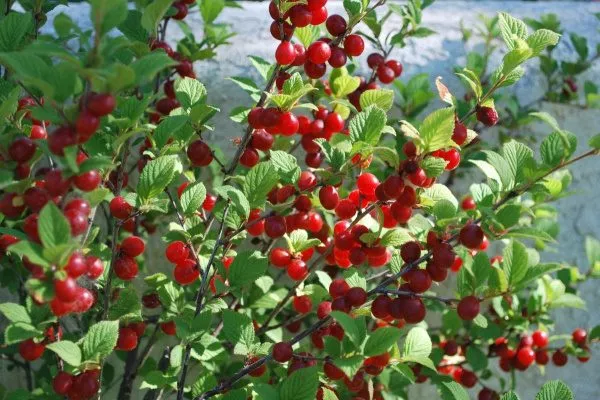
Self-fertile felt cherry trees don't require pollinators. They are capable of producing good fruit on their own. Pollination occurs from flowers of the same tree. This type of plant is the most prized due to its high fruit production. The plant produces 50% of its total flowers as berries. By comparison, self-sterile specimens produce only 10%.
Self-sterile
The vast majority of felt cherry varieties are self-sterile, meaning they require pollinators. To encourage fruit formation, it's recommended to plant 2-3 plants of other varieties in the same area. The ideal arrangement is a triangle, with 2 meters between plants. Common and steppe cherries make good companions.
Growing felt cherries
Growing felt cherry is not difficult if you know a few things. If rooted correctly, the plant will provide a bountiful harvest for 8-12 years.
Conditions
The Chinese fruit bush is a sun-loving plant and does not bear fruit well in the shade. However, it is drought-tolerant.
What else should you consider when choosing a location for a cherry tree:
- A site protected from the wind is needed.
- Partial shade is suitable for the plant. You can place the tree near the cherry plum at a distance of 2 m.
- If the purpose of planting is to decorate the garden, then the location does not matter, but some varieties may die if grown in lowlands.
- The ideal soil is calcareous and neutral. Peaty, heavy, or clayey soils will stunt growth and significantly reduce frost resistance. Prepare the substrate at least one year before planting.
- Felt cherry can grow in one place for no more than 12 years. After that, replanting is required.
- The plant is sensitive to excess moisture. Therefore, avoid planting the seedling in low-lying areas, areas with high groundwater levels, or areas experiencing heavy snowmelt.
- It is not recommended to plant other stone fruit crops near cherries. Similar plants share common diseases.
- The dwarf perennial performs best on slopes or near the walls of buildings, where little snow accumulates in winter.
Landing
Plant felt cherry trees in the spring, before the buds open. It's also possible to begin planting in the fall, in September. Otherwise, the shrub won't take root. Cuttings can be overwintered in a cool basement.
In this case, place them in a container so that the root system is submerged in the soil. To improve the plant's adaptability, choose two-year-old planting material.
Landing algorithm:
- Dig a hole. The depth and diameter are about 50 cm.
- Add 3 kg of mullein, 0.7 kg of dolomite flour, 0.05 kg of superphosphate, 0.025 kg of potassium sulfate.
- Add plenty of water. A mixture of soil and fertilizer should form in the hole.
- Inspect the seedling. Trim the roots to 20 cm. This will encourage more lateral root growth.
- Drive a stake into the center of the hole to support the plant.
- Form a mound of earth at the bottom.
- Place the tree in the hole so that the root collar is level with the soil surface.

- Tie the stem to the support.
- Spread out the root shoots, fill with soil, and compact the mixture. There should be no air pockets.
- Pour in 10 liters of water.
- After the moisture has been absorbed, mulch the trunk circle with sawdust or peat.
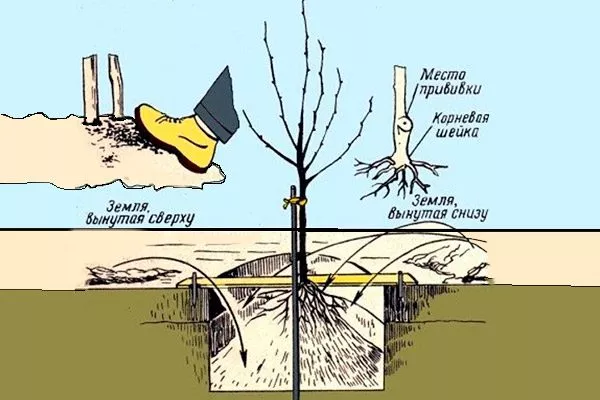
The distance between fruit crops is about 2 m, regardless of variety.
Care
Felt cherry is demanding during its first few years of growth. Pay particular attention to care. Here's what to do:
- Remove weedsUnwanted vegetation takes away nutrients and moisture from the perennial.
- Loosen the soil. This is necessary for aeration. This will ensure air and water reach all parts of the root system.
- Moisten the soilWater the planting only during dry periods. Make sure the water doesn't stagnate around the trunk; it should be absorbed immediately. It's best to apply the liquid in small amounts. Young trees (those in their first year of planting) require regular watering.
The norm is 10 liters per bush once a week, but provided there is no rain.
Top dressing
Felt cherry, like other fruit crops, requires fertilization. However, be careful when applying fertilizer. Excessive amounts are harmful. Enrich the plant with beneficial micronutrients no more than once a year. Apply in the spring after flowering. The recommended rate per square meter is:
- 7 kg of decomposed humus or compost;
- 60 g superphosphate;
- 15 potassium salt;
- 20 g of nitrogen composition.
Distribute all formulas evenly over the entire surface of the soil under the crown and lightly incorporate them into the soil layers by gently loosening them.
Felt cherry grafting
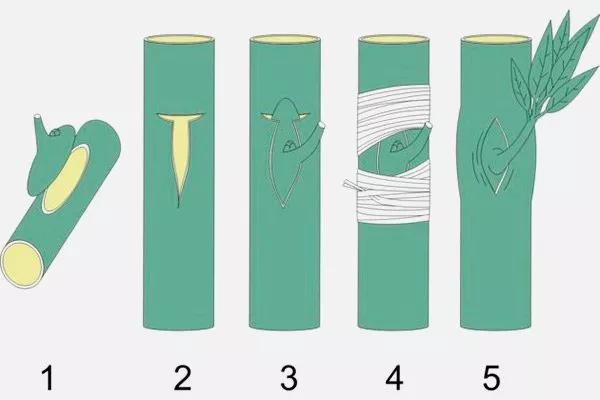
Budding is the simplest method of grafting felt cherry. This procedure is necessary not only to create a new bush but also to improve the characteristics of an existing plant.
Procedure:
- Select a healthy seedling. This will be the future rootstock.
- In the southern part of the bush's crown, identify a well-developed shoot from this year's growth. Carefully cut it off with a sharp, disinfected knife. Place it in a container of water.
- Take the cutting to the rootstock plant. From the second one, cut off the corymb—a bud with a portion of bark. Remove the leaf from the bud, leaving only the petiole.
- Make a T-shaped cut in the wood of the rootstock trunk.
- Insert the scion's scion into the cut in the rootstock's bark and wrap it tightly with elastic bandage. The bud remains exposed.
By the end of summer, the grafted bud will have adapted. Don't remove the adhesive tape until spring.
Reproduction of felt cherry
There are several ways to propagate felt cherry in your garden. Make your choice based not only on ease of use but also on the specifics of the method.
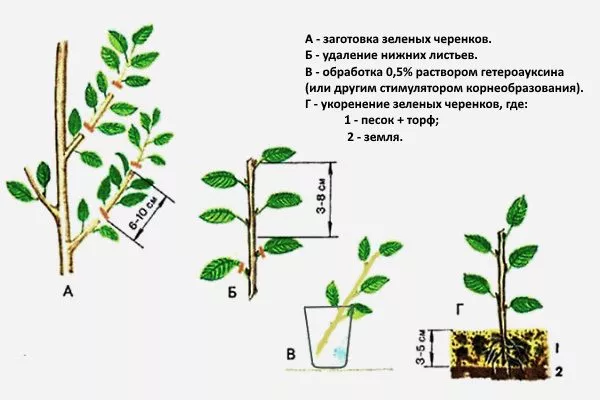
Green cuttings
This variation is suitable for all varieties of dwarf plants. Gardeners note the simplicity and speed of the procedure as one of its advantages. The only drawback is the high risk of root collar rot after winter.
How to conduct:
- Select a healthy second- or third-order shoot. Form cuttings. Make the top cut straight and the bottom cut diagonally. The length of one cutting should be up to 20 cm. Make sure there are four internodes on the branch.
- Remove the lower leaves.
- Place the planting material in a solution of Kornevin (1 g per 1 liter of water) for 2 hours.
- Plant the cutting in a box filled with fertile soil, deepening it by 3 cm.
- Water the planting and cover with plastic wrap. The soil should always be moist until roots form.
- After a month, you can transfer the felt cherry to open ground.
Seeds
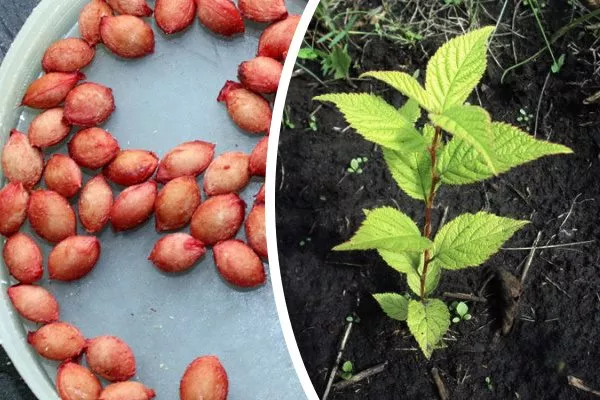
The main advantage of this propagation method is the wide range of opportunities to produce plants with distinctive characteristics. In this case, preserving varietal traits is very difficult. Another disadvantage of this variation is that the cherry tree only begins to bear fruit in its fourth year of growth.
How to propagate by seeds:
- Wash the seeds of ripe berries under running water and dry them in a dark place.
- In September, place the seeds in a container with sawdust or sand. Place the container in a cool place and water the planting periodically.
- In October, transplant the seedlings into open ground. Make a 3-cm-deep furrow, spacing the seeds 2 cm apart. Fill the hole with soil.
- In spring, select the healthiest specimens and replant.
Layering
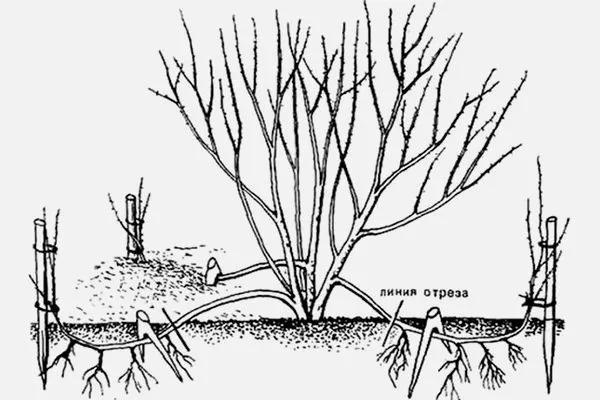
Propagation by layering is not difficult. However, there are many points a gardener should be aware of when choosing this method.
Advantages:
- varietal characteristics are fully preserved;
- several shoots can be taken from one bush at once;
- Even a beginner can handle the work.
Flaws:
- the mother plant spends energy on feeding the offspring, which means the yield decreases;
- There is a high risk of damaging the tree when separating the seedling.
Progress of work:
- In spring, select a developed lower shoot.
- Dig a small ditch underneath it.
- Bend the branches down into the hole you've created. Secure them in place with garden staples. Cover with soil.
- Tie the part of the stem that remains above the ground to any vertical support.
- Inspect the bush in the fall. Assess how well the root system of the layering has developed. If the shoots are healthy and strong, transplant the future cherry tree to a separate location. In some cases, it makes sense to leave the layering until spring.
Trimming
Felt cherry requires crown shaping more than other fruit trees. Sanitary pruning is also essential. Otherwise, lateral branches block airflow into the foliage, resulting in incomplete pollination.
Remove plant parts in the spring, before buds open and sap begins to flow. Shaping is required from the first year of growth. After 2-3 seasons, a balanced, strong crown will emerge.
What to cut:
- lateral shoots directed inward;
- weak, dry, deformed branches with traces of pests;
- old parts that do not take part in fruiting and do not have annual growth.
Prune a mature specimen until no more than 12 strong stems remain. If the plant has been growing for more than 8-10 years, a radical pruning of the bush's components is required – gradually prune out old skeletal branches.
If you weren't able to carry out the work in the spring, you can postpone it until the fall. However, in this case, pay attention to new growth. Warm weather encourages the formation of new shoots that won't survive the winter. Therefore, it's best to prune back one-year-old branches longer than 60 cm by a third.
Problems with felt cherry and what to do about them?
Not all gardeners succeed in growing tasty and abundant felt cherries. The crop has its own unique challenges, which can be difficult to resolve.
What you may encounter:
| Description of the problem | Causes of occurrence | Solutions |
| Flowering is not observed | Buds form on plants in their third year and beyond. If a five-year-old bush doesn't bloom, it means:
| Before you begin troubleshooting, determine the cause. What can you do next?
The only thing you can't fight is thaws. They are detrimental to the felt cherry. |
| There are buds, but no harvest | The cause is usually a lack of pollinators. It's also possible that the flowers were damaged by frost. Their appearance won't change (if the frost was light), but the center will be damaged, and there will be no fruit. | Plant different varieties of cherry trees near the dwarf perennial. If good pollinators are available, protect the tree from freezing temperatures. Cover the tree with a non-woven covering material, pressing the edges firmly to the ground. Remove the "blanket" during the day. |
| Immediately after flowering, the leaves turn yellow, dry out, and appear burnt. | This is a dangerous disease - moniliosis, caused by fungi. | Cut out the affected parts, leaving 2 cm of healthy tissue. Burn them. In the spring, treat the plant twice with any copper-containing fungicide: before flowering and immediately after. |
| The berries rot and become covered with a grey coating. | This is gray fruit rot. | Collect and destroy any damaged fruit. If the infestation is widespread, cut out all diseased branches and burn them. In the spring, before and immediately after flowering, spray with any copper-containing fungicide. |
| The cherries are green and look like pods. | fungal disease - Taphrina deformans (plum pockets) | |
| The leaves are gnawed | This is the result of the caterpillars of harmful butterflies. | Remove the pests by hand. If there are excessive numbers, treat the plant with pyrethroid insecticides in the fall after harvest. |
| The leaves are curled and covered with small sucking insects. | aphid |
Reviews
Felt cherry is a fruiting shrub no more than 3 meters tall. It can be grown in any region of Russia. It is easy to care for but requires specific growing conditions. There are several varieties: self-fertile and self-sterile. This variety can be propagated in various ways.