
The Skazka cherry belongs to the felt variety and is suitable for cultivation in all regions of our country. It is versatile but has poor transportability. Its fruits ripen evenly, so the fruiting period is not considered prolonged. It is characterized by good winter hardiness and resistance to fungal diseases.
History of selection
The variety was developed at the Far Eastern Experimental Station of the All-Russian Research Institute of Crops. Breeding began in 1986, but it wasn't until 1999 that Skazka was added to the Russian State Register.
Several breeders worked on the development: Vera Petrovna Tsarenko and Natalia Albertovna Tsarenko. The Leto cherry variety, which served as the maternal line, and a mixture of pollen from the Red and Pink cherries were used for the cross.
Description of the culture
It's a medium-sized plant with high quality characteristics. It absolutely does not tolerate high humidity, so gardeners emphasize this aspect when growing it.
Bush
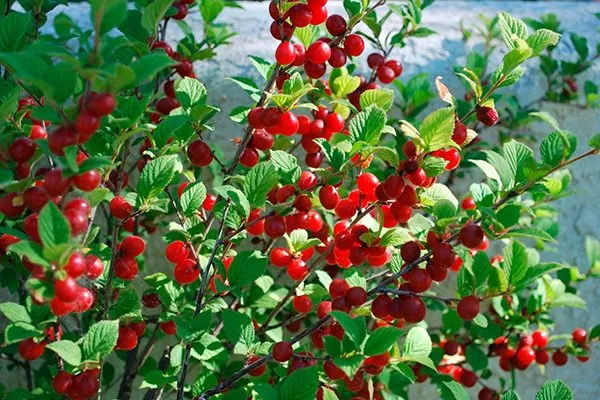
The felt cherry is a shrub-type tree, with the tree reaching a height of 110 to 130 cm. Features of the bush:
- crown - neat and oval;
- foliage - moderate;
- shade of bark – initially brown and pubescent, but as it matures it becomes grey and flaky;
- type of shoots - upright;
- kidneys - triple, deflected from the shoots, with sharp tips.
Leaves
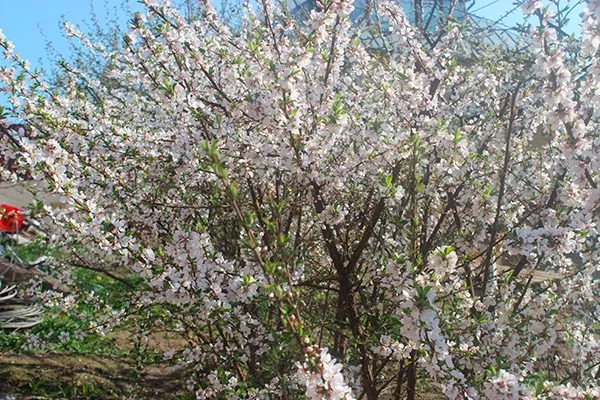
This felt cherry tree has beautiful foliage, oval-shaped and double-serrated. Other distinctive features include:
- the color of the above-ground part is dark green;
- pointed at the top and base;
- type – corrugated;
- front surface – with felt pubescence;
- the reverse side of the leaf blade has a small number of hairs;
- dimensions – 4.6-5.0 cm in length, 2.2-2.5 cm in width;
- petioles – shortened, length varies from 0.7 to 1.0 cm, medium thickness;
- petiole color – classic green;
- stipules – pubescent, linear, sharply serrated, 2-3 pieces in number.
Flower
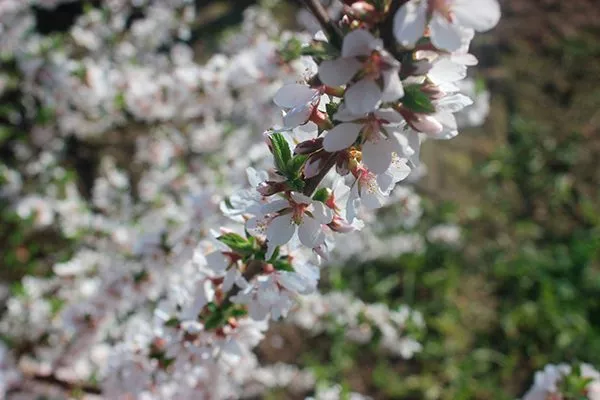
During flowering, you can observe medium-sized, saucer-shaped flowers consisting of exactly five interlocking petals. Their color is a delicate white-pink. The bud contains up to 25 short stamens and a longer pistil.
Other indicators:
- the calyx is cylindrical, anthocyanin-containing and pubescent;
- flower diameter – 2.3-2.6 cm;
- ovary - with pubescence;
- sepals - with small teeth.
Fruit
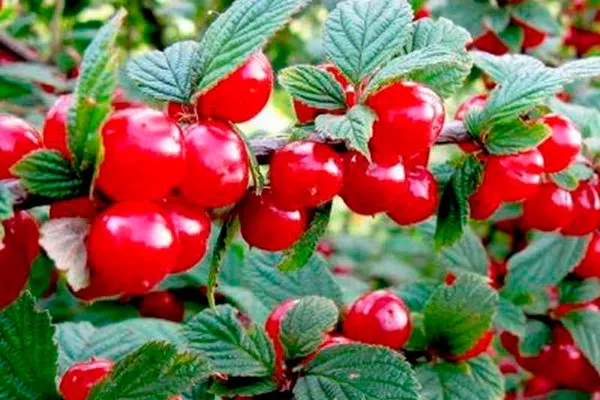
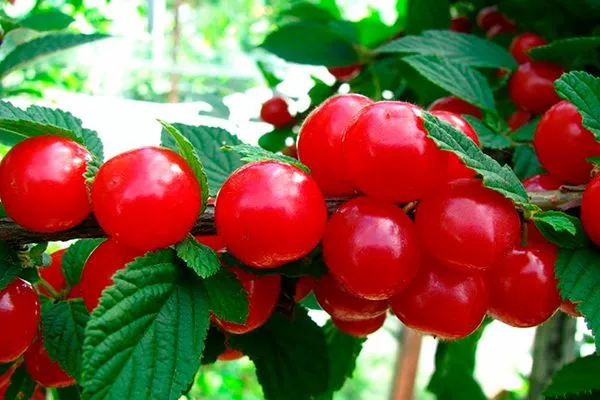
The fairy tale is characterized by large berries – their weight is 3.2-3.8 g. Other subtleties:
- shape – round-oval, slightly elongated in technical maturity;
- the base and top are round;
- there is a deep funnel near the stalk;
- the skin color is bright burgundy, the shade of the cartilaginous pulp is red;
- juiciness – increased;
- the seeds are small in size (only 5.2% or 0.17 g), and are not separated from the pulp;
- the surface of the skin is shiny and smooth, but there is a slight hairiness;
- abdominal suture - like a strip;
- pulp - compacted;
- The stalk is shortened – no more than 5 mm, the separation is completely dry, thanks to the deep funnel.
Taste qualities
The flavor and aroma of this cherry are truly magical – it harmoniously combines sugariness with a slight tartness – sugar content is approximately 7.0-7.5%, acidity – 0.8-1.0%. The juiciness is ensured by the low dry matter content – 12.0-12.8%. The ascorbic acid content per 100 g of product is 24 mg.
Characteristics
This criterion is the most important after taste – it determines the degree of difficulty or ease of growing a crop.
Drought resistance, winter hardiness
The variety is resistant to both drought and frost—the bush can withstand temperatures as low as -36 to -40 degrees Celsius. Even if there's been a prolonged lack of rain and water, the tree will continue to bear fruit.
Cherries are easily grown in regions with strong winds because they are resistant to drying out and sudden temperature changes.
Pollination, flowering period and ripening time
The Skazka cherry is unable to self-pollinate, so it requires the planting of nearby pollinators. They should bloom at the same time. The best varieties are Alisa, Yubileynaya, and Vostochnaya. Cross-pollination with cherries and classic cherry varieties is strictly prohibited.
Flowering begins after May 20th, and the first harvest can be picked as early as mid-July. Ripening occurs simultaneously, so all the fruits are picked from the bush at once. According to the originator's recommendations, it's not advisable to leave the berries on the tree for too long, otherwise the cartilaginous texture will disappear.
Productivity, fruiting
Despite the bush's small size, it produces a generous supply of berries. The average yield per tree is 9-11 kg. Fruiting is early, so the first berries appear in the fourth year on own-rooted bushes, and in the second year on grafted ones. The fruiting season lasts for 16-17 years.
Application of berries
The dark fruits are used in a variety of ways: fresh, preserved for the winter, and used to make fruit drinks, compotes, juices, liqueurs, jams, etc. Wine is even made from this variety.
Resistance to diseases and pests
The leaves are quite tough, so pests refuse to visit Skazka. The only danger comes from rodents during the winter, when there's a shortage of food. Diseases that can occur include rhinocerosal and moniliosis.
Advantages and disadvantages
The main advantage of this variety is its large, juicy, and sweet fruits. However, there are other positive qualities that are important to gardeners:
The variety has a minimum of disadvantages: susceptibility to moniliosis and pocket disease, and smaller fruits when the harvest is overloaded.
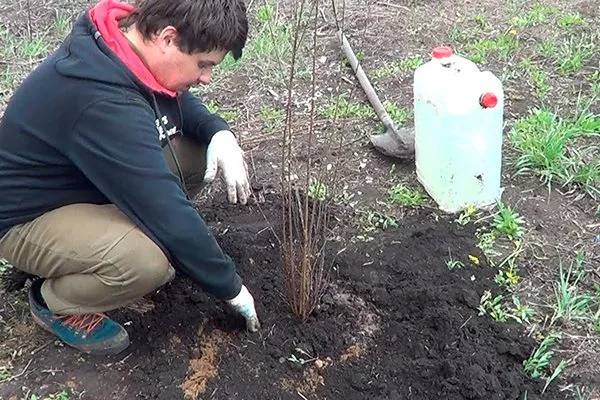
Landing features
The procedure is standard; you only need to take into account a couple of points regarding varietal requirements:
- Neighborhood. Avoid planting near pear and apple trees. It's best to plant grapes, rowan, and hawthorn nearby.
- Place. The fairy tale prefers plenty of sunlight—only then will the berries be sweet. Therefore, planting near buildings or tall trees is strictly prohibited.
- Planting period. Seedlings adapt easily and gain strength during both spring and fall plantings. This should be done in early spring or within 1-1.5 months of the first frost.
- Scheme. The distance between plants should be at least 2.5-3 meters, as the shrub's root system is strong and developed. The depth and diameter of the planting hole depend on the size of the seedling's root system.
- ✓ Soil pH should be between 6.0-6.5 for optimal growth.
- ✓ The groundwater depth must be at least 1.5 m to prevent root rot.
Subsequent care of the culture
Fairytale is easy to grow, so any beginner can handle it. Here are some things to keep in mind:
- Top dressing. The variety is not particularly demanding in terms of fertility, so it is sufficient to apply fertilizer twice a year:
- immediately after the end of the flowering period, use 4-5 kg of compost (humus, rotted manure), 20-25 g of potassium sulfate and 60-70 g of superphosphate for one bush;
- Before wintering, fertilize with potassium and phosphorus.
- Watering. They are carried out only when the soil layer up to 10 cm dries out. The soil should not be over-watered.
- Trimming. Rejuvenate the bush approximately once every five years, and perform sanitary pruning twice a year. The bush doesn't require shaping, which significantly reduces labor costs.
Diseases and pests, methods of control and prevention
Among the diseases that occur most frequently are the following:
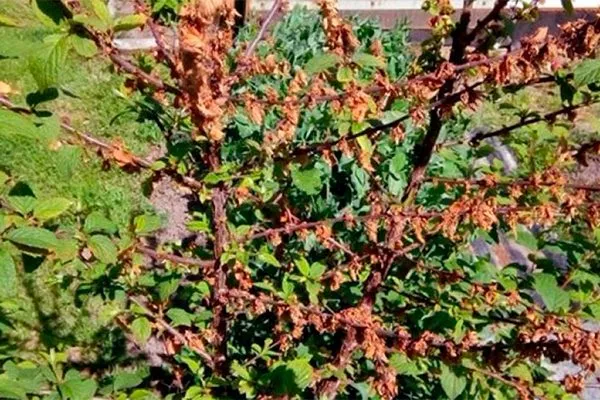
- Moniliosis. Signs include wilting leaves and flowers, and drying shoots. Treatment is with Fundazol at a 1% concentration. Be sure to trim off all affected areas and burn them away from the garden to prevent the infection from spreading.
Don't forget to treat the cut areas with garden pitch or dust them with crushed wood ash. As a preventative measure, especially for this variety, try not to overcrowd the tree, as this is the main cause of moniliosis.

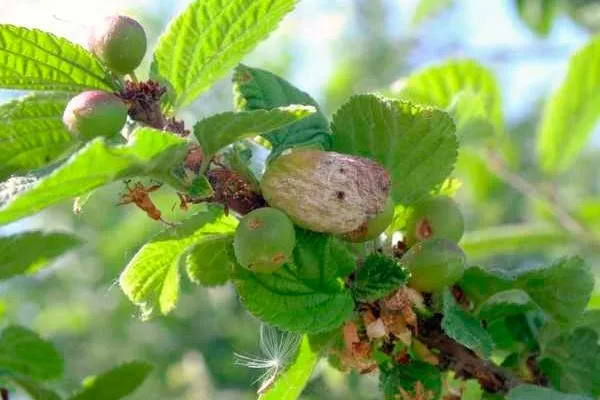
- Pocket disease. This condition manifests itself as the absence of seeds in the berries, which take on a different shape, resembling drooping sacs. Various systemic fungicides are used for treatment. As in the previous case, all affected areas are removed.
To prevent pocket disease, plant bushes in sunny areas with a water table at least 3 meters below the soil surface (to prevent the roots from being constantly wet). In the spring, treat the above-ground portion and the trunk area with copper-based products or regular copper sulfate at a concentration of 1-3%.
| Fungicide | Concentration | Protection period |
|---|---|---|
| Fundazol | 1% | 14 days |
| Copper sulfate | 3% | 30 days |
Pests don't attack the bushes, but you need to protect the bark from rodents. To do this, wrap the trunk with burlap or other material during pre-winter preparation. Additionally, install fine-mesh wire mesh. Place poison under the bush to deter mice.
Reproduction of felt cherry
Felt cherry can be propagated in a variety of ways: by green and woody cuttings, root suckers, and pits. The latter method is not recommended, as it takes several years to grow a seedling.
Reviews
The Skazka cherry tree is an easy-to-grow variety, characterized by hardiness and increased frost resistance. Its blooms are beautiful and rapid, and its branches grow vigorously, yet the bush requires no shaping. Once planted, standard care is sufficient, and you'll reap a bountiful harvest of large, sweet cherries.