
Many gardeners in Russia have a choice of when to plant cherry trees—spring or fall. But in some regions, spring planting is unavailable. Let's explore when and why gardeners choose spring planting, how to do it, and its advantages.
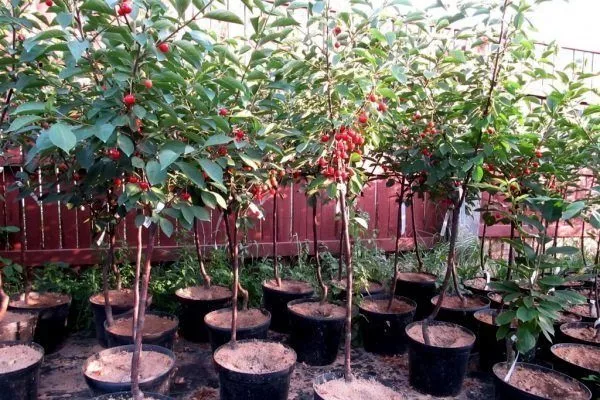
Timing and conditions for planting cherries in spring
The optimal time for planting seedlings varies by region. Generally, the best time is late March to mid-April. If you rush, the tree will freeze during the return frost; if you delay, it will be weakened and have poor immunity.
Spring planting begins when the following requirements are met:
- The temperature does not drop below 0 °C at any time of the day.
- The seedling hasn't started growing. If buds have begun to open on the tree, it will become stressed when planted, which will negatively impact its survival and future life.
The optimal temperature for planting seedlings in spring is +5°C.
To determine whether it is time to plant fruit seedlings, plunge a shovel into the soil - if it goes into it without resistance, it is time for spring planting.
Pros and cons of spring planting
Fall planting of seedlings is popular only in regions with moderately cold winters. Young trees planted in the fall, even those that have established roots before frost, have a hard time surviving the harsh winters typical of the central and northern regions.
To finally decide on planting time, it's worth knowing the advantages of spring planting:
- Spring planting allows the seedlings to gain a good foothold before winter, giving them a full six months to grow.
- During the first six months after planting, gardeners can monitor the tree's development, promptly responding to challenges such as pests, diseases, moisture stress, and so on. By taking timely measures, gardeners prevent weakening of the seedling, which can be fatal for a young plant.
- Thanks to the increased humidity typical of spring soils, the root system of seedlings quickly takes root and begins to grow actively.
- In the fall, prepare the plot and planting hole. The soil settles by spring, so it's easier to avoid the main mistake of novice gardeners—planting too deep at the root collar.
The disadvantages of spring planting include the significant energy required for the seedling to actively develop. Trees planted in the spring must expend energy not only on the root system but also on the development of their aboveground parts.
Preparatory activities
The success of the project depends on the quality of the planting and the precise implementation of all agricultural requirements. Failure to adhere to the planting deadlines and conditions leads to future problems—the tree will be weak and the harvest will be meager.
Choosing a location
Landing site requirements:
- Illumination. Cherries are heat-loving and sun-loving, preferring open, well-lit areas. Insufficient sunlight negatively impacts fruiting, so cherries should not be planted near spreading trees.
- Attitude to the wind. Cherries don't like wind and drafts, so it's best to plant them near fences. This has another advantage: the fence not only protects the tree from the wind but also traps snow in the winter, protecting the roots from freezing. Cherries grow well on slopes and hills, provided there are no strong winds.
- Soil. Preference is given to light, fertile soils with a neutral reaction.
- Humidity. Choose a site with moderate moisture—swampy areas are unsuitable. Groundwater levels should be at least 2 meters below the ground surface.
Selecting a seedling
Cherry is a fairly frost-hardy crop, but when choosing seedlings, preference is given to varieties suitable for a specific region. It's also worth paying attention to external characteristics:
- there should be no damage to the bark;
- the age of the seedling is no more than two years;
- height – up to 130-150 cm;
- the diameter of the main conductor is about 1 cm;
- the root system should have 3-4 well-developed roots;
- There should be no swollen or blossoming buds or other signs of vegetation.
- ✓ Check for a certificate of conformity for the variety.
- ✓ Check for signs of disease on leaves and bark.
- ✓ Assess the development of the root system – it should be fibrous and well-branched.
If peeling bark is visible on the trunk but there is no damage, the seedling was improperly stored over the winter and froze. Do not purchase such planting material.
Soil preparation
The procedure for preparing the soil for spring planting:
- The area at the intended planting site is dug over, removing plant rhizomes from the soil. This should be done in the fall or at least two weeks before planting.
- If the soil has high acidity, it is neutralized by adding lime – 500 g per 1 sq. m.
- Dig a hole—it's also best to prepare it in the fall. The hole should be approximately 70 x 70 x 70 cm. It should be larger if the seedling has a highly branched root system.
Experts recommend preparing the soil in the fall—the soil, having absorbed the fertilizer, will acquire the necessary fertility by spring. In the spring, the soil is loosened to allow it to receive oxygen.
If several seedlings are planted, they are placed according to the following pattern: 3x4 m and 2.5x3 m, respectively, for tall and low-growing bush-like species.
Fertilization
The soil removed from the hole is separated into upper and lower layers. The fertile soil layer is mixed with humus—two buckets per tree. The following are also added:
- superphosphate – 100 g;
- potassium salt – 50 g;
- ash – 1 l.
Sand is added to clay soil—one bucket per square meter. Peat is added to sandy soil, increasing the amount of organic matter to 30 kg.
Planting depth
When planting a seedling, it's important to plant it correctly. Cherry trees don't thrive in deep plantings. The root collar should remain at the surface, extending 5 cm above the soil surface. By leaving this distance, the gardener allows for soil settlement and prevents the seedling from rotting.
After the soil settles, the root collar will be level with the ground. By planting a seedling too deep, inexperienced gardeners condemn it to slow growth and root collar rot. If the seedling is planted too high, its roots will dry out during the summer heat or freeze in the winter.
The root collar is the boundary where the trunk transitions into the root system. It is located 3-4 cm from the topmost root branch.
Landing requirements
Before planting a seedling, a gardener should carefully consider the choice of planting location to avoid having to replant the tree in the future.
If a cherry variety is self-sterile, it will require pollinators, which should be taken into account when choosing a site. If there is no suitable pollinator in the garden, you will need to plant at least one more along with the new sapling for pollination. Varieties that do not require pollinators are called self-fertile.
Good and bad plant neighbors
The development of a tree, its yield and the quality of its fruit depend largely on the trees growing in its immediate vicinity.
It is not recommended to plant cherries next to:
- cherry plum;
- plum;
- walnut;
- peach;
- apricot;
- pear.
Favorable neighbors:
- cherries;
- grape;
- rowan;
- hawthorn.
These plants don't interfere with cherry growth, and cherries are also effective pollinators. Planting cherries near each other increases the yield of both crops.
We recommend reading the article review of the best cherry varieties.
Features of planting cherries in spring in different regions
Each region has its own specific cherry planting characteristics, determined by the local climate:
- Moscow region and Central region. The region experiences cold winters with stable snow cover and moderately hot summers. Favorable planting conditions develop by mid-April. Spring frosts usually end by the 20th of May. Trees are planted in areas protected from northern winds.
- Leningrad region. This is a risky gardening zone. Only zoned varieties are planted here. Severe frosts, squalls, heat waves, and heavy rains are common here—the weather is unpredictable. There's no alternative to spring planting—saplings planted in the fall risk freezing. The soil in this region is not particularly fertile, so it requires ample fertilization.
- Siberia. Here, in the harsh winters and short summers, only the most frost-hardy and early-bearing varieties survive. Bush cherries are primarily planted here. Bush cherries are planted on hillsides, where the soil warms up faster and is more oxygenated.
The snow melts here in mid-April. The ground remains cold, but the air warms up by May, creating a temperature differential between the roots and the trunk, which risks the plant's death. In mid-April, the seedlings in their containers are brought outside. The roots begin to develop, and by May, buds appear. The seedling is removed from the container along with the soil and planted directly on the surface—no hole is dug. The roots are covered with soil up to the root collar and tied to a stake. This creates a comfortable temperature for the roots.
Additionally, read our article which will tell you about popular cherry varieties for growing in the Moscow region.
Planting: Step-by-Step Instructions
The procedure for planting a cherry tree seedling:
- Soak the seedling's roots in water to stimulate biological processes. This will activate and accelerate rooting.
- Inspect the seedling's roots. If you notice any damage or defects, trim off the affected areas.
- Drive a 0.8 m long stake into the bottom of the planting hole.
- Fill the hole with the previously prepared mixture of topsoil and fertilizer. Fill the hole 2/3 full. Form a mound and top with fertile, unfertilized soil—approximately 7-9 cm thick. This will prevent the fertilizer from burning the roots.
- Place the tree in the center of the hole, perpendicular to the soil surface. Spread the roots over the mound. If the plant is container-grown, move it along with the root ball.
- Carefully tie the seedling to the stake. Use twine; wire should not be used, as it can damage the trunk. Tying the seedling will prevent it from being blown over by the wind.
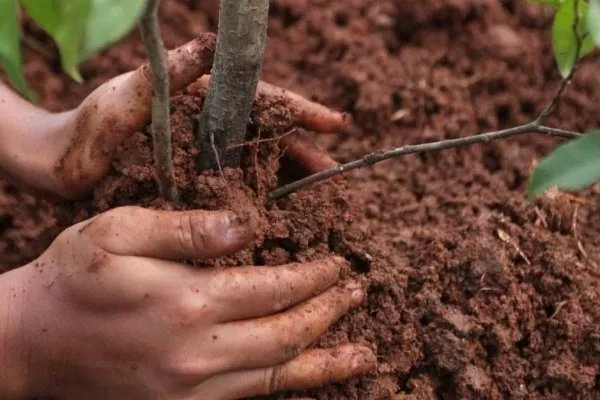
- Holding the tree by the trunk, fill the hole with soil, shaking it occasionally to ensure there are no empty spaces between the roots. Firm the soil, working from the edge to the center of the hole. Pay attention to the position of the root collar and adhere to the recommended planting guidelines.
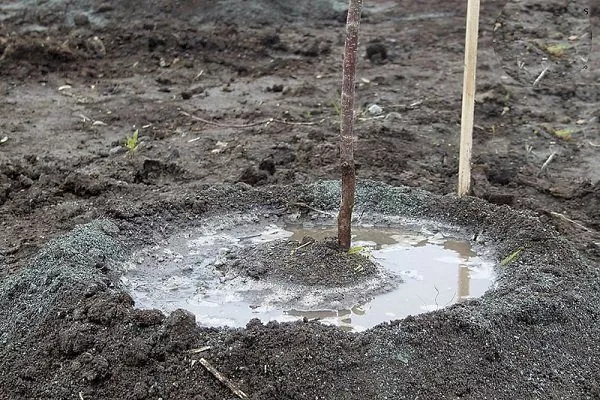
- Form a circular watering hole, creating a 10 cm high mound of soil. Water the seedling with two buckets of water. Apply the water slowly.
- Mulch the soil around the tree trunk with hay or straw. A 10-cm-thick layer of mulch prevents the soil from drying out, inhibits weed growth, and protects the root system from freezing.
- A one-year-old seedling is pruned to a height of 0.8 m above the ground. For a two- to three-year-old seedling, the branches are reduced by 1/3, and the main conductor is pruned so that it is 15 cm higher than the top branch.
- ✓ Provide the seedling with regular watering during the first 2 months after planting.
- ✓ Protect the young tree from direct sunlight during the first weeks.
You can see the cherry tree planting procedure in the video below:
Caring for a seedling
To ensure that young trees grow vigorously and become strong, productive trees in the future, they require care:
- regular loosening of the soil in the tree trunk circle during the growing season;
- weeding - they take away moisture and nutrients;
- autumn digging of the soil in the tree trunk circle;
- preventive/curative treatment against diseases and pests;
- removal of damaged and diseased branches, crown formation;
- protection from rodents and insulation for winter;
- regular watering in summer.
Cherry trees should be watered carefully—overwatering damages the roots, and in mature trees, the fruit as well. Excess moisture can cause root rot and the cherries to crack.
Types of landing errors
When planting cherry tree seedlings, inexperienced gardeners often make typical mistakes:
- Failure to prepare the planting hole in advance results in the root collar becoming too deep, which slows down the tree's growth.
- Overdosing on fertilizers during planting leads to suppression of the root system.
- Planting a seedling older than two years. Such trees take a long time to adapt and have difficulty establishing themselves, resulting in weakened immunity.
- Failure to plant on time often results in the death of the tree.
- Lack of pollinator trees – without them, crop yields drop.
- Buying seedlings from unverified sellers. The quality of the planting material is not guaranteed, and the results are unpredictable.
To ensure a seedling takes root well, it's important to follow all planting requirements and rules. It's also important to consider local conditions—climate, soil composition, topography, and other factors that influence the growth and development of a young tree.