
Every gardener must decide for themselves whether to plant cherry trees in spring or fall. There's no definitive answer—much depends on the climate, the condition, and the variety of the seedlings. In this article, you'll learn about the intricacies of planting cherry trees in the fall, their advantages, and how to ensure the seedlings survive the winter safely.
Features of autumn planting
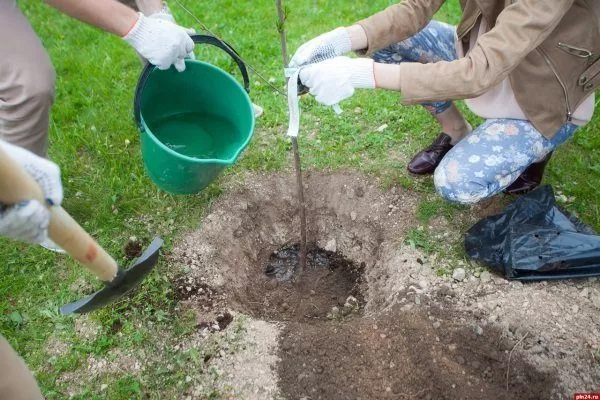
Most gardeners prefer to plant seedlings in the spring, but there are circumstances in which fall planting is much more effective and safer. Seedlings planted in the fall have more time to establish roots than those planted in the spring.
Why is it better to plant cherry seedlings in the fall:
- No risks associated with spring planting. In spring, seedlings are exposed to a variety of adverse factors—they can be attacked by recurrent frosts and suffer from sudden temperature fluctuations.
- Minimal exposure to adverse natural factors. If the seedling is planted correctly, it will experience a period of optimal temperature conditions. The trees will have time to establish themselves before the first frost.
- High-quality healing of wounds caused during planting. The seedling is pruned immediately before planting. During the dormant period, which lasts until spring, all wounds will heal.
- Trees planted in the spring develop faster. The root system of "autumn" seedlings has time to develop well, and when spring arrives, the tree begins rapidly expanding its vegetative mass.
- The planting material is of higher quality than that obtained in spring. Nurseries dig up seedlings in the fall, and those not sold immediately are stored until spring. Seedlings purchased in the spring are inferior in strength and viability to those purchased in the fall. Even though they were stored properly, they were still subjected to stress, which disrupted their natural development.
- It is easy to determine the health of a seedling by examining its fresh root system.
- Fall planting is easier than spring planting. Just plant the tree and cover it—nothing else is required. Watering, weeding, treating with fungicides, and fertilizing—all these are spring activities.
The main condition for autumn planting is that there should be a month or a month and a half left before the onset of persistent cold weather.
Risks of autumn planting of seedlings:
- The possibility of freezing of the roots and the entire tree during severe winter frosts.
- In winter, seedlings are threatened by icing, heavy snowfalls and gusty winds.
- Damage to the bark by rodents.
Recommended timeframes
The timing of planting cherry seedlings is selected taking into account:
- features of the local climate;
- average temperatures in the region;
- long-term observations of the nature of autumn weather.
Knowing, or rather, assuming, the possible date of the onset of frost, count 20, or better yet, 30 days from it - this is the optimal planting time.
- ✓ The soil temperature should be at least +5°C for successful rooting of seedlings.
- ✓ Soil moisture should be maintained at 70-80% of the total moisture capacity.
Optimum temperatures for seedlings:
- daytime – from +10 to +15 °C;
- night – from 0 to +2 °C.
A contraindication to autumn planting is purchasing seedlings late in the season. If they don't have time to take root, they will either die or become weakened, low-yielding trees. If this isn't possible, it's best to bury the seedlings in the ground until spring.
Landing requirements
Cherries don't tolerate transplanting well. They are demanding of soil, light, and other conditions. Before starting work, gardeners carefully select a site where the tree will thrive. Under favorable conditions, cherries can bear fruit for 15-25 years.
Landing site
When choosing a site for planting cherry trees, consider, first and foremost, light exposure and protection from the wind. Characteristics of a site suitable for planting cherry trees:
- Good sun exposure. No shade from neighboring plantings. A gentle south- or southwest-facing slope is ideal. The tree should receive sunlight from morning until midday—at least, and preferably until evening.
- The presence of a nearby barrier, such as a fence. The barrier should face north to protect the tree from cold winds. Otherwise, the risk of frost damage to the flowers increases.
Conditions unsuitable for cherries:
- close occurrence of groundwater – less than 1.5 m;
- waterlogged and swampy lowlands;
- acidic peatlands;
- close proximity to oak, linden, spruce, birch, pine, apple, tobacco, raspberry.
Soil
Cherry trees are not recommended for planting in low-quality, nutrient-poor, or waste soils. Before planting, thoroughly cultivate the topsoil—it should be at least 20 cm thick.
Cherries grow and bear fruit best in black soil, sandy loam, and loamy soils with a neutral pH. But before preparing the soil for planting, it's important to find out what conditions a particular cherry variety requires.
Features of soil preparation for planting cherries:
- Acidic peaty soils are definitely not suitable – the entire top fertile layer has to be replaced.
- To neutralize the acidity of the soil, dolomite flour or wood ash is added to it.
- Weeds interfere with the root system of cherries, so before planting, the soil is thoroughly dug over – repeatedly, and during digging, weed roots are removed from the ground.
- When digging the plot, add compost, manure, or mineral fertilizers. Apply 8-10 kg of manure/compost per square meter, 60 g of superphosphate, and 30 g of potassium chloride.
Preparatory activities
Once the site has been selected and prepared, they move on to the next stage – preparing the seedlings and the hole for planting.
Selecting and preparing a seedling
Cherry varieties are often self-sterile, so to ensure proper fruit production, at least three seedlings of different varieties are purchased. Mixed planting of self-fertile cherries is also recommended, as it significantly increases the tree's yield.
Before choosing a seedling, it's important to familiarize yourself with the best cherry varieties. You can read about popular varieties here. Here.
Rules for selecting seedlings:
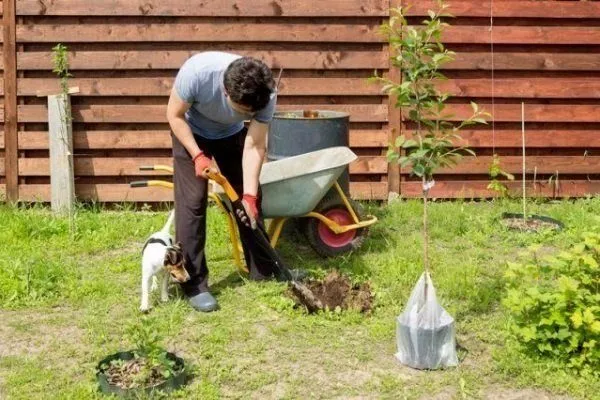
- The seedlings must be healthy, without damage to the bark and root system.
- The best seedlings are one-year-olds 0.7-0.8 m tall or two-year-olds 1.1-1.2 m tall.
- Developed root system – from 25 cm long.
- A height of over 1.2 m indicates over-nitrogenation—such seedlings have reduced winter hardiness. It's best not to plant such trees before winter—they will die.
- Own-rooted seedlings are considered more winter-hardy. Grafted seedlings are best planted in the spring.
Before planting a seedling in a hole, its roots are spread out, long roots are trimmed, and they are dipped in a manure-clay slurry. Leaves are plucked to prevent moisture evaporation. Soaking the seedlings in a heteroauxin solution (an organic growth stimulant) also improves their survival rate.
Preparing the pit
The hole for the cherry tree is prepared taking into account the size of the root system. Typically, a hole measuring 60 x 60 x 60 cm is dug. The planting holes are prepared two weeks in advance. The hole layout depends on the type of plant.
Prepare the soil mixture in advance. When digging the hole, set the top layer of soil aside to be mixed with fertilizer:
- humus - a bucket;
- superphosphate - 200 g;
- potassium sulfate - 30 g.
If the soil is heavy, add a couple of buckets of river sand. Drainage is made at the bottom of the hole—expanded clay can be used, for example. The prepared soil mixture is poured into the hole so that it fills a third of the space. The mixture is lightly compacted.
When planting cherry trees and other fruit trees, avoid applying nitrogen fertilizers, as they impair rooting. Chicken manure contains a lot of nitrogen.
Planting technology
Step-by-step instructions for planting a cherry tree seedling:
- Drive a stake approximately 2 m long into the hole. Place it closer to the north side.
- Form a mound of soil mixture in the hole.
- Place the seedling into the hole, distributing the roots evenly over the mound.
- Cover the roots with the remaining soil and compact it. Form a circle around the tree trunk, creating a rim around its edge.
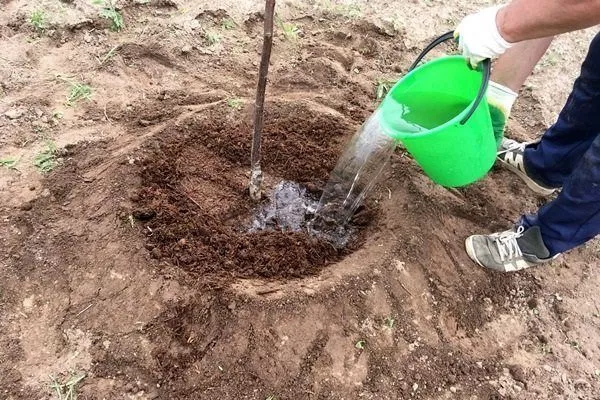
- Water the seedling with warm water – 2-3 buckets will be enough.
The seedling is planted to the optimal depth, determined by the position of the root collar. It should be 3-5 cm above the ground surface. Once the soil settles, the root collar will be level with the soil. If the root collar is still out of place after watering and soil settlement, it is adjusted.
If the seedling's root system is buried too deep, it will develop poorly. If the roots are too close to the surface, they risk freezing in the winter.
Planting patterns for different cherry varieties
The planting pattern for cherry trees depends on the type of tree, its height, and the spread of its crown. Cherries are typically not planted singly; pollinators are placed nearby. The first thing a gardener must decide is how far apart to plant the seedlings.
Recommended planting patterns for cherry tree seedlings (distance between trees x distance between rows):
- bush cherries – 2x2 m;
- low-growing tree-like cherries – 2x3 m.
- tall tree-like cherries – 3x3 m or 3.5x3.5 m.
To ensure a good harvest, it's recommended to plant two or three varieties that bloom at the same time to ensure cross-pollination. The optimal arrangement is a staggered planting pattern.
Post-planting care
The fall planting process itself is straightforward, and care can be left untouched until spring. After fall planting, gardeners only need to perform one agricultural procedure: insulating the seedling.
To ensure the seedling survives the winter safely, protect it from frost, snowstorms, and rodents. Here's how:
- Water the tree. The recommended amount is 5 liters. When cold weather sets in, fill in the hole around the tree trunk to prevent meltwater from stagnating in the winter.
- Just before the frost sets in—a month or a month and a half after planting—the seedling is hilled up, adding an additional 30-35 cm of soil. Even better, mulch the soil with sawdust, humus, or peat.
- The top is additionally covered with spruce branches, reeds, or other breathable material. This protection will protect the seedling from both cold and damping off. In the spring, the protective layer is removed and the soil around the base of the tree is leveled.
All other care for the seedling is postponed until spring. As soon as the weather warms up, the tree is pruned, watered, treated with fungicides, and loosened.
Timing and specifics of cherry planting in different regions
The timing of autumn cherry planting varies depending on the region's climate. Gardeners primarily consider the timing of the first frosts and persistent cold spells.
Approximate dates for planting cherry tree seedlings depending on the region
| Region | Optimal timing for autumn planting | Note |
| Central Russia and the Moscow region | from early to mid-October | The seedlings are planted when a favorable temperature is established, which promotes rapid adaptation and rooting. |
| Southern regions | from mid-October to mid-November | The plant, entering a dormant period, finds itself in conditions optimal for adaptation. |
| Northern regions and the Urals | beginning of September | Frosts come early here, so it's important to plant seedlings on time. |
In regions with harsh winters – in the north of Russia, Siberia, the Urals – it is advisable to plant cherries in the spring.
We recommend reading the article about popular cherry varieties for growing in the Moscow region.
What mistakes are made when planting cherries?
No gardener is immune to mistakes. Given the variety of planting techniques and the abundance of nuances, it's easy to get confused. The most common mistakes are:
- Purchase of large seedlings. By giving in to such desires, you risk ending up with a problematic tree. The larger the seedling, the older it is, and the more difficult it is to establish. Avoid buying a seedling older than two years.
- Purchasing planting material for future use. Don't buy seedlings in advance. If the tree doesn't enter dormancy and prepare for the coming winter, it won't root well.
- Digging up the area shortly before planting. It's best to do this in advance, ideally in the spring. The hole should be prepared no later than two weeks in advance—if this rule is not followed, the root collar will be pushed deeper into the soil due to soil subsidence.
- Overdosing when applying fertilizers to the planting hole. When there is an excess of mineral elements, the bacteria that convert fertilizers into forms accessible to plants die.
- Use of fresh manureThe decomposition of unrotted manure in the soil is accompanied by the release of carbon dioxide and ammonia, which inhibit the root system of plants.
There's nothing complicated about planting cherries in the fall—the key is to learn the proper cultivation techniques and time them correctly. If approached correctly, fall planting will bear fruit—the seedlings will root successfully and grow quickly in the spring.