
To ensure cherry tree saplings take root, they are planted primarily in spring in temperate regions. Spring planting is much more reliable than fall planting in cold winters and extreme temperatures.
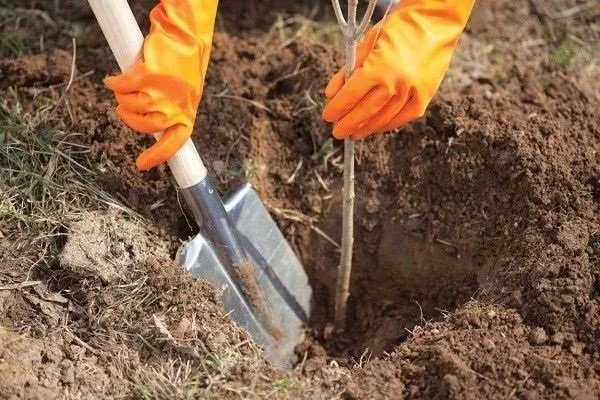
When is spring planting done?
Until recently, it was believed that the cherry tree was exclusively native to the south, unable to withstand the frosts typical of the temperate zone. Thanks to selective breeding, varieties suitable for cultivation in various regions of Russia have emerged.
- ✓ The optimal soil temperature for planting should be at least +10°C at a depth of 10 cm.
- ✓ The distance between seedlings should be at least 3 meters to ensure sufficient space for root system growth.
Recommended dates for planting cherries depending on the region:
- Southern regions. Here, cherry trees are planted primarily in the fall, as soon as the leaves begin to fall. The seedlings take root well in the fall, and by spring they're a fully established plant.
- Central regions, Siberia, Far East. Due to the cold winters, autumn planting of saplings is contraindicated here. Cherry trees are planted mainly in the spring. Saplings are usually planted in April, before the buds have swollen. Holes for spring planting are prepared in the fall.
Cherry varieties recommended for cultivation in certain regions of Russia
| Region | Recommended and cultivated cherry varieties |
| Volgograd | Black Daibera, Early Pink, Rossoshanskaya, Valeria, Priusadebnaya |
| Leningrad Oblast | Leningrad Black, Revna, Fatezh |
| Urals and Siberia | Cherry trees are grown on the dwarf rootstock VSP-2 in creeping and standard forms. |
Advantages and disadvantages of spring planting of cherries
Spring and fall planting each have their own pros and cons, which largely depend on climate conditions. To determine the right timing, it's important to evaluate and compare the characteristics of fall and spring planting.
Why is it beneficial to plant a seedling in spring:
- If a seedling is planted in April, it has at least six months to take root and gain strength. By growing shoots before winter, the seedling will survive it safely.
- Spring planting has a significant advantage over fall planting: gardeners can monitor the plant's development throughout the summer, taking steps to eliminate negative factors such as drought, overwatering, pests, and diseases if necessary.
- The seedling is planted in a hole prepared in the fall. The hole settles over the winter, making it easier to plant the seedling correctly—so that the root collar isn't buried deeper than necessary.
Disadvantages of spring planting:
- If you plant a seedling in the spring, then in March or April it will suffer from dry winds and pest infestations.
- In spring, the seedling, while spending energy on rooting, also spends energy on vegetation – the formation of shoots and leaves.
Selecting a seedling
There are a number of features that are important to pay attention to when purchasing a cherry tree seedling:
- Graft. The graft should be visible on the seedling—this guarantees the quality of the planting material. The quality of such a seedling is much higher than that of one grown from a seed.
- Zoning. They select varieties that are zoned for a specific region – those that have proven themselves best in a given climate zone.
- External characteristics of the seedling. The tree should have a strong main stem that dominates the side branches. Trees with forked trunks are unsuitable, as they may break under the weight of the berries. The seedling should have a well-developed root system, with no broken or damaged roots. The seedling selected for planting should be dormant.
- Age. You shouldn't buy seedlings older than three years.
We recommend reading the article to help you choose the most common varieties of cherries.
Seedlings are purchased from nurseries or specialized retail outlets with the necessary permits. It's best to have a variety certificate, which typically includes instructions on how to properly plant and care for the seedling.
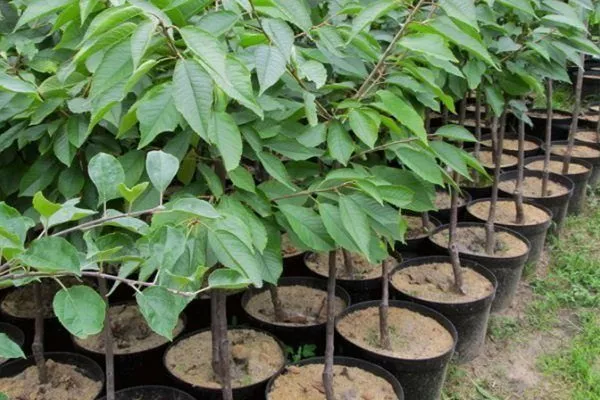
What trees can you plant with cherries?
Cherries only produce full fruit when planted in favorable surroundings. Moreover, if nearby trees conflict with the cherry tree, there may be no harvest at all.
Cherry is a tree with cross-pollination, therefore two or more seedlings are planted at once.
Favorable neighbors for cherries:
- cherry;
- apple;
- plum.
It is not advisable for cherries to grow near:
- pears;
- peach;
- walnut;
- black currant;
- rowan.
Preparing for landing
Planting a cherry tree sapling is a responsible task that shouldn't be rushed. One mistake can cause the tree to die or fail to produce a harvest. A gardener must consider everything, from the proximity of fruit trees to the soil composition. Before planting the seedling, it's important to select a site, prepare the area, and prepare the sapling for planting.
Choosing a location
Landing site requirements:
- Good lighting. Choose a site on a southern or southeastern slope to ensure it receives good sun exposure.
- Protection from northern winds.
- Low groundwater level. If the water table is 1.5 meters below ground level, the tree dies due to gum flow.
Cherries are never planted in lowlands.
Soil preparation
In arid climates, cherries grow best in fertile loams. In regions with relatively high humidity, they thrive in sandy loams. Clay, peat, and sandy soils are unsuitable for cherries. A suitable pH is 6.7-7.1. If the seedling is planted in humus-rich cherries, a pH of 8.0 is acceptable.
- Two weeks before planting, analyze the soil for pH and nutrient content.
- Add corrective additives (lime to increase pH or sulfur to decrease it) according to the analysis results.
- A week before planting, add organic fertilizers (compost or humus) at a rate of 5 kg per 1 m².
The soil for planting a seedling should be:
- airtight;
- moderately humid;
- slightly acidic.
For spring planting, the soil is prepared in the fall by digging it and adding fertilizer. Most gardeners also prepare the planting holes in the fall.
If the soil does not meet the requirements for planting cherries, it is improved by adding sand to clay soils and clay to sandy soils.
To provide the cherry tree with nutrients, a mixture of soil and fertilizer is added to the planting hole. It is prepared from:
- topsoil – 2 parts;
- humus - 1 part;
- peat - 1 part;
- potassium sulfide – 50 g;
- superphosphate – 100 g.
The components are mixed, and 10 days before planting the seedling, the hole is filled 1/3 full with the resulting mixture.
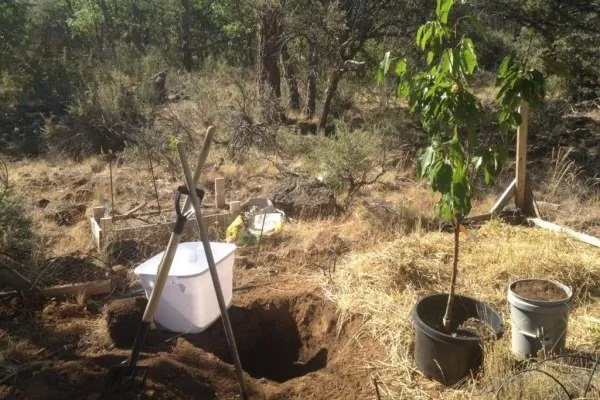
Nitrogen fertilizers are not applied when planting cherry seedlings, as they can burn the roots.
What should the hole be like?
Once the planting site has been selected, begin digging the hole. The topsoil is set aside separately from the excavated soil. If spring planting is planned, prepare the hole at least two weeks in advance. Recommended hole dimensions:
- depth – 70 cm;
- width – 80-100 cm.
The dug hole should not have any narrowing of the sides. When planting several seedlings, leave a gap of 2 m or more between adjacent holes.
Seedling
Proper seedling preparation for planting determines its future development. Preparation procedure:
- 24 hours before planting, the seedling is immersed in a bucket of water to activate the root system.
- Before planting, trim off damaged roots, if any.
- Long roots are trimmed so that the root system fits completely into the planting hole.
- All leaves are removed so that the seedling does not lose moisture.
Step-by-step instructions for planting
The procedure for planting a cherry tree seedling:
- Drive a support into the center of the hole to which the seedling will be tied.
- Mix fertile soil with compost and add complex fertilizer, placing the mixture at the bottom of the hole.
- Place the seedling in the center of the mound of potting soil and add enough soil so that the root collar is 3 cm above the soil level. Tamp the soil down to remove any air pockets.
- Form a mound of earth around the seedling.
- Pour 20 liters of water under the root of the seedling.
- Pour peat into the tree trunk circle to prevent water evaporation.
- Tie the seedling to the support carefully, without overtightening the trunk.
Experienced gardeners advise planting berry bushes in the spaces between cherry tree seedlings.
To learn how to plant a cherry tree seedling, watch the video below:
Basics of further care
Caring for a young seedling:
- After planting a seedling, its central conductor is immediately cut off – shortened to 1 m.
- A seedling planted in spring is watered every 10 days. The recommended watering rate is 2 buckets. After mid-July, the tree can be left without watering.
- During the first year of life, the tree does not require fertilizing – all the necessary substances are included in the planting hole.
- Throughout the season, gardeners should monitor the health of their trees, spraying them with pest and disease control products in a timely manner.
- In the second year, several (3-4) skeletal branches are left on the tree, pruning them by a third. Gradually, by annually pruning the central conductor and removing excess branches, three tiers are formed. The final tier consists of 1-2 branches.
- Cherry trees don't like weeds, so the area around the trunk—the root circle—should be free of them. The soil should be regularly loosened, removing weeds at the same time.
- To ensure a successful wintering, young seedlings require autumn fertilization. In September, apply granulated superphosphate at the root zone at a rate of 40-60 g per square meter.
Common mistakes when planting in spring
Any mistake made by a gardener results in a reduced harvest, even a complete failure. The ultimate damage is the death of the tree.
Common mistakes when planting cherry tree seedlings
| Error | Consequences of mistakes |
| Deepening of the root collar | The buds do not open on time |
| A variety that is not suitable for a particular region has been selected | Tree freezing |
| Yellowed and crimson leaves after planting | Watering with cold water |
| Inhibition of the root system and death of the seedling | Overdosing on fertilizers when planting |
| Long-term adaptation | Planting a seedling older than 2 years |
Frequently Asked Questions
Gardeners often have questions about planting cherry tree saplings. They wonder what the best method is for planting this tree and whether it can be transplanted.
How to plant grafted cherry trees?
Grafted cherries are planted in the same way as own-rooted ones. However, if the graft is located lower than usual, it's important to ensure that the graft is not buried deep. Ideally, the graft should be 6-7 cm above the soil level. If the region is prone to snow, seedlings with the graft located at a height of 50-100 cm are needed.
How to plant a cherry tree from a pit?
Growing a cherry tree from a seed won't produce a truly unique plant. A seed taken from the tastiest and largest cherry tree will produce a common wild cherry—small and sour. A tree grown from a seed is frost-hardy, disease-resistant, and pest-resistant. What's the point? It can be used as a rootstock for grafting cherries or for landscaping.
How to plant a cherry tree from a pit:
- The seeds are taken from completely ripe fruits, removed from the pulp, washed, and dried.
- Place the seeds in a paper bag and store until December at room temperature.
- When December arrives, the seeds are soaked for several days, with the water changed daily.
- The bones are placed in a container with moistened sand and sawdust.
- Place the container in a cool place (you can put it in the refrigerator) for 3 months.
- They take it outside in March and cover it with snow.
- Sprouted seeds are placed in individual pots, planted at a depth of 1.5-2 cm.
- The seedlings, having grown to 10-15 cm, are transplanted into larger pots.
- By autumn, the seedlings grow up to 30 cm.
- A month before frost, they are planted in the ground, covered with plastic bottles.
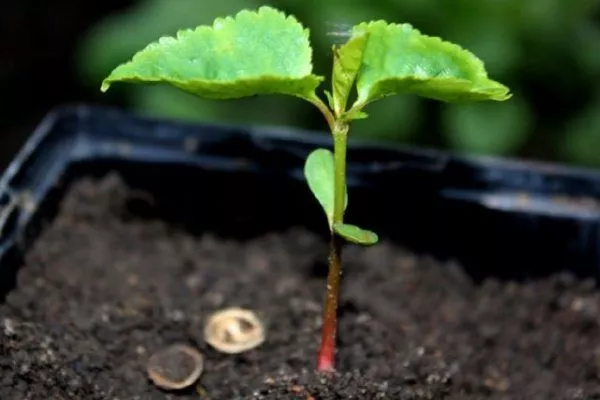
Is it possible to plant cherry trees using cuttings in spring?
Propagation by cuttings allows a new tree to acquire all the varietal characteristics. However, this method of propagation is not suitable for all varieties. Typically, no more than 10% of cuttings root. Only a few varieties achieve this rate of rooting at 50%.
You can plant cherry trees from cuttings in the spring, just like planting regular seedlings. However, the cuttings need to be rooted first. This isn't difficult, but it does take time. In central Russia, the best time to harvest cuttings is June 10-30.
How to transplant a tree in spring?
If you decide to transplant a young tree, it is dug up in the fall and planted in the spring. Here's the procedure:
- The soil is moistened the day before digging.
- Carefully remove the tree, having first dug a trench around the circumference – according to the diameter of the root system.
- Without disturbing the soil lump, the tree is buried outside for winter storage.
- In the fall, the planting hole is prepared.
- When early spring arrives, the buried tree is removed and planted just like a regular seedling.
- To prevent the plant from losing its strength to growing shoots, its skeletal branches are pruned by 30%. All flowers are also removed to prevent fruiting in the first year of replanting.
Sometimes, it's necessary to replant a mature cherry tree. This isn't beneficial for the tree, but it's entirely feasible if necessary. Here's the replanting procedure:
- In September, draw a circle around the tree with a diameter corresponding to the root system, trying to cover as many roots as possible.
- Using a shovel, trim the roots by 1/2 of their circumference and dig a trench along this half. The trench should be one shovel blade deep.
- In the trench, the roots are again cut back by one bayonet.
- After filling the trench, water it—the tree feeds from the half of its roots that remains intact. New roots will emerge from the cut portion.
- After a month, the procedure is repeated for the second half of the circle and watered for two weeks.
- When spring comes, the tree is dug up and moved to a new location along with the lump of earth.
Spring planting of cherry trees is ideal for central Russia. Saplings planted in spring have a better chance of successfully rooting and growing into strong, high-yielding trees.