
When planting cherry trees in the fall, it's important not only to plant the sapling correctly but also to consider the local climate. If you follow proper fall planting techniques, the tree will thrive. Let's learn how to plant cherry saplings in the fall and how to help them survive their first winter.
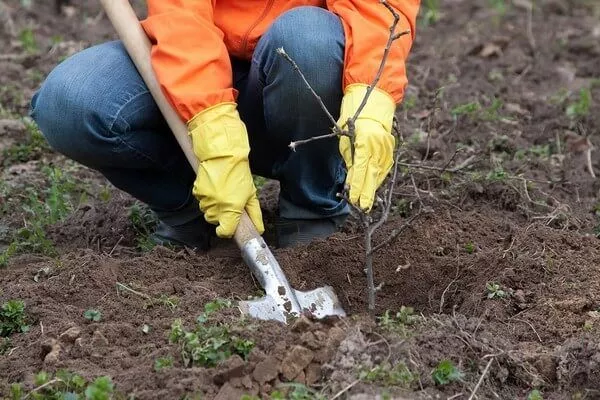
Features of autumn planting
Cherries, like any fruit tree, can be planted in any season. It's impossible to say definitively when is the best time to plant cherry saplings; many factors influence the timing, including climate, variety, weather conditions, availability of planting material, and more.
There are circumstances in which fall planting is preferable to spring planting. Features and advantages of fall planting:
- It's in the fall that the market is filled with varietal seedlings—this is when nurseries sell their products. You can not only find the right variety but also choose the best seedlings. Read about the most common cherry varieties. here.
- Fall planting is an option for southern and temperate regions. In areas with harsh climates, it's unprofitable and risky—saplings planted in the fall may not survive their first winter.
- The timing of autumn planting depends on the regional climate. Saplings are planted 1-1.5 months before temperatures drop below 0°C. If there's snow on the ground, but the ground isn't frozen yet, and there's no frost yet, cherry trees can still be planted.
Selecting a seedling
Seedlings aged 1-2 years are best for fall planting. Signs of a good seedling:
- The height of an annual plant is up to 80 cm, and that of a biennial plant is up to 100 cm. It is not advisable to choose tall seedlings for planting, as they require more time to root.
- A healthy root system. It's the roots that receive the most attention. Ideally, the seedling should have many succulent, fibrous shoots. The roots shouldn't be dried out or damaged.
- The leaves are not of fundamental importance - even if they are there, they are torn off.
- The graft should be visible on the seedling. This is proof that it is a true varietal. When purchasing a cherry tree, it's important to know that it is not customary to propagate this crop from pits. Unlike cherries, a seedling grown from a pit may completely lose the varietal characteristics of the parent plant.
- Branches are encouraged—they'll allow the tree to begin forming a proper and comfortable crown soon. It's crucial that the seedling has a central conductor—without it, the tree won't grow well and branch. Furthermore, it risks breaking apart during heavy fruiting.
- ✓ Check for the presence of active root buds, which indicate the viability of the seedling.
- ✓ Check for signs of disease on the bark and roots, such as spots, growths or unnatural colors.
If you need to transport the purchased seedling, wrap its roots in a damp cloth and cover it with oilcloth on top.
It’s not worth buying three-year-old seedlings – they practically never take root.
Selecting varieties for different regions
When growing cherries, winter hardiness is crucial. To ensure the tree survives the winter safely, select only varieties suitable for a specific region. Temperatures as low as -20°C (-4°F) are enough to kill a cherry tree.
Cherry varieties for different regions:
| Central region | Far East | Siberia | North-West region |
| Bryanochka | Sweet pink | Northern | Teremoshka |
| Valery Chkalov | Sakhalin | Michurin | Rechitsa |
| Italian | Ordynka | Kozlovskaya | Dawn |
| Beauty Zhukova | Francis | In memory of Astakhov | Leningrad Black |
| Iput | Yellow Dragana | Fatezh | Bryansk pink |
| Pink sunset | Ariadne | Symphony | Jealousy |
Preparation
Cherries are demanding when it comes to growing conditions. They require fertile soil and plenty of sun. The future development of the seedling, its vigor, and its yield depend on proper planting.
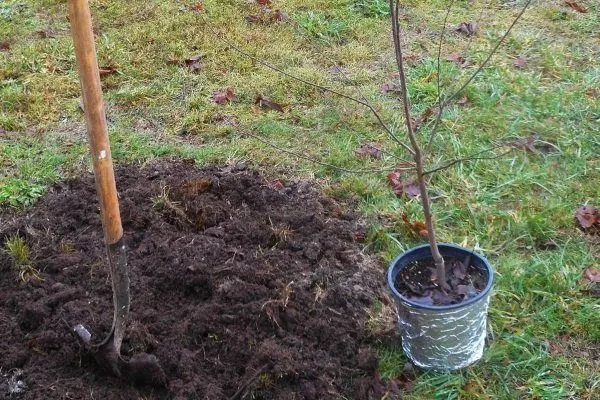
Place
To ensure cherry trees grow well and bear fruit, it's important to select a site with favorable conditions. Site requirements:
- good lighting;
- wind protection;
- fertile and moisture-retentive soils;
- the best soils are loams and sandy loams;
- deep groundwater level – not less than 1.5 m;
- no risk of spring flooding;
- the best neighborhood is cherries, sweet cherries, plums;
- Undesirable neighbors: walnut, rowan, peach, pear, black currant.
The soil for fall planting is dug over 2-3 weeks before planting. Humus is added at the planting site—one bucket per square meter. The soil composition is also adjusted. Sand is added to clay soils, and clay to sandy soils. A special soil mix, available at farm supply stores, can also be added.
Acidic peat bogs are not suitable for growing cherries.
Preparing the pit:
- Dig a hole that is spacious – 80 cm wide and 70 cm deep. Don’t make the hole too narrow – the roots should fit comfortably in it.
- Place a drainage layer on the bottom – broken brick, gravel, crushed stone.
- Drive a stake into the ground – it will serve as a support for the seedling.
- Ten days before planting, fill the hole one-third full with a nutrient mixture. The mixture should consist of:
- fertile soil – 2 parts;
- humus – 1 part;
- peat – 1 part;
- superphosphate – 90-100 g;
- potassium sulfide – 40-50 g.
The hole can be filled with a soil mixture of the following composition:
- compost – 2 buckets;
- ash – 1 kg;
- superphosphate – 400 g.
When planting, avoid using nitrogen fertilizers and lime. They negatively impact the seedling's survival rate and can even burn its roots.
Preparing a seedling for planting
To ensure the seedling takes root successfully, it is prepared for planting:
- Place the seedling in water 10-12 hours before planting. Add a growth stimulant, such as Kornevin, if desired.
- Before planting, trim off any damaged roots. Also trim off any long roots—they should fit comfortably in the prepared hole.
- If there are leaves, do not forget to pick them off, as they can cause dehydration of the seedling.
Planting in open ground
If the hole is prepared, the soil in it has settled, and the seedling is ready, you can begin planting.
Watch a video showing how a cherry tree is planted in the fall:
The procedure for planting cherry tree seedlings:
- If you didn't install a stake while digging the hole, now is the time to do so. Drive an 80cm high stake into the center of the hole.
- Rake the soil from the hole into a mound. Place the seedling's roots on it. Position it so that the roots are spread out and the root collar is 5-6 cm above the ground surface. As the soil settles, the root collar will sink.
- Cover the roots with the soil removed from the hole. Spread it gradually, shaking the seedling occasionally and compacting the soil with your hands to fill the spaces between the roots.
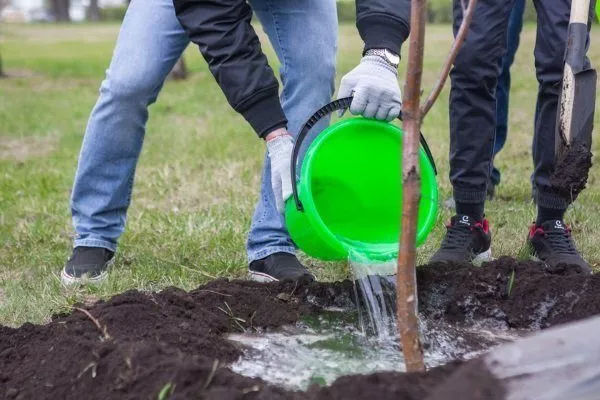
- After filling the hole halfway, add a bucket of water to help the soil settle. Once the moisture has been absorbed, continue backfilling. Finally, firmly compact the soil around the trunk. Tie the seedling to the support, being careful not to damage or compress the bark.
- Water the seedling. To ensure proper watering, dig a 5 cm deep trench around the trunk. Form a ridge around the trunk using the soil removed during the trenching process. Water poured into the trench will be evenly distributed throughout the hole, settling down to the roots.
- Tree trunk circle mulch peat, mown grass or other mulch.
Caring for a planted cherry tree in the first year
In the first year after planting, cherries require special attention. Care for the young tree begins with the arrival of spring. After the cherry tree sleeps peacefully throughout the winter, the onset of spring begins with the introduction of agricultural practices.
Watering and weeding
During the growing season, the tree requires watering. Cherry trees are demanding, but excess moisture should be avoided as this will negatively impact the root system and the overall growth of the tree.
Watering rules:
- Cherry trees are watered regularly, taking into account weather conditions and soil conditions.
- In normal weather, water the young tree once a month; during periods of drought, water it every week.
- It's best to water the tree in a trench dug around its circumference. However, don't use the same hole dug when planting—it should be gradually widened, eventually reaching a depth of 1 meter.
- The recommended watering rate for a young cherry tree is 2-3 buckets per tree. As the tree matures, the watering rate doubles.
After watering, sprinkle the area around the tree's trunk with peat or humus. The mulch layer retains moisture and prevents weed growth. The moisture stored in the fall will help the tree survive its second winter.
Cherry trees don't tolerate weeds; they require regular weeding. Throughout the growing season, the soil around the tree's trunk is loosened, removing weeds along the way.
Fertilizer
During the first year after planting, no additional feeding is necessary—the plant will thrive on the fertilizer placed in the planting hole. Here are some guidelines for fertilizing cherries after the first year:
- The best fertilizer for cherries is compost. It's enough to apply it once every 2-3 years.
- To stimulate large-fruited trees, they are fed complex mineral fertilizers—the same ones applied at planting. These are usually applied in the second or third year.
- In the second year, it is recommended to feed the cherry tree with nitrogen fertilizer, such as urea. Apply 120 g per tree. Spread it around the trunk after watering.
- In the fourth year of life, when the roots exceed the diameter of the trunk circle, fertilizer is applied to the larger diameter. In the spring, 120-200 g of urea is applied, and at the end of August, 500 g of superphosphate and 100 g of potassium sulfate.
The width of the tree's trunk circle is increased to 1 m in the second year. Then, an additional 50 cm is added to its diameter each year.
Is pruning necessary?
During the first year of life, the seedling doesn't need pruning. Cherry trees planted in the fall are inspected in the spring. If any shoots are broken or damaged over the winter, they are pruned.
Formative pruning is performed in the second year of growth. First, three strong shoots are left on the tree, and the rest are pruned. After shortening the selected branches by a third of their length, the central conductor is pruned 1 m from the lower tier. Pruning is then repeated annually.
Formative pruning, in which the upper branches are shortened by a third and all inward-growing branches are pruned, creates a cup-shaped crown. This cup-shaped crown provides good light to all shoots, increases yield, and simplifies fruit picking.
When and how to prune cherry trees is described in this article.
Preparing for winter
Most cherry varieties are characterized by moderate frost resistance, so young trees must be carefully prepared for winter. If extreme frosts occur, young cherries may freeze.
Winter preparation procedure:
- Before frost sets in, wrap the tree trunk in burlap—it's essential to use a breathable material. However, if the winter is mild, the tree may rot under the burlap, so keep a close eye on it.
- When snow falls, cover the trunk with it – this will provide reliable insulation for the young cherry tree.
- To prevent rodents from damaging the bark, scatter poison near the tree. Or cover the trunk with spruce branches.
- ✓ Make sure the mulch layer is at least 10 cm thick to effectively protect the roots from frost.
- ✓ Make sure the trunk covering material is breathable to prevent damping off.
Planting cherries in autumn is virtually the same as planting them in the fall. It has many advantages, but only gardeners in the southern regions—Rostov Oblast, Krasnodar Krai, and the North Caucasus—can take advantage of them. In harsher climates, this heat-loving crop is usually planted in a different location.planted in spring.