
Cherry tree feeding is a key component of overall care to increase yield and protect against diseases. Fertilizers help fruit trees better withstand winter cold. Nutrients are applied in spring, summer, and fall.
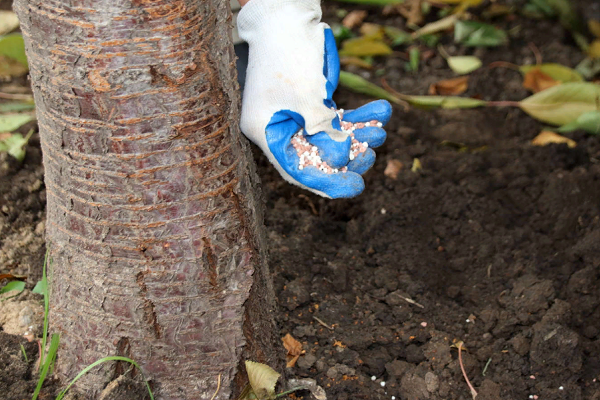
Why do you need to fertilize your cherry tree?
Yield directly depends on soil composition and moisture levels at all stages of cherry tree growth, including autumn (fertilizers affect the number of spring ovaries and the tree's frost resistance). Why is fertilizing necessary?
- ensuring growth and development;
- strengthening the plant's immune system against diseases;
- increasing crop yields;
- improving the taste of fruits;
- increase in berry size;
- fruit color saturation.
- ✓ Soil pH should be between 6.0-7.5 for optimal nutrient absorption.
- ✓ The soil temperature when applying fertilizers should not be below +10°C to activate microorganisms.
When to apply fertilizer?
Cherry trees require fertilization in all seasons except winter, but the amount and type of nutrients applied are important factors. For example, a young sapling requires a lower dose of fertilizer. Knowing exactly when to apply the fertilizer is crucial.
In the spring
Spring fertilization prevents fruit trees from becoming diseased and protects them from the harsh effects of sudden temperature changes.
Regardless of climatic conditions, fertilizers are applied in early spring (the air temperature should be at least +5 °C), when the snow has completely melted and the tree shows signs of sap flow.
This is an important process in which the root system expels liquid, directs it to the crown, and then returns (similar to the circulatory system). This awakening of the plant from hibernation allows nutrients to be distributed throughout the tree.
There are 3 ways to determine the onset of sap flow:
- Use a knife to cut a thin branch and peel off the bark. If the plant is still dormant, the bark will be difficult to remove.
- Examine the color of the bark - when the liquid moves, it acquires warm shades (in winter, the bark has a cool tone).
- Feel the areas where the buds are forming – they should swell.
- ✓ The appearance of drops of juice on the cut branches when lightly pressed.
- ✓ Change in the elasticity of branches – they become more flexible.
What and how to feed:
- Apply nitrogen fertilizer for the first time (100-120 g). Spread it dry around the trunk, dig the soil to a depth of 10 cm, and lightly moisten the soil.
- Apply the next three feedings between April 20 and May 30. Use nitrogen again. To do this, dilute 25 g of the product in 10 liters of water and water the area around the tree trunk.
- In April, treat the crown with fungicides (the dosage is indicated on the product packaging). You can use a mixture of 0.05% zinc sulfate, 0.005% boric acid, and 0.5% each of manganese and urea.
After flowering begins, apply superphosphate (350 g) or potassium sulfate (200 g) to the roots. This is especially important in the South, as cherries ripen very early.
In summer
Many gardeners neglect summer fertilization, mistakenly believing that the tree no longer needs it. However, after flowering and fruit formation, the plant loses much of its strength, weakens, and needs nutrients. If you don't fertilize, the plant will bear little fruit the following year.
Rules and timing for applying fertilizers in summer:
- The first feeding is done immediately after the fruit ripens. To do this, dig holes up to 20 cm deep around the trunk, fill them with compost or well-rotted manure, cover with soil, and moisten.
- After 1-2 weeks, apply nitrogen fertilizer foliarly. Then apply the same fertilizer 2-3 more times, starting in mid-July.
- When the harvest is collected, the tree requires minerals – potassium, calcium, phosphorus.
- After 2-3 weeks, add mullein (8 parts), chicken manure (1 part) to 20 parts water.
In the fall
In the fall, buds begin to develop, which will produce fruit in the spring. Before fertilizing, thoroughly dig around the trunk area and apply the following fertilizers (dry only):
- 70-80 g of potassium preparations, 170-200 phosphorus;
- organic matter – rotted manure – 7 kg per 1 sq. m;
- stove ash – 230-250 g per 1 sq. m;
- ferrous sulfate or another iron-based preparation (necessary to protect the plant from fungal infection).
Recommendations for autumn feeding:
- Apply fertilizer no earlier than mid-October (for central regions). Otherwise, shoot development will be stimulated, which will lead to freezing during winter dormancy.
- The air temperature should not be below +6 °C.
- Before frost sets in, be sure to wrap the tree and the root zone with non-woven material. This will prevent the fertilizer from freezing, which will reduce its effectiveness.
Types of fertilizers and dosage
The type of fertilizer is selected based on the deficiency of a particular substance in the soil, as indicated by signs on the tree. Therefore, you can determine for yourself which fertilizer to apply.
How does mineral deficiency manifest itself:
- Phosphorus. The leaves lose their vibrant color, the fruits fall off before they have time to ripen, and there are too few buds on the branches.
- Magnesium. The leaves take on a brown edge, and the crown becomes dull. The tree stops producing new shoots and foliage.
- Potassium. The fruits appear wrinkled and tasteless. The leaves turn yellow, become covered with red spots (scorched), and become small.
- Calcium. Cherry trees are subject to shoot curvature, leaf curling and spotting, and slow growth and development are observed.
- Nitrogen. Signs of the disease appear in early spring as thin, limp shoots and low branching. Later, the foliage turns yellow.
It is strictly forbidden to exceed the dosage of the medications indicated in the instructions - this leads to a burn and hypermineralization (overdose), which entails unpleasant consequences.
Superphosphate
This mineral fertilizer has a multifaceted effect on plants. The active ingredient is phosphorus, while the additional components are sulfur, magnesium, and calcium.
Regular use of the preparation helps accelerate metabolic processes, increase yields, improve the quality of berries, and accelerate the formation of buds and ovaries.
There are two types of superphosphate:
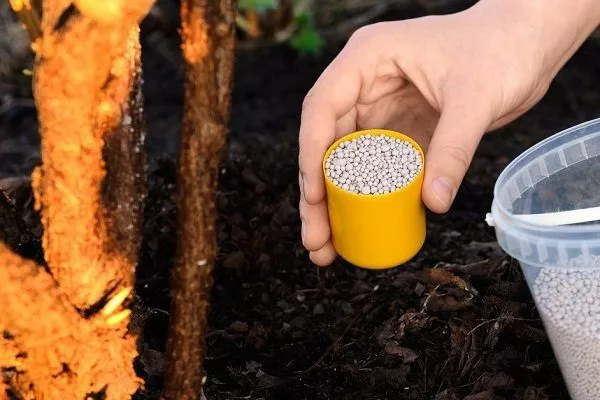
- Ordinary. Available in granular and powder form. In the fall, apply dry fertilizer around the trunk to a depth of at least 15 cm. In May and June, it is advisable to water with a solution (500 to 600 g per square meter).
- Double. High phosphorus concentration (50%). In addition to the essential nutrients (magnesium, calcium, and potassium), it also contains iron and aluminum phosphates. Apply 300 g per square meter in spring and fall.
If the soil is very depleted, the dosage can be increased.
Potash fertilizers
Potassium is found most in clay and loamy soils (up to 3%); other soils contain very little, which is why supplementing with the mineral is so important. A deficiency causes stunted shoot and bud growth, wilt, and weakens the tree, making it susceptible to frost and drought.
Types of fertilizers for cherries:
- Potassium salt. The active ingredient content reaches 40%. The small crystals have a dirty pink hue. The product is highly concentrated, as it is produced by combining sylvinite and potassium chloride, so it is applied to the soil in small doses—15 g per square meter.
- Potassium magnesium sulfate. Contains potassium (29%) and magnesium (9%). It is a solid, gray-pink substance that dissolves quickly in liquid. Fertilize in the fall and spring. 8-10 g per square meter is required. If necessary, the dosage can be doubled.
- Cement dust. Contains 36% potassium. The powder mixture dissolves easily in water, quickly penetrates plant fibers, and additionally neutralizes soil acidity. The recommended dosage for 1 square meter is 150 to 300 g.
- Ammophoska. It consists of 30% potassium, 5% nitrogen, and 25% phosphorus. 25 to 35 g is required per square meter.
- Potassium nitrate. Contains the highest concentration of active ingredients—50%—and is supplemented with nitrogen (13%). It comes in the form of yellowish crystals. 20-25 g is used per square meter.
Ash
Wood ash is widely used by gardeners because it contains potassium, calcium, magnesium, and sodium in the form of silicates, sulfates, chlorides, orthophosphates, and carbonates. It can be used year-round in dry form. One kilogram of ash is required per square meter.
Urea
Another name for it is urea. It is a water-soluble, white, odorless granule. It leaves no residue. It is considered a nitrogen fertilizer, as it contains 49% of this substance.
Due to the high concentration of the element, it is necessary to strictly adhere to the proportions: no more than 60-70 g is applied per 1 sq. m. The best time for fertilizing with urea is March, April (during the formation of green mass).
Fertilizing with urea in the fall is not recommended (except in very depleted soils). Decomposition by soil microorganisms releases ammonium, and the active ingredients in urea penetrate deep into the soil without lingering on the root system.
Ammonium nitrate
This substance contains 35% nitrogen. It is most often used to promote foliage growth and accelerate fruiting. Ammonium nitrate has a light yellow hue and is sold in medium-grain granules.
Note: Spraying is not recommended, as it can burn the delicate leaves. 1 kg of the product is required per square meter.
Compost
This is the most popular organic fertilizer for fruit and berry crops, as it contains large amounts of phosphorus, nitrogen, potassium, and other minerals. This fertilizer is completely free for gardeners (compost is made from grass clippings, fallen leaves, food scraps, etc.).
Composting destroys harmful microorganisms, so the fertilizer adds only beneficial nutrients to the soil. Approximately 40 kg of compost is required per square meter.
It is forbidden to feed the tree with liquid compost or fresh manure, as they still contain pathogens, which makes the tree susceptible to disease.
Dolomite
Dolomite flour is obtained by crushing carbonate minerals, resulting in the formation of crystals of different shades – white, gray, brown.
Dolomite, composed of potassium and magnesium, performs the same function as lime—alkalinizing the soil, but is gentle on the soil (it doesn't alter its composition). It is applied dry at a rate of 70-80 g per square meter.
Lime
This substance is necessary for eliminating excessive acidity. The dosage depends on the soil pH, but on average, 150 to 300 grams of powder is required per square meter.
You can identify high acidity yourself by examining the plants that grow there. These include buttercups, horsetail, sorrel, clover, mustard, and other herbs that prefer an acidic environment.
Mineral fertilizers
Cherries require minerals, which are found in various fertilizers. However, to make the gardener's job easier, you can purchase a ready-made fertilizer from a specialty store. The following products are recommended for this fruit crop:
- ROSLA. Chicken manure (a nitrogen source), magnesium, phosphorus, potassium, and sulfur are used in production. It is intended for summer and spring treatment of cherry trees. If planting a seedling, apply 200 to 300 grams of the preparation per square meter. For fertilization in subsequent years, 150 grams is sufficient.
- Nutrivant Plus. It is used for root and foliar fertilization of trees. The recommended dosage of the working solution is 400-600 g per 10 liters of water.
- Mivena. Designed exclusively for fruit and berry crops, it contains various minerals and normalizes soil pH. It is used only once per season. The recommended dosage for 1 square meter is 160-170 g.
How to apply fertilizers correctly?
Cherry trees are fertilized in three ways: by spraying the crown, by watering, and by dry incorporation of granules into moist soil. The first method is used to prevent, protect, and control insect pests; the second is essential in summer; and the third, in spring and fall.
Foliar feeding
This method involves treating the tree—bark, branches, and leaves—with a preparation. It increases yield, accelerates metabolic processes in the plant, and improves fruit quality.
This occurs due to the compensation of the deficiency of nutrients, which are supplied to the crown from the root system in insufficient quantities.
Rules for foliar feeding:
- spraying is carried out in the absence of wind and rain;
- It is better to do the procedure in the evening or early in the morning (at 4-5 o'clock), since the scorching rays of the sun during the day can burn the plant;
- optimal temperature range is +20-25 °C;
- It is necessary to strictly adhere to the dosage of the medications indicated in the instructions for use.
Fertilizer at the root
Organic components and mineral preparations are applied to the roots in dry or liquid form. Root feeding saturates the tree and soil with beneficial elements, strengthens the immune system, and increases potassium absorption by 15%, phosphorus by 13%, and nitrogen by 15%.
Peculiarities:
- When applying dry fertilizers, you must first loosen the soil, make holes up to 5-10 cm deep, add granules, cover with soil and water (it is acceptable to fertilize before rain);
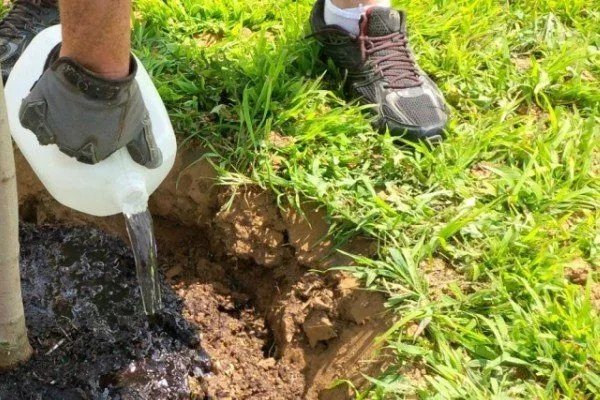
- The liquid mixture is introduced directly under the tree without digging, since when mixing the components, the granules have already dissolved, so they will quickly penetrate to the root system.
You can also learn how to feed cherries in the following video:
Features of cherry tree care
To ensure that your cherry tree grows healthy and produces good fruit, you must also adhere to other basic care rules.
Watering:
- It's especially important to moisten the soil during the period of active fruit growth (May) and during berry ripening (June). Watering is essential in hot weather, which prevents branches and roots from drying out, and in the fall before frost, which helps the plant survive the winter more easily.
- Moisturizing is carried out once a week.
- Watering should be abundant, since the root system goes into deep layers of soil (up to 40 cm).
- Before the procedure, it is necessary to make a circular groove into which the liquid is injected.
- The amount of watering is reduced twice per season: when the fruits ripen (the skin will crack) and starting from the end of August (new shoots will begin to grow, which will reduce winter hardiness).
- For each mature tree, apply 10-40 liters of water, depending on the weather. This prevents cracks in the soil (indicating drying out) and waterlogging (which can lead to fungal diseases).
- The seedlings need to be watered daily – 2-3 liters of liquid per plant.
Tree pruning and shaping:
- To prevent the branches from stretching upward, pruning is carried out in the spring, but before the sap begins to flow.
- The weather should be warm and sunny.
- Pruning level: up to 70 cm.
- The branches are removed so that the central trunk is 15-20 cm higher than them.
- The skeletal branches are shortened by one third and strictly to the bud from the outside.
- The first tier should not contain more than 3-4 branches, the second one less, etc.
- If the branches do not participate in the formation of the crown, they are cut back to 30-35 cm.
- The cut areas are treated with garden pitch.
Helpful tips
Follow the advice of experienced gardeners and specialists to properly fertilize your cherry trees:
- Plant young trees in the fall or spring, adding fertilizer at the same time. At least three weeks before planting, dig holes and add humus, compost, or manure—one bucket is enough.
When planting, add 80 g of potassium and 150 g of superphosphate to the hole. Treat the soil surface around the trunk with 200 g of wood ash mixed with soil. - Fertilize mature plants in the standard manner.
- Distribute dry granules or liquid mixture evenly around the tree trunk circle.
- The area where fertilizer is applied depends on the age of the tree and the width of its crown – the older and more branched the plant, the larger the circle you make.
- Fertilize seedlings only at planting time. The next nutrient application should be in 2 years (if the soil is very depleted, it can be done the following season).
- Until the age of 5, add growth stimulants in larger quantities.
Don't forget to loosen the soil, as cherries appreciate aeration, especially before fertilizing. Remove weeds near the trunk, and monitor the leaves for changes that may indicate disease or pests. By following these simple rules, you'll reap a bountiful harvest.