
Spring pruning of cherry trees is a crucial agricultural practice, determining the longevity and productivity of cherry trees. Let's learn why spring pruning is so important and how to do it correctly.
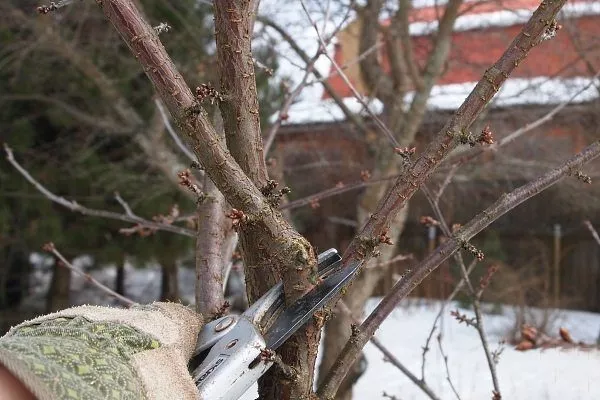
Why is spring pruning necessary for cherry trees?
One of the qualities that attracts gardeners to cherry trees is their early maturity. This tree grows and bears fruit quickly. However, this advantage comes with a downside: cherry trees lose fruit yield just as quickly. This rapidly aging tree requires regular pruning; if ignored, the cherry tree dies prematurely.
Objectives of spring pruning:
- Crown formation. The plant should be symmetrical. Its crown is shaped and thinned to avoid overcrowding.
- Productivity regulation. Proper pruning significantly increases cherry tree productivity.
- Removing old and damaged branches. Along with diseased and dry branches, sources of infection are removed to prevent its spread.
- Improving fruit characteristics. By removing excess branches, you can improve the taste of the fruit and increase its size.
- Rejuvenation. A special pruning technique significantly extends the lifespan and fruiting of the plant.
Exact pruning times
Spring pruning isn't tied to a specific date, but is carried out taking into account the regional climate and weather patterns. Even within a single region, timing varies, influenced by specific weather conditions. The gardener's goal is to complete pruning before the sap begins to flow. This is indicated by swelling and opening buds.
In warmer climates, pruning is carried out around the end of March; in northern climates, a month later. In the coldest climates, the procedure can be carried out in early May.
If the winter was particularly cold and there is a high probability that the tree has frozen, pruning is postponed until a later date – in order to assess the extent of the damage by the opening buds and remove branches affected by the cold.
The best time for pruning is calm, windless weather. A warm day is preferable, as this minimizes the risk of gum flow (resin leakage from wounds).
Preparing for pruning
Many inexperienced gardeners ignore cherry tree pruning, even though this tree already produces quite a bit of fruit. This reluctance to pruning is understandable—it's one of the most labor-intensive and critical agricultural practices when growing any fruit crop. It requires knowledge, time, tools, and equipment.
Agrotechnical rules
Poor pruning will not only fail to benefit the tree, it can actually cause harm. Before you begin, learn the general rules for pruning cherry trees:
- The very first branches to be cut are those that, in close contact with each other, prevent light from reaching the trunk and fruits of the tree.
- Second, branches that intertwine with each other are removed. After assessing the quality of both branches, the denser and stronger one is left.
- If the branches are too intertwined, both are sawed off.
- Old, diseased, and damaged shoots are pruned. While these branches receive nutrients from the tree, they provide no benefit.
- The crown is thinned of excess shoots. The crown should be such that the tree is well ventilated, and overcrowding prevents this.
- Pruning is usually done once a year. However, if necessary, it is repeated in the fall.
- Five years after planting the seedling, the crown begins to form.
- If the cherry tree is bush-shaped, 7-9 skeletal branches are left; if it is tree-shaped, 4-6 pieces are left.
- Only young cherries, no older than 3-4 years, are pruned.
- One-year-old shoots longer than 0.5 m are reduced by 1/3.
- It is not worth pruning the annual growth of a fruit-bearing tree, as this can cause it to dry out.
- Root suckers are removed from grafted trees, as they reduce yield.
- If the annual growth of branches reaches 15 cm, rejuvenating pruning is carried out.
- Wounds that appear during branch removal are treated with garden pitch or oil paint.
Cherry tree branches affected by the disease are removed at any time of year and burned immediately to prevent further infection of the orchard.
What tools are needed?
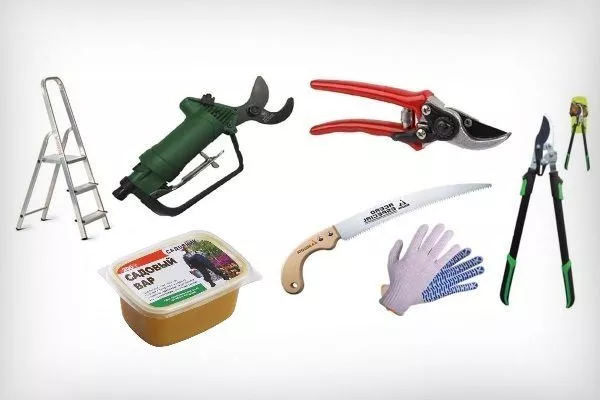
To easily remove a branch of any thickness, prepare the following tools:
- pruning shears – they cut thin branches up to 25 mm;
- knife – they clean cuts and use them for other purposes.
- lopper – they cut off branches with a diameter of up to 2.5-3 cm, located deep in the crown.
- garden saw – with its help you can cut off a branch of any thickness.
Before using the instrument, it is disinfected using one of the available methods:
- calcine over a fire;
- wipe with alcohol;
- treated with a 5% solution of copper sulfate.
Other inventory
- Ladder – you can’t do without it when pruning tall cherries.
- Gloves – to protect hands from damage.
- protective glasses – will protect your eyes from debris and chips flying around during pruning.
- Spacers - with their help, the angle of the branches is changed.
- Ropes – to secure branches whose deflection degree is changed.
Step-by-step instructions for pruning cherry trees in spring
The pruning procedure is determined by the type of cherry tree and its age. Young, mature, and older trees require separate pruning techniques. There are also separate crown shaping procedures for bush and tree cherries.
Young tree
Young cherry trees are pruned immediately after tree plantingThe purpose of pruning is to form a proper crown and promote root establishment. The procedure for pruning a young seedling is:
- The purpose of the shoots is determined. One vertical shoot will become the trunk, while the others will form the tree's "skeleton."
- Leave 5-6 shoots growing in different directions—these will be the skeletal branches. Space them 10-12 cm apart.
- Shoots growing inside and at the wrong angle are cut off.
- Remove shoots that cross and interfere with each other.
- The shoots at the base of the trunk are cut off.
- The cuts are sealed with garden pitch.
- ✓ Garden pitch should be plastic at temperatures from +5°C to +30°C.
- ✓ Does not contain substances harmful to wood, such as petroleum products.
- ✓ Have antiseptic properties to prevent infection.
To increase the productivity of the crop, the seedling is successively pruned, shaping and thinning the crown, over the course of 4-5 years.
Cherry trees typically develop a sparse, tiered crown. This work begins in the second year after planting. The pruning procedure is as follows:
- Second year:
- cut off shoots directed towards the center, dry, diseased, etc.;
- branches that have grown between the skeletal branches are cut off;
- shorten the lateral shoots so that they are 30 cm down from the top;
- branches that thicken the crown are removed to the ring - to the base.
- Third year:
- shoots that have grown to 60 cm or more are shortened by 9-10 cm;
- Two or three branches that have grown over the past year are found; they will be used to create the second tier, and all the others are not needed.
- Fourth year:
- remove branches that thicken the crown and look inward;
- The branches are trimmed, forming a herringbone-shaped crown - the lower branches should be longer than the upper ones, and the upper ones should be 10-15 cm lower than the top.
- leave 2-3 shoots for the third tier.
By the fifth year, the tree should have about 15 scaffold branches. On either side of the scaffold branches are semi-skeletal branches.
You can see how to prune a young tree in the video below:
Fruit-bearing tree
Pruning fruit-bearing cherry trees:
- After sawing off and cutting off the branches that thicken the crown, only horizontal branches are left.
- Trim branches that interfere with the proper growth of the main branches.
- If necessary, reduce the height of the main trunk if it is more than 20 cm higher than the skeletal branches.
- One-year growth is cut to a minimum length.
- Skeletal branches are shortened to the point where new lateral branches have ceased to grow. Subsequently, rejuvenation pruning is performed every 2-3 years.
Cherry tree pruning techniques are largely determined by the cultivar. Cherries can grow as either trees or bushes, and each requires its own pruning method.
Old cherry tree
Cherry trees older than 10-12 years require rejuvenation. "Rejuvenation" pruning prolongs the tree's lifespan and fruiting. It is performed in conjunction with sanitary pruning. If shoot growth per year is less than 15-20 cm, and yield has declined, it's time for rejuvenation pruning. This involves replacing dead, "empty" branches. The key is to take your time and work toward your goal gradually.
- ✓ Presence of live buds on more than 50% of the length of branches.
- ✓ Absence of large cracks and damage to the bark on the trunk.
- ✓ The growth of young shoots over the last year is at least 10 cm.
If the cherry tree has root suckers, the old trunk is cut down and replaced with a basal shoot.
There are several options for restoring cherry productivity:
- Rejuvenation of an old cherry tree by pruning the top:
- The crown is cut off at a height of 2.5-3 m. This pruning activates the lower lateral buds, from which new lateral shoots will grow.
- When new branches appear, the most favorably positioned ones are left. The others are removed.
- While new branches are growing, remove 1-2 old branches each spring.
- Creating a new skeleton from tops – branches located perpendicular to the surface:
- To stimulate the appearance of water sprouts, shoots in the crown are cut off so that stumps remain.
- The tops are tilted at a certain angle and tied to stakes.
- The method of shortening skeletal branches. On an old skeleton, branches are shortened to the upward-facing lateral branches. There are two options for rejuvenation pruning by cutting off skeletal branches:
- Light. The cut is localized where the wood is 2-3 years old - in front of the second-order branches, in the center of the frame branch.
- Deep. The skeletal branch is cut near the trunk – where the wood is 4-5 years old.
If the plant is neglected, don't remove too many branches at once—cherries don't tolerate any kind of pruning well. It's best to remove branches in stages.
You can see the pruning of an old cherry tree in the video below:
Tree cherry
Cherry trees bear fruit on special branchlets. Each branchlet bears several flower buds, with a single vegetative bud at the top. Branchlets bear fruit for several seasons. To promote branchlet formation, shoots from the previous year are pruned. For tree varieties, 5-6 skeletal branches should be left to form the crown.
Features of pruning tree varieties:
- If annual growth is less than 15 cm and the skeletal shoots are bare at the base, the tree should be rejuvenated. To do this, prune shoots that are three years old.
- If the branches dry out at the ends or completely, it is necessary to cut off the lateral branches on 5-year-old branches.
- For trees 3-3.5 meters tall, growth must be restricted. This is accomplished by pruning the skeletal branches, cutting off their tops to encourage growth to the lateral branches.
Bush cherry
In bush cherries, flowers and fruits form on the previous year's branches. Bush varieties, unlike tree varieties, produce fruit only on one-year-old shoots. A shoot, called a replacement shoot, grows from the apical growth buds and bears fruit the following year. Fruit is primarily produced by the tips of annual branches. This is why young shoots are never removed from bush varieties to avoid losing a harvest.
Bush varieties require extensive thinning. The plant is prone to becoming dense, so it's important to thin it thoroughly in the spring, otherwise the fruit will be small and the yield will be low.
Features of pruning bush cherries:
- The angle between the trunk and lower branches should be no more than 40 degrees. If the angle is too large, the tree may eventually collapse.
- To create a strong skeleton, branches that compete with the main trunk are pruned.
- When forming the crown, 7-8 skeletal branches are left.
- The shoots facing downwards are cut off.
- At the age of two years, branches that have reached 50 cm in length are cut back by 1/3 of the seedlings.
- The ends of skeletal and semi-skeletal shoots are cut off to the dormant bud.
- Only shoots from plants that have grown to a height of 80 cm are left.
Features of pruning felt cherry
Felt cherry trees begin bearing fruit in the second year after planting. They are known for their high yields. A properly pruned cherry tree has 10-12 main branches. Regular pruning is necessary for maintenance and rejuvenation. It's also important to monitor the height of the felt cherry tree, maintaining it at 2-2.5 m.
The plant tends to become dense, so pruning is done every spring. Berries form primarily on one-year-old shoots.
Features of pruning felt cherries:
- Annual shoots are the main source of fruits; they are reduced by 1/3 if they are longer than 60 cm.
- All old, diseased, damaged, dry and inward-facing branches are removed.
- On old felt cherries, lateral shoots are removed to the ring, without affecting the central part of the crown and skeletal branches.
Sanitary pruning of different types of cherry trees
| Type | What to do? |
| Tree-like |
|
| Bushy |
|
| Felt |
|
Annual pruning
Once the cherry tree's crown has formed, the tree has gained strength, and is producing fruit, it's sufficient to perform sanitary and stimulating pruning once a year, in the spring. This work requires precision and consistency. Mature fruit-bearing trees are pruned first—they bloom first—then young seedlings are pruned.
A gardener shares his experience pruning cherry trees in the following video:
Trimming order:
- They clear the crown, removing excess and thickening branches.
- They give the tree the desired shape.
What mistakes can be made?
What mistakes do gardeners make:
- Pruning is carried out after the sap begins to flow.
- They avoid pruning, believing the cherry tree can thrive without it. Without pruning, the tree risks developing a dense crown, small fruit, and low yields.
- Do not prune trees that are weakened, frozen, or not producing new shoots. Pruning promotes rapid recovery of fruit trees.
- An attempt to "revive" a cherry tree with a damaged main conductor and cracked bark on the trunk. The tree should be replaced with a young one.
Practical recommendations
What you need to remember when starting to prune cherry trees:
- Be sure to disinfect your tools when moving from one tree to another.
- Use a garden knife to trim the cuts so that no stumps remain – as they dry out, they pose a risk of infection.
- When pruning, take into account the characteristics of the tree – its age, type and condition.
- Destroy cut branches immediately to prevent the spread of diseases and pests.
To ensure the cherry tree in your garden is beautiful and produces a good harvest, it requires proper pruning. This procedure is carried out taking into account the tree's age, condition, and variety. Annual spring pruning can significantly extend the productive life of the cherry tree.
I only pruned my cherry trees in the fall, but now I know I need to do it in the spring too. I want to thank you for the very detailed instructions, timing, and so on. This is a helpful article; I'll recommend it to my neighbors.