
Cherry trees, like any stone fruit tree, require pruning in the fall. This procedure helps form a beautiful crown, increases yield, improves frost tolerance, and reduces the risk of disease.
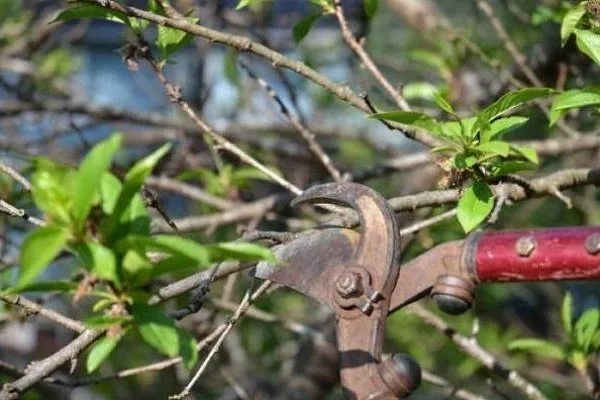
Why prune cherry trees in the fall?
In autumn, pruning is carried out for the purpose of thinning and sanitation. The following are subject to removal:
- diseased, old, dry branches;
- vegetation at the base of the trunk;
- shoots that grow into the crown;
- dense, intertwined shoots.
Along with infected branches and debris, bacteria, insects, and fungal spores are removed from the leaves. This eliminates the possibility of pests overwintering.
After the sanitizing treatment, the tree and the surrounding area are sprayed with a 5% urea solution. This fertilizer kills pests, fungi, and infectious pathogens.
Overgrown trees are thinned out to form a proper crown and allow unimpeded penetration of sunlight and air.
In autumn, cherry trees are dormant, making pruning easier. In spring, active sap flow begins, and buds begin to open. Any interference with this process can cause gummosis.
A good time for pruning
Each region has its own timeframe for the procedure:
- in the central part of Russia, the Volga region, Moscow and Leningrad regions - this is September to mid-October;
- for the Urals and Siberia - no later than the end of September;
- In the south of the country, pruning is carried out in November.
Cherry trees can be pruned with their leaves only in warmer regions. In other areas, the procedure is carried out before the leaves fall.
The main rule is to avoid severe frosts, otherwise the plant's winter hardiness will decrease. Branches are pruned in dry weather, before the onset of cold weather.
Inventory
Garden tools must be high-quality and safe to use. The following tools are used for tree pruning:
- pruning shears for removing branches up to 3 cm in diameter and young shoots;
- lopper, for work in hard-to-reach places and at the top of trees;
- a hacksaw or garden saw for cutting branches longer than 5 cm;
- a stepladder for working on tall varieties of cherry trees.
Garden tools should be kept clean after use to reduce the risk of disease transmission from an infected tree to a healthy one. Another important requirement is that tools should be sharp to allow for neat, burr-free pruning of branches.
Wearing gardening gloves will protect your hands from injury. Latex, canvas, or leather gloves are recommended.
How to trim correctly?
The shape, age, and variety of the tree influence the methods and purposes of pruning in the autumn, but there are universal rules common to all species:
- The first tier of branches should not deviate from the trunk by more than 40 degrees, so that the tree does not break.
- Old and thick shoots are removed using the "ring cut" method. Ring-shaped growths are visible at the base of the branch; these are carefully trimmed along the upper edge, leaving no stumps or damage.
You cannot make a cut along with the ring, this will lead to cracking of the wood, festering of the bark, and the appearance of a hollow. - Pruning to a bud is used to shape the tree's crown. To thicken the tree, pruning is done to an inner bud, while thinning is done to an outer bud. The cut is made at an angle, 5 mm from the bud.
- Dry and diseased parts of the tree are burned after removal. This will prevent the cherry tree from becoming infested again.
To learn how to properly prune cherry trees in the fall, watch the video below:
Pruning by age
The goals and methods of pruning differ for young and older, fruit-bearing trees. Let's look at the specifics of the procedure depending on age.
Young
A young tree is just gaining strength, so follow these recommendations:
- Don't prune seedlings during their first autumn. They may be killed by frost.
- In young trees, excess shoots are removed to promote the development of a proper crown. Strong branches (4-5) are left, spaced 10 cm apart and growing in different directions.
- Grown trees are shortened at the top, and excess branches directed inward into the crown are removed.
- Skeletal and main branches of young plants are not pruned.
The fruiting throughout the tree's life will depend on how the young cherry tree is pruned.
Old
In older cherry trees, excess branches are removed to rejuvenate the tree and increase yield. Shoots are shortened by 1/3 of their total length, thinned, and skeletal shoots are cut back to the level of developed lateral branches. One-year-old shoots are left untouched.
In autumn, the tree is cleared of dry, diseased, and overgrown branches.
Fruitful
During the peak fruiting season, annual shoots weaken, and skeletal branches become bare. To increase berry production, a third of the tree's main branches are pruned per meter. Developed annual shoots are pruned minimally.
In autumn, branches of fruit-bearing trees that interfere with each other due to growing in the wrong directions are cut off.
Mature cherry trees are pruned every 2-3 years. Young trees are pruned annually until the proper crown is formed.
Pruning depending on the tree shape
Cherry trees come in two varieties: tree-like and bush-like. Crown formation and fruit placement differ, so care requires its own nuances.
In bush varieties, flower buds are located only on one-year-old growths, while in tree varieties, they are located on growths from previous years, bouquet branches, and one-year-old shoots.
Bush cherry
Bush cherry varieties expand in summer. In the fall, the crown is carefully thinned. Also, suckers, dead, and diseased branches are removed. To ensure the plant maintains vigor and productivity, observe the following conditions:
- young shoots are not cut off (the branch may dry out);
- the branches of the crown are directed outward;
- bushes up to 50 cm long are left untouched;
- the bare ends of the branches are cut to 30-50 percent of the total length;
If the growth of bush cherry is less than 20 cm per year, intensive cleaning is carried out.
Tree cherry
The height of such a tree can reach 5 meters due to strong skeletal branches, so in addition to thinning, it is shortened at a young age.
Unlike bush cherries, tree cherries are pruned on their first-year shoots. This stimulates the development of lateral branches. Gardeners prefer a combination or sparse-tiered system when caring for tree cherries.
Do felt cherry branches need to be trimmed?
One of the differences between felt cherry and other varieties - the absence of thickening shoots, which simplifies the pruning procedure, but does not cancel it.
The felt cherry tree's crown is thinned annually, leaving no more than 10-12 bushy shoots. One-year-old branches are left alone, as they produce berries. The exception is half-meter-long branches, which are pruned by 1/3.
The following video shows how a gardener prunes a felt cherry tree:
Compliance with pruning conditions helps to increase the lifespan of felt cherry.
How to care for a cherry tree after pruning?
The cut areas are treated with garden varnish, paste, or putty. This is done to:
- prevent the entry of bacteria and insects;
- the trees have not lost much liquid (moisture comes out of the wound in the first hours).
- ✓ The cuts should be smooth, without nicks, for better healing.
- ✓ Apply garden pitch only in dry weather.
To activate the tree’s defenses, after pruning, the biostimulant “Novosil” is sometimes used (3 ml of the preparation per 10 liters of water).
Before filling the cuts, carefully trim away any uneven areas. Apply the mixture to the dry surface with a wooden spatula or putty knife.
Notes, hints and tips
Those just beginning to prune cherry trees will find it helpful to heed the advice of experienced gardeners:
- Before forming the crown, the top of the trunk is sawed down to the optimal height and only after that the crown is cleared of excess shoots.
- If you're unsure which branches to prune, look at the buds. Branches with fewer buds are cut off.
- Excessive unnecessary branches from one tree are removed over several seasons.
- Young cherries should not be pruned too much, otherwise there will be fewer fruits.
- Branches of a two-year-old tree that have grown more than 60 cm are shortened by a third.
- Horizontal branches produce a good harvest of berries. Care must be taken to ensure they grow upward.
- The first tier shoots growing downwards are cut off.
- To increase yield, tree growth is limited to 3 m. Care is taken to ensure that the central stem is 20 cm taller than the upper branches.
Some gardeners use the lunar calendar as a guide when pruning. Days during the waning moon and before the new moon are considered favorable.
Novice gardeners will benefit from studying the structure of a cherry tree and learning to distinguish between shoots, vegetative branches, and branching branches. Proper pruning helps cherry trees withstand winter cold better and extend their lifespan.