
Cherry tree yield directly depends on the quality of crown pruning. The success of the procedure is influenced by many factors, including the season of the work, the age of the tree, and adherence to the pruning instructions. This article describes the key features of branch removal, types of crown shaping, and common mistakes made by novice gardeners.
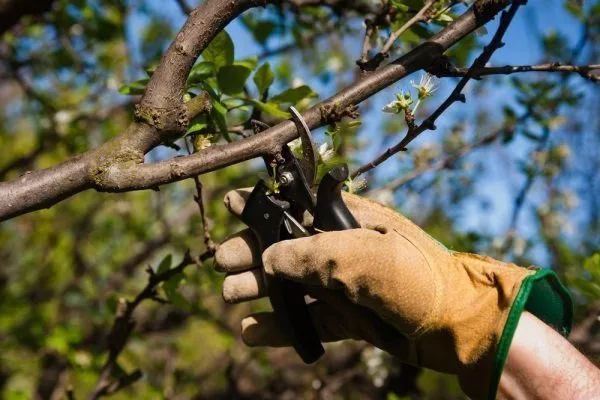
Why is pruning necessary?
Many homestead owners consider pruning unnecessary. Citing their own trees as an example, they boast of stable growth and abundant yields. However, without proper care, the crown quickly becomes dense, blocking light and air from reaching the tree's core.
Fruit-bearing branches begin to die off quickly, and the few remaining shoots produce significantly fewer buds. Fruit set in low light conditions grows small and tasteless, and the lack of ventilation in the crown promotes bacterial growth and wood rot.
Timely pruning of cherry trees improves the tree's condition and harmonizes its development:
- allows you to form the crown correctly;
- significantly increases crop yields;
- develops resistance to temperature changes;
- reduces the risk of infestation by garden pests.
It's known that lateral horizontal branches produce the greatest yield. Pruning directs the seedling's growth toward these areas, allowing for a high yield.
Timing of pruning
The start of pruning work often coincides with tree planting. This process is carried out in several stages, as removing a large number of branches in one season reduces the plant's vitality and yield. Let's consider the specific timing of pruning depending on the period of work.
- ✓ Consider the air temperature: not below -5°C for winter pruning to avoid wood cracking.
- ✓ Pay attention to the moon phase: pruning during the waning moon promotes better wound healing.
Timing of winter pruning
Since wood becomes brittle and vulnerable to temperature fluctuations during the cold season, extensive branch removal is undesirable. The only acceptable measure is rejuvenation pruning—a procedure performed on large, old trees experiencing declining yields and fruit quality.
It is better to carry out work in February, monitoring the temperature forecast and choosing the warmest days.
Timing of spring pruning
Spring garden landscaping should be carried out before buds swell and sap begins to flow, from mid-March to the first week of April. During this period, plant branches are thinned, which improves aeration of the crown and promotes even sunlight distribution. Trees are carefully inspected, removing damaged branches and shoots damaged by frost.
Summer pruning period
Summer pruning is carried out in two stages, between the end of flowering and the beginning of fruit formation. This is done in early July, during which young shoots are shortened and the foundation of the future structure is formed. The second pruning is performed after the harvest.
Timing of autumn pruning
Fall foliage is the signal for fall pruning. This procedure is carried out until late September or early October to allow the cuts to heal better and prevent the tree from wasting too many nutrients. Broken and non-fruiting branches are also removed; their absence allows the cherry tree to better survive the winter.
What tools are needed?
The main requirements for pruning tools are durability and quality. Tools purchased from an unscrupulous seller will quickly become unusable and fail to perform their intended function, which will adversely affect the tree's health and productivity.
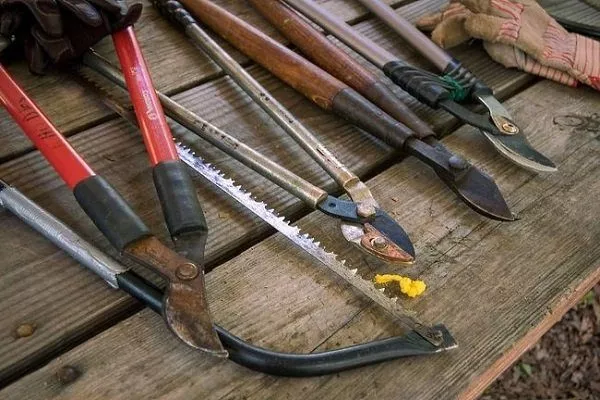
A sharp cutting tool for working with branches:
- Secateurs – used for cutting branches up to 2.5 cm thick.
- Loppers – Similar to pruning shears, but with longer handles, making it easier to work in hard-to-reach areas or in untidy tree canopies. Works well on thick branches over 3 cm.
- Garden saw – the main tool for processing old trees and sawing thick branches.
- Knife – used for cleaning cuts and performing procedures that require precision.
- Scissors – used for thinning seedlings and shoots that have not yet become woody.
Auxiliary equipment for gardening:
- Ladder – necessary for pruning tall trees.
- Work gloves – provide protection for hands when performing activities.
- Safety glasses – prevent small debris falling from the tree during pruning from getting into the eyes.
- Rope – fixes bent branches in one position.
- Spacers – a simple device that bends branches away from the area being treated.
- Cuffs – strips of elastic material that protect the bark of young branches from mechanical damage.
Cherry wood is softer and more brittle than that of other garden trees, so it's not recommended to trim branches with regular pruning shears. To minimize damage to the shoots, it's best to use pruning saws, carefully cleaning the cut areas with a knife.
How to prune branches correctly?
Regardless of the time of day when sanitary works are carried out, there are general recommendations that must be followed:
- The pruning process begins with an inspection of the garden. This will help identify poorly lit and ventilated areas within the tree's crown and remove diseased and underdeveloped areas. If some branches are crossing, they are pruned back, leaving the stronger ones.
- Cherry branches should be cut at the base, in the middle of the annular burl. This is where tissues that accelerate wood healing are located. If you cut beyond the burl, the wound will be too large, and the plant will take a long time to recover.
- Also, stumps should not be left on the main trunk or side branches—over time, they will rot and the tree may die completely. If the branch is thick and heavy, it can be cut in two stages: sawing off the main body of the tree and removing the remaining stump.
- Be sure to disinfect the cuts. When removing small branches up to 1 cm thick, treat the surface with garden pitch or natural oil paint. Larger cuts are coated with mullein and clay, then covered with plastic wrap.
If the procedure is performed in the spring, be careful of cold and damp conditions. Over-chilling during pruning can cause gum to form on the branches and trunk, which is harmful to all stone fruit crops.
Features of cherry tree pruning
The full range of pruning procedures depends on the region where the crops are planted, its climate, and the age of the tree itself. To create a healthy plant that will bear fruit vigorously, have an aesthetically pleasing appearance, and ensure easy harvesting, pruning should be carried out regularly from the first year of planting.
Spring pruning
During this period, different types of pruning are carried out, everything depends on the age of the cherry tree.
Saplings. When applied to seedlings in the early stages of development, this procedure lays the foundation for crown development and gives it a stable shape. This correction is typically performed when the seedling reaches a height of 70 cm or more. If the cherry tree was planted in the fall, the shoots are pruned no sooner than after a year and a half. Unlike mature trees, part of the top of the seedling is removed in the first spring. The required distance is calculated by counting six young buds from the main shoot.
The tree is 2 years old. In a two-year-old cherry tree, the lower tier of branches begins to form in the spring. To correct this area, select four strong shoots. Using pruning shears or loppers, shorten each branch by 40-50 cm. A similar procedure is performed with the central bud, from which the four upper buds are counted and the top is removed.
Third year. By the time a tree reaches its third spring, its crown is forming on two levels. To control this process, skeletal shoots are pruned to the same length as the smallest branch. Young growth directed toward the crown is completely pruned. If the remaining branches extend upward and sideways, forming an angle of no more than 45 degrees with the central trunk, the crown is formed correctly.
Fourth yearDuring the fourth spring pruning, the trunk is brought down to the level of young scaffold branches located on the sides of the crown. The third tier is trimmed to 20 cm below the crown, but no longer than 70 cm. If the second tier branches do not exceed this length, no shortening is required. All subsequent operations performed in the spring will involve the removal of branches growing deep into the crown or straight upward.
Watch a video about pruning cherry trees in spring:
Summer pruning
Timely summer pruning is a good way to limit the growth of annual shoots that are of no value to the gardener. A crown thinned during this season is exposed to favorable environmental influences, which directly improves the taste and quality of the growing fruit. Technically, the procedure is similar to spring pruning of a mature tree, but due to active growth, it is faster and causes less damage.
Summer corrective work is carried out at the end of May. During this process, the gardener removes defective branches and part of the central basal shoot, removing the trunk at a height of 3.5 m and directing growth to a strong lateral shoot. The current year's shoots are shortened by 4-5 leaves to a total length of 15-20 cm. This procedure stimulates branching and fruit set. If corrective work is missed, carry it out after the harvest.
At the end of the fruiting season, pruned branches will regrow. They should be shortened to 10 cm, leaving 3-4 leaves on which new flower buds will form next year. In addition to improving the tree's health, this will eliminate pest infestations, protect scaffold branches from being exposed, and reduce labor costs.
Pruning after planting
The optimal time to prune a seedling is right before planting. Removing excess branches at this stage gives the crown the desired shape, accelerates root establishment in the new soil, and improves nutrient distribution among the remaining shoots.
The procedure is performed before buds begin to form. The gardener selects 4-5 of the strongest branches, prunes the rest, and carefully seals the wounds. The remaining shoots should be directed laterally and spaced 10 cm apart. Further work is performed on seedlings that are well-rooted and have been in the garden for more than a year.
If you are interested in how to plant a cherry tree correctly, you can readthis articleIt describes in detail the method of planting cherry trees in spring and subsequent tree care.
Work on an old tree
Mature cherry trees produce a good harvest and have a well-formed crown, but they require pruning just as much as young saplings. Each year, frozen shoots appear on the trunk, the bark peels off in some areas and becomes diseased, and branches become mechanically damaged and stop bearing fruit. Pruning an old tree promotes rejuvenation and is performed in dry, warm weather.
When inspecting the trunk, remove all new growth that has appeared over the past 3-4 years, and remove broken branches and other defective areas. Similar to other pruning methods, the cut areas are coated with garden pitch, and if the wound is too large, they are wrapped in plastic wrap. If the pruning is performed correctly, the tree will produce many new shoots throughout the season, and the fruit production will increase significantly.
Pruning a young tree
A common method of pruning a young tree is to prune back the first-year shoots. There are three types of this procedure: light, medium, and heavy pruning. The specific method is determined based on the growth characteristics of other trees on the site, the soil composition, and the prevailing climate at the site.
- With weak shortening, the young seedling is cut by a quarter of its length, stimulating the growth of the upper buds and the stretching of the shoots at an acute angle.
- Medium pruning involves cutting off half of the plant: the seedling forms more lateral shoots and begins to bear fruit earlier, but the skeletal branches form more slowly.
- The severe pruning option involves removing more than half of the seedling. The remaining buds produce strong lateral shoots, running parallel to the trunk or slightly off-center.
- ✓ The presence of shoots growing at an angle of less than 45 degrees to the trunk requires their removal to form a correct crown.
- ✓ The absence of lateral shoots at a height of 50-70 cm from the ground indicates the need for stimulating pruning.
The process of pruning a young tree can be seen in the video below:
Formation of cherry trees
The goal of cherry tree training is to maintain the tree within certain boundaries, managing its growth and fruiting. Procedures performed at different stages of the tree's development vary in execution, but they are based on the same principle of increasing yield.
In the first year
A sparse, tiered crown is best suited for cherry trees. This consists of a thick trunk 3-4 meters tall and a series of skeletal branches extending from a central core at a 40-50 degree angle. To establish the foundations for this structure, annual growth is pruned by a third to half, removing immature parts and frozen shoots. This work is performed in early spring before bud formation.
In the second year
The main stage of corrective work occurs in the second year, when the seedling has successfully acclimatized to its planting site. The first tier of the crown consists of young shoots growing half a meter from the ground. The gardener selects three of the strongest branches, spaced 15-20 cm apart, and completely prunes off the remaining shoots.
The following years
In the third year, the cherry tree sapling has grown considerably, so it's time to begin forming the second tier. When pruning, extend half a meter up from the first layer of branches and select two strong shoots. The third tier is formed in a similar manner, 30-40 cm away from the second. One skeletal branch is left in this tier, and the central conductor that rises above it is pruned.
After cultivating the crown base, it's time to form lateral branches. To do this, select several first-order shoots from the main branches. When the selected branches reach 70 cm, they are shortened. If the shoots are used to create the skeleton, they are pruned to 50 cm; otherwise, to 20 cm. The cherry tree crown reaches its final shape in the fifth or sixth year, after which sanitary and rejuvenation pruning is performed.
Basic crown shapes
A sparsely tiered crown isn't the only way to arrange branches on a growing sapling. In horticulture abroad, crowns can be given other shapes, ensuring high yields and guaranteed fruiting stability.
When starting corrective work, create a pruning plan in advance. If the scaffold branches have already formed, it will be impossible to change the tree's structure.
Spanish Bush
The fruit crop correction technique adopted on the Iberian Peninsula not only curbs tree growth but also increases planting density, improving fruit ripening and facilitating harvesting. It is well suited to regions with mild climates and low temperature fluctuations.
How to carry out the formation:
- Formation of the "Spanish bush" begins in the spring, if more than a year has passed since the seedling was planted in its new location. Once the plant has reached sufficient height, it is pruned to 40-70 cm. The exact height depends on the number of buds on the trunk and the planned placement of the shoots that form the base of the crown.
- Over the summer, the remaining buds on the trunk form branches 50-60 cm long. Select the four strongest shoots and shorten them, leaving their tips 10-15 cm above the main trunk. To adjust the angle, tie the branches to stakes.
- In the fall, trellises are erected in the area where young trees are grown. One-year-old, half-meter-long shoots are tied to them. This procedure helps form a symmetrical, open crown, improve sunlight exposure to the fruit, and accelerate fruit set.
- A year after the corrective measures, the branches are pruned again. Shoots tied to the trellises and one-year-old growth on the sides of the trunk are shortened to a quarter of a meter. Branches located in the center of the crown or growing parallel to the ground are left untouched.
Correct execution of the work will promote branching of shortened shoots and the formation of the first harvest in untouched areas.
In this video, a gardener shares his experience cultivating a "Spanish Bush" cherry tree. This type is considered the most popular, so we decided to show it specifically:
Australian Bush
The Australian pruning method involves creating a low crown to facilitate fruit picking. The branch structure is strengthened by the presence of multiple trunks of equal size.
Cherry tree formation:
- Immediately after landing. Cherry trees are pruned to half a meter. During the summer, lateral shoots appear on the trunk, of which four are selected. Branches that are unsuitable in strength and length are removed. Once the shoot reaches 4-6 cm above its growth point, a clip is attached, positioned parallel to the trunk. This corrects the direction of the branches, making them almost horizontal.
- In the spring of the second year. The tree is inspected again, removing any shoots that are out of line with the crown structure. If the shoot is skeletal, the gently sloping branches of the first order are left on it, giving the cherry tree a fruit-bowl shape.
- In the third year. The cherry tree crown is cleared of young shoots, trimming them to a length of 8-10 cm. Failure to do this will result in the main branches being shaded, and the yield will be reduced.
Further work will include autumn pruning of annual growth, sanitary removal of shading branches, pest and frost control, and crown adjustments within the existing shape.
Cherry tree formation KGB
The Kym Green Bush is a modern training scheme that ensures compact planting, promotes tree rejuvenation, and reduces the risk of winter frost. The KGB system resembles the "Spanish Bush" but differs in the placement of the fruiting sections.
It is known that in fruit crops pruned using the Spanish system, vertical leaders remain permanent, and fruit set development shifts to renewable shoots and lateral branches. In the KGB system, on the contrary, lateral branch development is abolished, and fruit growth occurs on renewable vertical leaders.
Regardless of a tree's age, crown shape, or growing conditions, pruning stimulates its development, increases yield, and protects it from environmental stress. The nuances of this procedure, described in this article, will be useful for both novice gardeners and agricultural experts.