
Gardeners and gardeners face the challenge of choosing the right variety due to the wide variety available. Among these, the Novella cherry is particularly popular, gaining recognition for its excellent characteristics and delicious berries. With proper care and minimal effort, you can grow a strong and fruitful tree.
History of selection
Breeders A. F. Kolesnikova and E. N. Dzhigadlo worked on its development. Novella was created by crossing two cherry varieties (Rossoshanskaya and Vozrozhdenie) with bird cherry. Testing was conducted in Oryol at the All-Russian Research Institute of Fruit Crop Breeding. It was added to the State Register in 2001.
Appearance of the Novella cherry
Novella is a young but promising cherry variety. It is gaining popularity due to its low maintenance and other characteristics.
Tree
It reaches a height of up to 3 m. It has a rounded, spreading crown that is slightly raised. The bark on the trunk and main branches is brownish-brown, while on young shoots it is tan. The buds are small, approximately 4 mm in size, slightly tilted, and ovoid in shape.
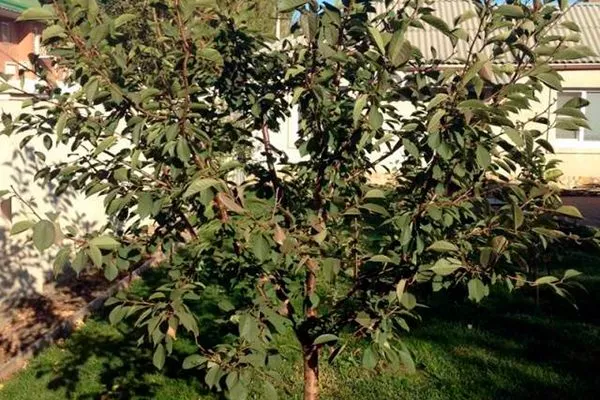
The leaves are matte and elastic, dark green in color. They are obovate in shape, with a pointed tip and a pointed base. The edges are decorated with small oblique teeth. A single gland is present on the petiole and at the base.
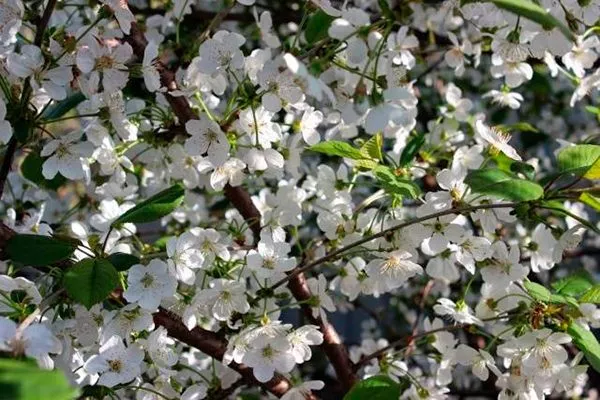
The inflorescence contains four flowers. The corolla is free-petaled and white. The stigma and anthers are located at approximately the same level. The berries form on the bouquet branches and the previous year's shoots.
Fruit
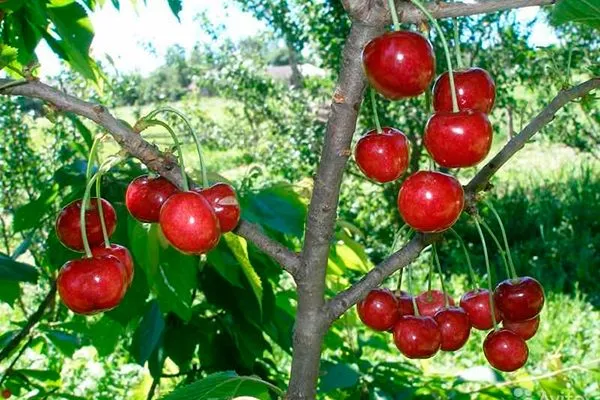
They have a rich, dark burgundy, almost black hue. The diameter of a ripe berry is approximately 2 cm, and it weighs approximately 5 g. The shape is broadly round with a slightly flattened appearance. The seed is yellow, round, and easily separated from the pulp. The seed weighs no more than 5% of the total berry weight.
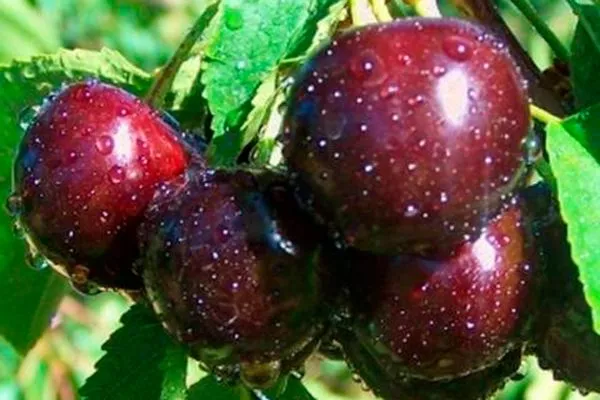
The stalk reaches a length of 3.8 to 4 cm, and the fruit separates easily, leaving a slightly moist area. The flavor is sweet and sour, and the flesh is medium-firm and dark burgundy. The juice is dark red. The fruits are easy to transport and are not prone to cracking.
Brief description of the variety
Novella has the potential to be long-lived, demonstrating high resilience with proper care in the Central Black Earth Region. It delights gardeners with abundant harvests and is disease-resistant with regular care.
Drought resistance, winter hardiness
It exhibits high winter hardiness, with bud resistance rated as average in the recommended growing region. In northern regions, there is a risk of bud frost damage. In the south, with its milder climate, additional cover is not required.
Drought tolerance is satisfactory. During hot summers, watering the tree 1-2 times per month is recommended to maintain optimal moisture levels.
Pollination, flowering period and ripening time
Flowering begins in mid-May, subject to weather variations, with the first buds typically opening between the 10th and 18th of the month. Berries ripen simultaneously, mid-early, and harvesting typically begins after July 15th.
It is a partially self-fertile variety, yielding 7 to 20% of its yield without pollination by other trees. For a good harvest, pollinators are recommended: Griot Ostheimsky, Shokoladnitsa, and Vladimirskaya.
Productivity, fruiting
Fruiting begins four years after planting. The average yield is 77.6 centners per hectare, with the maximum reaching 99.8 centners. Fruiting is not always consistent. In years when flower buds are exposed to low temperatures, the number of berries formed may be minimal.
Application of berries
It has a versatile use. The sweet and sour black berries are suitable for fresh consumption and are excellent for making jams, desserts, and other sweet dishes. They are characterized by their high juiciness. Crossbreeding with bird cherry imparts a unique flavor and aroma.
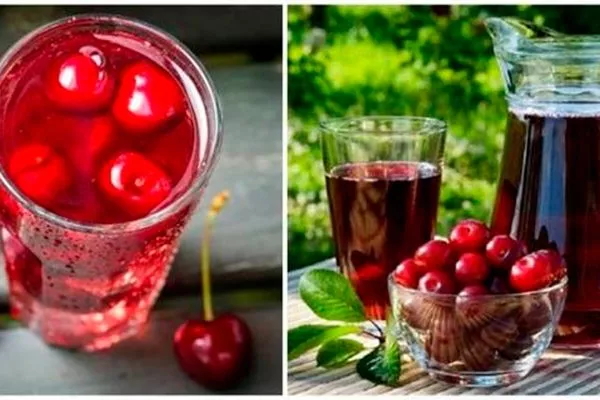
Particularly valuable processed products include juices, wines, liqueurs, and other beverages. Thanks to their excellent properties, these products can be a pleasant addition to culinary experiments and treats.
Resistance to diseases and pests
Novella is less susceptible to pests than other varieties. It exhibits high resistance to various pests and is highly resistant to fungal diseases.
What crops can and cannot be planted next to cherries?
When choosing neighbors, choose pollinator cherries. This will help ensure optimal pollination and increase yield. Other stone fruit varieties are also suitable. It's important that the tree crowns don't shade each other.
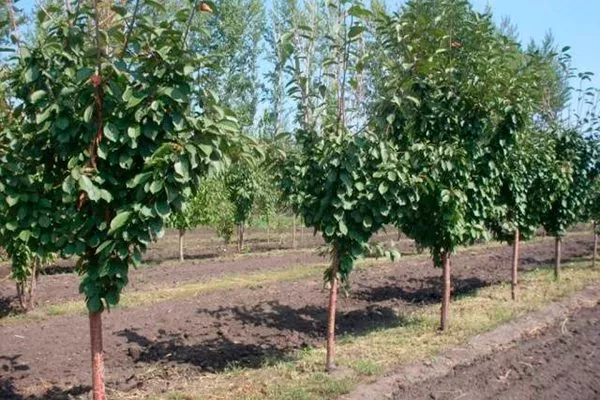
Avoid planting near linden, maple, walnut (especially walnut), and birch, as they can be incompatible neighbors. Cherry doesn't get along with black currant, and sea buckthorn, blackberry, and raspberry can compete for moisture and nutrients.
Once the plant has established roots, plant shade-tolerant groundcovers with shallow roots around the trunk. This will help protect the topsoil from overheating and reduce rapid moisture evaporation, promoting healthier growth and development.
Advantages and disadvantages
Before planting a new crop in your garden, make sure you are satisfied with its positive and negative qualities.
Among the disadvantages of the crop, gardeners note partial self-fertility and limited resistance of flower buds to possible recurrent frosts.
Landing features
Recommended planting times and locations vary by region. In the Central Black Earth Region, early spring planting is recommended, before bud break. In southern Russia, fall planting, after leaf fall, is considered a more suitable time.
- ✓ The soil pH level should be strictly within 6.5-7.0 for optimal nutrient absorption.
- ✓ The depth of groundwater is at least 2.5 meters to prevent rotting of the root system.
Helpful tips:
- The ideal location would be the sunny southern side of a fence or building, or a western slope with a minimal inclination.
- The soil should be fertile, loose, and neutral. Avoid proximity to groundwater at a depth of less than 2 m.
- Purchase planting material from reputable sellers. The root system should be well-developed. A one-year-old seedling should not exceed 80 cm in height, and a two-year-old should not exceed 110 cm. Mature trunk wood is grayish-brown in color.
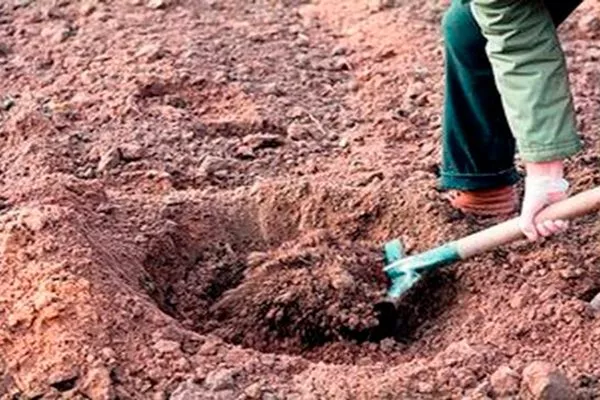
- The planting procedure involves soaking the seedling's roots for 3 hours or more. It's best to prepare the hole in the fall, measuring 40-60 cm deep and approximately 80 cm in diameter.
- Don't use the soil from the hole to fill in the roots. Add humus, 50 g of potassium salt, and superphosphate to the top layer of the excavated soil. Acidic soils require lime, while dense soils require sand.
Step-by-step instructions:
- Drive a stake into the side of the center.
- Place the seedling in the planting hole, gradually fill it with fertile soil, and compact it gently. The root collar should be 5-8 cm above the soil surface.
- Form a barrier around the hole using the remaining soil.
- Tie the seedling to a stake and water it with 20-30 liters of water.
Mulch the soil with humus.
Subsequent care of the culture
A young plant planted in spring requires ample watering throughout the season. The roots must receive adequate moisture to facilitate successful establishment and a safe winter. When the soil dries out, loosen the soil and remove weeds.
- In early spring, apply nitrogen fertilizer at a rate of 20 g per 1 m² to stimulate growth.
- In mid-summer, add potassium-phosphorus fertilizers (15 g per 1 m²) to maintain fruiting.
- In the fall, add organic fertilizers (humus) to improve the soil structure and prepare it for winter.
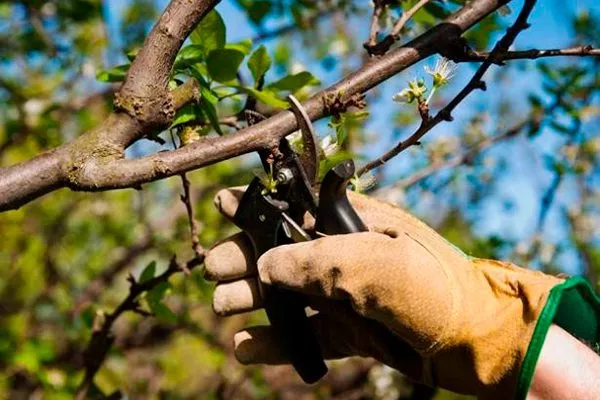
In subsequent years, regular watering is especially important during hot summers. In the fall, rehydrate the soil. Fertilize with cattle manure and ash. When using mineral fertilizers, apply nitrogen in the spring, and potassium and phosphorus in the fall.
Features of tree wintering
In regions with southern and Central Black Earth climates, this variety typically requires no winter cover. To protect against hares, you can wrap the trunk in burlap or tie it with straw.
Diseases and pests, methods of control and prevention
The crop exhibits high resistance to diseases and pests. However, this does not mean it is completely invulnerable to problems. Below are recommendations for preventative measures:
- Coccomycosis. The spots on the leaves eventually develop into holes. A coating appears on the underside. By mid-summer, the diseased leaves fall off.
In the spring, when the buds open, treat the plants with a copper-containing preparation, and after leaf fall, with ferrous sulfate. In the fall, remove and burn plant debris, and prune regularly. - Moniliosis. The plant looks scorched. After the flowers and leaves fade, entire branches die. Preventative measures are similar to those recommended for coccomycosis. Remove diseased branches down to healthy wood and seal the cuts with garden pitch.
- Aphid. Small, elongated, brown or green flying insects suck the juice from the cells of young leaves and shoots, secreting a sticky secretion.
Control ants – they attract aphids. Treat affected trees with Bifenthrin. - Cherry sawfly. Slimy, leech-like larvae chew holes in the leaves. Prune and thin out the leaves, and treat the plant with insecticides in the spring and fall when larvae appear. Use Actellic.
It is important to detect the problem in a timely manner in order to solve it as quickly as possible and with minimal risks.
Methods of reproduction
Increasing the number of seedlings at home is easy. It's important to choose the most suitable method:
- Cuttings. Cut mature shoots (cuttings) and place them in potting soil. This method is suitable for producing genetically identical plants.
- Root shoots. Use root suckers that form near the mother plant.
- Green shoots. Use shoots with leaves for propagation.
Purchasing seedlings from a nursery is considered a more reliable and convenient method. When purchasing, choose specimens with a closed root system.
Harvesting and storage conditions
Harvest the fruit as it ripens. The optimal time is dry weather, preferably in the morning after the morning dew has cleared or in the afternoon when sunlight weakens. Harvesting during rainy periods can negatively impact the quality of the berries.
Reviews
With so many modern varieties available, it can be difficult to choose. Gardeners who have appreciated the excellent qualities of the Novella cherry recommend it for planting in their gardens. With proper and timely care, the plant rewards with strong immunity and abundant harvests.
I'm not entirely sure why this cherry tree received such a low tasting score—only 4.2. The cherries are delicious and juicy, though. I have one of these trees growing. Now, after reading the article, I've learned a lot about not overfeeding and pruning it back significantly. I'll definitely follow your advice. Thank you!