
Morozovka is one of the most popular dessert cherry varieties among gardeners. It is characterized by its low maintenance, high yield, early ripening, and excellent berry flavor.
History of selection
Morozovka is a cherry variety developed by Russian breeders. The cultivar was developed by T. Morozova in the 1980s.
This cherry variety was developed for temperate climates. Morozovka was created by crossing the Lyubskaya and Vladimirskaya cherry varieties.
The Lyubskaya cherry produces large, tasty berries and is disease-resistant. The Vladimirskaya cherry is frost-hardy. The new Morozovka cherry variety has acquired the resistant characteristics of its parents.
Description of the Morozovka cherry
Appearance of the Morozovka cherry variety:
- Tree. Low to medium growth, reaching 2-2.5 m in height.
- Crown. Wide, raised.
- EscapesLarge, gray-green in color, they produce a small number of lenticels. Buds are forming on the shoots.
- Leaves. Oval-shaped, dark green in colour, with a glossy plate and a slight redness at the base.
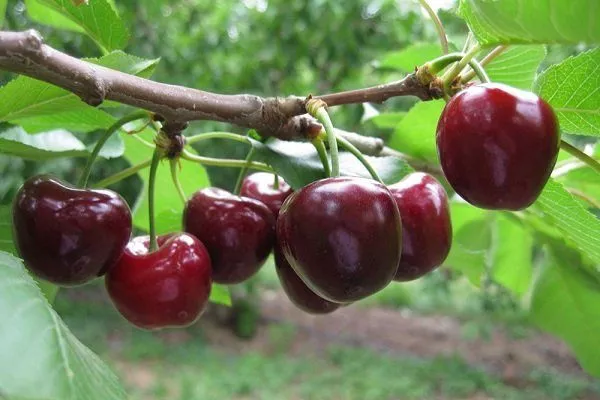
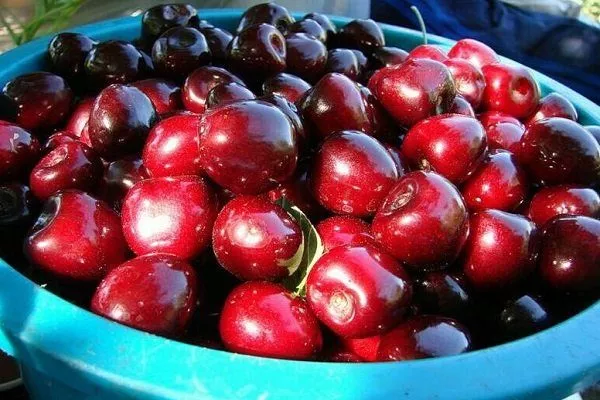
- Fruit. Dark red, no blemishes. Berries weigh 4-5 g. The flesh is firm, with a sweet and sour flavor. The skin is dense, elastic, and resistant to cracking.
- Flowers. Large, have rounded white petals.
Chemical composition of berries:
- sugars - 10.5%;
- acids - 1.37%;
- ascorbic acid - 30 mg/100 g.
Characteristics of the variety
The Morozovka cherry is a hybrid and is considered one of the best domestically bred varieties. Its juicy berries and high resistance to adverse weather conditions and diseases make it suitable for cultivation in both farms and private gardens.
Winter hardiness and drought resistance
You can water it several times a season, even in hot summers – the Morozovka variety has high drought resistance.
Good winter hardiness allows this crop to be grown in temperate and cool climates. The variety tolerates low temperatures well.
Flower buds can freeze only in the northern Black Earth Region.
Pollination
A characteristic feature of the Morozovka cherry is its inability to self-pollinate its flowers. To ensure normal development and fruiting, self-fertile cherry trees must be planted in close proximity.
The best pollinator varieties:
- Griot Michurinsky;
- Lebedyansky;
- Zhukovsky;
- Vladimirsky;
- Turgenevsky.
Without pollinators, the Morozovka cherry blossoms, but does not form ovaries.
Flowering period and ripening time
Cherry blossoms in April. The berries ripen in July, sometimes a little earlier, depending on the climate and weather. The tree bears fruit three to four years after planting.
Productivity and fruiting
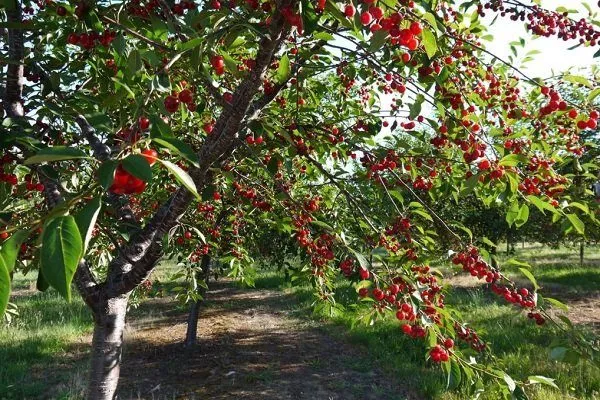
The crop produces high yields with the right pollinators. A single tree can yield over 35 kg.
Areas of use of berries
Uses of Morozovka cherries:
- freezing;
- pies;
- sauces;
- compotes;
- jelly;
- jam;
- syrups.
Resistance to diseases and pests
Disease resistance is increased, especially against coccomycosis. Even when other plants are heavily infested, the cherry tree remains unaffected. The variety has a moderate resistance to insects and their attacks.
Advantages and disadvantages
The advantages of this variety include the following qualities:
- early maturity;
- early fruit bearing;
- stable fruiting;
- excellent taste and appearance of fruits;
- frost resistance (tolerates frosts down to -27 degrees);
- undemanding in care.
The disadvantages include:
- early flowering, so in northern regions the buds may be damaged by spring frosts;
- self-sterility of the tree.
Planting Morozovka cherries
Choosing a planting site is crucial for Morozovka. One- or two-year-old grafted trees are typically planted. The seedlings aren't particularly demanding, but they prefer fertile soil with adequate drainage to protect the tree's roots from becoming overwatered during rainy seasons.
Timing and selection of landing site
Planting can be done in the spring, in the second half of March, or in the fall, in early September. During this period, the plant will be protected from frost and drought, allowing it to establish better.
When choosing a site for a young cherry tree, it's best to choose a southern or southwestern part of the garden. The area should be well-lit and protected from the wind. A sunny location 1.5-2 meters from a low fence is an excellent choice.
The groundwater level in the area should not be higher than 1.5 meters to allow the roots to develop freely. Cherries prefer loamy, sandy, and sandy soils with a neutral pH (pH 6-6.5).
- ✓ The soil pH level should be strictly within 6-6.5 for optimal nutrient absorption.
- ✓ The depth of groundwater is at least 1.5 m to prevent rotting of the root system.
Good and bad neighbors
You can plant crops such as:
- cherries;
- plum;
- elder;
- honeysuckle;
- grape.
Once the cherry tree has entered fruiting and is well established, groundcover plants can be planted underneath. These will protect the roots from overheating and retain moisture.
Cherry does not tolerate proximity to:
- sea buckthorn;
- raspberries;
- blackberries;
- black currant;
- gooseberries;
- peach;
- red rowan.
Selection and preparation of planting material
Don't buy seedlings from someone. It's better to buy them from nurseries or reputable garden centers. One-year-old cherry trees about 80 cm tall and two-year-old seedlings up to 1.1 m tall thrive.
It is better to choose seedlings with the following characteristics:
- height from 70 to 110 cm;
- root length at least 15 cm;
- the surface of the branches and trunk is without damage;
- the bark is light brown;
- the root is well developed.
Before planting, soak the seedling in water for several hours. If you purchased a bare-root tree, not protected by plastic wrap or clay slurry, soak it in water for 24 hours, adding rooting solution (1 g per 1 liter of water).
- Soak the root system of the seedling in water for 12-24 hours to restore turgor.
- Treat the roots with a solution of root solution (1 g per 1 liter of water) to stimulate the growth of the root system.
- Remove any damaged or dry roots before planting.
Landing
The procedure for planting a seedling is very simple to perform:
- Make a hole at least 0.5 m deep and wide.
- If you are planting more than one tree, leave a distance of 2.5-3 m between the holes.
- In the central part of the hole, form a mound 15 cm high, into which you will install a peg.
- Place the seedling in the hole, spreading the root system over the hill.
- Fill with soil and compact.
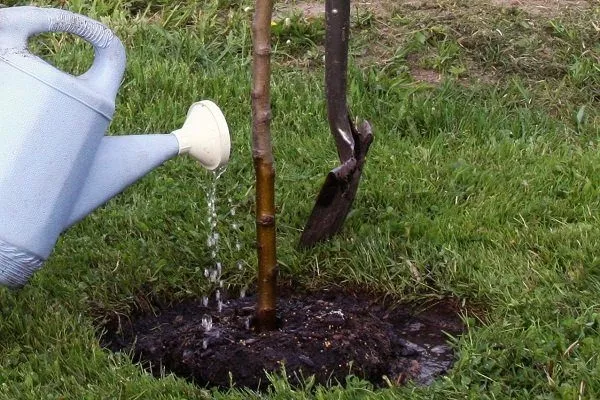
- At a distance of approximately 30 cm, dig a ring hole and fill it with water (30 l per seedling).
- Once the liquid has been absorbed, cover the tree trunk circle with mulch and tie the tree to a stake.
Caring for Morozovka cherries
Morozovka is considered an unpretentious cherry variety, but proper care will help the tree produce a bountiful and delicious harvest.
Watering
For normal fruiting, cherry trees should be watered 4-6 times per season. The recommended watering rate is 40-70 liters per tree (larger amounts for mature trees).
Watering is done during the following periods:
- end of flowering;
- ovary formation;
- end of harvest;
- preparation for winter (no later than mid-October).
The final watering is intended to deeply saturate the soil with moisture. It's best to apply water via drip irrigation, but you can also use sprinklers or watering through temporary ring furrows.
Top dressing
The quality of the harvest directly depends on fertilizing. Cherry trees need to be fertilized annually for the first seven years. After that, specific intervals are observed between fertilizing. Mineral fertilizers are applied every two years, and organic components every four years.
Fertilizing the Morozovka cherry tree:
- Before flowering, cherries are sprayed with urea (20-30 g per 10 liters of water) or root fertilized with ammonium nitrate (15-20 g per 1 sq. m of the tree trunk circle).
- During flowering, apply root fertilization with the following solution: 5 liters of mullein and 10 cups of ash per 50 liters of water. One bucket of fertilizer is required per tree.
- Two weeks after the second feeding, apply a phosphorus-potassium fertilizer: 1 tablespoon of potassium sulfate and 1.5 cups of superphosphate per 10 liters of water. One bucket of solution per square meter.
Additionally, manure or compost is added in winter to protect the root part of the tree from frost.
Soil care
Regular loosening of the soil under the tree is recommended to remove weeds and ensure good aeration. Loosening is done after watering, when the soil has dried slightly, to break up the soil crust. The soil should be worked to a depth of 10-15 cm (shallower near the trunk).
Starting from the fifth or sixth year after planting, you can sow the spaces between the rows with a lawn mixture. In this case, loosening the soil is unnecessary, but the grass should be mowed regularly and left as mulch.
Pruning and crown shaping
This cherry variety requires regular pruning, both sanitary and to shape the crown. Branches are removed with a sharp, sterile tool, and the cut surfaces are treated with 3-4 coats of oil paint or garden pitch to prevent trunk infection.
Tree pruning diagram:
- In the year of planting, the top of the cherry tree seedling is cut by 10-15 cm.
- In the second year, all lateral shoots located on the trunk of the seedling are cut out, except for the three most developed ones.
- In the third year, two or three well-developed third-order shoots are left on each of the main lateral branches.
- By the fourth year, the cherry tree crown is formed, so only the annual growth of branches is removed.
- In subsequent years, pruning can be used to regulate the height of the tree and the length of the main branches.
In addition to formative pruning, the tree requires sanitary pruning. This is done in October. All dead and damaged branches are removed to help the tree awaken more quickly from dormancy in the spring.
Mature cherry trees require rejuvenation pruning. This is done between the 10th and 12th year of life. If new growth does not reach 15 cm within a year, and the skeletal branches are bare at the base, the tree is pruned back to three-year-old branches, shortening them by 25-30%.
To rejuvenate a cherry tree, you can trim 50-60 cm of the main shoot, which will lead to lightening of the crown and the formation of new lateral shoots.
Preparing for winter
The crop easily survives the winters of central Russia, but the trees require certain preparatory measures.
To ensure that the cherry tree survives the winter successfully:
- Clear the soil under the tree of weeds, fruits, leaves and branches.
- Dig up the tree trunk circle.
- Mulch the tree's roots with sawdust or peat to a depth of 15 cm. Remove the mulch in the spring to prevent the roots from overheating.
- Whitewash the trunk and one-third of the first-tier branches with a solution of 1 kg of lime, 500 g of powdered clay, and 200 g of copper sulfate. For mature trees, dilute the mixture in 5-7 liters of water; for young trees up to 5 years old, dilute it in 10-14 liters of water.
- Cover young trees with burlap or spruce branches.
- In winter, rake the fallen snow under the tree into a high (at least 40 cm) snowdrift.
Diseases and pests
The main diseases of the Morozovka cherry:
- Clasterosporium or holey spot. A fungal disease that causes brown and tan spots to appear on leaves. Dead tissue falls off, leaving holes.
All affected parts are removed and burned (this is especially important to do in the fall before the cherry trees are wintered), and the trees are treated with 3% Bordeaux mixture. - CoccomycosisReddish spots appear on the leaves, which enlarge over time, turning into spots. A pinkish bloom is visible on the back of the spots.
They are treated with 3% Bordeaux mixture, and after flowering they are sprayed with copper oxychloride. - AnthracnoseDull spots appear on the fruit, followed by lumps. Over time, the cherries dry out.
Before flowering, spray with the drug "Oxyhom" (10 liters of water per 40-80 g of the product). - RustThe outer side of the leaf blades becomes covered with orange or brown swellings.
Spraying is carried out before and after the formation of flowers with copper oxychloride (40 g per 5 l of water, consumption of 4 l of solution per tree).
It is necessary to pay serious attention to pests that damage trees and crops:
- Cherry aphid. Signs include curling leaves and black dots appearing on the back side – these are aphid colonies.
Spraying the foliage with a soapy solution (1/2 bar of laundry soap per 10 liters of water) is effective against pests. Chemical pesticides such as "Iskra" (dilute one tablet per 10 liters of water and spray the affected areas) can also be used. - Slimy sawflyThe pest lays eggs on the underside of leaves. The leaves themselves appear scorched.
Use Fitoverm or Aktara (4 g per 10 liters of water). Spray once before or after flowering. - Cherry weevil. The reddish-bronze beetles eat buds and flowers, while the larvae gnaw at the leaves.
After flowering, treatment with Karbofos (35 g per 5 l of water) is carried out, and repeated after 7-8 days. - Hawthorn. The butterfly caterpillars feed on buds and leaves. They overwinter in nests made of dry leaves held together by cobwebs.
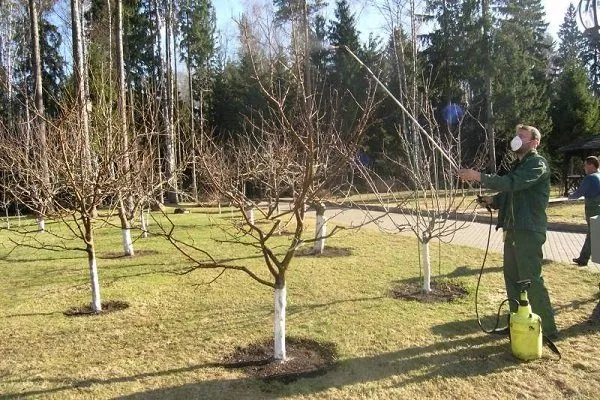
Spraying the tree and the trunk circle in early spring with a solution of 500 g urea and 100 g copper sulfate per 10 liters of water helps against the pest.
Protection from birds and rodents
The following will protect you from rodents that damage the bark and lower shoots of the tree:
- Wrapping the trunk with a special mesh or any other dense material.
- At the beginning of the season and before winter, the tree trunk is coated with whitewash. This deters animals and prevents them from feeding on the bark.
Birds eat some of your crops, so they need to be kept away. Effective ways to control these avian pests include:
- Cellophane bags tied to branches. They repel birds with a rustling sound (foil can be used instead).
- Cassette tape. Tied to branches.
- Nets that completely cover the tree crown along with the fruits.
- Special repelling devices that create low-frequency sounds.
With proper planting and proper care, the Morozovka cherry tree will reward you with a bountiful harvest of delicious and healthy berries. Its high tolerance to adverse weather conditions makes it popular among gardeners and farmers.