
The Garland cherry tree is widely popular among gardeners due to its high yields and a number of positive characteristics. To ensure successful growth and development, this crop requires proper care, including regular watering, soil loosening, and fertilizing.
History of selection
It was developed at the Rossoshanskaya Horticultural Station during variety trials in 1988. The breeder was A. Ya. Voronchikhina. The parents are the Krasa Severa cherry and the Zhukovskaya variety.
Description of the culture
The plant has a number of distinctive characteristics that make it popular among both novice and experienced gardeners. Below is a botanical description.
Height and dimensions of an adult tree
Characterized by a compact tree, not exceeding 4 m in height. Other plant details:
- It has a rounded crown. It is not too dense and consists of branches extending from the trunk at almost a right angle.
- Young shoots grow straight, have a reddish-brown hue and are distinguished by long internodes.
- Over time, the bark turns greyish-brown, and in the next stage it becomes grey-black.
- The branches are covered with large, smooth, and concave leaves, round, often asymmetrical, and dark green in color. The upper part of the leaf blade is sharply pointed, and the base can be either wedge-shaped or rounded.
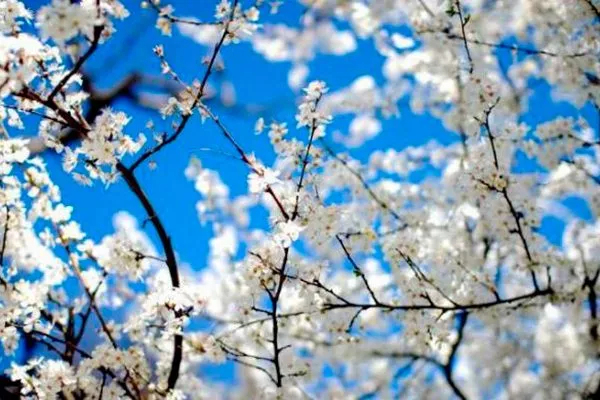
Large white flowers, collected on long stalks, are arranged in groups of 3-5, sometimes 1-2. Their diameter reaches 3.5-4 cm.
Fruit
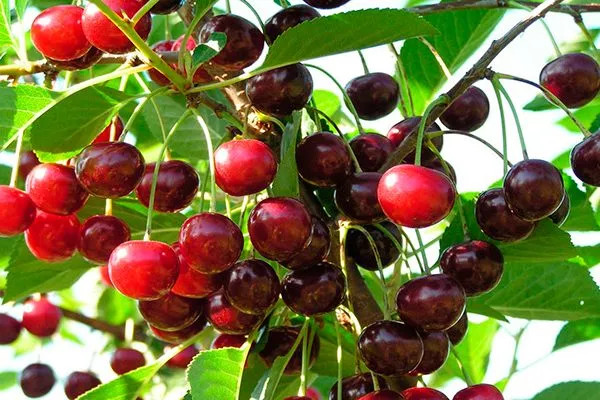
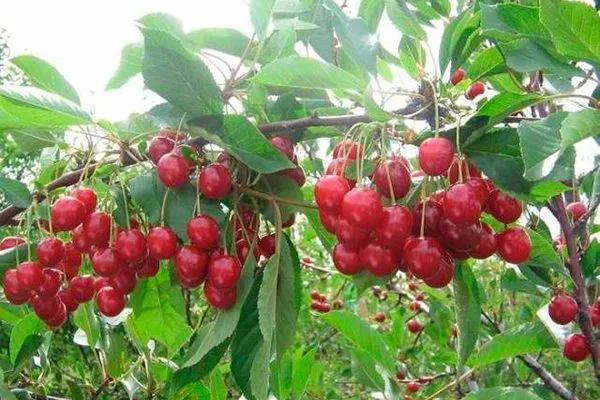
They are distinguished by their impressive size and weight of approximately 6.1 g. Garland berries are very easy to identify:
- When mature, they can take on a variety of shapes, from heart-shaped to rounded-conical specimens tapering toward the top. Their color reaches a deep red hue.
- The flesh is a rich red color with small light veins. The texture is meaty and tender, and the juice is light red.
- The taste is characterized by a harmonious combination of acidity and sweetness.
- Each berry contains a large seed that easily separates from the pulp. The seed can weigh up to 0.44 g.
- The composition includes 10.7-19.8% dry soluble substances, 8.7-12.0% sugars and 1.5-2.0% titratable acids.
Characteristics
The Garland cherry tree has significant potential. Its high yields attract gardeners not only in our country but also around the world.
Drought resistance, winter hardiness
The plant doesn't cope well with periods of drought, so it's important to avoid over-drying the soil. It tolerates frosts well and exhibits high frost resistance. Even in severe frosts, shoots only begin to freeze at temperatures below -30°C.
Pollination
It is self-fertile and does not require additional cross-pollination. However, planting adjacent cherry and sweet cherry trees with similar flowering periods can only increase yields.
Flowering and ripening time
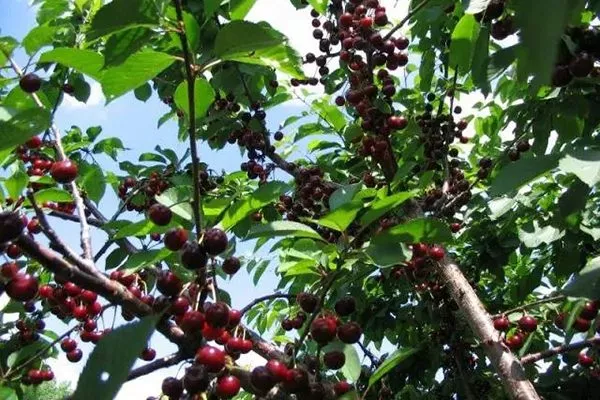
This is a mid-early variety. It begins bearing fruit 3-4 years after planting. Harvest occurs in mid-June, and mass ripening occurs in late June. A characteristic feature is the simultaneous ripening of the berries.
Productivity
A young tree produces about 8 kg of berries, and over time this quantity increases, reaching up to 25 kg. In particularly fruitful years, mature trees can yield up to 60 kg.
Application of berries
They have a versatile use. They can be eaten fresh, preserved, or used to make jam. The fruits are used to make juices and wine, as they contain sufficient amounts of acid and sugar.
Resistance to diseases and pests
It may be susceptible to attacks by pests typical for this crop. The variety has average resistance to coccomycosis, but exhibits high resistance to monilial blight.
Favorable conditions for growing
Recommended for cultivation in the North Caucasus. Currently, this variety is relatively uncommon and is cultivated in the southern Voronezh region and northern Rostov.
Favorable and unfavorable neighbors
It is recommended to plant other cherries, sweet cherries, or any stone fruit trees near the tree. Avoid planting near birch, maple, walnut, oak, or elm. After successful rooting, groundcover plants can be placed underneath.
Sea buckthorn and raspberries are best planted at some distance, as their extensive root systems can quickly spread outward, forming dense growth and negatively impacting growth.
Advantages and disadvantages
The variety's characteristics indicate that its numerous advantages outweigh its disadvantages. Among its advantages are the following:
Among the disadvantages, gardeners note a large stone, insufficient frost resistance of flower buds, average resistance to coccomycosis and low transportability.
Landing features
Plant the seedlings at the beginning or end of the season. In spring, do this before the sap begins to flow and the buds begin to open, and in autumn, 15-20 days before the onset of permanent cold weather.
- ✓ The optimal soil pH should be between 6.5 and 7.0. Deviations from this range can significantly reduce yield.
- ✓ The depth of groundwater should not exceed 1.5 meters to avoid rotting of the root system.
Helpful tips:
- Choose a planting site at an elevated elevation, eliminating the risk of stagnant meltwater and precipitation. The plant prefers warmth and light, so avoid shade and strong winds.
- If you plan to plant several cherry trees, keep a distance of 3-4 m between them to ensure free growth and development.
- Prepare the holes 4-6 months before planting. Standard hole sizes are 80 cm wide and 60 cm deep.
- Suitable soil types include loam, sod-podzolic soil, and chernozem. If the soil is heavy and compacted, line the bottom of the hole with a 1:1 sand and gravel drainage layer (10 cm thick).
- Drive a 1 m high stake into the center of the hole. This will serve as a support for the young tree.
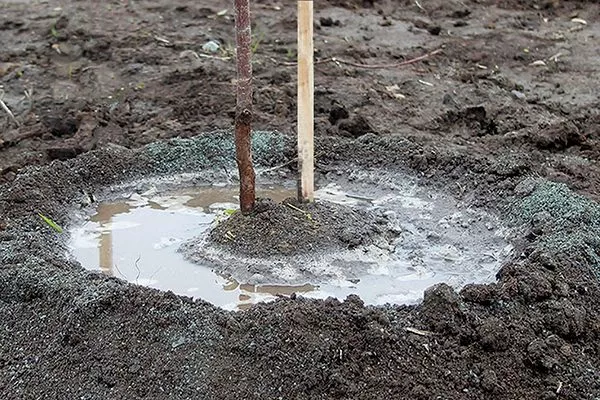
The planting stages include the following:
- 8 hours before planting, soak the plant roots in a growth stimulant solution, such as Kornevin.
- Level the hole and create a drainage layer if necessary.
- Place the seedling in the center of the hole, close to the peg, with the root collar located 3 cm above the soil.
- Carefully straighten the root system, covering it with soil.
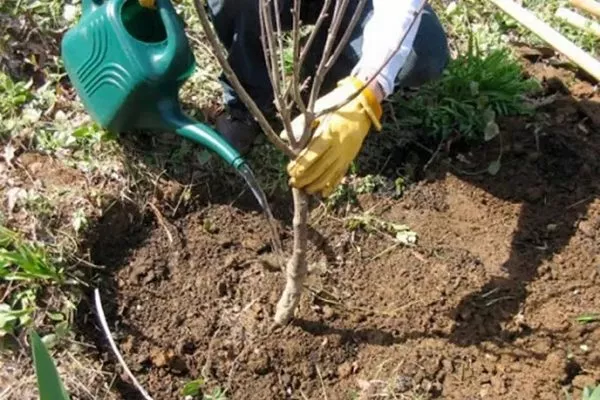
- After filling the hole with soil, water the plant with 20-30 liters of warm, settled water.
- Wait for the soil to compact and settle.
Create a circular mound of earth around the trunk, 5 cm high, and mulch the root circle with straw, sawdust, or pine branches.
Subsequent care of the culture
After planting, provide the young plant with abundant and frequent watering, especially during dry periods. Follow basic gardening practices:
- Mature trees require regular watering only in the case of a hot summer without precipitation, and in the fall, moisture recharging is carried out.
- During the first few years, loosen the soil under the tree regularly. The optimal fertilizer is a fall application of 10 kg of humus and 1 kg of ash, which contain all the necessary elements, to the tree's trunk circle. Apply nitrogen in the spring, and potassium-phosphorus compounds in the fall. The plant requires minimal amounts of phosphorus.
- The garland does not require winter shelter, but regular pruning and shaping before the sap begins to flow, as well as sanitary pruning, should be done as needed.
To protect the trunk from hares, use burlap, straw, or install a special metal mesh.
Diseases and pests, methods of control and prevention
In the fall, when persistent cold weather sets in, treat the trunk with garden paint or limewash to a height of 40-60 cm. This process provides protection against winter burns, rodents, hares, and pests. Wrap young shoots with thick agro-material or protect them with a plastic shield.
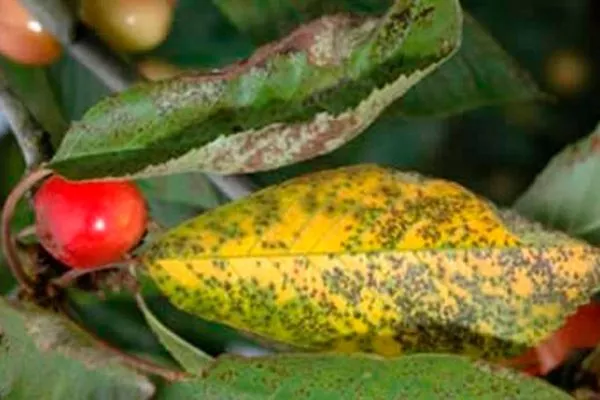
- In early spring, before the buds open, treat the tree with a 3% solution of Bordeaux mixture.
- After flowering, treat with an insecticide against cherry fly.
- In the fall, after the leaves have fallen, treat the tree and the trunk circle with urea (5% solution) to destroy the overwintering stages of pests.
As part of preventative measures to maintain a healthy garden, use complex preparations such as Fitosporin, Gamair, Gliokladin, and others. Among the most dangerous pests are fungal infections and pests, especially in areas with high humidity.
Reviews
The Garland cherry has already gained widespread recognition. Its high self-fertility, excellent yield, compact size, and versatile use of its deliciously flavored berries make it a sought-after variety among many gardeners.