
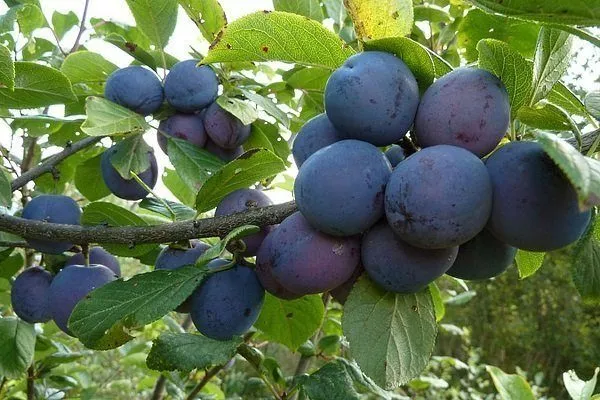
The Hungarian plum is a variety that combines varieties with similar characteristics. Many gardeners believe the Hungarian plum is the most remarkable plum in the world. It is hardy, tasty, productive, and, most importantly, only the fruits of this group are used to make the valuable product – prunes.
History of appearance
The Hungarian plum is a group of plums comprising dozens of varieties. These plums, with their oblong, dark-blue plums, came to Europe from Asia. The source of the prune began its triumphant march across the European continent from the Balkans. The variety arrived in Russia in the early 20th century.
This plum has been cultivated in Hungary for a long time—it was the Hungarians who invented the original method of harvesting it. They didn't pick the plums; they simply waited for them to overripe, wither, and fall. Dried plums acquired a unique flavor and lasted a long time.
Hungary is home to a plethora of plum trees, growing everywhere. It's said that parishioners who came to the priest for penance received a plum sapling from him. Thus, all the roadsides were planted with plum trees.
Description and characteristics of the varietal group
Features of Hungarian plum:
- Tree height – 5-6 m. The crown is oval or elongated-pyramidal. The shoots are reddish in color and grow quickly. If desired, the crown can be shaped so that the tree's height does not exceed 3-4 m.
- Average frost resistanceThe Hungarian tree is not suited for regions with harsh winters. However, the tree quickly regenerates after freezing.
- Drought resistance – trees are capable of producing large harvests even without irrigation.
- Most are self-fertile - they don't need pollinators.
- Good immunity – varieties are resistant to most viral and fungal diseases of fruit crops.
- Stable yield - without breaks.
- Productive lifespan – 30 years old.
- The trees produce a lot of root shoots. – this must be taken into account when choosing a site and neighbors for a Hungarian woman.
- Late flowering – harvesting times depend on the specific variety.
- The branches need support - because of the abundance of plums they break off.
- Ripe plums remain on the branches for a long time – they do not rot or crumble, maintaining excellent commercial qualities.
The Hungarian plum tree has one drawback, but gardeners easily forgive it—its advantages make its slow fruiting pale in comparison. Many older Hungarian plum tree varieties begin bearing fruit only 6-8 years after planting. For the most impatient gardeners, breeders have developed new varieties that begin bearing fruit in 3-4 years after planting.
It has been observed that the larger the Hungarian plum fruits, the higher the likelihood of damage to the tree by diseases and pests.
Pollinator trees
Even self-fertile Hungarian plum varieties benefit from pollinators. These pollinators are selected from plum varieties whose flowering times coincide with those of the specific Hungarian plum variety. Garden plums are commonly used as pollinators.
It is strongly recommended not to plant berry bushes near the tree, as they can interfere with the growth of shoots.
Popular varieties of Hungarian cabbage
Hungarian varieties are divided into:
- Canteens. They are popular among amateur gardeners and have good taste.
- Technical. They are used in commercial gardening. They are productive and undemanding.
| Name | Tree height | Frost resistance | Productivity |
|---|---|---|---|
| Korneevskaya | 4 m | High | 30 kg |
| Pulkovskaya | 3-4 m | High | 25 kg |
| Voronezh | 3-4.5 m | Low | 30 kg |
| Dubovskaya | Tall | High | 30 kg |
| Michurinskaya | Not specified | High | 25 kg |
| Azhana | 4-4.5 m | Low | 70 kg |
| Donetsk | 4.5 m | Not specified | 30 kg |
| Amazing | 4.5 m | High | 25-30 kg |
| Bogatyrskaya | 4 m | Not specified | 80-120 kg |
| Italian | Medium-sized | Not specified | 70-80 kg |
| Ordinary | 6 m | Not specified | 150-180 kg |
| Belarusian | 3.5 m | High | 30 kg |
| Moscow | 3-3.5 m | High | 40 kg |
Korneevskaya
A self-fertile, high-yielding variety of domestic selection, named after the breeder who created the hybrid. Pollinators are recommended for increased yield. Trees reach 4 m in height, with a spreading or pyramidal crown. The yield is 30 kg of plums. One-year-olds begin to bear fruit four years after planting. The lifespan is determined by the rootstock. The fruiting period lasts approximately 15 years. Harvest is from late August to the second half of September.
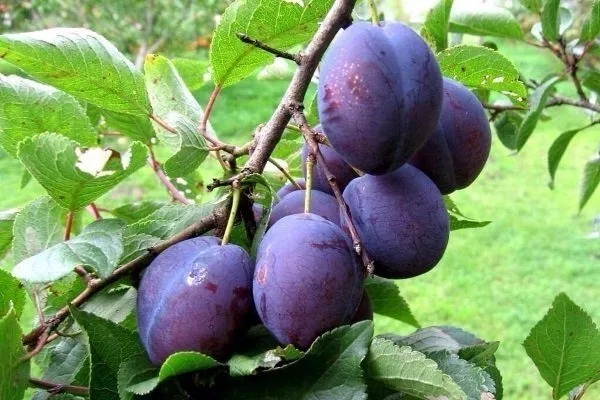
The fruits are blue with a brownish tint. They are juicy, with honey-colored flesh. The pit is small. The fruits weigh 30-35 g. The branches need support during fruiting. The fruits have a dessert flavor and are suitable for any processing. They travel well.
The tree is highly winter-hardy, with thick bark protecting it from low temperatures. Some buds freeze during severe frosts and sudden temperature fluctuations. It has limited resistance to some diseases.
Pulkovskaya
A late-ripening, partially self-fertile variety. The tree grows to 3-4 m, with a wide, spreading crown. It begins bearing fruit after three years. The yield per tree is 25 kg. The fruits ripen late and unevenly; they are harvested in stages throughout September. The tree's lifespan is 20-25 years.
The fruits are small, asymmetrical, weighing 20-25 g. The skin is dark red, the flesh is yellow. These plums are good for home consumption. The flavor is not ideal. The variety is distinguished by its high winter hardiness. A plus is that the fruits hang for a long time without falling off. The variety is resistant to aphids. A minus is the skin cracking in damp weather. Pulkovskaya is demanding of soil, preferring fertile loams.
Voronezh
This self-sterile, late-ripening variety was developed for southern regions. The tree grows to a height of 3-4.5 meters. The crown is oval, formed by upward-facing branches. Any plum variety suitable for flowering time can be used as a pollinator, including Peach, Zyuzinskaya, Michurinskaya, and others.
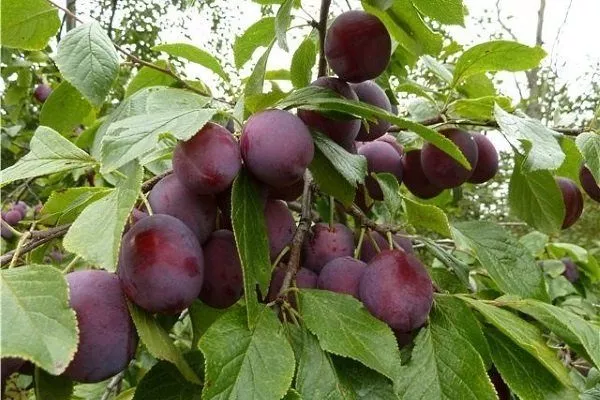
The yield per tree is 30 kg. Weight – 40 g. The shape is convex, pear-shaped. The skin is purple, fading to brown. The greenish flesh, reminiscent of an olive in consistency, has a very pleasant taste and aroma. The fruits are eaten fresh and canned.
The advantages include strong immunity and quick recovery from frost. The disadvantages include a long growing season and low frost resistance. If the summer is cool, the fruits may not ripen. In such cases, they are picked unripe and left to ripen.
Dubovskaya
This late-ripening variety is rare in Russian gardens. The trees are vigorous, with tall, rounded crowns. It is primarily found in the southern regions where it was bred. It begins to bear fruit in the fifth year. Harvest occurs in September. Yields up to 30 kg.
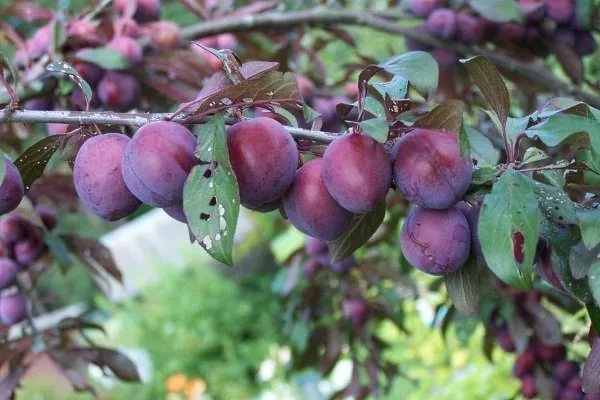
The fruits are medium-sized, dark purple, covered with a bluish waxy coating. They weigh 25-30 g and have a sweet and sour taste. The seeds are difficult to separate from the pulp. This variety is highly resistant to moniliosis and codling moth. It stores well and is transported over long distances.
Michurinskaya
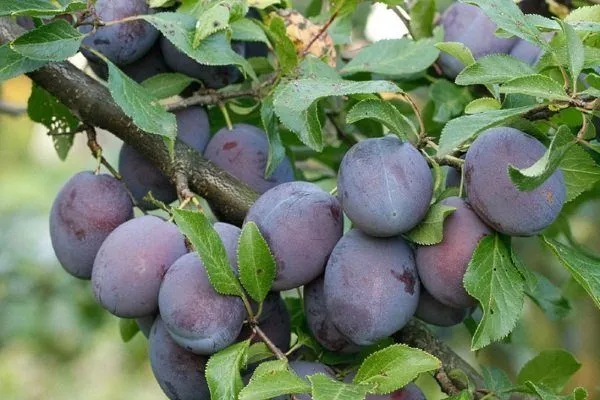
A self-fertile variety. One tree yields up to 25 kg. Fruit weighs 30 g. The purple plums are covered with a bluish bloom. The pulp is sweet, green, and crumbly. The flavor is excellent, with a slight acidity. The stone is small. The fruits, remaining on the branches for a long time, retain their marketable appearance and flavor.
It tolerates frost well and can be transported without loss. This variety is used in the food industry, particularly in baby food. A drawback is that the seeds are difficult to remove.
Azhana
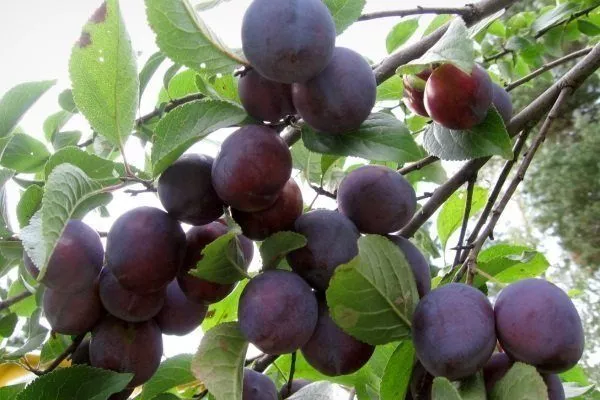
This variety was bred in France. The tree grows 4-4.5 m tall with a flattened crown. Fruiting begins in the fourth or fifth year. Trees yield up to 70 kg. Full ripening occurs in the last ten days of August. The variety is considered self-fertile, but pollinators such as Green Renklod or Altana are recommended.
The fruits are large, thick-skinned, and purple-red. The flesh is slightly fibrous, amber-colored, with a greenish tint. The juicy fruits have an excellent flavor and a slight tartness. They weigh 15-25 g. Ripe plums hang on the branches for a long time without falling off.
A disadvantage is that the fruits crack in rainy weather. After cracking, fungal diseases may occur. The most dangerous pest is the almond seed beetle. Winter hardiness is low, so this variety is grown only in southern regions.
Donetsk
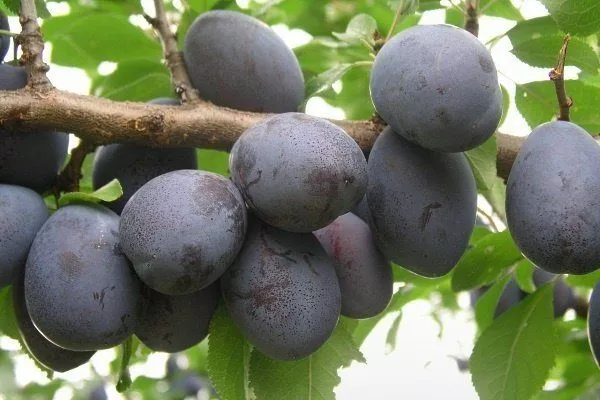
A self-fertile plum developed by Donetsk breeders. The trees are medium-sized, up to 4.5 m tall, with a spreading habit. They bear fruit 4-5 years after planting. The annual harvest is 30 kg. To increase productivity, pollinators are planted. The most suitable varieties are Anna Shpet, Italianskaya, and Renclode Altana.
The fruits weigh approximately 30 g. They are dark purple with a brownish tint and covered with a thick bloom. The olive-colored flesh is sweet and juicy, with a slightly tart flavor. The fruits are used to make prunes and delicious compotes. They keep for about three weeks, and even longer in a cool place or refrigerator.
This variety requires specific soil conditions. It does not tolerate dry, sandy soils; fertile loams are preferred. The fruit transports well and has a lifespan of up to 20 years.
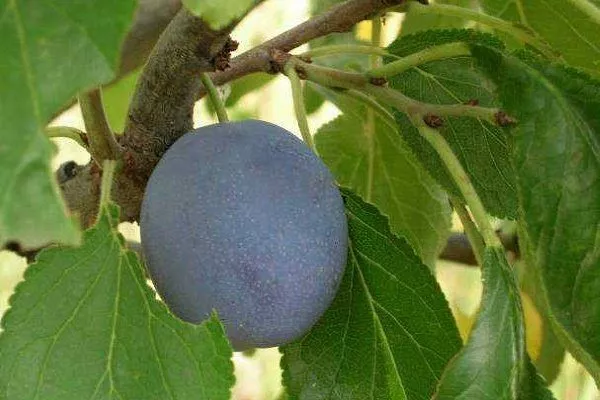
There are two varieties of the Donetsk Hungarian variety: early and late. They differ not only in ripening time but also in fruit flavor.
Amazing
Requires pollinators. Tree height is 4.5 m. The first harvest occurs in the 4th or 5th year. The average yield per tree is 25-30 kg of plums.
The fruits are medium-sized, teardrop-shaped, dark blue, with yellow flesh. They are covered with a blue waxy coating. They weigh 25-30 g. The seeds are difficult to remove from the sugary flesh. The variety is resistant to fruit rot. Its high frost resistance has made it popular in the Urals.
Bogatyrskaya
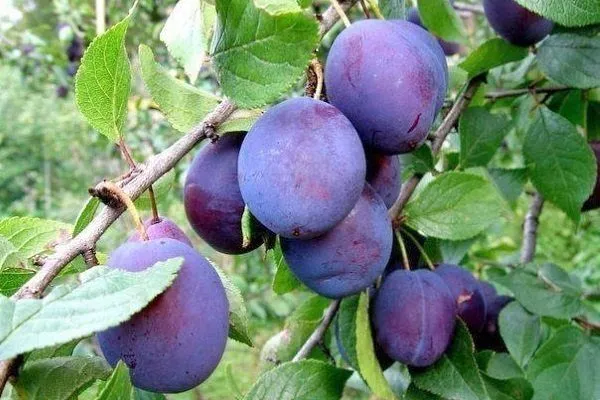
An early-ripening variety with excellent yields. The fruits ripen in mid-August. A single tree yields 80-120 kg of plums. The trees are medium-sized with spreading crowns, reaching a height of 4 m. They live for 30 years, bearing fruit in the 4th or 5th year.
The fruits are large, sweet and sour, with a honey-like flavor. They weigh between 30 and 60 grams. The skin is dark purple, almost black, with a whitish bloom. The flesh is light green. It has excellent agronomic characteristics. Plums of this variety transport well. A drawback is that the pit is difficult to separate from the flesh.
Italian
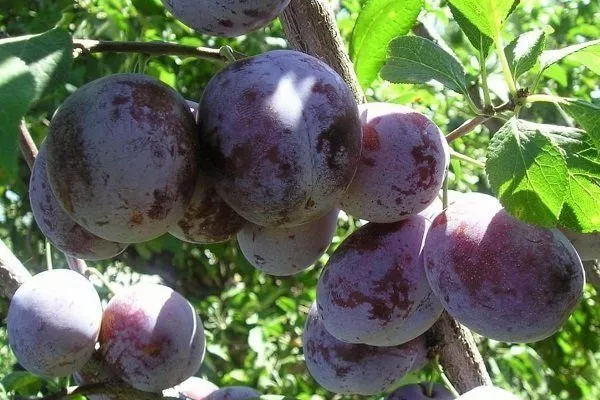
Late-ripening. The tree is medium-sized, with a spherical crown. Plums ripen in mid-September. Yield is 70-80 kg per tree. For increased yield, pollinators are recommended: plum varieties Altana, Green Renklod, and Ajanskuyu. The first harvest occurs in the fourth year of planting.
The fruits weigh 30-35 g. The skin is blackish-purple, covered with a bluish-white bloom. The flesh is greenish-yellow, firmer near the pit. The flesh has a mild aroma. The variety is resistant to fungal diseases and codling moth. It does not tolerate drought—the tree immediately loses its fruit.
The variety is recommended for southern regions, as even in moderate climates trees often freeze.
Ordinary
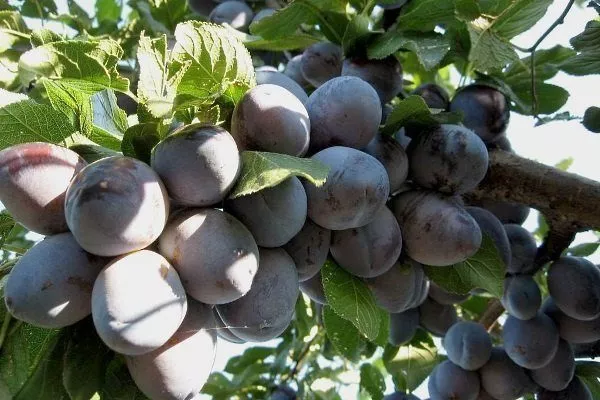
A popular variety. Trees grow tall, up to 6 m. Crowns are pyramidal, branches spreading. Trees live for 30 years, bearing fruit only in the 5th or 6th year. This is a very productive variety, yielding 150-180 kg per tree. The variety is self-fertile, but pollinators are recommended.
The fruits are small, weighing 20 g. The skin is dark purple, almost black. The flesh is sweet and sour. This variety requires watering—it prefers moist soil—and is disease-resistant. The fruits travel well and can be stored for up to 25 days. This variety is not suitable for regions with harsh climates.
Belarusian
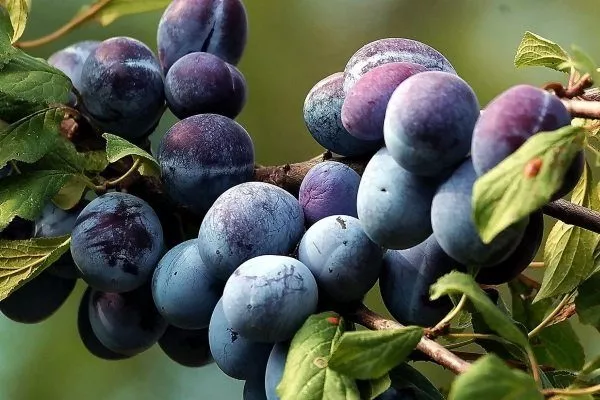
A large-fruited variety. The trees are medium-sized, reaching up to 3.5 m in height. The crowns are spreading and of medium density. Fruiting begins in the 3rd or 4th year. The variety is partially self-fertile. The fruits ripen in early September. Yield: 30 kg.
The plums are elongated, weighing approximately 40 g. The skin is purple. The flesh is orange, with a sweet and sour taste. This variety tolerates low temperatures well, is resistant to fungal diseases, and produces a consistent harvest. The plums store and transport well.
Moscow
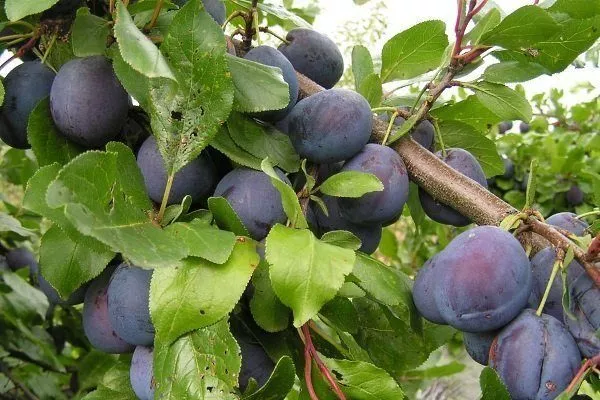
This self-fertile variety was developed in the 1950s. The tree grows to a height of 3-3.5 m. The crown is dense and spherical. The first harvest occurs in the 7th-8th year. Up to 40 kg can be harvested per tree. Ripening occurs in early to mid-September.
The fruits are asymmetrical, purple, and weigh 20-30 g. They are ovoid and elongated. The flesh is juicy and amber-colored. The seeds are easily separated from the flesh. This variety is inferior to newer cultivars – its fruits are small, but their flavor is mediocre, and the fruiting period is prolonged. This variety is widely used in amateur and commercial gardening.
Fruit characteristics and yield
The fruits of the Hungarian variety have common features that are characteristic of all varieties of this group:
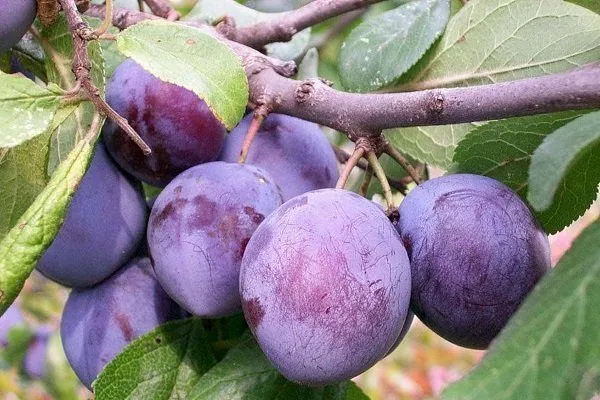
- Form. The fruits are oblong, asymmetrical, and pointed at the edges.
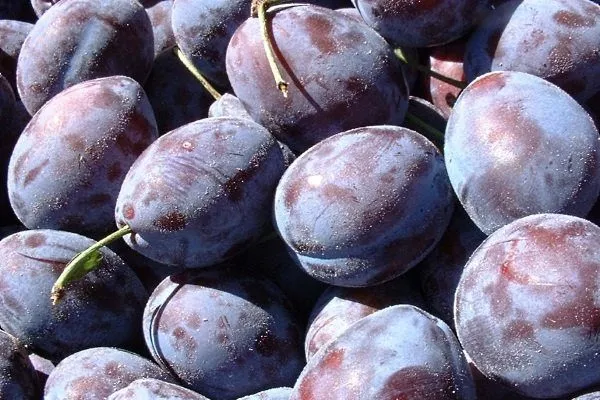
- Color. The skin is lilac or purple. There are varieties with greenish fruits. They have a waxy coating. The flesh is yellowish, dense, tasty, juicy, and has an excellent aroma.
- Weight and sizeThe fruits are large, reaching 6 cm in length and 4-5 cm in width.
- BoneSmall in size, oblong. Easily separated from the pulp. The fruits easily break into halves along the seam.
- Transportability. The fruits travel well. They don't leak or ooze during shipping.
- Keeping quality. The fruits do not spoil for a long time, especially in a cool place. If picked unripe, the fruits do not spoil, but rather ripen safely. The shelf life is 3-4 weeks.
- Productivity. Depends on the variety, but averages 30 kg per tree. The maximum yield is 150 kg.
- Compound. It differs from other varieties by its high sugar content—15%—and dense flesh, with 20% dry matter. The Hungarian plum can be used to produce prunes—no other plum variety is suitable for this purpose.
Hungarian cherries produce well in temperate climates. Their high yields and easy transportation make them ideal for profitability.
Fruit ripening times vary depending on the variety. Generally, the harvest period is from late August to October. Most Hungarian varieties fall into the mid- to late-ripening groups.
Preparing and planting Hungarian grass
The planting time for Hungarian plum trees is determined by the region's climate. In southern regions, it's recommended to plant Hungarian plum trees in the fall—at the end of September. In temperate regions, it's best to play it safe and plant the seedlings in April, before the sap begins to flow. Before planting the seedlings in their permanent location, gardeners prepare the soil in advance.
Choosing a location
What to pay attention to when choosing a site for planting Hungarian grass:
- Illumination. The Hungarian plum tree thrives on heat, so choose the warmest and sunniest location for it. The ideal location for the plum tree is a sunny spot in the southern or southwestern part of the garden. It should be elevated, but protected from strong winds.
- Soil. The best soil is slightly alkaline. If necessary, improve the soil's properties. Groundwater levels should not be closer than 1.5 meters to the surface.
- Humidity. Excessive moisture causes the bark, especially around the root collar, to rot. Therefore, avoid low-lying areas—they're damp, foggy, damp after rain, and create snowdrifts in winter—all of which are unsuitable for the Hungarian tree.
- Neighborhood with trees. Hungarian is planted no closer than 3 m from other trees.
- ✓ The optimal soil pH for Hungarian rhododendron should be in the range of 6.0-6.5.
- ✓ The depth of groundwater should not exceed 1.5 m.
Soil requirements and ground preparation
Hungarian plums thrive in sandy loam or loamy soils. Plums don't grow in acidic soils. To reduce soil acidity, add 600 g of wood ash or dolomite flour. Plums don't like dry sandy soils—they often cause fruit drop and yield reductions.
Don't add lime to the planting hole, as it can burn the seedling's roots. If liming is necessary, apply it well before planting, during tilling. The recommended rate of lime per square meter is 800 g.
To ensure the Hungarian rhododendron takes root quickly and thrives, favorable conditions are created in advance by preparing the soil. The area designated for planting is cleared of all weeds and thoroughly dug, adding compost during the process.
Selection and preparation of planting material
A well-chosen seedling is the key to a good start. Damaged or diseased planting material is often found at markets, so it's best to buy seedlings from specialized nurseries.
Requirements for plum seedlings:
- age – 1-2 years;
- the root system is fresh, not overdried;
- bark without damage;
- the trunk is even, without bifurcations;
- rootstock – dwarf or semi-dwarf;
- absence of dry branches or rotten roots;
- parameters for the first grade: height from 1.4 m, diameter – from 1.3 cm;
- parameters for the second grade: height from 1.1 m, diameter – from 1.1 cm;
- for branched trunks the height is from 0.5 m, the diameter is from 1.4 cm, the length of the branches is from 20 cm;
- no damage, signs of disease, lichen, broken or cut branches.
It's best to purchase seedlings in plastic containers with fertilized soil. This allows for stress-free transplanting without damaging the root system. The seedling is removed from the container and placed into the hole with the root ball.
- Soak the roots of the seedling in water for 12-24 hours before planting to restore moisture.
- Trim damaged roots back to healthy tissue.
- Treat the roots with clay slurry to protect them from drying out.
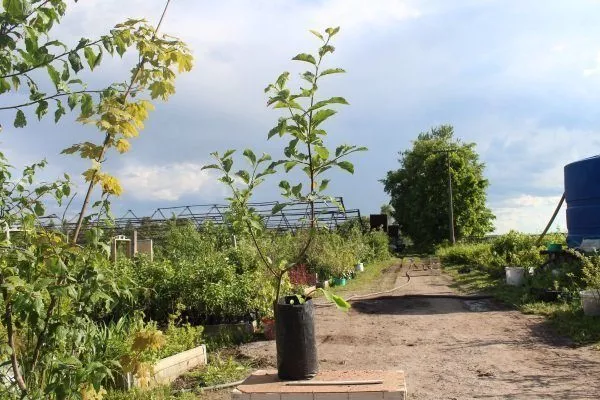
If the seedling is purchased without a container, then its roots are moistened and evenly distributed over a mound of soil mixture poured into the hole.
Landing
The seedling is planted in the fall or spring—the process is roughly the same. However, for spring planting, the hole can be prepared in the fall, if desired. The process for planting a Hungarian grass seedling:
- The planting hole is prepared approximately two weeks before planting the seedling. Here's how to prepare the hole:
- They dig a hole 60-70 cm wide and 50-60 cm deep.
- A peg is driven into the center of the hole, 20 cm deep into the ground.
- Fill the hole with the prepared soil mixture, which should fill two-thirds of its volume. To prepare the soil mixture, take the topsoil, mix it with humus in a 1:1 ratio, and add ammonium nitrate (100-200 g), potassium chloride (200-300 g), and superphosphate (500 g). It's a good idea to add river sand and gravel to the soil mixture to improve drainage and increase the soil's thermal capacity.
- Place the seedling on a mound of mixed soil, spreading its roots evenly – they should not twist or bend upwards.
- The hole is filled with fertile soil, watered and sprinkled with mulch on top - sawdust or peat.
How to care for a Hungarian cat?
Care for all Hungarian plum varieties is the same. The tree requires watering, pruning, and other standard agricultural practices.
Watering
Plums are moisture-loving plants, but one of the main advantages of the Hungarian plum tree is its high drought tolerance. There are varieties of Hungarian plums that can successfully bear fruit even in the most severe droughts. However, these extreme conditions can exhaust the plant. Therefore, a caring gardener should water the plum tree regularly, even if it tolerates drought well.
For normal development and fruiting, a mature tree requires approximately 5-6 waterings per season. The recommended watering rate is 8-10 buckets of water. It is especially important to water the tree:
- during flowering;
- during the period of ovary formation;
- during fruit growth.
When the fruits are ripening, watering is especially necessary – not only this year’s harvest depends on it, but also the next one, since flower buds are formed during this period.
Saplings need to be watered more frequently, as their roots are not yet able to meet the plant's moisture needs. The watering rate depends on the tree's age; a young sapling requires 3-4 buckets of water.
Fertilizer
The Hungarian fig tree is productive; the tree expends a lot of energy forming fruit. Organic and mineral fertilizers are the key not only to high yields and high-quality fruit, but also to the tree's longevity.
Varieties with a long growing season are not given nitrogen-containing fertilizers during autumn feeding.
Fertilizer application rates and timing for young Hungarian plum trees
| Growing season | Fertilizer | Application rate |
| Before fruiting | urea | for 10 liters take 45 g |
| During fruit ripening | nitrophoska | for 10 liters take 3 tbsp. |
| After harvesting | potassium sulfate and superphosphate | 30 g each |
| End of the growing season | rotted manure (sprinkle around the tree trunk circle) | 10 kg per tree |
Wood processing
The tree requires care throughout the spring and summer seasons. Care measures:
- regular removal of growth;
- weeding and loosening - if the tree trunk circle is mulched, then this can be done without;
- installation of supporting supports for fruit-bearing branches;
- The trunk is whitewashed - its lower part, and skeletal branches.
In the spring, before bud break, plum trees are treated with a urea solution (700 g per 10 liters) to combat diseases and pests. A little later, the trees are treated with insecticides against aphids, leaf rollers, and other pests, such as Fitoverm, Akarin, Iskra-bio, and others. During the next treatment, Zircon or Ecoberin are used to boost plant immunity. In the fall, the treatment is repeated with the same products to prepare the trees that have finished fruiting for winter.
In spring, birdhouses are hung in the garden to attract birds to help control pests.
Pruning and crown shaping
To form a proper crown and prevent many diseases, plum trees are pruned annually. The Hungarian plum tree is always laden with fruit, so only the most stable branches, those that form a right angle with the trunk, are left. The best crown shape for the Hungarian plum tree is a sparse, tiered form. When pruning, remember to remove suckers, frozen branches, and branches growing deep into the crown.
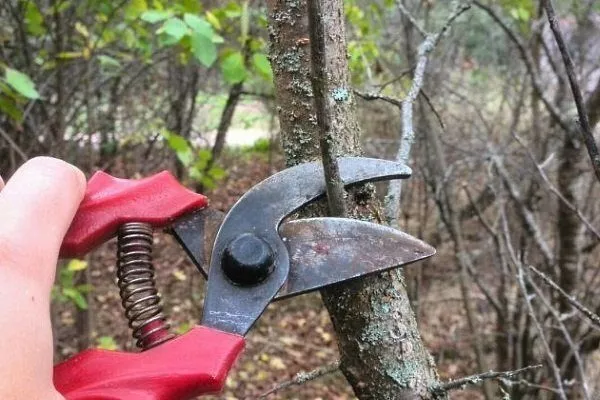
The optimal time for plum pruning is early spring. Temperatures should be relatively stable and not drop below -10 degrees Celsius. Pruning in the pre-winter period, before the cold weather sets in, is not recommended.
Features of Hungarian pruning:
- Crown formation begins in the second year of planting.
- Mature and old trees are rejuvenated by thinning and removing damaged, diseased and excess branches.
- Fast-growing varieties have a growth rate of over 70 cm per year; such shoots are shortened by a third of their length.
- The first tier should be no less than half a meter above the ground. Other branches are removed.
- Leave 5 to 10 skeletal branches. They should be joined at an angle greater than 45 degrees.
- Excess branches are cut into a ring, leaving no stumps.
- All skeletal branches are cut by 1/3.
- The height of the tree in the first year of life should be no more than 180 cm.
- The following spring, the conductor is pruned 40 cm from the top branch. Last year's growth is shortened by 1/3.
- Until the tree reaches 2.5 m in height, the conductor is shortened every year so that at least 6 buds remain from the upper skeletal branch to the top.
- Every year, branches directed towards the ground, damaged, diseased, and dry ones are removed.
- As a result of pruning, a pyramidal crown is formed.
- To stimulate the appearance of new growth, last year's growth is shortened on adult plums.
- Four-year-old branches are pruned – this eliminates the need for rejuvenating pruning in the future.
Pruning is carried out with a high-quality, sharp, disinfected tool.
Wintering and shelter from rodents
Most Hungarian plum varieties tolerate winter temperatures well in the regions where they are recommended for cultivation. Mature trees can easily survive the winter without insulation. However, it is recommended to apply a thick layer of mulch—compost or peat—around the trunk.
For young seedlings, it's best to provide insulation by wrapping their trunks in burlap. Another option is to cover them with spruce branches. Artificial insulation is prohibited, as the trees will rot underneath it, leading to trunk rot.
To protect the Hungarian tree from rodents, use standard techniques: protect the trunk with a rodent-proof material. The key is to ensure it's breathable, such as a metal mesh.
Reproduction of the Hungarian
Hungarian is propagated:
- Vegetatively. The tree can be propagated by cuttings or shoots. The most reliable method is rooting the shoots. The latter are then immediately planted in their permanent location.
- With bones. Before planting, they are kept in the refrigerator. The storage period is September-March. In the spring, they are planted in the ground, and in the fall, in a nursery. After a year, the seedlings are ready.
- By vaccination. This option is more complex and is only suitable for experienced gardeners.
Diseases and pests
Hungarian cabbage has a high immunity, but is not immune to diseases and pests. Effective fungicides and insecticides are used to protect the crop.
Diseases of Hungarian grass and control measures:
| Disease | Symptoms | Prevention | Treatment |
| Hollow spot | The appearance of multiple reddish spots on the leaves. Drying of shoots and leaves, and deformation of fruits. | Moderate watering and weed removal. | Before and after flowering, spray with 1% Bordeaux mixture or "Hom." Repeat treatment if necessary. |
| Black nodularity | On young shoots, swellings appear, which become denser and crack. The branches dry out and die. | Before the leaves appear, spray with 1% Bordeaux mixture. | Trim and burn affected parts. Disinfect cuts with 1% copper sulfate. |
| Rust | Yellow spots appear on the leaves, which become covered with a brown coating on the underside. The leaves dry up and fall off. | Removing weeds and loosening the soil. | 2-3 sprayings with 1% Bordeaux mixture. The interval between treatments is 10 days. |
Pests of the Hungarian grass and control measures
| Pest | Prevention | Control measures |
| Codling moth | Weed removal and loosening | Spraying with insecticides. Collection and burning of fallen shoots. |
| Gypsy moth | Pruning branches and processing the trunk | Manual collection of caterpillar eggs. Treatment of the crop with insecticides or natural preparations. |
Harvesting, storage and processing of crops
Features of plum picking:
- The fruits are collected only in dry weather.
- It is not recommended to pick plums immediately after rain or watering, or in the morning during dew.
- Harvesting begins without waiting for the fruits to become soft.
- The fruits of the Hungarian plum ripen unevenly, so harvesting is carried out in 2-3 stages.
- The fruits are placed in shallow containers to ripen. After a week, they will reach technical maturity, acquiring the flavor and aroma appropriate to the variety.
- Plums are picked from the tree, stems included, and immediately placed in containers for storage.
- The fruits should be handled as little as possible to avoid rubbing off the waxy coating that protects the fruit from environmental influences.
- Cleaning begins with the lower branches and gradually moves to the upper ones.
- To collect fruits located on the upper branches, ladders and special fruit pickers are used.
- You shouldn't climb the branches - the plum tree's wood is very fragile.
- Fruits collected for transportation or storage must not be collected by shaking.
Storage features:
- Whole, undamaged fruits are carefully placed in trays. They are laid on paper in a single row.
- Crates of plums are placed in a storage facility where the temperature is maintained at 0-2°C and the humidity is 85%. Under these conditions, plums remain fresh for 2-2.5 months.
- Plums also store well in plastic bags. At 0°C, they can stay fresh for up to two months.
Hungarian plums can also be preserved for the winter by drying them or drying them into prunes. Hungarian plums make excellent desserts, seasonings, and preserves, both with and without sugar.
Benefits and harms
Fresh and dried Hungarian plum fruits are an excellent antioxidant that slows down aging. Benefits of Hungarian plum fruits
- have a beneficial effect on the functioning of the circulatory system;
- lowers cholesterol levels;
- prevents bowel cancer.
- prevents thrombus formation;
- reduces pressure;
- prevents the negative effects of free radicals that accelerate aging.
If you have high stomach acidity, consume plums and prunes with caution. Prunes are high in sugar, so don't eat more than 3-4 prunes per day.
Nutritional information and composition:
- fats – 2%, proteins – 8%, carbohydrates – 90%;
- contains a lot of potassium and sodium, vitamins A, C, E;
- caloric content – 42 kcal per 100 g.
Gardeners' reviews of Hungarian cabbage
The Hungarian plum is an enviable addition to any garden. This easy-to-care-for, drought-resistant tree will never leave you without a bountiful harvest. With minimal time and effort, you'll get 30 to 150 kg of excellent plums from a single tree each autumn.