
The plum is a compact and undemanding fruit tree that never skimps on its harvest. This heat-loving crop, thanks to selective breeding, has become accessible to regions with harsh climates. Let's learn what gardeners should do to ensure plum trees remain healthy and productive for a long time.
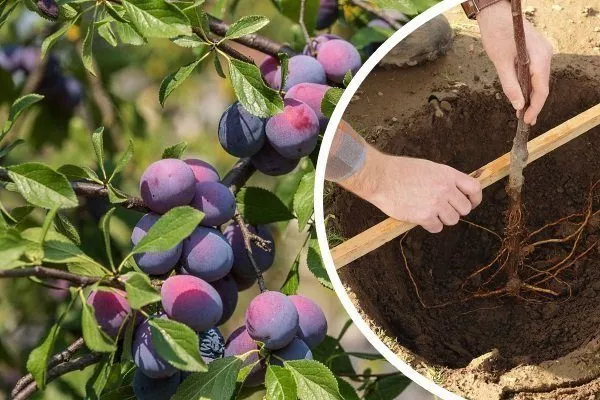
Description of the fruit tree
The plum is confidently among the top five most popular fruit trees. It belongs to the genus Arborescens, family Rosaceae. It is believed to be a hybrid, naturally produced by crossing blackthorn and cherry plum.
General description and characteristics of plum:
- Tree. Height varies widely depending on the variety. Some plums are as low as 1 meter, while others reach 15 meters. Gardeners prefer shorter trees, as they make it easier to harvest the fruit, which clings to the branches.
- Roots. Plum trees have a taproot system, most of which is located at a depth of 30-40 cm.
- Leaves. They are obovate or elliptical in shape. The margins are serrated or crenate. The underside of the leaf is pubescent. The petioles are short. Length – 4-10 cm, width – 2-5 cm.
- Flowers. Large white. Each flower bud produces 1-3 flowers. Diameter: 1.5-2 cm.
- Fruit. Juicy drupes. Each fruit contains a single seed. The fruit color can include shades of blue, purple, burgundy, yellow, light green, red, and black. The skin is covered with a bluish bloom. The fruit shape is round or oblong.
- Longevity. Plum trees aren't known for their longevity. They live for about a quarter of a century, but their productive lifespan is only 10-15 years.
- Precocity. It depends on the variety and the specific seedling. Early-bearing varieties begin to bear fruit 2-3 years after planting, while there are also varieties that take 6-7 years to produce a harvest.
The best varieties
| Name | Tree height | Fruit color | Ripening time |
|---|---|---|---|
| Domestic plum | up to 15 m | yellow, blue, green | depends on the variety |
| Hungarian | up to 15 m | purple, blue | late-ripening |
| Greengage | up to 15 m | green, yellow | mid-season |
| Mirabel | up to 15 m | yellow, golden | early ripening |
| Blackthorn plum | up to 4.5 m | blue, purple | early ripening |
| Chinese plum | up to 12 m | different colors | depends on the variety |
The most popular types of plums:
- Domestic plum. Trees up to 15 m tall. Varieties bear yellow, blue, green, and other colors. Subspecies:
- Hungarian. The fruits are elongated, the pulp is dense, and they are used to make prunes.
- Greengage. They have spherical fruits, with flesh that is more tender than that of Hungarians.
- MirabelSmall, round fruits, yellow or golden in color. The plums are sweet, with firm flesh, and are good for processing.
- Blackthorn plum. These are shrubs up to 4.5 m tall. They produce small fruits with a tart taste.
- Chinese plum. Trees grow up to 12 m tall. Fruit is large, oval or pear-shaped, and comes in a variety of colors. Subspecies: Ussuri, Manchurian, and Apricot.
Read our additional article about these and others.the most successful plum varieties.
There are about 30 types of plums in total, but the common plum is usually called “plum”.
Today, there are approximately three hundred plum varieties cultivated by gardeners. These varieties differ in:
- Ripening periods. There are early-ripening, mid-ripening and late-ripening varieties.
- Frost resistance. The growing area is determined by the temperatures that the tree can withstand.
- Productivity. From some varieties you can collect 6-8 kg, and from others up to 30-50 kg and even more;
- Characteristics of fruits. Fruits vary in color, weight, shape, flavor, aroma, and transportability across varieties. Large-fruited, medium-fruited, and small-fruited varieties are distinguished. Varieties are also divided into yellow, blue, and red.
- The height of the tree. There are low-growing, medium-growing and tall varieties.
- Features of pollination. There are self-fertile, partially self-fertile and self-sterile varieties.
- Drought resistance. There are varieties with high, medium and low drought resistance.
- Plant type. There are tree-like and bush-like plums.
Basics of planting plum trees
The most important thing when planting a plum tree is choosing the right variety. To ensure the tree survives winter and produces a good harvest, it must be suited to the local climate. Once the variety is selected, the site and optimal planting time are selected. If the planting is incorrect, the tree will be weakened, bear little fruit, or even die due to unsuitable conditions. Let's learn how to plant a plum tree correctly and what planting options are available.
Terrain, climate and habitat
Plum is a heat-loving plant, widespread in Europe and most temperate countries worldwide. It thrives in all southern regions of Russia, including the North Caucasus and the Krasnodar Territory.
The northern Moscow region is considered the plum's natural range—beyond this point, plums are rarely grown. However, thanks to selective breeding, frost-resistant varieties have been developed that grow and bear fruit in regions with harsh climates, such as the Urals, Siberia, and the Far East.
When planting plums, it's important to match local climate conditions with the frost resistance of the specific variety. The critical temperature for this crop is -30°C. However, if such frosts persist, the tree may not survive.
Where is the best place to plant a plum tree:
- In regions with mild and moderate winters.
- On moist, well-drained loamy soils. Plums do not grow well in acidic and alkaline, waterlogged soils. Salt-laden, heavy loamy soils, and dry sandy soils are also unsuitable for the plant.
- In areas where the groundwater level is at least 1.5-2 m above the surface.
- In sunny, well-lit areas. Without drafts or gusts of wind.
- ✓ The optimal soil pH for plums is 6.0-6.5. If the soil pH deviates from this range, the acidity must be adjusted.
- ✓ Root system depth: 30-40 cm, which requires good drainage and aeration of the topsoil.
Selecting a seedling
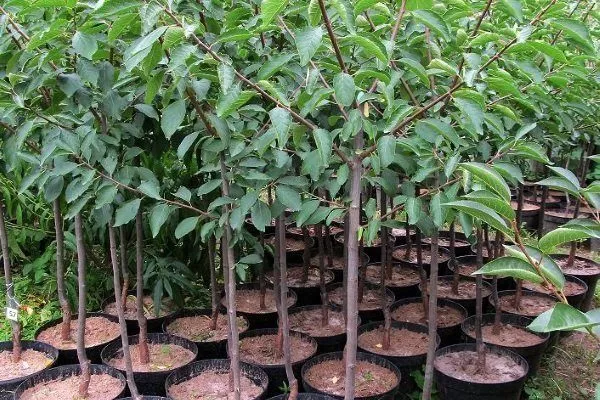
Seedlings sold by nurseries are usually obtained by grafting a cultivar onto rootstocks grown from seeds. Own-rooted seedlings, grown from cuttings or root suckers, are also available.
Parameters for choosing a good seedling:
| Parameter | Meaning |
| Age | 1-2 years |
| Height | 110-140 cm |
| Length of branches | 15-20 cm for one-year-olds and 30 cm for two-year-olds |
| Barrel diameter | 1.1-1.3 cm |
| The diameter of the trunk at a distance of 10 cm from the graft | 1.3-1.7 cm |
| Roots | 4-5 roots 25 cm long |
Autumn planting
Autumn planting should be done at a time that leaves about a month before frost. Here's the procedure for planting plum seedlings:
- Dig the soil to the depth of a spade. Improve the soil structure and composition if necessary. For example, if the soil is acidic, add acidifiers during digging—dolomite flour or ash (600-700 g per square meter) are suitable.
- Prepare a hole 2-3 weeks before planting. The minimum depth is 60 cm, and the diameter is approximately 70 cm. When digging the hole, set aside the top fertile soil layer—this will be used to prepare the soil mixture.
- If there are several seedlings, the holes are dug 3 meters apart. The holes are prepared in advance to allow the soil mixture time to settle.
- A stake is driven into the center of the hole to serve as a support for the seedling. It should extend at least 0.5 m above the ground. The stake should be positioned on the north side of the seedling.
- The excavated soil is mixed with peat/humus (2:1). The prepared mixture is poured into the hole – it should be approximately 2/3 full.
- After spreading the roots, the seedling is placed in the hole—a mound of potting soil—and the roots are carefully covered with regular soil, without fertilizer. As you fill, compact the soil to ensure there are no voids between the roots. The root collar should not be buried deep—3-5 cm should remain above the soil surface.
- The seedling is tied to the support with soft material.
- Water the tree generously. Once the water has been absorbed, loosen the soil slightly and then mulch.
- 2-3 weeks before planting, analyze the soil for pH and nutrient content.
- Add corrective additives (dolomite flour to increase pH or sulfur to decrease it) according to the analysis results.
- A week before planting, add organic fertilizers (humus or compost) at a rate of 10 kg per 1 sq. m.
An experienced gardener will explain how to plant a plum tree correctly in the video below:
It is not recommended to add mineral fertilizers to the planting hole in the fall, as they will stimulate shoot growth and, more importantly, risk burning the seedling's roots.
Spring planting
Spring planting is practiced in regions with harsh winters. Seedlings planted in the spring have a better chance of taking root and surviving their first winter. But this is the only advantage of spring planting.
Disadvantages of planting seedlings in spring:
- It's difficult to find planting stock for the required variety. Nurseries sell seedlings in the fall. Therefore, gardeners often buy seedlings in the fall, preparing for spring planting. They then "preserve" them by burying them in the ground—in a cellar, basement, or greenhouse.
- Plum trees are awakened from their winter dormancy early – you can be late with planting, missing the start of sap flow.
- Often, seedlings bloom before planting – such trees will become sick and risk dying.
Planting begins after the snow melts; the trees must be planted before the sap begins to flow. But not earlier than 5 days after the soil has completely thawed.
Spring planting differs from fall planting only in the fertilizer applied to the planting hole. Since the tree will continue to grow and develop, the fertilizer mix should contain nitrogen, which is contraindicated for fall planting.
A soil mixture of topsoil (15-20 cm) and humus is added to the hole in a 1:1 ratio. The following are added:
- superphosphate – 200-300 g;
- potassium salt – 40-60 g;
- wood ash – 300-400 g.
All other steps are similar to fall planting. In the fall, after planting the seedling, no work is planned until spring, but after spring planting, maintenance begins immediately—watering, loosening the soil, spraying, etc.
Care and cultivation of plums
Although the plum is unpretentious, like any garden tree, it requires care. Each season has its own specific needs. The spring and summer months are the most demanding.
Subtleties of care at different times of the year
The taste and size of the fruit, the tree's productivity, health, and longevity depend on proper and timely care. Plum tree care by season:
- Spring:
- The winter cover is removed from the trunk.
- Sanitary pruning is performed. Damaged and deformed branches are removed. The crown is shaped. Mature trees undergo rejuvenation pruning, if necessary.
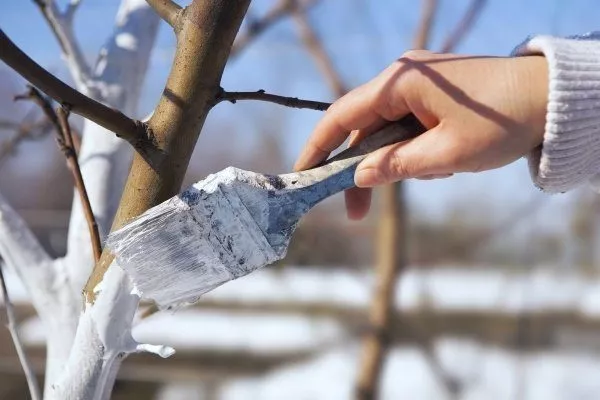
- The trunk is whitewashed to prevent sunburn and protect against pests.
- For prevention, spray with Bordeaux mixture and copper oxychloride.
- Fertilize with mineral fertilizers as needed. The recommended fertilizer application rate for young trees is 100-200 g of urea/calcium nitrate, and for fruiting trees, 300-400 g.
- Summer:
- Water as needed.
- The tree is inspected for diseases and pests. If necessary, it is sprayed.
- Fertilize with nitrogen fertilizers (three times per season). Other fertilizers are applied individually, as needed.
- Harvesting. This is usually done in stages, as the fruit ripens.
- Autumn:
- They are fed with organic fertilizers.
- They insulate the trunks for winter.
- Repeat sanitary pruning.
- Winter. There's little work to do in winter—you just need to monitor the insulation and brush snow off the branches regularly.
Watering times
The watering schedule for a plum tree depends on its age. A young tree requires 30-40 liters, while a mature tree requires 70-80 liters. Here's a rough watering schedule for a mature, fruit-bearing tree:
- A couple of weeks before flowering begins.
- During the growth of ovaries and shoots.
- 1-2 weeks before harvesting.
- After harvesting.
- Autumn moisture-recharging irrigation.
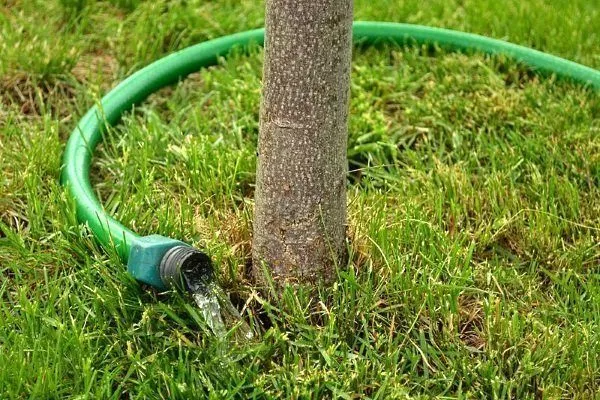
When watering, the soil should be moistened to a depth of 1 meter. Avoid overwatering the plum tree, as this is harmful to the harvest. The frequency of watering depends on the condition of the soil—it should not be dry.
The timing and frequency of watering depend not only on the region's climate and current weather conditions, but also on the tree's age. Watering considerations vary depending on age:
- The first year of life. Water the soil with a watering can as it dries out. Typically, young seedlings need to be watered once every 7-10 days.
- Second year.Reduce the frequency of watering. Water the tree as the soil dries out and during long periods without rain.
- Up to 15 years oldWater according to the schedule indicated above.
- Over 15 years old. Along with watering, the tree is fertilized. But rather than simply scattering the fertilizer, it's poured into depressions dug around the perimeter.
The main criterion for watering plums is the condition of the soil. It should be moist, but not wet. There should be no standing water.
When and how to feed plums?
Features of plum fertilizing:
- During the first year of its life, the tree is not fed.
- In the second year, foliar feeding with urea is carried out in the first and third ten days of June.
- From the third year until fruiting begins, apply fertilizer into furrows (5-10 cm deep) dug in a circle around the tree. Apply 15-20 liters of solution per tree. Timing and application rates:
- May. Urea and liquid sodium humate – 2 tablespoons per 10 liters of water.
- June. Nitrophoska – 3 tbsp per 10 liters of water.
- August-beginning of September. Superphosphate and potassium sulfate – 2-3 tablespoons per 10 liters of water.
- Fruit-bearing tree. Fertilizer doses are increased, applying per 1 square meter:
- organic fertilizer (humus, compost) – 10 kg;
- urea – 25 g;
- superphosphate – 60 g;
- potassium chloride – 20 g.
What else do you need to know about plum fertilizing:
- Nitrogen fertilizers are applied only in the spring. Phosphorus-potassium fertilizers are applied in the fall, during digging.
- Acidic soils are limed once every 5 years.
- If you overfeed the tree with nitrogen, the quality of the fruit will deteriorate.
- If the leaves turn brown and curl, the tree lacks potassium.
- If the veins of the leaves turn brown, magnesium is needed.
- Pale green leaves indicate nitrogen deficiency.
Tree pruning
Pruning is necessary to increase frost resistance, shape the crown, prevent it from becoming too dense, and give the tree a beautiful appearance. Plum trees can develop many extra branches, which can thicken the crown and reduce yield. Regular pruning can help correct this.
Requirements
Rules for pruning plum trees:
- Pruning is done in spring, fall, and summer. Some gardeners also perform winter pruning, but this is specific and unsafe for the tree. The best time for pruning is spring.
- Young seedlings are pruned minimally; pruning is aimed mainly at forming the crown.
- Varieties that branch weakly are pruned less than plums that branch strongly.
- Once the tree begins to bear fruit, pruning is carried out only as a last resort.
- Most often, plums are shaped into a cup-shaped crown.
For trimming you will need the following tools:
- garden knife;
- garden saw;
- pruning shears.
All cutting tools must be well sharpened to ensure smooth cuts. All tools must be cleaned and disinfected.
Spring pruning
Spring is the best time for pruning. It's done in late March or early April, before the sap starts to flow. During the first three years of a tree's life, the crown is formed; if you miss this time, the branches will grow excessively, become tangled, and interfere with each other.
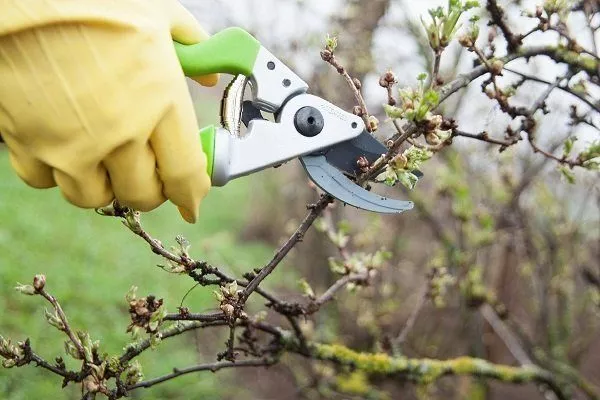
In spring, any shoots growing incorrectly and old branches that aren't producing fruit are clearly visible. Spring pruning rules:
- In the first year of life, all lateral shoots are cut off from the tree, and the main shoot is cut off so that the height of the seedling is 60 cm.
- In the second year, the main stem is cut back to 40-50 cm, along with the terminal bud located above the cut. The lower lateral branches are pruned almost completely, leaving stumps 7 cm long. All other lateral shoots are cut back to 1/3 of their length. The angle of the skeletal branches should be 50-60 degrees.
- In the third year, select 6-8 skeletal branches and remove all others. Leave no more than 4 buds on the remaining branches.
Subsequently, spring pruning is reduced to maintaining the desired crown shape:
- All branches growing incorrectly – inward into the crown or located at an obtuse angle – are removed.
- If the crown is lush, it is thinned out and old branches are removed.
- Last year's growth is shortened - this helps the tree form new fruit branches.
- Remove branches that are broken or frozen over the winter, as well as those on which birds have damaged buds.
Pruning is carried out in clear, windless weather, at a temperature of at least +10 °C.
Summer pruning is only applicable to young trees; it is harmful for mature trees and is carried out only in cases of extreme necessity – for example, when diseased branches are discovered.
Autumn pruning
Autumn pruning is carried out after the leaves have fallen, around mid-September. It's important to allow sufficient time between the procedure and the onset of frost so the tree can recover from the stress. Autumn pruning is primarily performed in regions with warm climates. In regions with harsh winters, spring pruning is preferable.
Autumn pruning scheme:
- All diseased, dry and broken branches are removed.
- The main conductor is cut off if it stretches too much during the growing season.
- Fast-growing shoots, competing shoots, and those that crowd the crown are pruned. All pruned branches are burned.
Depending on the age of the tree, the pruning order changes:
- In the first year of life, in the fall, the main conductor is cut by 1/3, other branches - by 2/3.
- Regardless of age, thin out the crown, remove incorrectly growing and rapidly growing branches.
- After 4-5 years of age, rejuvenating pruning is performed. The frequency of such procedures is once every 4-5 years.
Plum propagation
Learning how to propagate plum trees can save you money on planting material. Propagation methods:
- Cuttings. This is the easiest method. Cuttings are taken in early July. Here's the growing procedure:
- In the morning or evening, cut a shoot 20-30 cm long. After cutting two or three leaves from the shoot, soak them in a stimulator for 14-15 hours. When cutting the shoots, make one cut straight and the other at a 45-degree angle.
- The bed is located in a shady spot. Mix peat and sand (1:1) and spread the mixture onto the prepared bed to a depth of 10-15 cm. Add 2-3 cm of sand on top and water with a superphosphate solution (1 teaspoon per 10 liters of water).
- The cuttings are planted in moist soil, buried 3 cm deep. The interval between cuttings is 6-7 cm. The bed is covered with plastic film, after constructing a wire frame. The optimal temperature in the greenhouse is 25-28°C.
- The cuttings are watered several times a day; roots appear within 3-4 weeks. For the winter, the planting is mulched and insulated, and in the spring, it is planted in its permanent location.
- Root shoots. This propagation method is only suitable for own-rooted plums; it is not suitable for grafted trees. Propagation procedure:
- The tree should have a branched crown, a low trunk, and a well-developed root system. In September or April, two-year-old shoots with roots are dug up. The shoots should be taken from a sunny location, away from the trunk.
- The shoot is cut off from the parent root. The shoot is shortened by a third of its length.
- The shoots are planted in loose soil, like seedlings. When the shoots are separated, the cut is coated with garden pitch.
- By layering. This method is used in early spring. Propagation procedure:
- A small tree's shoot is bent down to the ground. A trench is dug here, 10-15 cm wide and deep.
- After dusting the shoot with a stimulant, place it in the trench, leaving a 20 cm long tip. Cover with soil, compact, and water. Press the stem into the ground with a clamp to prevent it from straightening.
- In autumn, the plant is separated from the mother plant and transplanted to a permanent location.
- With bones. This method is used only for growing rootstocks – plants onto which cuttings are grafted.
- By vaccination. This propagation method requires two components: a scion and a rootstock. The latter is easily grown from a seed, or a plum rootstock can be used. The main grafting options are:
- copulation;
- kidney grafting;
- budding in the butt.
Preparing for winter and frost resistance
Preparing seedlings for winter occurs in the fall. This process includes the following steps:
- autumn pruning – sanitary and formative;
- application of fertilizers - with the exception of one-year-old seedlings;
- moisture-charging irrigation;
- whitewashing of tree trunks;
- insulation and protection from rodents.
Insulation and wintering requirements depend on the tree's age and the severity of winters in the region. Young trees are recommended to be insulated, while one-year-old seedlings should be buried under snow for the winter.
The procedure for insulating wood:
- dig up the soil in the tree trunk circle;
- young trees are tied to a strong support, and their branches are tied into a bundle to withstand the winds;
- the trunks of young trees are covered with hay, wrapped in paper and tied with rope;
- To protect the trunk of a mature tree from rodents, it is wrapped in burlap, roofing felt, fiberglass, metal mesh, and lined with spruce branches.
- Large trees with branches extending from the trunk at an acute angle are supported to prevent branches from breaking under the weight of snow.
Preparation for winter depends on the region:
- In Siberia and the Urals, trees of any age are insulated.
- In the middle zone, young trees are insulated, and pre-winter care is limited to pruning, whitewashing, digging, and other agricultural measures.
Diseases, pests, treatment and prevention
Plums have many diseases and potential pests. Some of them affect all stone fruit trees, while others are specific to plums. Some diseases are curable and others are incurable, while others are easily preventable.
The main pests andplum diseasesLet's look at the table below:
| Diseases/pests | Symptoms/What it affects | What to do? |
| Clusterosporiasis | A fungal disease that affects leaves, branches, buds, and flowers. The leaves develop spots that develop into holes. | Thin out the crown and remove fallen leaves. Two to three weeks before flowering, treat with 1% Bordeaux mixture/copper oxychloride (30-40 g per 10 liters of water). |
| Moniliosis | A fungal disease that affects all parts of the tree. The fruit turns brown and becomes covered with gray spots. | Collect and destroy affected fruits and branches. Before and after flowering, spray with 1% Bordeaux mixture. You can also treat the tree with fungicides after flowering. |
| Gomoz | Gum flow. Resin secretes from the bark. Affected branches dry out and die. | Prevent mechanical damage. Wounds are treated with 1% copper sulfate and petrolatum. Severely damaged branches are pruned. |
| Rust | A fungal disease that affects leaves, causing rusty spots to appear. Trees weaken and lose their winter hardiness. | Remove fallen leaves. Pre-bloom treatment with copper oxychloride (40 g per 5 liters of water). Apply 3 tablespoons of the solution per tree. Treat with 1% Bordeaux mixture. |
| Fruit rot | Brown spots appear on the fruits, then grey pads with fungal spores. | Destroy affected fruit. Treat the tree with 1% Bordeaux mixture. |
| Coccomycosis | A very dangerous fungal disease. It attacks leaves, fruits, and shoots. The leaves appear as red-brown and purple spots. The undersides of the leaves are covered with a pink coating containing spores. | Fallen leaf removal. Treatment with copper chloride oxide (30 g per 10 liters of water) or 1% Bordeaux mixture. |
| Plum codling moth | Caterpillars eat away the flesh of plums. The fruits ooze gum, turn dark, and fall off. | Destroy affected fruits. Treat with 10% malathion and benzophosphate. |
| Cherry moth (affects all stone fruits) | Caterpillars eat out buds and gnaw through green shoots. | Before sap flow – Nitrafen, during bud swelling – 10% Karbofos. |
| Plum aphid | It sucks the juice out of the leaves, causing them to curl and dry out. | In early spring, spray with Nitrafen. During bud break and after flowering, apply Karbofos and Benzophosphate. |
| Apple scale (affects all stone fruits) | It spreads along the tree bark and sucks the juice from young shoots. | Before sap flow, apply Nitrafen (200-300 g per 10 liters of water). After flowering, apply Karbofos. |
Plum can also be attacked by apple glassworm, black plum sawfly, plum gall mite, downy silkworm, fruit moth and other pests.
Gardeners' reviews of plum tree planting and care
The beauty of plums lies in their diversity, ease of maintenance, and generous harvests. By planting several different varieties in your garden, you'll have plenty of plums for the entire summer. With a little effort, your garden will produce buckets of plums every year—early and late, blue and yellow, sweet and tart, for compotes and prunes.