
Columnar plums have appeared in our gardens relatively recently, but they've already become quite popular among gardeners. Let's figure out how to grow and care for these fruit trees.
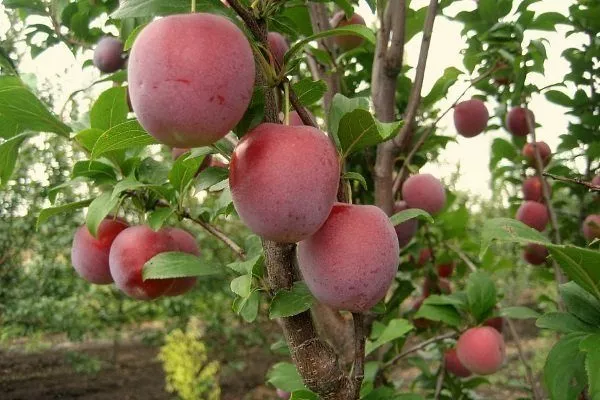
What does columnar plum mean?
A columnar plum is a tree whose crown grows in a columnar shape. Its branches don't spread out as usual, but rather extend upward and are often laden with numerous fruits.
Moreover, this plum variety was not artificially created. This mutation was discovered completely by accident in the 1960s by an American breeder.
A scientist noticed a thicker, vertically growing branch on a Mackintosh apple tree. Its trunk was abundantly covered with apples. This intrigued the breeder, who attempted to propagate the specimen, which, after two years, resulted in the columnar apple cultivar "Vozhak." Pear and plum trees, distinguished by their good yields and ease of cultivation, were also bred in a similar manner.
Description of the tree
The columnar plum tree belongs to the Rosaceae family. It's easy to recognize by these key characteristics:
- short stature;
- shoots growing upwards rather than to the sides;
- narrow, poorly developed crown;
- thin branches covered with smooth bark.
The height of a fully grown tree is usually no more than 2-2.5 meters, which significantly distinguishes them from ordinary plum trees. Plums can be yellow, blue, or violet-purple in color.
Advantages and disadvantages of columnar plum
The columnar plum, like any other fruit tree, has its advantages and disadvantages. Let's take a closer look.
Advantages of columnar plum tree:
- A good harvest. Depending on the variety, a single tree can yield between 6 and 11 kg of fruit. This is due to the small number of branches, which allows nutrients to be used directly for fruiting.
- Early maturity. The first harvest can be collected as early as the second year after planting, and by the fourth to seventh year, the tree will reach its peak productivity, which will remain constant for another 10 years. Only by the 14th to 17th year will the plum tree gradually stop producing fruit.
- Cold resistance and endurance. Columnar trees tolerate temperatures down to -30°C, allowing for plantings to expand from Siberia to the Krasnodar region. The branches of this plum tree are strong and easily support the weight of ripe fruit.
- Crown shape. Since the tree has only one trunk and very few "extra" branches, there is no need for frequent pruning.
Therefore, if you're interested in a bountiful harvest, the trees need to be renewed. This can be done 13 or 15 years after planting, replacing old trees with new seedlings. However, trees that have stopped bearing fruit don't need to be uprooted; they can be left as decorative garden ornaments.
Pollination and "neighborhood"
Some columnar plum varieties are self-pollinating (e.g., Imperial, Commander, Rubin, and Angers). However, most such trees require pollinators to produce fruit.
Pollination occurs primarily by bees. However, during cold snaps, frosts, or prolonged rains, their activity decreases, so experienced gardeners plant pollinator varieties nearby. Trees that self-pollinate provide the opportunity to harvest even in unfavorable weather. Entire orchards can be formed from such varieties, but the harvest may not be as desired.
As for “neighborhood,” the following will get along peacefully next to the plum:
- plum trees;
- apple trees;
- quince and cherry plum.
Raspberries, blackcurrants, and gooseberries can be planted nearby as shrubs. Since the crown of a columnar tree provides little shade, lilies of the valley, hyacinths, primroses, or other primroses can be planted beneath the tree. Thyme also doesn't interfere with the tree's growth.
It's important to remember that plums don't tolerate pears, walnuts, peaches, cherries, sweet cherries, and sea buckthorn as neighbors. They also don't like being near birch, fir, or poplar.
What are the columnar varieties?
Varieties of columnar plum trees can have different ripening times, fruit color, and self-pollination abilities. Among the many varieties, the most common and popular ones are distinguished.
| Name | Ripening period | Fruit color | Tree height |
|---|---|---|---|
| Imperial | mid-to-late August | purple, red-brown | up to 2 m |
| Blue Sweet | end of August | dark purple | up to 2 m |
| Yellow | end of June | golden | up to 2.5 m |
| Honey | end of July | yellow-golden | up to 2 m |
| Mirabella | mid-August | yellow, with a blush | up to 1.7 m |
| Russian | mid-August | red-violet | up to 1.7 m |
| Ruby | beginning of September | red | up to 2 m |
| Commander | midsummer | violet | up to 2 m |
| Oscar Plus | September | pink-violet, brown-red | up to 2 m |
| Anzhe | mid-August | burgundy-violet | up to 2 m |
| Olenka | not specified | bright red with a purple tint | not specified |
Imperial
Imperial is one of the most popular varieties. It is prized for its large fruits (up to 55 g) and delicate, aromatic flavor. The plums are round, with a flattened top and a wide base. The skin is quite thick, but this doesn't affect their flavor.
This tree grows up to 2 meters tall and begins bearing fruit in mid- to late August. It doesn't require pollinators, as it's a self-pollinating variety. Imperial plums are often pinkish-purple, but reddish-brown fruits are also common.
Among the disadvantages of the Imperial are its need for abundant watering and the possibility of flowering in the first year. If this occurs, the flowers should be pinched off, as such an early harvest can exhaust the young tree.
Blue Sweet
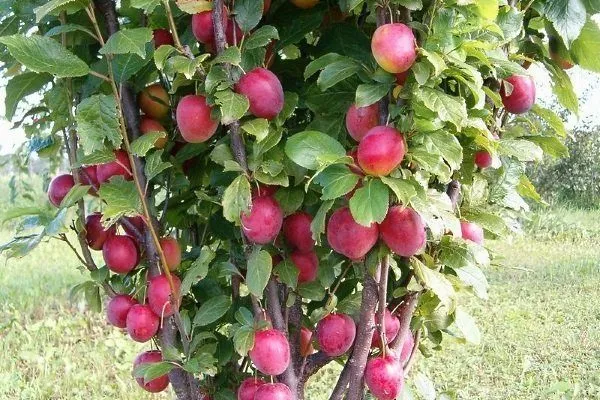
The second most popular type of columnar plum. The fruits of this variety are also large, reaching 75 g in weight. The shape is oval, slightly flattened. The thick skin has a waxy coating. Blue Sweet grows to a height of no more than 2 m. The taste is refreshing with sweet and sour notes.
A tree produces approximately 12-15 kg of plums per season. The fruits ripen towards the end of August and require pollination. This is usually done with the Blue Free or Stanley varieties. The Blue Sweet variety produces purple plums with a pinkish tint to the flesh.
Among the variety's drawbacks is the potential for the tree's crown to split due to frost, which can subsequently cause problems restoring the crown's shape. And just like the Imperial, this variety can begin blooming in its first year. If this occurs, all emerging blooms should be pruned.
Yellow
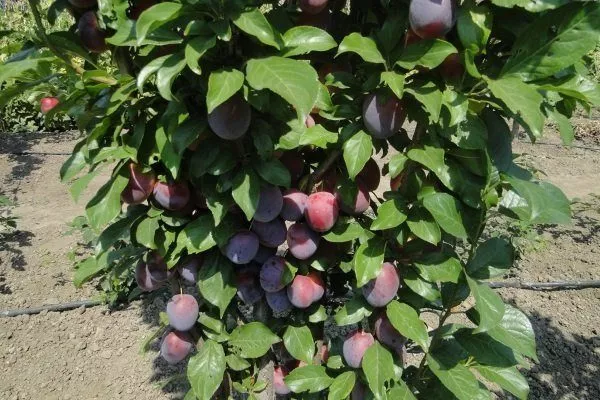
The "Yellow" columnar plum tree is renowned for its early fruiting and self-pollination. Fruits are ready to harvest in late June. The plum tree grows to 2.5 m tall, and the fruits weigh between 40 and 70 g each. The plums themselves are round and golden in color. They have a sweet, honey-like flavor.
Honey
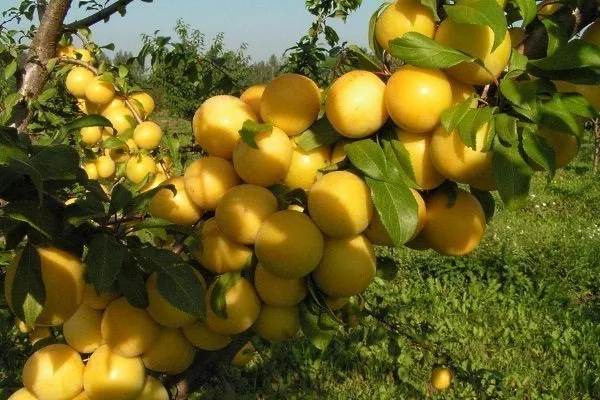
The columnar plum variety "Medovaya" produces yellow-golden, sweet-tasting fruits weighing up to 50 g. It requires the "Renklod Karbysheva" or "Vengerka Donetska" varieties for pollination. It begins bearing fruit in late July.
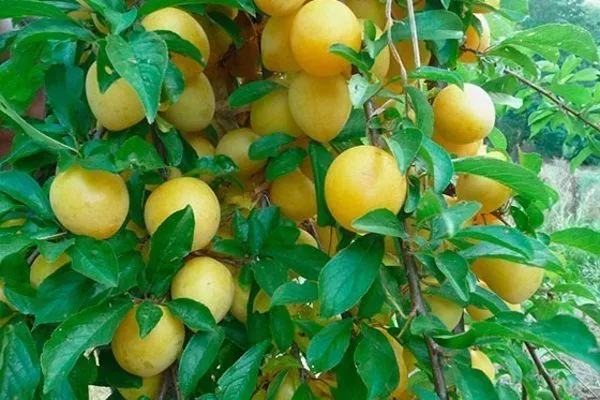
Mirabella
Mirabella is a columnar plum variety resembling apricots. Each fruit weighs approximately 40 g, and a single crop can yield up to 15 kg of plums.
The tree begins bearing fruit in mid-August. Pollinators are not needed. Another advantage is the tree's ability to hold fruit on the branches for a long time without shedding.
The tree itself is very small—about 1.7 m. The flavor is sweet and sour, and the color is yellow, sometimes with a slight blush on the sides. A drawback of this variety is the difficulty separating the pit from the pulp.
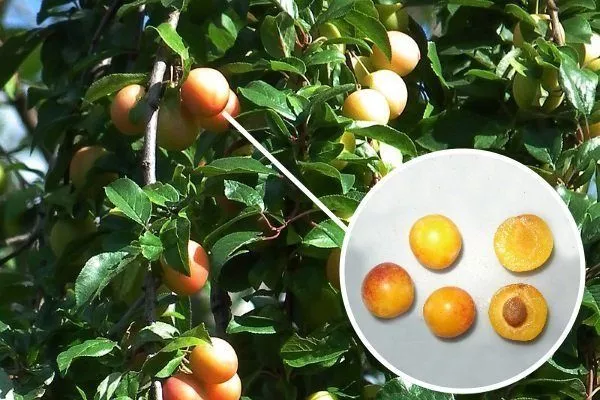
Russian
Another type of columnar plum, it can be considered a dwarf, as its height does not exceed 1.7 m. The fruits are small (up to 40 g) and ripen around mid-August. Pollination occurs via cherry plum. The plums themselves are reddish-purple and have a sweet taste.
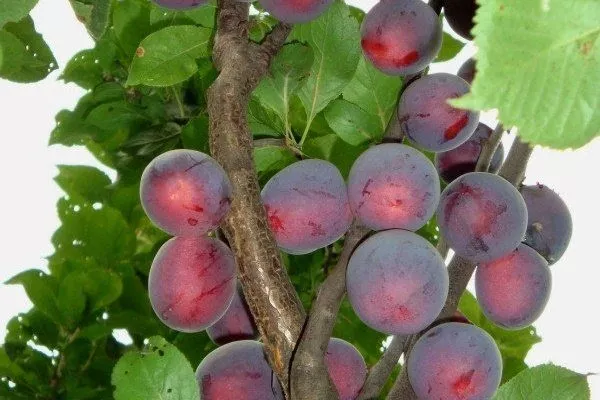
Ruby
Rubin is a self-pollinating plum variety. Each fruit weighs approximately 60 g. The plant grows to a height of 2 m, the fruit is red, and the flavor is sweet with a hint of tartness. A drawback of this variety is that the fruit is harvested in early September.
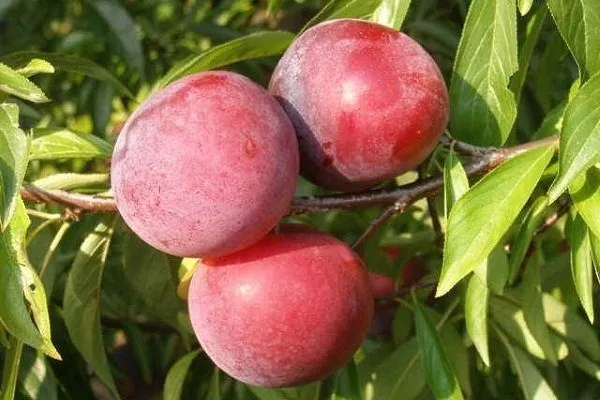
Commander
Another self-pollinating variety with oval, purple fruits weighing approximately 50-55 g. It begins to ripen in mid-summer. Height: up to 2 m. The fruits themselves are very juicy and sweet, with a slight tartness.
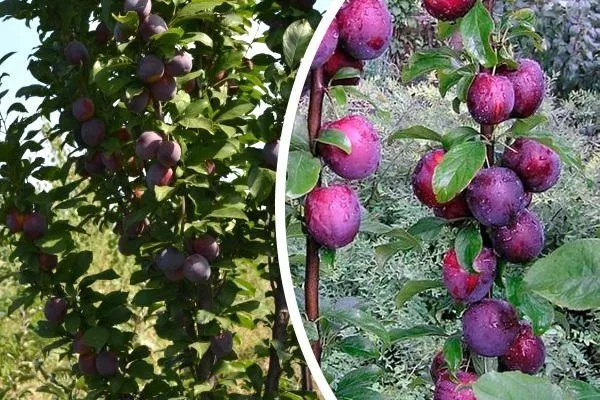
Oscar Plus
Oscar Plus is a variety whose fruit doesn't appear until September. The fruits weigh 45-55 grams each, are spherical, and their color can range from pinkish-purple to brownish-red. Pollination of these plums is possible with trees that bloom at the same time. The tree grows to a height of about 2 meters. The flavor is sweet and tart.
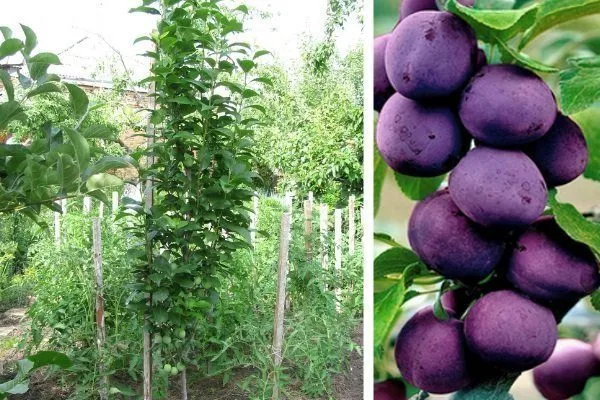
Anzhe
Anzhe is a self-fertile, mid-season variety. Its burgundy, purple-tinged fruits weigh up to 40 g and have a sweet, tart flavor.
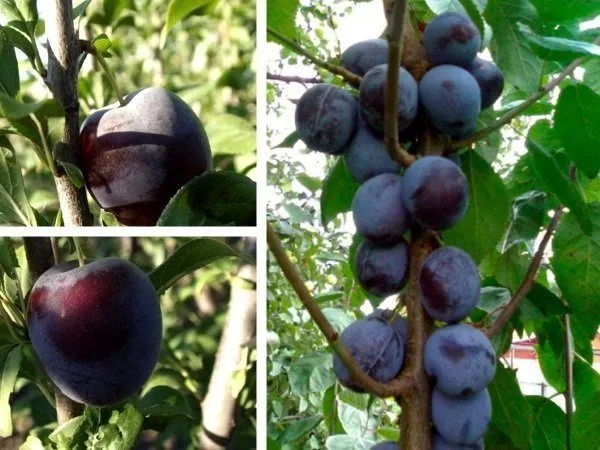
Olenka
Bright red plums with a slight purple tint. The fruits of this variety are small, weighing only 25 g. For pollination and fruit production, they require Stanley or Blue Free trees.
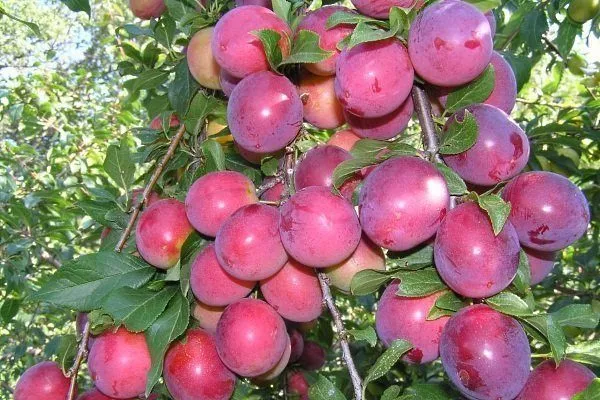
Summary table of varieties by characteristics
To figure out which varieties are best for you, you can study the comparison table with tree characteristics.
Table 1 – Characteristics of columnar plum varieties
| Name of the variety | Growing region | Ripening time | Color |
| Imperial | Moscow region and central Russia, Northwestern region (St. Petersburg region) | mid-to-late August | purple, red-brown |
| Blue Sweet | Moscow region and central Russia, the Urals | end of August | dark purple |
| Yellow | Moscow region and central Russia | end of June | golden |
| Honey | Moscow region and central Russia, Siberia | end of July | yellow-golden |
| Mirabella | Moscow region and central Russia | mid-August | yellow, with a slight blush on the sun-exposed side |
| Russian | Northwestern region (St. Petersburg region), Urals, Siberia | mid-August | red-violet, dark red |
| Ruby | Siberia | beginning of September | red |
| Anzhe | Ural | mid-August | burgundy-violet |
Landing features
The abundance of the harvest and the health of columnar trees depend on the adherence to the technology of planting and growing these crops.
Planting columnar plums begins with selecting seedlings. Afterward, a site is chosen for the trees, and the soil is prepared accordingly.
Selection of seedlings
Purchasing a specific columnar plum variety depends on your personal preference. Consider the seedlings' resistance to regional weather conditions, disease resistance, and ability to produce the desired amount of fruit.
When choosing a columnar plum tree, look at its roots – they should be free of damage and dry or broken shoots, and have many branches. The branches should also be in good condition, with no signs of disease.
- ✓ Check for a certificate of conformity for the variety.
- ✓ Assess the condition of the root system: it should be moist, without signs of rot.
- ✓ Make sure there is no mechanical damage to the trunk and branches.
What else can you recommend when buying columnar plum seedlings:
- choose an annual crop, as an older seedling may have a harder time taking root in a new location;
- Buy seedlings from specialized nurseries – this will give you a better chance of getting a tree that is already adapted to the climate conditions of your region.
When choosing a seedling in a nursery, also ask a specialist for advice on the care and cultivation of the variety you are purchasing.
Selecting a place and time
The key to growing columnar plums is to plant the seedlings at the right time. Frost and adverse weather conditions can damage the tree's crown, which will negatively impact its development and crown formation.
Deciding when to plant trees should be based on the region's climate. For example, in southern Russia, the best time to plant is autumn, while in northern latitudes, the Urals, and central Russia, it's spring (after the snow melts and the cold weather has completely subsided).
As for the landing site, it should be:
- sunny - columnar plum does not like shade;
- protected from wind and drafts;
- having non-swampy, light soil (for example, sandy loam);
- with a groundwater level of at least 1.5 m.
Avoid planting plum trees in low-lying areas, as they are cooler than higher elevations, and groundwater often accumulates there. If these conditions aren't met, the roots of the seedlings may rot, the trunk may become damaged, and the plum tree may become diseased.
Soil preparation
Before you start planting the crop, you should prepare the soil:
- Treat the selected area with humus (usually 3-4 kg is taken per tree), then loosen the soil and level it;
- dig a hole for the seedling in advance (30-40 cm wide and 2 times deeper than the tree’s root system), then place a mixture of soil and fertilizer at the bottom of the hole;
- As a fertilizer, use up to 80 g of potassium and up to 100 g of superphosphate - sprinkle the nutrients on the bottom on the day of soil preparation so that by the time the tree is planted, the mixture has already settled.
Planting technology
To avoid mistakes when planting, follow these step-by-step recommendations:
- Plant columnar plums at a distance of 50 cm from each other, and maintain a width of about 1-1.5 m between rows.
- Add a fertile soil mixture (such as compost mixed with soil) to the bottom of the dug holes. Use 3-4 kg of substrate per seedling. Avoid using mineral or other additives during planting, as the seedling's weak roots can be easily damaged by chemicals.
- Next, place the tree in the prepared hole and gently spread its roots. The root collar (the area where the trunk changes color from greenish to brown) should protrude 3-4 cm above the ground.
- If there is groundwater near the planting site, create drainage at the bottom using small stones or broken bricks.
- After placing the plant in the hole, fill the hole with clean soil and then firm it around the trunk. Then water the tree. To ensure the seedling grows straight, tie it to a support.
Additionally, after planting, use root growth stimulants, such as Kornevin. It's quite simple to prepare: dilute 5 g of the product in 5 liters of water. The recommended dose for one seedling is 350 ml. A second application can be made three weeks after planting. It's important to follow all the proportions—overdosing on stimulants is unacceptable!
The process of planting a columnar plum is shown in this video:
How to care for a planted tree?
Once the tree has been planted in the ground, it remains to be properly cared for in order to obtain a bountiful harvest.
Irrigation scheme
Columnar plum trees prefer moderately moist soil and respond well to watering. This should be done once a month (spring, summer, and fall), watering the seedling generously. If the summer weather is extremely dry, water more often, depending on the tree's needs.
How, when and what to feed?
To ensure plums grow well and produce delicious, tasty fruit, they need to be fed. One of the most popular fertilizers is urea: 50 g of the substance is diluted in 10 liters of water. For each plum, 2 liters of solution are used.
The feeding scheme is as follows:
- 1 time – after the buds have been released;
- 2 times – 14 days after the first feeding;
- 3 times – 14 days after the second feeding.
In the second year of growth of columnar plum, you can feed it with saltpeter, diluting 20 g per 1 liter, and also use growth stimulants.
During the first 2-3 years of a tree's life, the fertilizer applied at planting is sufficient. After that, additional feeding begins three times a year:
- in spring – nitrogen substances;
- in summer – potassium;
- in autumn – with phosphorus.
Do columnar plums need to be pruned?
Columnar trees require virtually no pruning because they have very few sideways branches. Prune only diseased or damaged branches.
Pruning will also be necessary if the top of the tree has been slightly frozen, causing several shoots to emerge from it. In this case, select the strongest trunk and prune the others so they don't interfere with the normal development of the crown.
Mulching
To ensure sufficient oxygen reaches the roots, periodically loosen the soil around the trunk and remove all weeds. Mulching the area around the trunk with compost or peat will also benefit the tree. More information on soil mulching can be found here. here.
Preparing for winter
During the first two years of life, the columnar plum is very sensitive to low temperatures, so it requires some preparation to enter the winter period.
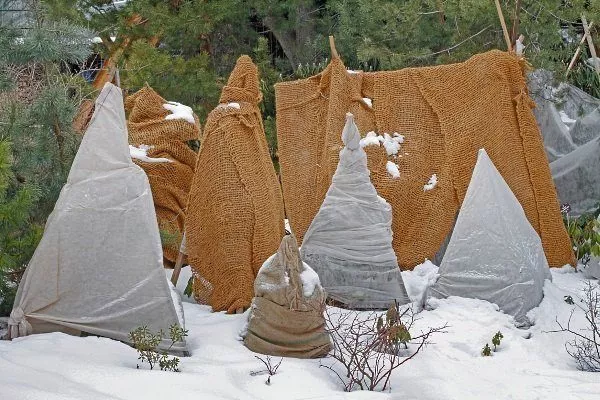
Preparing a tree for winter includes the following stages:
- last autumn watering;
- top dressing with phosphorus or organic matter under the trunk;
- covering the tree trunk circle with spruce branches, straw or hay.
If winter is snowy, use additional snow, compacting it tightly around the tree.
Diseases, pests, treatment and prevention
Columnar plum trees are fairly disease-resistant, but if the roots or branches are damaged, the plant can become ill. In this case, prompt recognition and treatment are key.
Diseases, their symptoms, causes and treatments:
| Disease | Symptoms | Reasons | Treatment |
| Coccomycosis | red spots on the leaves that are starting to fall off | excess moisture | spray with copper oxychloride or Bordeaux mixture |
| Gummosis | resin drops on the tree trunk and branches | severe frost, overdose of fertilizers, excess moisture | treat with a 1% solution of copper sulfate |
| Clusterosporiasis | brown spots "burning" the leaves | mushrooms | apply Topsin-M according to the instructions |
| Name of the variety | Resistance to coccomycosis | Resistance to gummosis |
|---|---|---|
| Imperial | High | Average |
| Blue Sweet | Average | High |
| Yellow | High | High |
As for prevention, try to remove all weeds around the tree in a timely manner and fertilize the crop.
When and how to harvest?
The plum harvesting time depends on the variety and climate. For example, in Siberia and the Urals, plums ripen in late summer and early fall, while in southern Russia, some varieties can be harvested as early as late June.
Early plums are harvested over several weeks, while late plums are picked all at once, as they ripen almost simultaneously. To be sure of a plum's ripeness, taste it, as reaching its final color doesn't necessarily mean it's ready for picking.
Rules for harvesting plums:
- collect fruits only in dry weather;
- If the variety is early ripening, remove it from the branches in several stages, as the fruits ripen unevenly;
- plums intended for transportation or storage should be picked with the stems or carefully cut off, and then immediately placed in trays;
- First, remove the fruits from the lower branches, and then from the upper ones;
- start collecting from the ends of the branches, moving towards the trunk;
- When working, do not crush the plums or damage the wax coating and stem.
Storage and transportation features
To prevent fruits from spoiling during storage, observe the following conditions:
- Maintain the temperature in the storage area at around 0-2°C and humidity at least 85%;
- Store fruits in shallow trays with paper at the bottom or in wooden boxes;
- Try not to damage the wax coating during transportation.
If you don't plan to store plums for any reason, it's best to eat them right away or use them for winter preserves.
Don't store unripe plums in the refrigerator—this will stop the ripening process and ruin their flavor. Place the plums in a bowl and leave it on the counter at room temperature. Don't place them on a windowsill—the sun will overheat the fruit and cause it to rot.
Plums for transport should be picked from the branches five days before they are fully ripe. They can be stored for three weeks at a temperature of about 7°C.
Gardeners' reviews
Also watch a video review where one gardener shares his impressions of growing a columnar plum:
The columnar plum is ideal for growing in virtually any region of Russia. Its main advantages—frost resistance, abundant fruiting, and ease of care—make this tree highly sought after throughout the country.