
The Bogatyrskaya plum is one of the best varieties of this fruit, distinguished by its high yield. With proper care, a single plant can yield approximately 80 kg of delicious, ripe fruit per season. Its frost resistance makes it suitable for cultivation in northern regions.
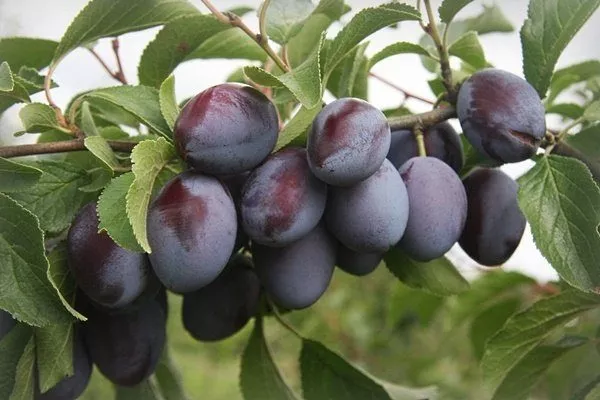
Plum variety "Bogatyrskaya"
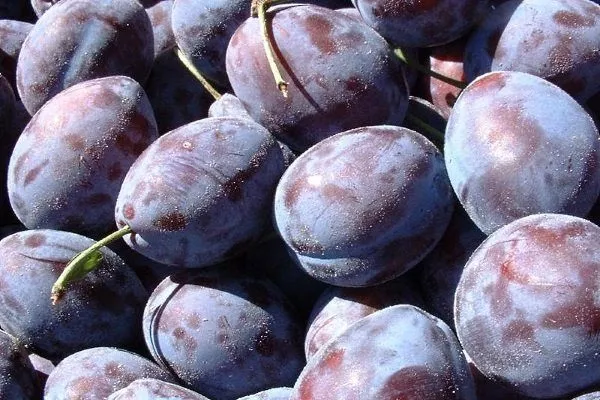
The fruits of the Bogatyrskaya plum have a delicate, juicy taste with a honey flavor
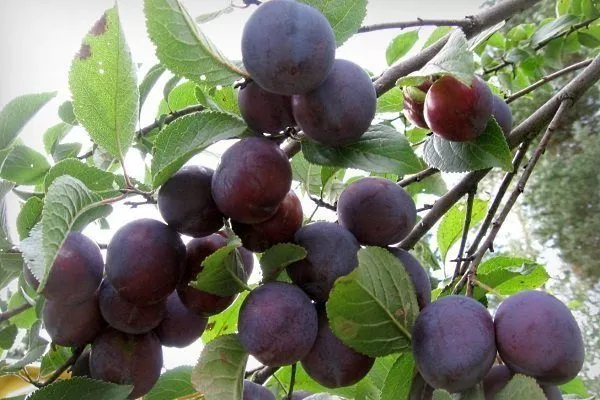
The plum variety "Bogatyrskaya" is unpretentious and productive
Description of the Bogatyrskaya plum
Trees are considered tall, but this only applies until the fruiting period. Once the plum tree begins to produce fruit, it stops growing and is considered medium-sized.
The crown is narrow in density, with spreading branches. Gray bark forms around the central branches, appearing to peel. An angle appears between the branches and the trunk. The branches are pale in color and slightly curved. The tree's shoots are gray, with thin but strong shoots. The buds are located in islands.
The leaves of the Bogatyrskaya plum are unusual: dark green on one side and light green on the other. The fruits are large, weighing approximately 40 g each. They are purple in color and long oval in shape. A waxy layer develops on the plum. The ventral suture is invisible. The flesh is yellow-green, dense, tender, and sweet-tasting. The stone is small, accounting for approximately 9% of the fruit's total weight.
History of selection
Originating in the Volgograd region of Russia, the variety was developed in a specialized laboratory. The laboratory specializes in creating new varieties of fruits.
The Bogatyrskaya plum variety originated in the Dubovsky stronghold. V. A. Korneev headed the breeding efforts. Later, the scientist transferred his responsibilities to his son. It was thanks to these two breeders that the Bogatyrskaya plum variety was born.
Characteristics of the variety
The Bogatyrskaya plum is a low-growing tree, reaching a maximum height of 4 m. It is very popular among gardeners due to its delicious fruits and ease of care.
Frost and drought resistance
The tree can tolerate mild drought, but will die without watering. It easily tolerates frost and cold winds and requires no special winter protection. Due to its high cold tolerance, plums are planted and grown in northern regions.
Pollinators of the Bogatyrskaya plum
The plant's main advantage is that it is self-pollinating, producing both female and male flowers. Planting other varieties near the plum is not necessary. However, their presence will increase the yield of all plums growing in the area. The plant begins blooming in late spring, and the fruits form and ripen late, filling out in late summer.
Productivity and fruiting
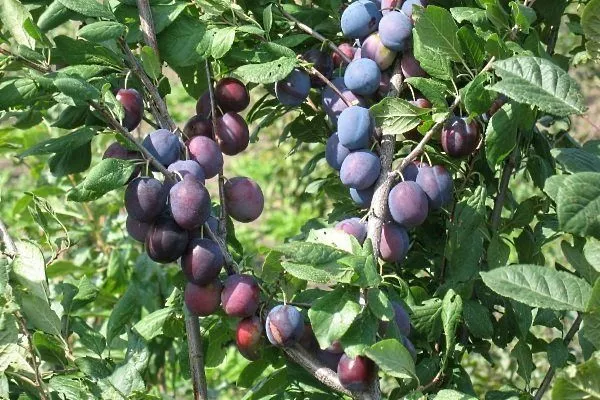
The harvest is good, bearing fruit almost annually. The number of fruits increases as the plant grows. A young sapling will produce about 50 kg of fruit in one season, and a mature tree about 85 kg. Fruit appears five years after direct planting in open ground. The tree bears fruit for about 25 years, depending on how well it is cared for.
Areas of use of berries
Fresh fruits are delicious and juicy, containing a wealth of beneficial micronutrients essential to the body. Berries are preserved and used to make jams, preserves, juices, and compotes. In spring, they make an excellent liqueur.
Advantages and disadvantages of the variety
Benefits of plum:
- large fruits of excellent taste;
- strong immunity to many diseases;
- the harvest does not crack in damp weather;
- excellent frost and drought resistance;
- high yield;
- excellent transportability;
- self-pollination.
The main disadvantage of this variety is that the plum produces a large harvest, so the branches cannot withstand it and break, and over time the fruits become smaller.
Planting and care
Since the plant is self-pollinating, it does not need additional plum varieties, so the gardener can devote time to only one Bogatyrskaya plum.
We recommend reading our article about How to plant and grow a plum tree.
Planting dates
This plum variety can be planted in either spring or fall. However, it's best to plant it in spring, as the root system will take root over the summer and adapt to the new environment and soil. In southern regions, the tree can be planted in autumn. Prepare the planting site 14 days in advance.
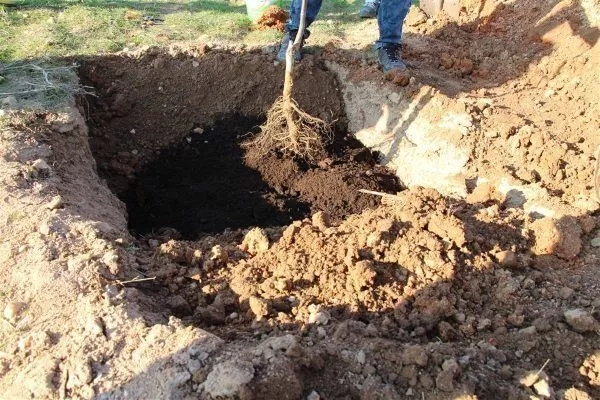
For planting, dig a hole 0.6 m deep and 0.8 m wide. The distance between trees of the same variety should be at least 4 m. Add the following to the top layer of soil:
- 1 bucket of peat;
- 1 bucket of humus;
- 0.5 kg of superphosphate;
- 45 g potassium sulfate;
- ash.
If the soil is very acidic, add lime at a rate of 0.5 kg per 1 sq. m. Eggshells and nutrient mixture are placed in the hole.
- ✓ The soil pH level should be strictly within 6.0-6.5 for optimal growth of the Bogatyrskaya plum.
- ✓ The depth of groundwater is at least 1.5 m from the surface.
Choosing a location
In temperate climates, it's best to plant the plant on the south or southeast side of the garden. The area should be well-lit, especially in the morning. A small, sunny hill is ideal. The roots should not touch groundwater, and waterlogged areas are not recommended.
Seedlings should be protected from cold and wind. They are planted near barriers such as fences, outbuildings, etc.
The Bogatyrskaya plum has moderately spreading branches; to prevent them from intertwining, the trees should not be planted too close together. The soil should be loamy or sandy. If the terrain is clayey, add river sand.
Plum does not grow well in highly acidic soils; they must be neutral.
What crops can and cannot be planted next to each other?
Nut trees, especially walnuts and hazelnuts, are bad neighbors. Linden, poplar, and birch trees should not be planted near plums. Apple and pear trees are not particularly favorable neighbors, but with proper care, they can coexist. Just don't plant them too close together.
Plant blackcurrants next to the plum tree; they will help produce a larger plum harvest. Leave at least 3 meters between the currants and the tree.
Selection and preparation of planting material
To plant a tree, choose a one-year-old sapling. By this age, the rootstock is fully developed. The part of the plant above ground is a small twig grafted onto the rootstock.
The root system can be closed or open. If it is open, the plant is soaked in a solution of potassium permanganate or "Kornevin." This disinfects the seedling, protects it from diseases and pests, and accelerates its establishment in the soil.
Plants purchased in pots are taken out and their roots are examined; if everything is in order with them, they are planted in soil.
Planting diagram
Algorithm for planting in open ground:
- Fertilize the soil in the fall and dig it up in the spring.
- Add fertilizer to the hole.
- Place the seedling on a mound of soil and spread out its root system.
- Position the tree so that its root collar is 4-6 cm above the soil.
- Do not confuse the root collar with the grafting site, which is located above it.
- Moisten the root system with water, cover with soil, compact it slightly, and water. You'll need about a bucket of water.
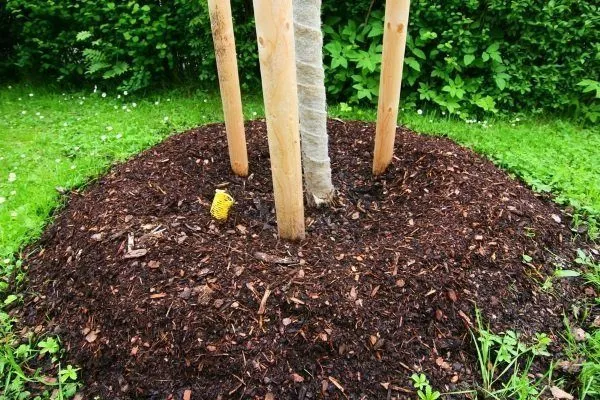
- Place mulch around the root zone to prevent the root system from drying out. This method will prevent weeds from appearing and the formation of a dry soil layer.
Further care of the plum after planting
Regular care will help the gardener grow a healthy plant and get a rich harvest.
Watering and loosening the soil
Care for a seedling always begins with rootstock treatment. The soil is loosened immediately after watering, and weeds that rob the tree of its nutrients are removed.
After loosening, pour 1 bucket of humus under the plant.
The tree loves water, but too much can have negative effects: the foliage turns yellow, and fruit fails to set. Seedlings should be watered once a week with 3 buckets. Mature trees require 4 buckets of water (applied 6 times per season). If the plum tree is underwatered, the fruit will fall off, not ripen, and the ovaries will crumble.
Before the first frost, a lot of water is added to the plant - this is a moisture charge.
Tree fertilizing
Fertilizer is not applied immediately after planting (enough was used during site preparation). During the first year, the plum tree is sprayed with growth stimulants once every 7-12 days.
- In the first year after planting, apply 50 g of ammonium nitrate in early spring.
- In mid-summer, add 30 g of superphosphate and 20 g of potassium salt under each tree.
- In autumn, add 2 kg of rotted manure around the trunk.
A tree that has begun to bear fruit is fed 3 times per season:
- Urea (90 g per 2 l of water) – before flowering.
- Nitrophoska (60 g per 2 l of water) – during fruit ripening.
- Superphosphate (60 g per 20 l of water) – after harvesting fruits.
In autumn, the tree needs to be fed with rotted manure (1 bucket per 1 plant).
Fertilizers are applied annually. Once the plant reaches 15 years of age, the amount of organic fertilizer is doubled. Nitrogen is not used in the fall, as this chemical promotes the development of the tree's green mass, and in the fall, the tree must prepare for dormancy.
Before and after flowering, you can feed the plum with organic matter: chicken manure or 20 kg of mullein.
Apply 2 kg of ash per plant; acidic soils require lime or dolomite flour. Plants are very sensitive to the absence or deficiency of beneficial micronutrients:
- If a plum tree lacks potassium, the leaves turn yellow. This can be helped by spraying the crown with ammonium nitrate (20 g) and urea (50 g).
- If a tree lacks magnesium, leaf edges curl and veins darken. This can be remedied by adding magnesium and potassium to the soil (30 g per square meter).
Trimming
Crown shaping is an important part of tree care. This process is carried out in late March or early April. It all depends on the air temperature, which should be at least 10 degrees Celsius.
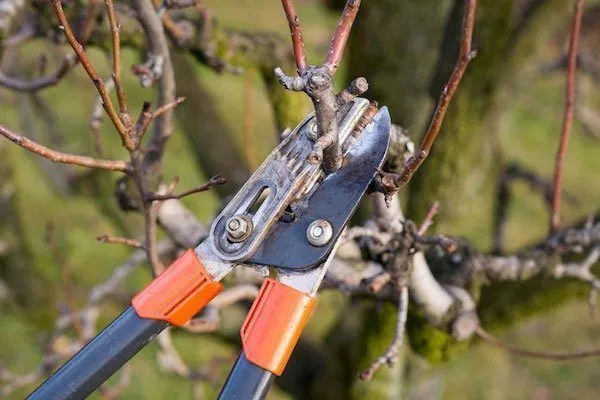
Plum tree branches become overloaded with fruit, so only the branches that grow at an angle—they're the strongest—are preserved. The best form for the plant is a tiered form.
Trimming diagram:
- The following year after planting, leave four strong shoots: the center and three side branches. Cut the others back to the level of the ring bud.
- Leave the shoots at an angle. They should be spaced 0.2 m apart.
- In the third year, form a second tier from two branches at a distance of 0.7 m from the first. The central conductor should be 0.2 m longer than the others.
- After one year, begin creating the third tier. This consists of two branches placed 0.5 m from the second row.
- Subsequent pruning is aimed at removing branches that grow vertically or thicken the tree.
If annual shoots grow up to 0.4 m, they cannot be cut; if the size is more than 0.5 m, the branch is shortened by a quarter.
Gardeners also recommend pruning branches in the fall to reduce the number of diseased and weak branches. Some gardeners disagree with this advice, believing that pruning in the fall leads to winter damage to the trunk.
Mature trees require rejuvenating crown pruning, removing thickening and inward-growing branches. In this case, the tree's conductor should not be touched.
Harvesting, storage and processing of crops
Fruit harvesting begins five days before it's fully ripe. This is done to ensure the fruit can be safely transported without damaging its appearance. The fruit is quickly removed from the branches; gardeners often use mechanical harvesting.
It is not possible to store fruits for a long time; they will last no more than 2 days in the refrigerator.
The harvest is used to make preserves, marmalades, juices, compotes, and much more. Plum liqueur is especially delicious.
Preparing for winter
Scientists classify this plum variety as frost-resistant, but a few tricks can help the plant survive the cold more comfortably.
Algorithm for preparing the Bogatyrskaya plum for winter:
- In the fall, clear the tree trunk area of leaves and debris. Burn everything to destroy spores and larvae of diseases and pests.
- Apply a moisture-recharging watering, dig up the soil, and add mulch. Read about soil mulching. here.
- Remove dead bark from the trunk surface, and do the same with moss and lichen. Wash affected areas with a solution of ferrous sulfate (40 g per 2 liters of water) and treat the tree with garden pitch.
- Cover the trunk and branches with a lime mixture (6 kg of lime and 4 kg of clay per 20 liters of water).
- Rake the soil around the plum tree trunk to a height of 0.2 m.
- Treat the plant with spruce branches; they protect the tree from mice and hares.
Diseases and pests, methods of control and prevention
The Bogatyrskaya plum has a strong immune system, but the plant is susceptible to disease. Gardeners should be aware of the most dangerous plum diseases and how to combat them.
| Diseases/pests | Symptoms | Prevention |
| Hollow spot | Holes appear on the leaves and fruit. This fungal disease quickly damages the tree during rainy season. | Burn fallen leaves. |
| Gum flow | Gum appears on the cuts of branches and cracks. Branches dry out, leaves fall off. | Avoid mechanical damage to the plant. |
| Coccomycosis | It damages foliage and fruit, causing them to become spotted and dry out. | Plant only disease-resistant varieties in your area. |
| Fruit rot | Gray spots appear on the fruit and are spread by the wind to other plants. | Destroy all affected fruits. |
| Sooty mold | A black coating appears on the leaves. | Keep the soil moist and prune the tree on time. |
| Gray mold | The leaves look like they've been set on fire. | Cut off the branches and burn them. |
| Marsupial disease | The tree grows, but remains empty inside. | Cut off diseased branches. |
| Rust | A characteristic coating appears on the leaves. | Collect the leaves and burn them. |
| Hawthorn | The pest eats the green mass of the tree. | Removing caterpillars. |
| Plum aphid | Damages leaves and shoots. | Destroy the larvae. |
| Yellow plum sawfly | They eat plum fruits. | Before the plant blooms, spray the tree with special products. |
Gardeners' reviews of the Bogatyrskaya plum
The Bogatyrskaya plum is a frost-resistant variety. It produces a good harvest, with excellent flavor and versatile fruits. High productivity can only be achieved by following proper planting and care practices.